In this guide
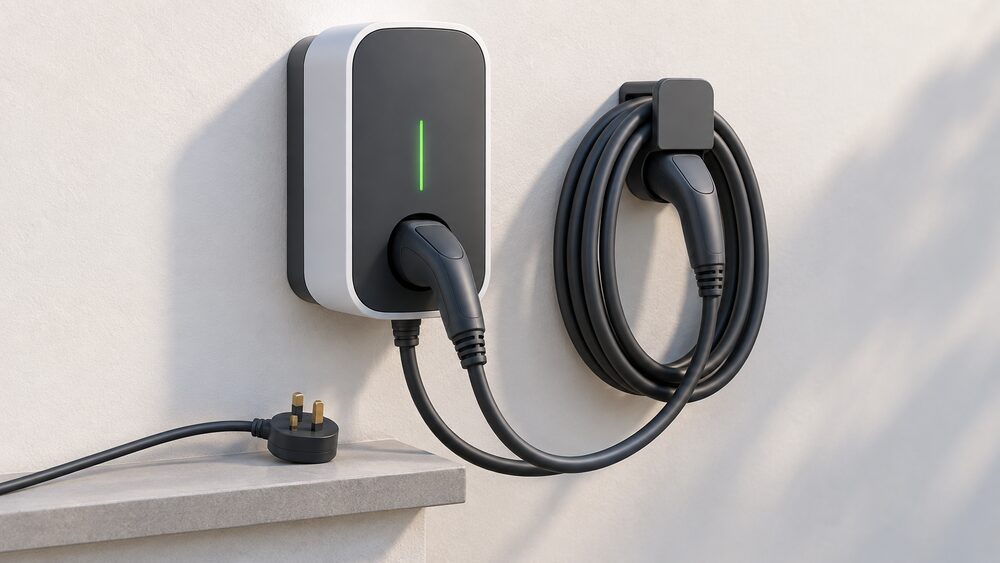
How long an electric car takes to charge is set by two numbers, not one: the power the charge point can deliver, and the maximum the car itself will accept. On a home wallbox, official guidance puts fast charging at 7 to 22 kW and gives four to eight hours for a battery1. A 7.4kW home unit is given as filling a typical 60kWh battery from empty to full in just under eight hours, while a 3.6kW unit takes around 16 hours for the same car2. At the other end, a DC rapid or ultra-rapid point reaches 80 per cent in 20 to 60 minutes1.
Those are averages across a wide spread. On a standard 7kW AC home charger, a Nissan Leaf takes approximately seven hours to go from 0 per cent to 100 per cent, so a bigger battery on the same unit takes proportionately longer3. A three-pin household socket is slower again: charging an average EV battery that way could take over 24 hours4. And the car's own onboard charger caps everything on AC, which is why a 22kW unit often delivers no more than an 11kW one.
For a household, the practical answer is that almost all charging happens overnight, at home, at a speed that finishes long before morning. Speed matters less than the number of hours the car is parked. Where speed does matter is en route, and there the constraint moves from the wallbox to the battery's own DC charging behaviour and its temperature.
The four charging speeds: slow, fast, rapid and ultra-rapid
UK guidance divides charge points into four bands, though the boundaries are drawn slightly differently by different bodies.
| Band | Power | Time quoted | Source |
|---|---|---|---|
| Low speed | 0 to under 3.7 kW | 12 to 15 hours for a full charge | 3 |
| Slow | Up to 3.6 kW | 6 to 12 hours | 6 |
| Fast | 7 to 22 kW | four to eight hours for a battery | 1 |
| Fast (alternative) | 7 to 22 kW | 4 to 6 hours | 7 |
| Fast (network view) | 7kW to 22kW | up to four hours | 8 |
| Rapid | 50 kW to 149 kW | 15 minutes to one hour to 80% | 3 |
| Rapid (alternative) | 43 to 50 kW | 30 minutes to 1 hour | 6 |
| Ultra-rapid | 150 kW and over | 10 minutes to one hour to 80% | 3 |
The disagreement in the table is real, not a rounding error. Older guidance defined rapid charging as 43 to 50 kW, because that was what the network offered6; current statistical work defines rapid as 50kW up to 149kW and ultra-rapid as 150kW and above9. One maker's guidance puts rapid at 50kW and above with ultra-rapid at 100kW and above10, and another guide describes rapid as spanning 25kW to 100kW11. Where a figure matters, the power rating on the unit is a better guide than the label on it.
Low-power public charging is more common than drivers expect. In January 2025, 57 per cent of UK public charging stations were between 3 and 8kW, which at best is slightly faster than an at-home charger12. At that speed a car takes anywhere from six to 18 hours to charge to 80 per cent13. Typical on-street points are given as taking 6 to 12 hours to recharge a car to 80 per cent or above, depending on the model, the charge point's power rating and the weather5.
Charging times by battery size on a 7.4kW charge point
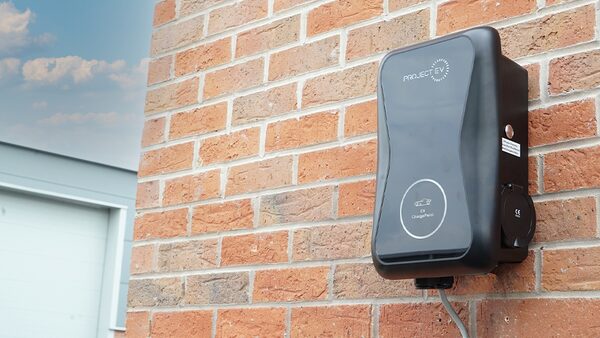
A 7.4kW wallbox is the common domestic fitting on a single-phase supply, and the arithmetic of battery size drives the time almost linearly.
| Battery | Time on 7.4 kW AC, from 20% charged |
|---|---|
| 25kWh | 3h 45m |
| 50kWh | 7h 45m |
| 75kWh | 10h |
| 100kWh | 13h 30m |
Those figures come from independent guidance dated April 2026 and assume the car starts at 20 per cent3. Other published figures land nearby: roughly 14 hours for a 100kWh battery and 7 hours for a 50kWh on a 7kW unit14, and just under 8 hours for a typical 60kWh battery from empty to full on 7.4kW2. A 54kWh battery on a typical 7kW home charger is put at around 7 hours 42 minutes15.
Broader ranges are published because real cars and real starting points vary. A 7kW charger is described as generally taking a car from 20 to 80 per cent within six to 12 hours16, as charging most electric cars in 4 to 8 hours17, and as fully charging most EVs in 6 to 8 hours overnight18. One supplier gives 8 to 15 hours to fully charge with a standard 7kW unit4. The spread reflects battery size above all: a 25kWh city car and a 100kWh saloon are not the same job.
One consequence for a household budget: an hour of charging at 7kW consumes about 7 kWh of electricity [36 is not this source]3. Energy use, not time, is what appears on the bill, and that is covered in more detail on EV charging running costs.
Why your car's onboard charger caps AC charging speed
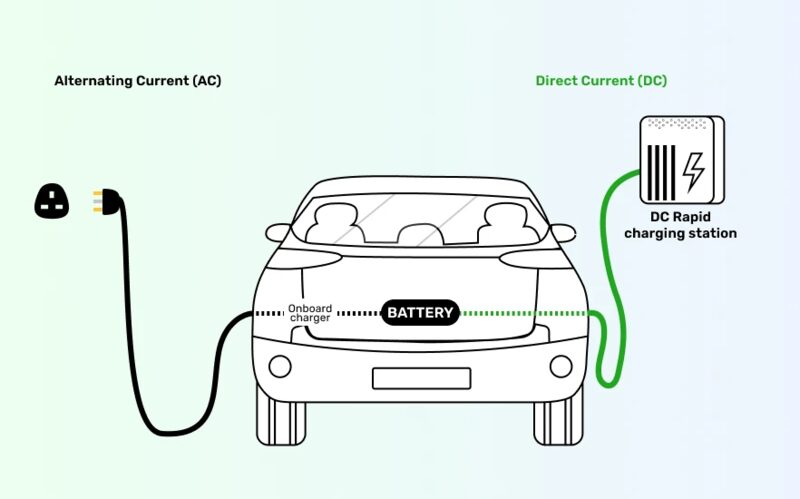
On alternating current, the charge point supplies AC and the car's onboard charger converts it to DC for the battery. The vehicle will only charge at the maximum rate of its onboard system19. A charge point rated above that limit does not overrule it: it simply delivers less than its badge.
Most electric vehicles are limited to an 11 kW onboard charging speed18. That is why a 22kW unit frequently buys nothing. A Kia EV6 Long Range on a 22 kW AC charger is given as taking around eight hours from 20 to 80 per cent, and approximately eight hours on an 11 kW charger, because of the vehicle's maximum AC charging rate20. The two figures are the same because the car, not the charge point, is the bottleneck. The trade-off is set out on 7kW vs 22kW home charger.
The Nissan LEAF is a sharper illustration. Its maximum AC charging rate is 6.6kW16, below the 7kW or 7.4kW of a typical domestic wallbox. On DC its maximum is 46kW16, below the 50kW rating of many rapid points. Charging speed and range also depend on the specific variant, as different models carry different battery capacities16.
Temperature is the other cap. Charging takes longer in cold weather because extra power is needed to heat both the inside of the car and the battery21. In warmer weather charging times tend to fall, but if the battery overheats the charging speed could decrease or stop altogether as a safety measure22. A quoted time is therefore a mild-weather figure.
"your car will only be able to charge at the maximum rate of its onboard system"
Rapid and ultra-rapid charging: 20 to 60 minutes to 80%
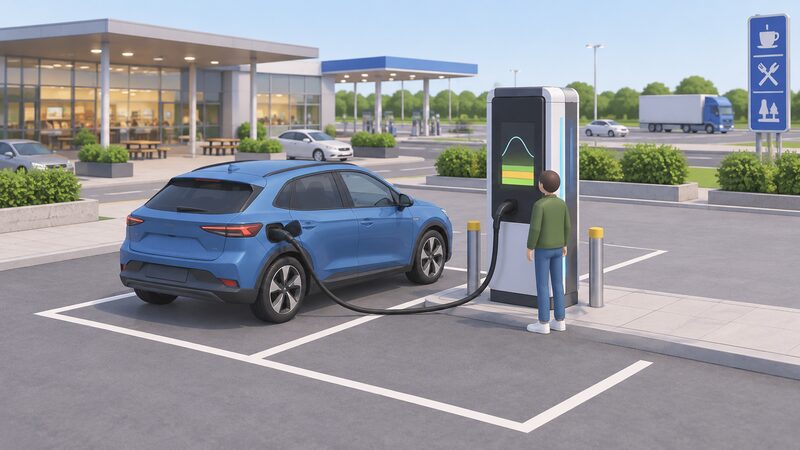
Official guidance gives 20 to 60 minutes to reach 80 per cent on a DC rapid or ultra-rapid charger, and states that some such chargers can deliver enough charge for 200 miles of driving in just 15 to 30 minutes1. A separate official page puts typical rapid and ultra-rapid charge times at 20 to 40 minutes23.
Independent and maker figures broadly agree while differing at the edges:
- Rapid chargepoints, 50 kW to 149 kW: 15 minutes to one hour to 80 per cent3
- Ultra-rapid chargepoints, 150 kW and over: 10 minutes to one hour to 80 per cent3
- Ultra-rapid points take many newer models from 20 to 80 per cent in between 20 and 30 minutes20
- At higher-powered points, up to 80 per cent in as little as 20 minutes, depending on make and model20
- Rapid and ultra-fast points charge 80 per cent of a battery in 30 to 60 minutes8
- Around 40 minutes at a motorway services rapid or ultra-rapid point for 20 to 80 per cent12
- A rule of thumb: a 45-minute rapid charge usually gets you from about 20 to 80 per cent14
- Rapid chargers deliver an 80 per cent charge in 20 to 60 minutes10
- Rapid charging operates at 50 to 150kW DC and charges most cars to around 80 per cent in 20 to 40 minutes24
- A typical 60kWh car at a 150kW rapid station: as little as 30 minutes or less2
The consistent element across all of them is the 80 per cent endpoint, and there is a reason for that. Charging slows significantly after about 80 per cent to protect the battery and prolong its lifespan14. In some cases it can take as long to charge from 80 to 100 per cent as it does from 20 to 80 per cent13. A rapid charger's headline power is a peak, not a constant: it applies to the middle of the battery's range and tapers away near the top.
Slow and fast charging at home, and why overnight wins
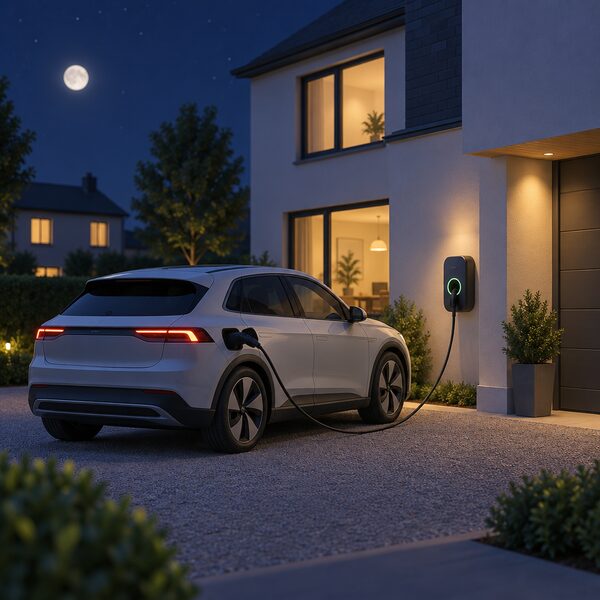
Home chargers are designed so cars can be fully charged in a matter of hours, and most people charge overnight to take advantage of time-of-use EV tariffs6. Monitoring of Living Lab homes found peak EV charging occurs between midnight and 6am, consistent with behaviour optimising for current time-of-use tariffs25. That is six hours of parked time, enough to cover most of the charge times in the table above without the driver thinking about speed at all.
The financial case follows the clock rather than the kilowatt. Charging at home or at work overnight when electricity is cheap reduces overall fuel costs by more than 70 per cent26. Charging overnight can also save up to 26 per cent on carbon dioxide emissions per charge on average27. Published full-charge costs at home differ by battery and tariff: approximately £17 for a 50kWh battery on a standard tariff28, £13 as the average UK home charge in October 2024 based on 24.5p per kWh and a typical 54 kWh battery29, around £11.20 for a typical 60kWh battery on a 7kW charger taking about eight hours30, and £14.70 for a 60kWh battery31. With an off-peak tariff it can cost less than £10 for a full charge12, and home charging on an EV or other time-of-use tariff has been published at £832.
This is where charging speed meets household energy independence. A faster wallbox does not make electricity cheaper; a tariff and a schedule do. Overnight charging still depends on a grid supply and a supplier's tariff structure, and the smart-charging function that shifts the session usually depends on the charger's app and cloud connection. See EV tariffs and home charging and smart EV chargers.
Slow charging still has a role. A slow charger will normally fully charge a partly charged car in around four hours8, and where a car is parked all day or all night the low rate is rarely the constraint. Below 3.7 kW, a full charge takes 12 to 15 hours3, and official guidance gives 12 to 40 hours or sometimes more for slow charging1. The question of whether a three-pin lead is adequate is covered on charging an EV from a 3-pin socket.
What rapid charging does to battery life
Regular use of rapid and ultra-rapid charging can reduce battery longevity over time24. The mechanism given is heat: while rapid DC charging is convenient for long journeys, excessive use can generate more heat and potentially accelerate battery degradation compared with slower alternating current charging33. Guidance on extending battery life lists using rapid charging only when needed, not fully charging the battery, and not letting the battery get too low on charge34.
The effect is cumulative rather than immediate, and the wording across sources is careful: "can" and "potentially", not "will". A driver who rapid charges a few times a year on long trips and otherwise charges at home overnight is in a different position from one who relies on rapid charging as a primary method. Most electric car batteries are guaranteed by manufacturers to last for eight years or around 100,000 miles11, which sets a floor on the manufacturer's own expectation, though warranty terms vary by maker.
Rapid charging is also generally taken to 80 per cent of the battery's capacity, because beyond that point the rate falls away19. Charging to 80 per cent at a rapid point therefore serves two ends at once: it avoids the slow tail, and it avoids the highest states of charge. Further detail sits on EV batteries, charging habits and degradation.
The 20 to 80% rule and other habits
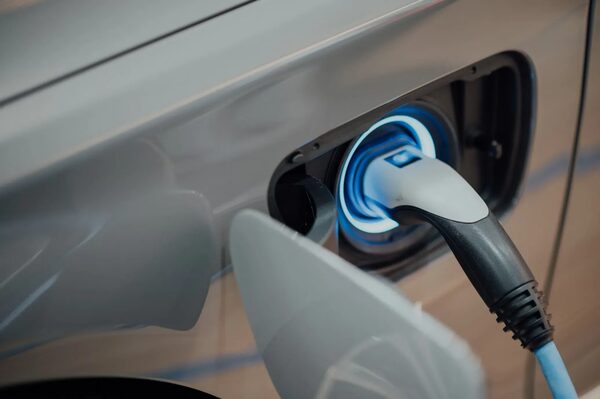
The most widely repeated rule is to keep the battery between 20 and 80 per cent. Maintaining a charge between 20 and 80 per cent can significantly extend a battery's overall life33, and the same range is recommended for optimal battery health when leaving a car idle30. Most vehicle manufacturers recommend only topping up to 80 per cent to preserve battery life35, and one guide advises keeping the car charged to about 80 per cent to keep the battery in a good state of health36. In hot weather specifically, charging only to 80 per cent is recommended22.
At the lower end, a rule of thumb is to avoid letting the charge reach the 20 per cent mark11. Zapmap's Leaf guidance recommends charging to 80 per cent to protect the battery and maximise efficiency37.
The 80 per cent ceiling is not only about chemistry. Because charging slows significantly after about 80 per cent14, and the final fifth can take as long as the preceding 60 per cent13, stopping at 80 is also the faster use of a public bay. At home, where the car sits for eight hours regardless, the time argument disappears and only the battery-health argument remains.
- Charge overnight where a time-of-use tariff is available6
- Use rapid charging when it is needed for a journey rather than routinely34
- Expect longer sessions in cold weather, as power goes to heating the cabin and the battery21
- Expect the rate to fall or stop if the battery overheats in hot weather22
Nissan LEAF: a worked example of the caps
The LEAF makes the general rules concrete, and it is one of the most common used EVs in Britain: around 28,000 zero emission Leafs were sold in the UK between 2010 and 2018, equivalent to around 825MWh of battery storage capacity38.
| Attribute | Figure | Source |
|---|---|---|
| Maximum AC charging rate | 6.6kW | 16 |
| Maximum DC charging rate | 46kW | 16 |
| Rapid DC capability (Leaf MkII) | 50 kW | 37 |
| Nominal capacity (Leaf MkII) | 40 kWh | 37 |
| First generation capacity | 24 kWh | 37 |
| First generation update | 30 kWh | 37 |
| Official WLTP range | 168 miles | 37 |
| Real-world range | 151 miles | 37 |
| 7kW charging to 100% | 7.5 hours | 37 |
| 0 to 100% on a standard 7 kW AC home charger | approximately seven hours | 16 |
| 20 to 80% on a 50 kW DC charger | approximately 43 minutes | 20 |
| Rapid connector (older models) | CHAdeMO, tethered to the unit | 37 |
| Inlet location | behind a flap in the centre of the grille | 37 |
A 40kWh Leaf on a 7kW home charger is given as reaching an 80 per cent charge in around six hours39, and 6 hours empty to full on a 7kW unit against 11 hours on 3.7kW17. The 43-minute DC session from 20 to 80 per cent adds approximately 14 to 116 miles of range depending on variant20.
Connectors differ by generation. Older Leaf models still use CHAdeMO for rapid charging, but CCS has largely replaced it14, and CHAdeMO is described as primarily used for rapid DC charging on older Nissan Leaf models [28 is connector-types]. The new LEAF announced by Nissan in November 2025 uses CCS 2 for DC charging, takes 11kW AC, quotes DC quick charging of 20 to 80 per cent in under 30 minutes, and a 30-minute DC recovery range of 273 miles for the 75kWh version40. That model is set to be built at Nissan's Sunderland plant [29 is catapult]. See CHAdeMO vs CCS and EV connectors and charging cables.
Where faster charging does not help
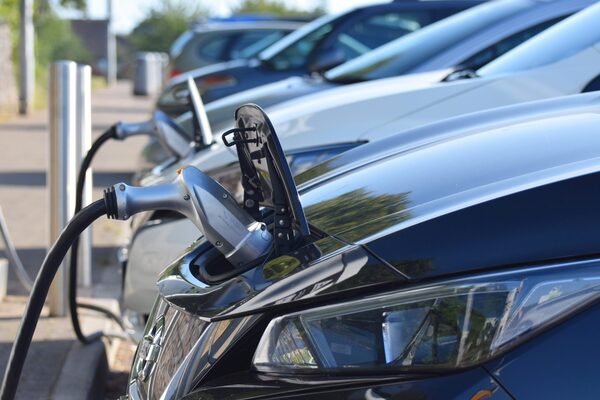
A higher-rated charge point changes nothing in three common situations. First, where the car's onboard AC charger is the limit: 22kW and 11kW give the same eight-hour result on a car capped at 11kW20. Second, where the car is parked far longer than the charge takes: overnight, a 7.4kW unit finishing a 60kWh battery in just under eight hours2 is already finished before the tariff window closes. Third, near the top of the battery, where charging slows significantly after about 80 per cent regardless of the supply14.
Faster charging does help on a long journey, where 200 miles of driving in 15 to 30 minutes at a DC point1 is the difference between a stop and a stay. It also helps a household with two cars sharing one supply, where load is split, and a home with limited off-street time.
What none of it changes is the dependence underneath. Home charging still runs on a grid supply and a supplier's tariff; public rapid charging depends on a network operator, its pricing and its uptime; smart scheduling depends on an app and a cloud service. Pairing charging with generation, covered on charging an EV from solar panels, shifts part of that dependence but does not remove it. The full picture sits on the EV charging guide and on EV charging and household energy independence.
Sources40 cited
- Electric vehicle charging, SMMT, 2025-06-25
- How long to charge an electric car, Pod Point, 2025-11-11
- Charging electric vehicles, Energy Saving Trust, 2026-04-23
- How to charge your electric car at home, Power NI, 2025-08-05
- On-street charging, Zap-Map, 2026-02-26
- How to charge an electric car, Uswitch, 2022-02-02
- EV connector types, Uswitch, 2022-02-03
- Charging electric vehicles at home, Electricity North West, 2026-09-19
- Rapid charging prices, Zapmap, 2026-09-01
- The UK's EV charging revolution, waEV-charge, 2026-01-09
- Electric cars and energy bills, Uswitch, 2026-04-27
- Should I buy an electric car?, Which?, 2026-04-16
- Guide to EV charging, Zapmap, 2026-09-04
- Electric car charging guide, Carwow, 2025-07-16
- zappi car charger, myenergi, 2026-09-17
- How long does it take to charge an electric car, Zap-Map, 2026-04-15
- How long to charge an electric car, Power NI, 2025-08-20
- Choosing a home electric car charger, SolaX Power, 2025-12-31
- How long does it take for an electric car to charge, Project EV, 2021-02-19
- How long does it take to charge an electric car, Zapmap, 2026-04-15
- How long to charge an electric car, Uswitch, 2024-11-26
- Tips for electric cars in hot weather, Zapmap, 2025-07-08
- EVs: the facts, SMMT, 2025-09-22
- Understanding electric car charging, Spirit Energy, 2026
- Grid impacts of heat pumps, EVs and solar revealed, Energy Systems Catapult, 2025-08-18
- EV basics, Zapmap, 2024-05-14
- Making the switch: experiences of people using electric vehicles, Energy Saving Trust, 2025-03-31
- Electric vehicles: debunking myths, Energy Saving Trust, 2025-09-22
- EV charging statistics, Uswitch, 2024-10
- Electric car charging at home, myenergi, 2026-09-17
- Electric vehicle charge points, Flexi-Orb, 2025-04-22
- Smart charging electric vehicles, Energy Saving Trust, 2025-03-25
- Electric car battery guide, Fuse Energy, 2026-05-19
- Electric vehicle battery basics, Energy Saving Trust, 2025-09-16
- Top tips for new EV drivers, NAPIT, 2024-09-09
- Driving an electric car: top tips, Zapmap, 2024-12-06
- Nissan Leaf charging guide, Zap-Map, 2026
- Connector types, Zapmap, 2026-05-20
- Home charging, Zap-Map, 2025-06-19
- All-new Nissan LEAF 75kWh pricing and specification, Nissan, 2025-11-21
 Home EV Charger ManufacturersWhich home EV charger brands are worth considering, and how do you choose between them?
 Types of Home EV ChargerWhich home charger suits your car and your driveway?
 Cost to Charge an EV at HomeHow home charging cost is worked out from battery size, efficiency, the unit rate paid and the tariff behind it, with full-charge costs of about £8 to £17, cost per mile, annual running costs and what changes for EV owners from April 2028.
 EV Charging Device StatisticsHow many public charging points are there in the UK, and why do different sources give different totals?
 Charging and Energy IndependenceCharging an electric car at home can cut your fuel costs, but how much does it really free you from the grid?
 Charging With a Home BatteryHow a home battery and an EV charger share one supply, whether a battery can usefully charge a car, and how combined systems are controlled so the battery is not discharged into the vehicle at a loss.