
On this page
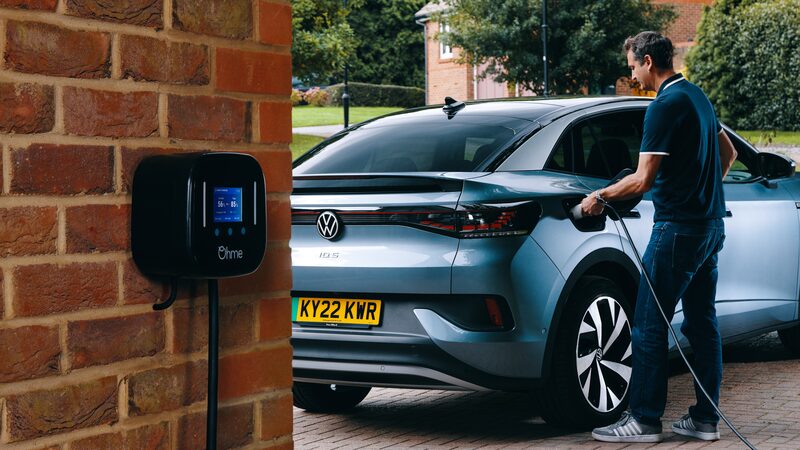
Charging an electric car at home is an overnight job, not a wait-by-the-car job. A typical home wallbox delivers around 7 kW, charges most electric cars in 4 to 8 hours, and adds around 25 miles of range for every hour it runs1. A 60 kWh battery, a common size, usually takes around 7 to 8 hours to charge from empty on a 7 kW charger1. Plug in when you get home and the car is full, or close to it, by morning.
The slow alternative is a standard three-pin socket. That works, and every electric car comes with the cable to do it, but it is trickle charging: Which? warns that charging the same battery from a three-pin plug at home would take around 30 hours2. That is why almost every household that charges regularly installs a dedicated wallbox, and why the charging conversation at home is really about what happens while you sleep.
How long a home charge takes: the short answer
The Society of Motor Manufacturers and Traders gives the headline range for home charging: a home charger with a Type 2 Mode 3 outlet will typically take between four and 10 hours to charge an EV battery5. That band covers the spread of battery sizes on UK roads, from small city cars to large electric SUVs, all charging at broadly the same 7 kW rate.
Independent guidance narrows it further. A 7 kW charger will generally charge a car from 0 to 80% within several hours6, and a typical home wallbox delivering about 7 kW gives a full charge in around 10 hours while adding roughly 30 miles of range per hour3. Power NI, the Northern Ireland utility, puts the average home charging time at around 8 hours1. The maker Ohme states that with a 7.4 kW home charger, most EVs can be fully charged in 6 to 8 hours, which it describes as suited to overnight charging7.
For a household, the practical meaning is simple. Charging time at home is not time you spend waiting; it is time the car spends parked while you do something else. The only households for whom home charging time genuinely matters are those who need a lot of range twice in one day, and no home charger, at any power available to a normal house, is designed for that.
Charging time by battery size: 25 to 100 kWh on a 7.4 kW charger
Charging time scales with the size of the battery, and Energy Saving Trust publishes a table that shows exactly how. Assuming the car starts from 20% charged, a 7.4 kW charger takes 3 hours 45 minutes for a 25 kWh battery, 7 hours 45 minutes for a 50 kWh battery, 10 hours for a 75 kWh battery and 13 hours 30 minutes for a 100 kWh battery8.
| Battery size | Time on a 7.4 kW charger (from 20% charged) | Time on an 11 kW charger (from 20% charged) |
|---|---|---|
| 25 kWh | 3h 45m | 2h |
| 50 kWh | 7h 45m | 5h 15m |
| 75 kWh | 10h | 6h 45m |
| 100 kWh | 13h 30m | 9h |
The 11 kW column comes from the same guidance and shows what a three-phase supply would buy you: roughly a third off the charging time8. But 11 kW and 22 kW chargers need a three-phase electricity supply, which most UK homes do not have, so for the great majority of households the 7.4 kW column is the relevant one3. The comparison between the two is covered in more detail in 7kW vs 22kW home EV charger.
Other sources land in the same place by different routes. Carwow calculates that a 7 kW charger gives a full charge in roughly 7 hours for a 50 kWh battery and roughly 14 hours for a 100 kWh battery3. Ohme states that on average a 7.4 kW home charger takes about 11 hours to fully recharge a car, averaged across the models on the road7. The differences between these figures are differences of assumption: starting charge level, battery size and whether the car's own charging electronics slow the rate near full. The pattern that holds across all of them is that a 50 kWh car fits an evening, and a 100 kWh car needs a long night.
Three-pin socket versus a dedicated wallbox: why the outlet matters
Every electric car can be charged from an ordinary domestic socket, and for occasional use, at a relative's house or on holiday, that is a genuine convenience. For regular charging it is the wrong tool. Which? describes three-pin charging as taking a long time, at least 30 hours depending on the car9, and elsewhere puts the same battery at around 30 hours from a three-pin plug2. Carwow's figure is 30 to 35 hours for a full charge, depending on the battery3.
The reason a wallbox is strongly recommended for regular charging is not just speed. Zapmap's buying guidance is blunt that because of the higher current demands of EV charging, a dedicated unit is strongly recommended even though slow charging at home can be carried out using a standard 3-pin socket10. A domestic socket was designed for a kettle, not for a sustained load running through the same outlet for a day and a half. A dedicated charge point has its own circuit, its own protection, and weatherproofing to standards built for the job; the electrical requirements are covered in electrical requirements for a home EV charge point.
The gap is smaller for a plug-in hybrid, because the battery is a fraction of the size. Uswitch's guidance says a 3-pin plug takes up to six hours to charge a plug-in hybrid, while a wallbox charges the same car in around three to five hours11. For a fully electric car, the gap is the difference between an overnight charge and a charge that runs into a second day.
Why a 7 kW charger usually means an overnight charge
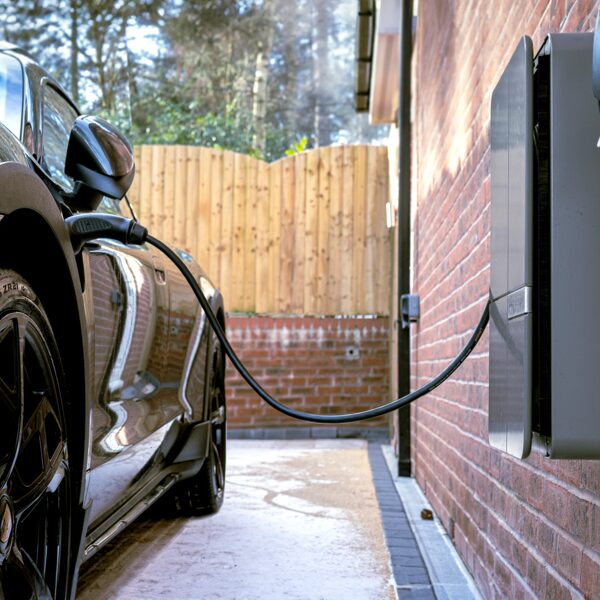
A 7 kW charger adds about 7 kWh to the battery for every hour it runs12, which is why the miles-per-hour figures cluster where they do. Power NI says a 7 kW home charger adds around 25 miles of range per hour of charge1; carwow says typical home wallboxes add roughly 30 miles per hour3; and a Scottish Government consultation on building regulations notes that for most vehicles, over 25 miles of range can be added per hour at 7 kW13. Call it 25 to 30 miles an hour.
Set that against how far people actually drive. A ten-hour overnight charge at that rate adds well over 200 miles, which is more than most UK households use in a day. This is why the charging time figures that look long on paper, 8 hours, 10 hours, 13 hours 30 minutes, rarely translate into inconvenience: the car is parked anyway.
The other reason overnight works is that the last part of a charge is the slowest. Zapmap notes that if you are using an EV charger with a power rating of 3 kW, 5 kW or 7 kW, it will generally take between six and 12 hours to charge from 20% to 80% or above14, because cars taper the charging rate as the battery fills. Charging to 80% rather than 100% therefore saves a disproportionate amount of time as well as suiting the battery, which is covered below.
For households with solar panels, the overnight logic changes: a 7 kW charger can also absorb surplus generation during the day, and a solar-aware charger can prioritise it. That is covered in charging an EV from solar panels.
Slow, fast and rapid charging compared
The industry divides charging into three bands, and home charging sits in the middle one. SMMT describes fast chargers as delivering 7 to 22 kW and usually taking between four and eight hours to charge an EV battery5. A home wallbox at 7 kW is a fast charger by this definition3.
| Band | Power | Typical time | Where you find it |
|---|---|---|---|
| Slow | 3 kW and below | 30 hours or more for a full charge | Three-pin socket at home9 |
| Fast | 7 to 22 kW | 4 to 8 hours for a full battery5 | Home wallboxes, destination chargers |
| Rapid / ultra-rapid | 50 kW and above | Around 40 minutes from 20% to 80%15 | Motorway services, public hubs |
Rapid charging is a different experience. Which? advises allowing around 40 minutes to charge from 20% to 80% at rapid or ultra-rapid stations such as motorway services15, and Zapmap says ultra-rapid chargers take many newer models from 20% to 80% in 20 to 30 minutes14. But rapid charging is expensive and hard on the battery if used as a routine, and it is not something a home can offer: no domestic supply supports it.
The comparison matters for expectations. Public charging in the UK is mostly not rapid: 57% of UK public chargers are between 3 and 8 kW, which at best is slightly faster than a home charger and at worst would take nearly a full day15. On-street charge points, the public equivalent of home charging for households without a driveway, generally take 6 to 12 hours to recharge a car to 80% or above16. In other words, the public network is largely built around the same overnight logic as your driveway. The full picture is in EV charging speeds and times.
Installation of a home wallbox: what to expect
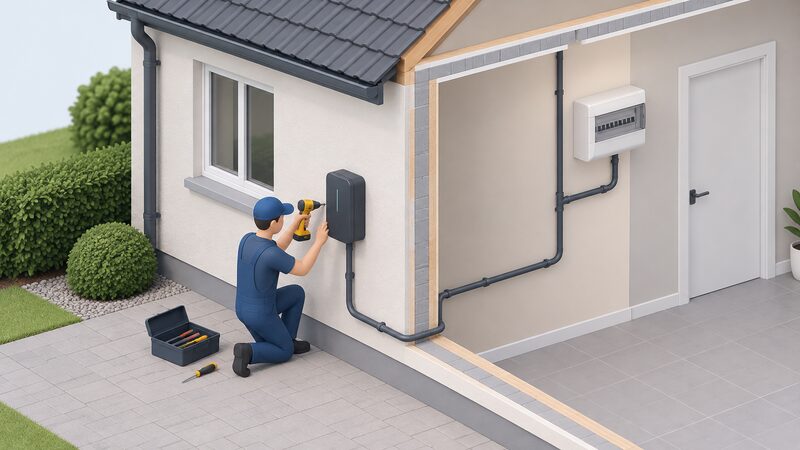
Installation is quick. Uswitch's guide to the process says it should not take more than about two or three hours to install a home EV charger, assuming no major issues, with a second day scheduled if extra works are required4. Carwow says installation usually takes around two hours, with the installer coordinating with your Distribution Network Operator3, and Uswitch's broader charging guidance agrees that it should only take a couple of hours or so, depending on charger type and location17.
What takes longer is everything around the fitting. The charger needs its own circuit from the consumer unit, which is why the work must be done by a competent installer; NICEIC notes that EV charger installation and maintenance is a specialist electrical service, and that charging at home is likely to be cheaper than at a public EV station18. Which?'s advice on finding a trader for a home charger installation points out that nobody wants to spend 30 hours or more trickle-charging via a standard three-pin plug, which is the alternative19. The process, the paperwork and who can do it are covered in home EV charge point installation.
The charger itself is chosen for the household, not the car: tethered or untethered, smart or basic, and the options are set out in types of home EV charger. Costs of the unit and the fitting are in how much a home EV charge point costs.
What a full home charge costs
Charging time and charging cost are linked, because both are set by the tariff you charge on. Energy Saving Trust gives approximately £17 for a full home charge of a car with a 50 kWh battery on a standard tariff20. Uswitch's statistics put the average cost of a home charge at £13 in October 2024, based on the average UK domestic electricity rate and a typical 54 kWh battery21. An older comparison, from Electricity North West, put a full charge of a typical 60 kWh car at around £2022.
Off-peak charging changes the arithmetic. Energy Saving Trust puts home charging with an EV tariff or other time-of-use tariff at £8 per full charge23, and Which? notes that with an off-peak tariff it can cost less than £10 for a full charge15. Flexi-Orb's guidance gives a worked example: if you are able to charge overnight at a cost of 10p per kWh, the same full charge would only cost £624.
Against public charging there is no contest. Energy Saving Trust's comparison for a full 220 miles of charge puts home charging at £17, public fast charging at £37, public rapid charging at £53, and a full tank of petrol at £458. Part of the gap is tax: public rapid charging carries a 20% VAT rate, compared with the 5% applied to domestic electricity25. Zemo notes that home charging is five to 10 times cheaper than public alternatives26. The detail is in home vs public EV charging costs and what it costs to charge an electric car at home.
Overnight charging and its effect on the grid
Overnight charging is where a household's interest and the electricity network's interest align, mostly. SMMT notes that on-street residential charge points typically have an output of between 3 and 7 kW, making them suitable for overnight charging5. Zapmap's guidance for EV drivers is that charging at home or at work overnight, when electricity is cheap, reduces overall fuel costs by more than 70%27. Energy Systems Catapult's analysis of homes in its Living Lab found that peak EV charging occurs between midnight and 6am, consistent with households optimising for current time-of-use tariffs28.
That behaviour is good for the household bill but concentrates demand in a narrow window. One hour of charging draws about 7 kWh12, and if every household on a street does it in the same six hours, the local network feels it. This is why smart charging matters: a smart charger can shift the charge within the off-peak window, and the rules requiring it are covered in the Electric Vehicles (Smart Charge Points) Regulations 2021 and smart EV chargers. Households can also earn rewards for shifting their charging at the network's request, covered in smart charging, flexibility services and reward schemes.
For energy independence, home charging cuts both ways. It removes dependence on the public charging network and its prices, and on an off-peak tariff it gives a household a large, predictable, controllable load. But it deepens dependence on the grid and on the supplier's tariff structure: the cheap overnight rate is the supplier's offer, not the household's right. Pairing the charger with solar panels, a home battery, or in time vehicle-to-home charging is what turns the car from a grid-dependent appliance into part of a self-sustaining household; those routes are covered in EV charging and household energy independence.
Charging to 80%, not 100%, and why it also saves time
Independent guidance is consistent that a nightly full charge is unnecessary and unhelpful to the battery. Zapmap's driving tips say it is a good idea to keep your car charged to about 80%, to keep the battery in a good state of health29. Its hot-weather advice is more specific still: only charge your electric car to 80%, especially in hot weather30. Uswitch's tariff guidance suggests keeping the EV's charge between 20% and 80% most days31.
This connects back to charging time. Because cars taper the charge rate near full, the last 20% takes disproportionately long, so a household that charges to 80% spends less time plugged in for the miles it actually needs. The battery science behind this is covered in EV batteries, charging habits and degradation, and whether to leave the car plugged in once it is full in should you leave your electric car plugged in?.
Sources31 sources
- How long to charge an electric car, Power NI, 2025-08-20
- How to use electric car charging points, Which?, 2026-05-20
- Electric car charging guide, Carwow, 2025-07-16
- EV charger home installation process, Uswitch, 2022-02-03
- Electric vehicle charging, Society of Motor Manufacturers and Traders, 2025-06-25
- Destination charging, Zapmap, 2026-02-26
- New to EVs, Ohme, 2026-07-09
- Charging electric vehicles, Energy Saving Trust, 2026-04-23
- Electric car charging at home, Which?, 2026-02-25
- EV buying guide, Zapmap, 2024-12-06
- Does a hybrid car need an EV tariff?, Uswitch, 2025-07-02
- Taking part in the Demand Flexibility Service, Centre for Sustainable Energy, 2024-02
- Scottish building regulations: proposed changes to energy standards, Scottish Government, 2021-07-23
- How long does it take to charge an electric car?, Zapmap, 2026-04-15
- Should I buy an electric car?, Which?, 2026-04-16
- On-street charging, Zapmap, 2026-02-26
- EV charging, Uswitch, 2026-09-19
- Electric vehicle charger installation and maintenance, NICEIC, 2025-08
- Looking to install a home charger for your electric car, Which?, 2023-09-05
- Electric vehicles: debunking myths, Energy Saving Trust, 2025-09-22
- EV charging statistics, Uswitch, 2024-10
- Electric vehicles for home: costs and taxation, Electricity North West, 2022-12-05
- Smart charging electric vehicles, Energy Saving Trust, 2025-03-25
- Electric vehicle charge points (EVCP), Flexi-Orb, 2025-04-22
- Tesla Model 3 charging, Zapmap, 2026
- Government set to change rules on cross-pavement charging, Zemo, 2026-04-22
- EV basics, Zapmap, 2024-05-14
- Grid impacts of heat pumps, EVs and solar revealed, Energy Systems Catapult, 2025-08-18
- Driving an electric car: top tips, Zapmap, 2024-12-06
- Tips for electric cars in hot weather, Zapmap, 2025-07-08
- Best EV charging tariff, Uswitch, 2025-07-02