In this guide
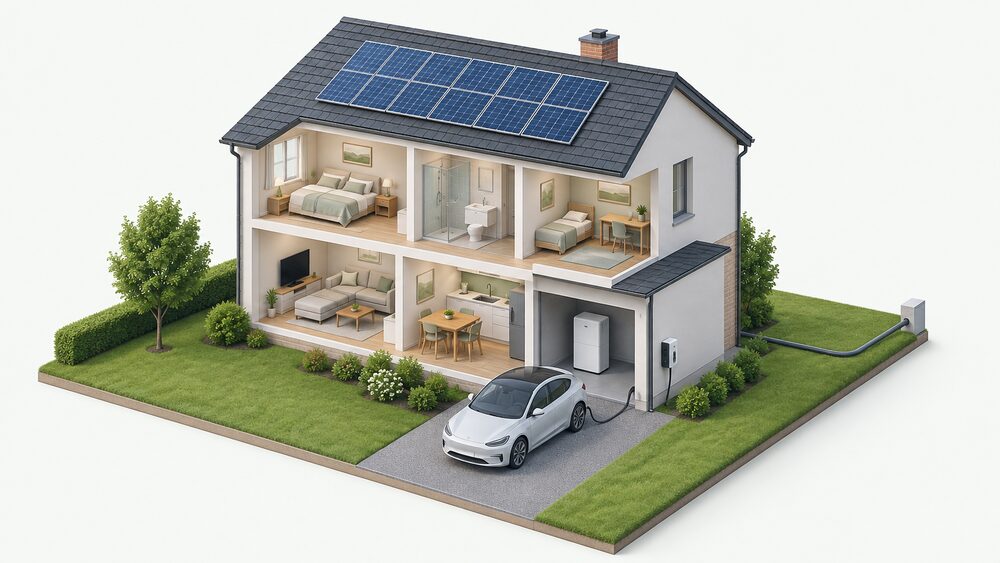
A home charge point is the single largest step a household can take towards energy independence in motoring, because it moves the fuel supply onto the property. Energy Saving Trust states plainly that a dedicated chargepoint is the cheapest way to charge an EV, and that charging at home is likely to be cheaper than at a public station1. The independence is real but partial: the electricity still arrives through a metered connection, the charger usually depends on a manufacturer's cloud service, and the car itself remains a grid-connected asset.
The scale of the shift is worth setting out. A standard home charger runs at 7kW, and Zapmap reports that a 7kW unit costs between £700 and £1,200 fully installed2. Which? puts the general range at £500 to £1,200, with 7kW chargers around £9003. Charging times on that power rating run from six to 12 hours for a 20 to 80 per cent top-up4, which is why the household's own generation and tariff, not the charger, decide how independent the arrangement really is.
What follows separates the parts of home charging a household controls from the parts it does not. Solar generation, a home battery and bidirectional charging all reduce reliance on imported electricity. The grid connection, the network operator's approval, the supplier's tariff and the charger's software platform remain outside the household's control, and the sections below say how far each can be pushed.
Why a home charge point is a pillar of household energy independence
The independence argument rests on where the money and the control sit. A public chargepoint is someone else's infrastructure, priced by someone else, available when someone else maintains it. A home unit is on the household's own supply, and Energy Saving Trust describes it as the cheapest and most convenient way to charge1. That is the foundation: the fuel no longer comes from a forecourt or a third-party network.
The second layer is the tariff. Uswitch notes that a home EV charger is a precondition for an EV tariff, since there is no point holding one if the car cannot be charged at home7. An EV tariff is still a supplier relationship, so it does not deliver independence in the strict sense, but it moves the household from a single flat rate to a rate it can choose and time its consumption around.
The third layer is generation. Where a household has solar, the electricity is its own, and E.ON states that solar generation can directly charge an EV if the right equipment is present8. That is the point at which charging stops being a purchase and becomes a use of an asset the household already owns.
There are hard limits. Northern Ireland Networks warns that EV chargers and other low-carbon technologies can push a home's electricity demand above the available supply, which may require an upgrade9. Cenex frames the same point positively, describing the potential for a household to use an EV as a supplementary energy source to power a heat pump, aiding grid flexibility and resilience10. The car can become part of the home's energy system rather than only a load on it, but only where the connection, the charger and the car all support it.
Home EV chargers: power ratings, connectors and charge times

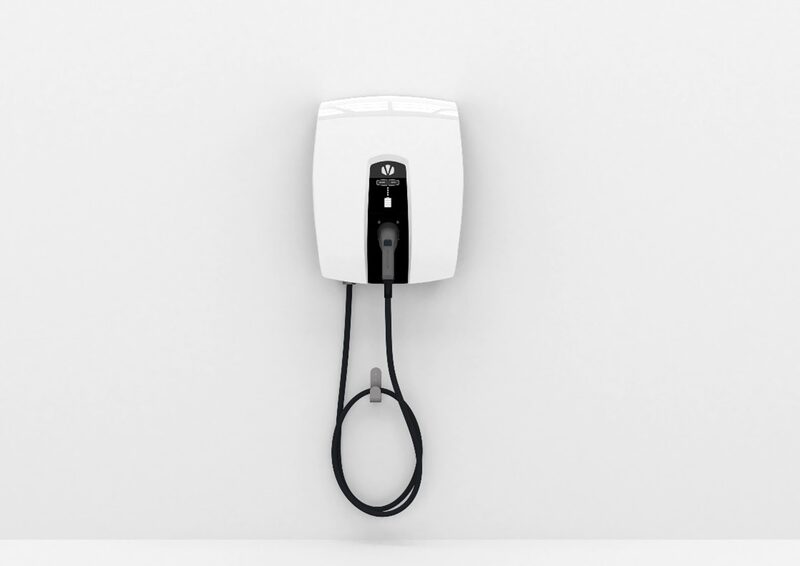
Home charging splits into three power bands, and the choice is usually made by the property's electrical supply rather than by preference. Which? reports that the cheapest chargers tend to be 3.6kW, that 7kW units are a good choice for most households at around £900, and that 22kW chargers are the most expensive and require a three-phase connection3. Zapmap confirms 7kW as the standard power rating for a home charger2.
Charge time follows directly from the rating. Zapmap reports that a charger rated 3kW, 5kW or 7kW generally takes between six and 12 hours to move a battery from 20 to 80 per cent or above4. myenergi gives a single-vehicle figure: a typical 60kWh battery reaches full from empty in around eight hours on a 7kW charger11. The spread between the two figures reflects battery size and starting charge rather than any disagreement about the equipment.
| Rating | Typical use | Notes |
|---|---|---|
| 3.6kW | Slowest home charging | Cheapest chargers3 |
| 7kW | Standard home charging | Around £900 installed; six to 12 hours for 20 to 80 per cent3 |
| 22kW | Fastest home charging | Most expensive; requires three-phase connection3 |
Rapid charging sits outside the home entirely. Energy Saving Trust lists a 240kW DC charger delivering 6 minutes for 25kWh, 12 minutes for 50kWh, 17 minutes for 75kWh and 22 minutes for 100kWh, assumed from 20 per cent charged1. Those speeds depend on public infrastructure and are not available on a domestic supply.
Certification matters more than headline speed for a household buying once. BSI Kitemark certification for charge points covers safety, security, quality and reliability, and applies to both home and commercial units12. Low Carbon Hub notes that fast charging takes hours and suits longer stays or overnight charging13, which is the pattern most homes actually use.
Tethered or untethered: which fits which home
The choice between a tethered and an untethered charger is about cable ownership and storage, not about power. NICEIC explains that tethered chargers come with a cable and connector installed, while untethered chargers have only a socket where a cable is plugged in5. myenergi uses the same distinction: tethered units have a permanent lead and socket attached, untethered units let the user plug in separate cables11.
The practical consequences run in both directions. A tethered unit means the cable is always present and cannot be left behind, but it is fixed to one connector type. An untethered unit allows the cable to be kept in the car and used elsewhere, at the cost of handling it every time. Zapmap notes that the absence of a cable on public charge points is deliberate, keeping streets tidy and free of trip hazards and allowing almost any EV to charge without cable type being a restriction14. The same logic applies at home where more than one vehicle is charged.
Cost is affected by the choice. NICEIC lists charging speed, tethered versus untethered, installation complexity, and grants and incentives among the factors that drive installation cost5. A tethered unit is not automatically more expensive, but the cable and connector are part of the hardware rather than a separate purchase.
For a household with one car and one connector standard, a tethered unit removes a recurring task. For a household with two cars of different connector types, or one that expects to change cars, an untethered socket keeps the options open. Neither choice affects how independent the charging is; both draw from the same supply.
Cost: what a home charge point costs to buy and install
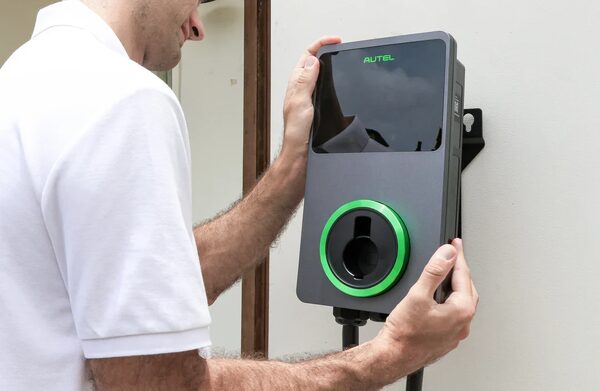
Published prices cluster in a narrow band. Which? reports that a home EV charger typically costs between £500 and £1,200 to buy and install, with 7kW chargers around £9003. Zapmap gives £700 to £1,200 fully installed for a typical 7kW charge point2. Uswitch cites a Checkatrade report putting the average installation cost at £1,000 in parts and labour15. These are quoted figures from 2025 and 2026 and are not a fixed market price.
What drives the spread is the property, not the box. myenergi states that cost varies with charger model and output, installation complexity, and any electrical upgrades required11. NICEIC lists charging speed, tethered versus untethered, installation complexity, and grants and incentives as the cost factors5. A straightforward wall mount close to the consumer unit sits at the bottom of the range; a long cable run, a supply upgrade or a heritage property sits at the top.
The independence angle on cost is that the money buys an asset rather than a service. A public charging habit is an ongoing payment to a network operator; a home charge point is a one-off capital cost after which the marginal cost of charging is the household's own electricity price. Energy Saving Trust's position that a dedicated chargepoint is the cheapest way to charge an EV is the financial expression of that1.
Grants and tax rules that shape the price you pay
Grant support is targeted rather than universal. Energy Saving Trust states that the UK Government grant offers up to £350 per socket for residential landlords, people living in flats and people who rent their homes1. Uswitch reports the same £350 figure for landlords and flat tenants, noting it can reduce the installation cost to as low as £65015. Home Energy Scotland describes installing a home charge point as the cheapest and most convenient way to charge for those who own or use an EV16.
| Scheme | Support | Who it covers |
|---|---|---|
| Electric vehicle chargepoint grant | Up to £350 per socket | Residential landlords, flat residents, renters1 |
| Workplace Charging Scheme | Up to 75% of purchase and installation costs including VAT, capped at £500 per socket | Businesses17 |
The Workplace Charging Scheme is the commercial counterpart, covering up to 75 per cent of the total costs of purchase and installation including VAT, capped at £500 per socket17. It is not available to a household for its own driveway, but it matters where an employer provides charging that reduces a household's reliance on both home and public charging.
Northern Ireland operates its own arrangements. The Department for Infrastructure publishes separate guidance on electric vehicle chargepoint and infrastructure grants17, which means a household there should check the devolved scheme rather than assume the GB grant structure applies. Scotland's route runs through Home Energy Scotland16.
Charging from your own solar panels
Solar is where home charging moves closest to genuine self-sufficiency. E.ON states that solar generation can directly charge an EV if the right equipment is present, and that using electricity made by the household's own panels is cheaper than buying it from the grid8. The Council for Property Advice notes that charging from your own electricity is significantly cheaper than using grid power and far cheaper than petrol or diesel over the same distance18.
The economics rest on a simple asymmetry. Hammersmith and Fulham Council states that rates for selling electricity to the grid are much lower than tariffs for using electricity from the grid, so using solar electricity yourself is much more cost-effective19. Every kilowatt-hour diverted into the car rather than exported is worth the avoided import price, not the export price.
A home battery changes what is possible rather than whether it is possible. The Council for Property Advice explains that a home battery captures surplus solar energy for later use, including overnight EV charging, whereas without one the unused solar electricity is wasted or exported, often at a relatively low rate18. Without storage, charging has to happen while the sun is up, which suits a car that is at home during the day and not one that is out at work.
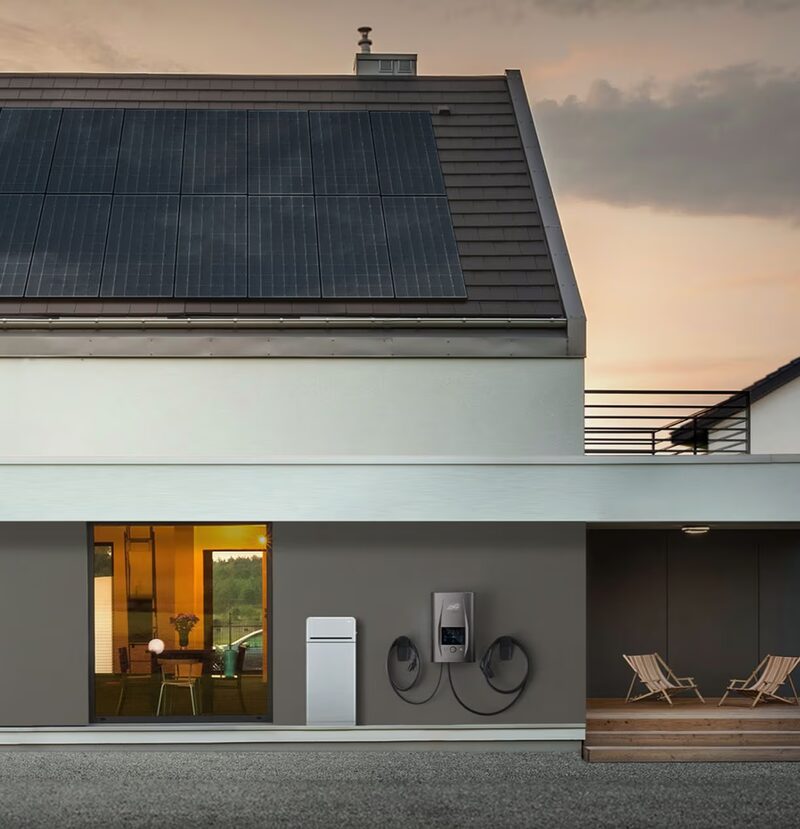
Plug-in solar is a newer route to the same end. Energy Saving Trust reports that plug-in solar panels can operate without taking any electricity from the grid20, which is the clearest statement of independence in the material: a generation source that does not require an import at all. For a household weighing solar against a battery, the sequence matters, and the site's guide to charging an EV from solar panels sets out the equipment side in more detail.
Vehicle-to-grid: your car as a household battery
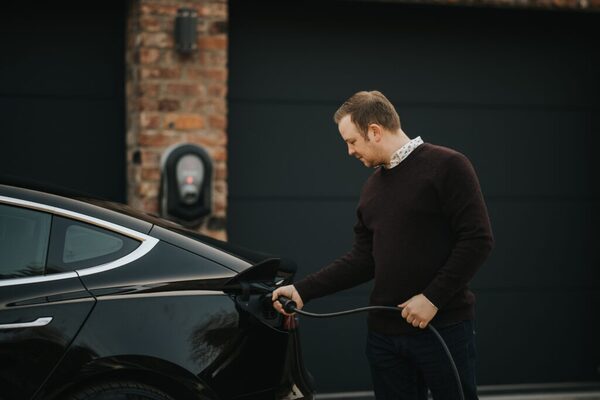
Bidirectional charging turns the car from a load into a store. Energy Saving Trust describes vehicle-to-grid technology as allowing an EV charger not only to charge a vehicle but also to take energy from it21. The Climate Change Committee frames the wider category, V2X, as allowing electric vehicles to operate bidirectionally, charging from the electricity grid but also discharging to the grid, a building or a home as needed22.
The distinction between the three terms matters. V2G is the grid-facing version, where a V2G-enabled charge point draws power to charge the vehicle and exports electricity from the car battery back to the home or the grid23. V2H is the same hardware discharging to the home rather than the network. V2L is a vehicle's own onboard outlet, with no charge point involved. The Society of Motor Manufacturers and Traders describes the integration as allowing EVs not only to draw energy from the grid but also to return it when needed24.
The system-level case is substantial. Ofgem's case study reports that if 50 per cent of 2030 EVs were V2G enabled, this would open up 22 TWh of flexible EV discharging capacity per year, and could provide around 16GW of daily flexible capacity to the grid25. Energy Saving Trust states that having electric vehicles as battery storage will allow the UK's energy to be better managed21. That is a national benefit, and it is also the mechanism by which a household gets paid for lending its battery.
Eligibility is not universal. Uswitch states that using V2G requires a smart meter, a compatible V2G charger and a car that supports the technology26. All three must be present, which is why the household-level rollout has been slower than the system-level case suggests.
What V2G earns and saves: the numbers
The revenue figures are modelled rather than observed, and they vary widely with how long the car is plugged in. Cenex reports that a 7kW V2G charger could achieve annual revenues of around £436 above smart charging for a high plug-in rate archetype, where the car is plugged in 75 per cent of the time6. The same report notes that a 7kW V2G charger could capture around £436 a year, four times that achieved with the average plug-in rate6.
The comparison with smart charging is the more important number. Cenex states that if grid services to the system operator and distribution network operator are excluded, smart charging is able to capture 80 per cent of the value of V2G6. The same source gives a second, conflicting figure: smart charging can capture 80 per cent of the value of V2G for low plug-in scenarios, or 24 per cent for high plug-in cases6.
Battery size affects the return. Project Sciurus reports that EVs with battery sizes of 40 kWh or above were able to capture more revenue through V2G tariff optimisation than smaller-battery vehicles27. The same trial used an Indra V2G unit with a maximum charge rate of 6kW27.
On battery wear, the evidence is more encouraging than the concern. Cenex reports that EV-elocity found V2G could extend the life of an EV battery by about 10 per cent, around one extra year of use28. Uswitch acknowledges concerns that frequent charging and discharging could shorten battery life, but states the impact should be relatively minimal within recommended guidelines26. The two positions are not fully reconciled, and the site's guide to vehicle-to-grid and vehicle-to-home charging covers the hardware side.
Dynamic load management and charging within your home's power limit
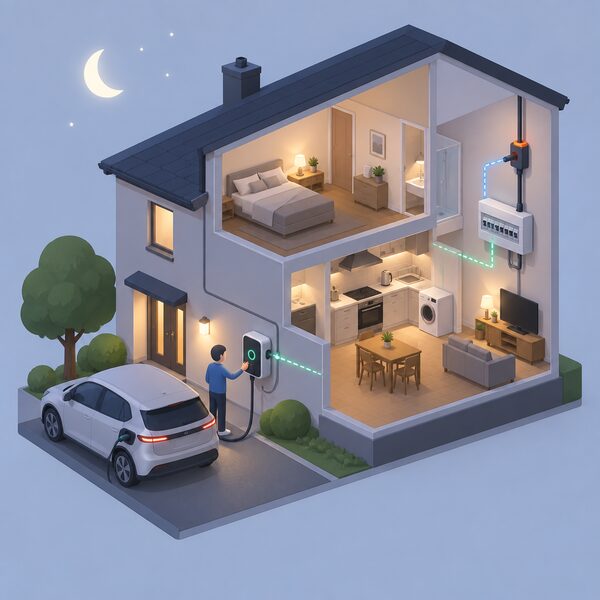
A home charger adds a large load to a supply that was sized before the car existed. Northern Ireland Networks warns that EV chargers and other low-carbon technologies can push a home's electricity demand above the available supply, which may require an upgrade9. Load management is the alternative to that upgrade in many cases.
E.ON describes the mechanism: dynamic load balancing keeps an eye on how much electricity the house is using and changes the charging speed of the EV, stopping the electrical circuits from overloading8. The charger measures the whole-house demand and reduces the car's draw when other appliances are running, then restores it when they stop. The household keeps its supply limit and still charges overnight.
This is a form of independence in itself, because it removes the need for a network upgrade in many properties. It also interacts with solar: a charger that can vary its output can follow generation rather than run at a fixed rate, which is what makes surplus solar charging practical rather than theoretical. The site's guide to load management and load balancing covers the settings and the hardware.
The limit is that load management protects the supply, not the household's independence from it. The car still draws from the grid whenever the sun is not generating and the battery is empty. What changes is the size of the connection required, and therefore the cost and delay of getting one.
Installation, safety and where a charger can go
Installation is regulated work, not a DIY job. The Council for Property Advice states that EV chargers should be installed by a qualified electrician with relevant experience, and that compatibility between the charger, the solar system and any battery storage should be considered from the outset18. myenergi makes the same point: installing a charger at home is usually straightforward, but it is important to use a qualified electrician11.
Building regulations approval is always required when installing a home EV charger, and a competent and reputable installer should be used, with specific processes for notifying the local building control authority29. Most local authorities specify that households install a dedicated EV charger with protective earth neutral fault protection30.
Planning permission is usually not needed. NICEIC states that a charger normally falls within permitted development rights, with exceptions for listed buildings, conservation areas or cross-pavement solutions5. The Planning Portal confirms that where a home has off-street parking, installation is likely to fall under permitted development with no planning application required, provided the criteria are met31. Permission is usually required for on-street parking, conservation areas, listed buildings, areas where installation is restricted, and more than one upstand per parking space31.
| Situation | Permission position |
|---|---|
| Off-street parking, standard dwelling | Likely permitted development31 |
| Wall-mounted outlet under 0.2 cubic metres | No permission required, unless on scheduled ancient monument land32 |
| On-street parking, conservation area, listed building | Permission usually required31 |
| Charger less than two metres from the highway | Permission required30 |
| Pavement cable crossing | Highways Authority permission, and possibly separate planning permission33 |
Two further conditions catch households out. Planning permission is required if the charger is installed less than two metres from the highway30, and a pavement cable crossing needs permission from the Highways Authority, with separate planning permission possibly required for the crossing itself33. Cotswold District Council notes that permitted development rights can be removed in some areas, which changes the position entirely32.
Sources34 cited
- Charging electric vehicles, Energy Saving Trust, 2026-04-23
- Home charging, Zapmap, 2025-06-19
- Electric car charging at home, Which?, 2026-02-25
- How long does it take to charge an electric car, Zapmap, 2026-04-15
- Electric vehicle charger installation and maintenance, NICEIC, 2025-08
- V2GB - Vehicle to Grid Britain, Cenex, 2026-09-17
- EV energy tariffs, Uswitch, 2025-09-17
- EV chargers for solar panel charging, E.ON Next, 2026-09-17
- If your electricity supply can't cope with the new equipment, Northern Ireland Networks, 2026-09-19
- Driving the shift to sustainable living, Cenex, 2024-01-30
- Electric car charging at home, myenergi, 2026-09-17
- Powering trust in electric vehicle charging with BSI Kitemark certification, BSI, 2026-09-17
- Clean energy boost, Low Carbon Hub, 2024-06-25
- Tethered vs untethered, Zapmap, 2026-02-23
- EV charging statistics, Uswitch, 2025-12-15
- MCS electric vehicle, Home Energy Scotland, 2024-04
- Electric vehicle chargepoint and infrastructure grants, Department for Infrastructure Northern Ireland
- Can solar panels charge electric cars?, The Council for Property Advice, 2026-04-15
- Solar panels, Hammersmith and Fulham Council, 2026-09-17
- Plug-in solar panels now available, Energy Saving Trust, 2026-08-27
- Vehicle-to-grid best practice guide, Energy Saving Trust, 2026-05-05
- Well-adapted energy system, Climate Change Committee, 2026-09-19
- Register energy devices in homes or small businesses, GOV.UK, 2021-03-31
- Toyota to expand EV charging ecosystem across the UK, Society of Motor Manufacturers and Traders, 2025-12-04
- Case study: UK electric vehicle to grid (V2G) charging, Ofgem, 2030
- Vehicle-to-grid charging, Uswitch, 2025-07-02
- Project Sciurus trial insights report, Cenex, 2021-05
- An introduction to vehicle-to-grid charging for electric vehicles, Cenex, 2022-08
- Electric vehicle chargers, Planning Portal, 2026
- Cross-pavement charging solutions, Energy Saving Trust, 2025-07-18
- Planning permission for electric vehicle charging, Planning Portal, 2026
- Permitted development, Cotswold District Council, 2026-09-17
- Approved pavement crossings, Planning Portal, 2026
- Electric vehicle charging, Planning Portal, 2026
 Charging an EV from Solar PanelsCharging your car from solar panels means using the power your roof makes instead of sending it to the grid.
 The Full EV Charging GuideCharging an electric car at home usually means a wallbox, but do you need one, and what will it cost to fit and run?
 Leaving the Electricity GridCan you really cut your home off the grid completely, and what does it cost to have your electricity supply removed for good?
 Suppliers and IndependenceCan you really cut your energy bills by making your own power, and how much of your supplier do you still need?
 Energy IndependenceA heat pump runs your heating on electricity instead of gas or oil, so how much does that really cut what you pay and how exposed you are when fuel prices jump?
 Charging With a Home BatteryHow a home battery and an EV charger share one supply, whether a battery can usefully charge a car, and how combined systems are controlled so the battery is not discharged into the vehicle at a loss.