In this guide
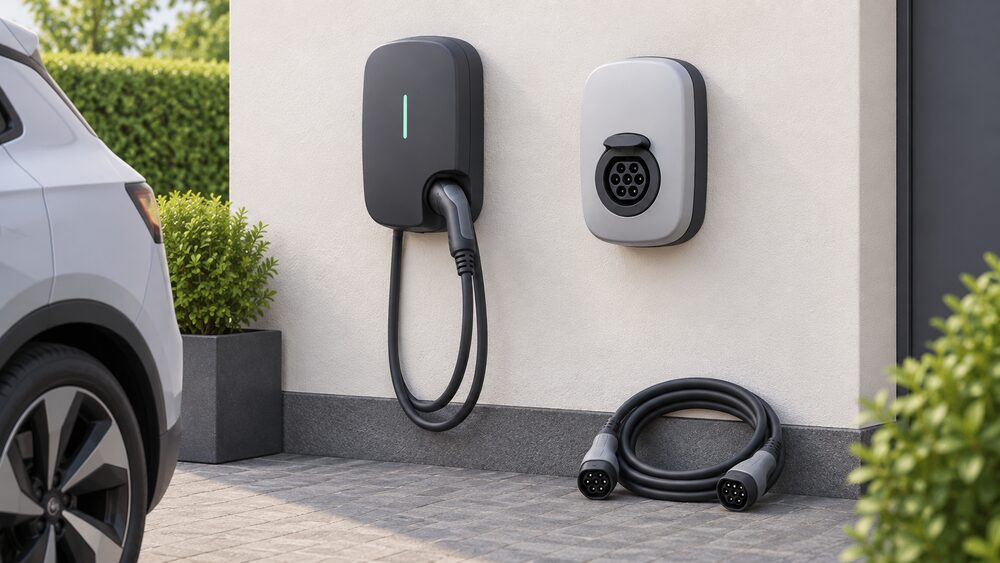
Home charge points in the UK divide along four axes: whether the cable is attached (tethered) or the unit is a bare socket (untethered), how much power the unit can pass (commonly 3.6 kW, 7 kW or, on a three-phase supply, 22 kW), which connector the car takes (Type 1 or, for almost every modern car, Type 2), and how much intelligence sits behind it (a plain scheduler, a tariff-linked smart charger, or a solar-aware unit that follows the output of a rooftop array). All new chargers sold for domestic use have to be smart, able to be set to charge when there is less demand on the grid or more renewable electricity is available1.
Tethered units come with a cable and connector already installed; untethered units have only a socket, into which a separate cable is plugged2. That socket is almost always Type 2 in the UK, which is the standard for home and public AC charging here and across Europe3. Most households on a standard single-phase supply end up with a 7 kW unit, the power level that dominates domestic and destination charging; 22 kW needs a three-phase connection and is the most expensive option1.
Installed costs cluster around four figures. Planning Portal guidance puts installation between £450 for a basic model and around £1,200 as power and capability increase4. Which? reports a typical £500 to £1,200 to buy and install, with around £900 for a 7 kW unit1. Zapmap gives £700 to £1,200 fully installed for a 7 kW charge point5.
Tethered or untethered: which cable setup suits the driveway
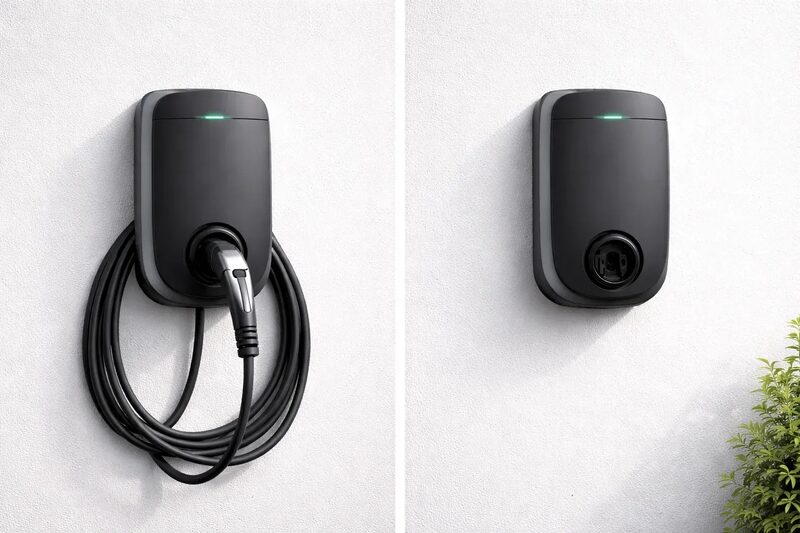
The split is simple. A tethered charger has a permanent lead and connector attached to the unit9. An untethered charger is a socket, usually a Type 2 socket in the UK, into which a separate cable is plugged10. Untethered units let a household use its own cable or the one supplied with the vehicle11, and almost all electric cars come from the manufacturer with a cable carrying a charger-side Type 2 connector12.
The trade is convenience against flexibility. Untethered chargers are less convenient, because the cable has to be connected and disconnected at both ends each time11. Tethered units are restricted to either a Type 1 or a Type 2 charging connection, fixed at the point of purchase11. That restriction is the real consideration: a tethered Type 2 lead suits the car on the driveway today, but a future vehicle with a different inlet would need the whole unit changed, whereas a socket accepts whichever cable the next car arrives with.
Cable length is a driveway question rather than a technical one. A tethered lead has to reach the car's charge port wherever the car is habitually parked, and charge ports sit in different places on different models. Where two vehicles share a driveway, or where a car is sometimes reversed in and sometimes not, a socket plus a longer separate cable gives more room to manoeuvre.
Public and destination charging follows the same pattern and is worth noting because it shapes what cable a household carries. Tesla destination chargers use Type 2 tethered cables, with a non-Tesla-specific charge point installed alongside for any driver whose car has a Type 2 inlet13. Mode 3 AC charging cables, the ones that connect a car to a charging station at home, at work or in a car park, are the most common type of electric car charging cable in use14.
A fuller side-by-side sits on tethered vs untethered EV charger.
Power ratings: 3.6 kW, 7 kW and 22 kW
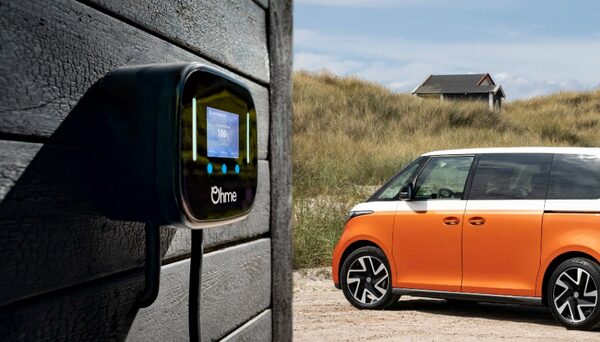
Power is what sets charging time, and on a domestic supply it is set by the incoming connection more than by the charger. Most suppliers offer 3 kW or 7 kW as standard, though specific chargers can charge at up to 22 kW15. Manufacturers typically offer the same model family in 7 kW, 11 kW and 22 kW variants6. The EmonEVSE unit is documented as 7 kW single-phase and 22 kW three-phase, which is the clearest statement of the physical constraint: the higher ratings need three phases coming into the property16.
| Rating | Supply needed | Where it is typically seen |
|---|---|---|
| 3 kW to 3.6 kW | Single phase | Offered as a standard option by suppliers15 |
| 7 kW | Single phase | The common domestic and destination rating16 |
| 22 kW | Three phase | Highest AC rating, most expensive unit16 |
Destination charging shows the same band: most of those chargers are AC and between 7 kW and 22 kW17. Public networks label 7 kW to 22 kW as "fast" charging18, with rapid units at 50 kW and above and ultra-rapid at 150 kW and above sitting in a different, DC category that has no domestic equivalent.
Two practical constraints follow. The first is the current limit built into the hardware: on an Ohme charger, the maximum charging speed cannot be set higher than 32A19. The second is the house supply. EV chargers and other low-carbon technologies can push a home's electricity demand above the available supply, which may require an upgrade20. This is why the installer's assessment of supply capacity comes before the choice of rating, and why load management is a live topic where a heat pump or a second charger is also in the picture: see load management and load balancing and 7kW vs 22kW home charger.
Type 1 and Type 2 connectors: what fits the car
Type 2, also called Mennekes, is the standard for EVs in the UK and Europe for both home and public AC charging3. Home chargers are available either with a tethered Type 1 or Type 2 cable that plugs straight into the car, or with a Type 2 socket for use with the vehicle's own cable5. E.ON Next, for example, supplies chargers with Type 2 sockets21, and Ohme states its chargers are compatible with all Type 1 and Type 2 EVs22.
Type 1 is the exception, more common on older models or some imports. A car with a Type 1 inlet needs either a tethered charger carrying a Type 1 cable, or an untethered charger with a Type 2 socket used with a Type 2 to Type 1 adapter cable10. That is the strongest single argument for the socket-only unit in a household that might later change cars: the socket does not care what is on the far end of the lead.
Connector choice is not something a householder has to resolve alone. NICEIC's guidance is that the electrician will confirm what type of connector is compatible with the vehicle2. Connector detail across AC and DC, including CCS and CHAdeMO, is covered on EV connectors and cables and Type 2 vs CCS.
Smart chargers: what the app adds and what it depends on
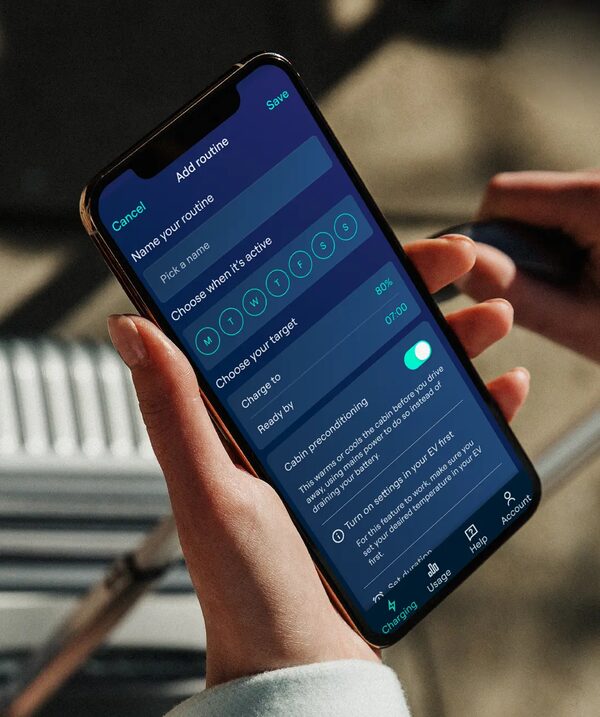
Smart is no longer a category; it is the baseline. All new chargers need to be smart, able to be set to charge when demand on the grid is lower or more renewable electricity is available1. In practice that means a scheduler, a data connection, and an app. Many modern chargers come with mobile apps that allow scheduling, status monitoring and an estimated cost per session23. Some units support several control methods, RFID cards as well as an app6. Chargers bought from a supplier are often tied to that supplier's own app: an E.ON Next charger gives access to the E.ON Home app, with control from scheduling to tracking energy use21.
Scheduling logic differs between makers, and the detail matters more than the marketing. On an Ohme charger with Dynamic charging enabled, a charging target can be set for the charger to meet during the off-peak hours; with Dynamic charging disabled, or the target set to 100% with a "ready by" time, the charger schedules as much charge as possible within the hours defined by the price cap. If it cannot deliver the requested charge in the hours given, it adjusts the session to deliver the maximum possible in that window and notifies the user through the app. A Max Charge button overrides any other setting or schedule and delivers as much charge as possible until the vehicle is full or the charger is unplugged24.
The dependencies are real. Most EV tariffs require a smart meter as well as an EV charger25, and time-of-use add-on tariffs need a compatible home charger and a working smart meter26. The app itself depends on the maker's servers and on connectivity: an Ohme charger can go offline because of a decrease in 4G connectivity in the area, because it has just completed a firmware update, or because its breaker has been turned off or tripped27. Account control is also constrained. Ohme supports only one account linked to a charger at a time, using the credentials used when first connecting, though the same email and password will sign in on multiple devices; where the account was created with Facebook, Google or Apple ID, the same social account must be used again. Customer care can disconnect a charger from an account on request, with proof of ownership documentation required for privacy reasons, after which a new account can be paired using a different email or sign-in method28.
Smart units also carry safety functions in the same package: built-in temperature monitoring and surge protection29. More on the regulatory side at the Smart Charge Points Regulations 2021 and on control and data at EV charger cybersecurity and data.
Solar-aware charging: when the charger talks to the panels
A solar-aware charger is a smart charger that takes a second input: a live reading of what the house is generating and exporting. Some chargers have special modes to charge the car only using the extra solar energy that the house is not using and would otherwise send back to the grid; smart chargers work with panels, and sometimes with the energy tariff, to charge the car at the cheapest time, usually when the panels are making the most power9. The features to look for in this class are solar diversion, which lets the charger prioritise solar power for EV charging and so reduce reliance on the grid, app control and dynamic scheduling30.
Compatibility is not universal and is not automatic. A solar system can be used to charge an EV with renewable energy, but the charger's compatibility with the panels has to be checked23. NICEIC notes the general benefit of charging from renewable generation31. The Cotswold-based trade guidance is blunter about the sequence: chargers should be installed by a qualified electrician with relevant experience, and compatibility between the charger, the solar system and any battery storage should be considered from the outset32. Some suppliers state all their chargers are solar compatible when set to the correct solar charging setting29.
Two caveats belong here. Surplus-only charging is slow by definition, because it is limited to what the array is exporting at that moment; a household chasing a full battery overnight will still be drawing from the grid. And a solar-aware unit is not a prerequisite for owning one: a myenergi zappi will draw power from the national grid like a conventional charger where there are no panels, and is described by the maker as future-proofed for solar added later33. A detailed treatment sits on charging an EV from solar panels and do I need a special EV charger to charge with solar.
What a home charger costs, installed
Published figures overlap but do not agree, partly because some quote the hardware and the labour together and some do not.
| Source and date | Figure | Scope |
|---|---|---|
| Planning Portal4 | £450 to around £1,200 | Installation, rising with power and capability |
| Which?, February 20261 | £500 to £1,200 | Buy and install |
| Which?, February 20261 | Around £900 | A 7 kW charger, bought and installed |
| Zapmap, June 20255 | £700 to £1,200 | 7 kW charge point, fully installed |
| Checkatrade via Uswitch, December 202535 | £1,000 average | Parts and labour |
| Elec-Mate, July 202636 | £800 to £1,500 | Electrical work only, excluding the unit |
| Fuse Energy, April 202610 | £1,000 to £1,350 | Fully installed 7 kW smart charger |
Two maker figures for a UK installation disagree, one giving £1,000 to £1,350 and another £800 to £1,600, and that conflict is unresolved; both are quoted as typical ranges for a fully installed 7 kW unit10. What drives the spread is set out consistently: cost varies with the charger model and output, the complexity of the installation and any electrical upgrades required33. A long cable run from the consumer unit, a supply that needs uprating, or a three-phase unit will all push a quote toward the top of these bands. 22 kW chargers are the most expensive, requiring a three-phase connection1.
Grant money moves the net figure. Uswitch reports landlords and flat tenants as eligible for a government grant of up to £350, reducing an installation cost to as low as £65035, while the current rate from 1 April 2026 is up to £500 towards the cost of installing a chargepoint for renters and flat owners7. Prices here are as published on the dates shown; a household's own figure is installer-quoted. See how much a home EV charge point costs, fitted.
Safety, weather and siting
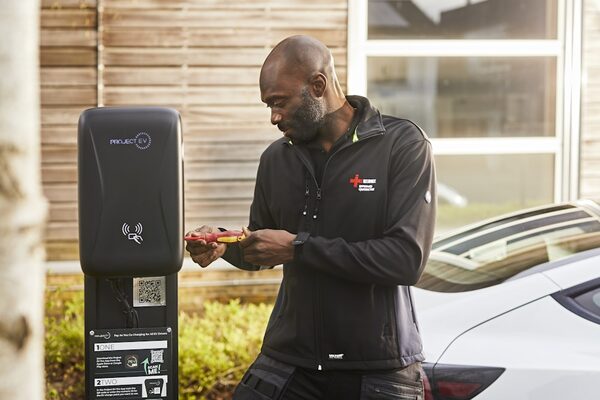
A domestic charge point is a permanently connected outdoor appliance on a dedicated circuit, and the rules around it are the main reason it is not a do-it-yourself job. It must be installed in line with the current edition of BS 7671, the national standard for electrical installations, and NICEIC's guidance is to use an electrician registered with a recognised certification body2. Installers need competence in the IET Code of Practice for Electric Vehicle Charging36. That Code places three duties on the installer: assess the adequacy of the supply capacity for the new EV load plus existing demand, assess the adequacy of the earthing, and notify the Distribution Network Operator once the charge point has been installed37.
Earthing is the specific technical point. Most local authorities specify that households install a dedicated EV charger with protective earth neutral (PEN) fault protection39, and makers build this in: Ohme chargers carry open-PEN earthing protection22. Surge protection is a related consideration. Ohme's reasoning is that EV chargers are high-value electrical devices, permanently connected to the home's electrical system, and may be exposed to outdoor conditions and grid fluctuations, and that in many cases including a surge protection device aligns with current wiring regulations and best practice40.
Weather is designed for rather than avoided. Charging in the rain is completely safe, because the hardware is designed to be used in dry and wet conditions33, and most commercial EV chargers are rated IP54 or IP65 as standard36. Independent certification exists to demonstrate the safety, security, quality and reliability of EV chargers41.
Where a household adds a second vehicle, a dual charger is a self-contained unit, and expanding to a third or fourth EV may be better served by adding another charge point than by replacing the existing one23. Further detail sits at EV charge point safety, standards and certification and electrical requirements for a home EV charge point.
Planning permission: usually not needed, with clear exceptions
Installing a home charger is classified as development, so it falls to the householder to ensure the correct permissions are in place45. In most cases that is a formality. Where a home has off-street parking, the installation of a domestic charger is likely to fall under permitted development with no planning application required, provided it meets the criteria46. A wall-mounted outlet does not need permission provided the outlet and its casing will not exceed 0.2 cubic metres and it is not located on scheduled ancient monument land47.
Permission is usually required for:
- on-street parking45
- conservation areas45
- listed buildings45
- areas where installation is restricted through article 4 directions45
- more than one upstand per parking space45
NICEIC states the same position, noting exceptions for listed buildings, conservation areas and cross-pavement solutions2. Flats add a layer: a standard wall-mounted charger is generally classed as permitted development and most homeowners need no permission, but listed buildings, conservation areas or flats may require additional consent from the local council, landlord or freeholder48. Permitted development rights are a devolved matter, so the detail differs between England, Scotland, Wales and Northern Ireland; planning permission for a home EV charge point across the UK covers the nations separately, and can I install an EV charger in a conservation area deals with that case.
The OZEV chargepoint grants and the March 2027 deadline

The grant landscape changed on 1 April 2026. Three schemes closed for applications on 31 March 2026, and five grant schemes have been extended until 31 March 2027 with new grant rates8. Those five chargepoint grant schemes are available until 31 March 202749. From 1 April 2026, the grant for renters and flat owners provides up to £500 towards the cost of installing an EV charge point at a property7, and that scheme has been extended for a year until 31 March 20277. The landlord grant closes at 31 March 2027, 11:59pm51, and the renters and flat owners grant carries the same closing time52.
Eligibility carries conditions beyond the property type. Applicants who are moving house or planning on moving are listed as ineligible for the renters and flat owners grant, and where a vehicle lease is bundled with a chargepoint, applicants are told to make sure the chargepoint warranty meets the grant requirements53. The grant schemes are set out individually on the Electric Vehicle Chargepoint Grant for renters and flat owners, the EV Chargepoint Grant for residential landlords and the cross-pavement charging grant.
What a home charger does, and does not do, for energy independence
A charge point is not a generator. Left to itself, a wallbox is a grid appliance: a zappi draws power from the national grid much like a conventional charger where no solar is present33. What a domestic charger buys a household is control over timing and price, not over supply. Independent modelling puts the value of an EV charger on a time-of-use tariff at £680 a year in annual saving, with EV ownership required54. That saving comes from moving consumption, which means it depends on a supplier's tariff continuing to offer a cheap window, and on a working smart meter25.
The dependencies stack up honestly. The grid supplies the energy. A supplier sets the off-peak window. The charger's scheduler usually runs through the maker's cloud and app, with the account restrictions and connectivity failure modes described above27. And the physical supply is a constraint: a charger can push a home's electricity demand above the available supply, which may require an upgrade20, and a voltage fault may require the charger to be switched off and on at the isolator55.
Solar changes the balance but does not remove it. Surplus diversion genuinely reduces reliance on the grid for the hours the array is producing30, and pairing a charger with panels and storage from the outset is the route to the largest share of self-supplied miles32. Even then, the car is charged from the house rather than the house from the car, unless a bidirectional unit is fitted, which is a separate class covered on vehicle-to-grid and vehicle-to-home charging. The broader account is on EV charging and household energy independence, and the full topic map on EV charging at home.
Sources55 cited
- Electric car charging at home, Which?, 2026-02-25
- EV charger installation and maintenance for householders, NICEIC, 2025-08
- EV connector types, Zapmap, 2026-05-20
- Electric vehicle chargers, Planning Portal, 2026
- Home charging guide, Zapmap, 2025-06-19
- EV Charger product page, Haier HVAC, 2026-09-17
- OZEV grant 2026, Ohme, 2026
- Changes to electric vehicle chargepoint grant schemes from 1 April 2026, GOV.UK, 2026-07-07
- EV chargers for solar panel charging, E.ON Next, 2026-09-17
- Tethered vs untethered EV charger, Fuse Energy, 2026-04-26
- Difference between tethered and untethered chargers, myenergi, 2026-04-10
- Tethered vs untethered, Zapmap, 2026-02-23
- Destination charging, Zap-Map, 2026-02-26
- Electric vehicle charging, SMMT, 2025-06-25
- EV charging guide, Uswitch, 2026-09-19
- EmonEVSE overview, OpenEnergyMonitor, 2026-09-17
- Destination charging guide, Zapmap, 2026-02-26
- Public chargers, E.ON Next, 2026-09-19
- Explore advanced settings, Ohme, 2026-09-17
- If your electricity supply cannot cope with the new equipment, NIE Networks, 2026-09-19
- How to choose the right EV charger, E.ON Next, 2026-09-17
- Ohme chargers, Ohme, 2026-05-21
- Dual EV chargers, E.ON Next, 2026-09-17
- How can I charge at my off-peak times, Ohme, 2026-09-17
- How to choose the best energy company, Which?, 2026-01-19
- EV energy tariffs, Zapmap, 2024-09-16
- My charger is offline, Ohme, 2026-02-02
- Troubleshooting signing into the Ohme app, Ohme, 2025-12-10
- Upgrading to a smart EV charger, OVO Energy, 2025-09-01
- Integrating solar panels with EV charging, Uswitch, 2025-07-02
- Everything you need to know about EV charging points, NICEIC, 2024-09-27
- Can solar panels charge electric cars, The CPA, 2026-04-15
- Electric car charging at home, myenergi, 2026-09-17
- Home charging, Zap-Map, 2025-06-19
- EV charging statistics, Uswitch, 2025-12-15
- Section 722 EV charging complete guide, Elec-Mate, 2026-07-02
- Single EV connections, Electricity North West, 2026-09-20
- FAQs about connecting to the networks, Energy Networks Association, 2026-09-17
- Cross-pavement charging solutions, Energy Saving Trust, 2025-07-18
- What is a surge protection device, Ohme, 2026-03-20
- BSI Kitemark certification for EV charging, BSI Group, 2026-09-17
- Product safety report: ROMADA New Energy charging pile, GOV.UK, 2026-09-15
- EV charging cable SEVA-24016P recall, Electrical Safety First, 2026-09-17
- WAI EVCUK216WC charging cable recall, Electrical Safety First, 2026-09-17
- Planning permission for electric vehicle charging, Planning Portal, 2026
- Electric vehicle charging: smart search, Planning Portal, 2026
- Permitted development for retrofit and energy efficiency, Cotswold District Council, 2026-09-17
- EV charger installation in Salford, Fuse Energy, 2026-08-28
- Government grants for low emission vehicles, GOV.UK, 2026-04-01
- Electric vehicle chargepoint grants, GOV.UK, 2026-04-01
- EV chargepoint and infrastructure grants for landlords, Find a Grant, 2026-09-18
- Funding schemes, OFTEC, 2026-09-20
- Electric vehicle chargepoint grant: eligibility, GOV.UK, 2026-09-17
- Clean heat: supporting low income households, Energy UK, 2026-06-11
- Voltage changes in your home or business, UK Power Networks, 2026-09-17
 Home EV Charger ManufacturersWhich home EV charger brands are worth considering, and how do you choose between them?
 Charging by Home TypeHow the practical and legal position for home EV charging changes by property type: flats and leasehold consent, terraced homes without frontage, shared car parks and metering, rural properties with long cable runs, and listed or conservation area homes.
 Charging With a Home BatteryHow a home battery and an EV charger share one supply, whether a battery can usefully charge a car, and how combined systems are controlled so the battery is not discharged into the vehicle at a loss.
 Charging and Energy IndependenceCharging an electric car at home can cut your fuel costs, but how much does it really free you from the grid?
 AC-Coupled vs DC-CoupledCan you add a battery to your existing solar panels without swapping the inverter, and does one kind waste more of your solar power than the other?
 EV Charging Speeds and TimesHow long an electric car takes to charge depends on the charger and the car together, so a faster charge point will not always speed things up.