
In this answer
Short answer
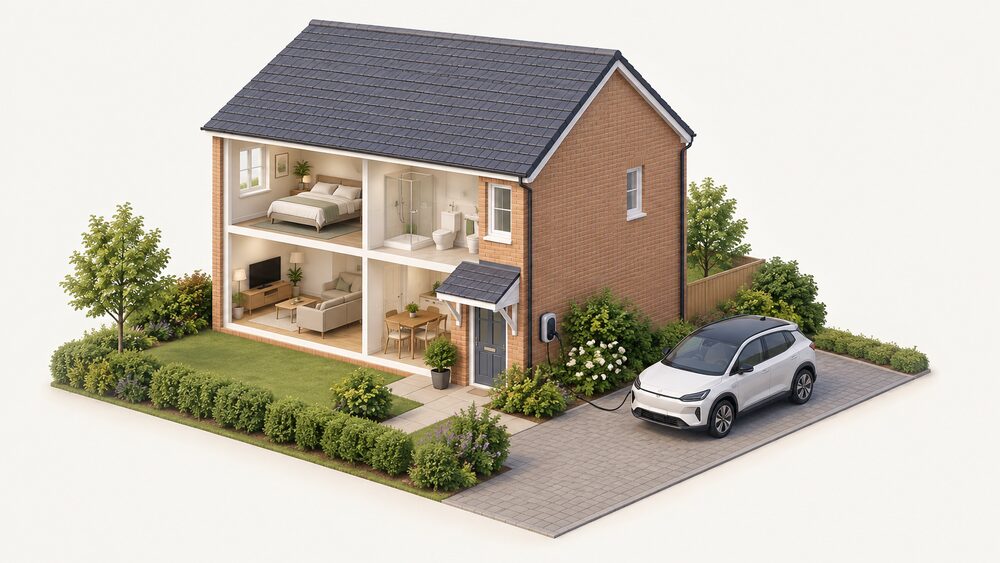
A conservation area changes the answer to the charger question, but it does not close it off. Planning guidance lists conservation areas among the cases where permission is usually required, alongside on-street parking, listed buildings, areas restricted through article 4 directions and more than one upstand per parking space1. A home with off-street parking normally falls under permitted development instead, so the same charger on the same street can sit on either side of the line depending on where the car is parked3.
The practical route for a protected home is to design the installation so it barely registers: around the side of the house, on a porch, or screened with planting, which is the approach planning guidance itself describes for minimising impact on the visual context of the local area1. Where there is no driveway, a cross-pavement channel such as Kerbo Charge, which holds a Section 178 licence for installation on the public highway, allows charging from the house to a car at the kerb5.
Money is available for some of these homes. The Electric vehicle chargepoint grant is open to renters and flat owners, and the rate rose to up to £500 from April 2026 under schemes running to 31 March 20276. Home charging carries 5% VAT, against 20% at public chargepoints9.
Conservation areas, listed buildings and the permitted development line
Permitted development is the default for a domestic charge point where the home has off-street parking, and the planning rules turn on whether the dwelling has off-street or on-street parking4. That single distinction decides most cases. A driveway or garage keeps the installation inside permitted development; a car kept at the kerb moves it into the territory where permission is usually required1.
The exceptions are listed explicitly. Planning permission is usually required for on-street parking, conservation areas, listed buildings, areas where installation is restricted, and more than one upstand per parking space1. Article 4 directions, which remove permitted development rights in a defined area, sit in the same list, so a home that would otherwise qualify can still need consent because of a local direction1.
Where permission is needed, the application is judged on visual impact. Guidance advises that the development should minimise impact on the visual context of the local area, suggesting placement around the side of the house, on a porch, or disguising the charge point with bushes and plants1. That is the design brief for a conservation area: the equipment is acceptable, the visibility is the issue.
The Planning Portal sets the test in terms of visual impact, stating that development should minimise impact on the visual context of the local area.1
The Energy Saving Trust has argued in a consultation response on permitted development rights that the framework should be examined, which signals that the rules are not fixed14. For a household, the sequence is straightforward: establish whether the car is parked off-street or on-street, check for a conservation area designation or article 4 direction, and treat permission as likely if either applies1.
Renters and flat owners: what changed for the chargepoint grant
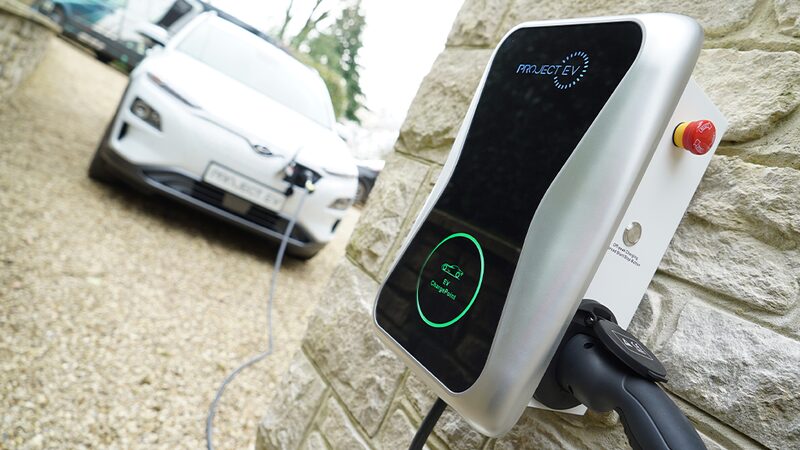
The grant for renters and flat owners funds support towards the costs of the purchase and installation of EV charge points, and it is available to flat owners and renters, with separate grants for landlords12. The eligibility wording is narrow on one point: the home must have its own private off-street parking space, and that space must be accessible at all times6.
That condition is what separates this grant from the on-street parking grant. A flat with a dedicated bay qualifies; a flat whose car sits on the road does not, and belongs in the on-street scheme instead6. The scheme rules also set out how changes are handled: the government aims to provide four weeks' notice if the grant ends or the grant amount changes, and claims made before any public announcement are honoured subject to the grant criteria12.
The application process changed on 31 March 2026. Applicants now apply themselves through the Find a Grant portal rather than through their installer, contacting an OZEV-authorised installer for a quote first, then selecting the Start new application button, creating an account and submitting property and vehicle details through the form provided. The Office for Zero Emission Vehicles introduced the grants, with the Energy Saving Trust delivering webinars on them17.
The £500 EV chargepoint grant: who qualifies and how to apply
The headline rate moved. Independent reporting states that instead of the previous £350 discount, eligible motorists now receive up to £500 towards installing a home charging point, under a scheme running from April 2026 to March 20277. Five chargepoint grant schemes are available until 31 March 2027 with new grant rates8. Older guidance still quotes up to £350 per socket for residential landlords, people living in flats and renters, so both figures circulate and the date matters18.
| Item | Position | Date |
|---|---|---|
| Grant rate from April 2026 | up to £500 | April 2026 to March 20277 |
| Earlier published rate | up to £350 per socket | 2026-04-2318 |
| Scheme availability | five schemes to 31 March 2027 | 2026-04-018 |
| On-street parking grant funding | confirmed to 31 March 2027 | 2026-09-1716 |
| Notice of change | four weeks, prior claims honoured | 2026-09-1812 |
The £350 figure also appears as £350 or 75% off the cost of installing an electric car charger, whichever is lower, for flats with dedicated off-street parking3. That formulation belongs to the earlier rate and to the flat-owner route specifically. The £500 rate is the newer position and applies across the eligible groups from April 20267.
Northern Ireland runs its own arrangements. The Electric vehicle chargepoint and infrastructure grants are administered there by the Department for Infrastructure rather than through the OZEV household schemes, so a household in Northern Ireland checks that route rather than the Find a Grant portal19. In Great Britain the grant is claimed through the portal, with the installer providing the quote and the householder submitting the application.

When 5% VAT applies to EV charging
Home charging sits at 5% VAT, and the figure is stated plainly by the Society of Motor Manufacturers and Traders: VAT on home charging is just 5%9. Independent statistics put charging at home at 5% VAT and public charging at the higher 20% rate10. The gap is the reason home charging is the cheaper habit where a household can do it, and the Energy Saving Trust notes that a dedicated chargepoint on a driveway or in a garage is the cheapest way to charge an EV18.
The public side of the argument has moved. A First-tier Tribunal ruling in February 2026, in a case brought by Charge My Street, found that public EV charging can qualify for the reduced 5% VAT rate where supply at a single location to an individual customer does not exceed 1,000kWh per month. That decision concerns public charging and does not alter the domestic rate, which was already 5%10.
For a conservation-area household the VAT position is the same as anywhere else: charging at home is charged at 5%, and the planning status of the charger does not affect it9. Where a home cannot charge at home and relies on the public network, the 20% rate applies to that energy, which is the cost penalty the tribunal case sought to address10.
On-street parking: the Kerbo Charge route to home charging
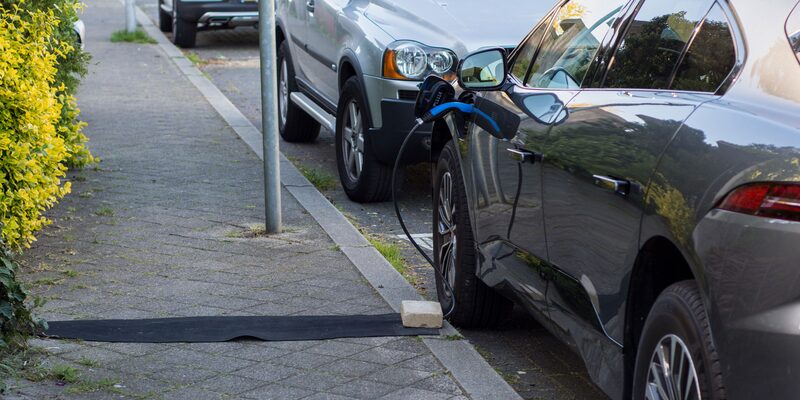
Where there is no driveway, the cable has to cross public pavement, and that is a separate permission from the charger itself. Kerbocharge holds a Section 178 licence, allowing installation on the public highway5. The householder is required to install a dedicated EV charger and provide an electrical safety certificate to verify it, so the channel is not a substitute for a compliant charge point but a route to one5.
The grant that fits this situation is the Electric Vehicle Chargepoint Grant for Households with On-Street Parking. The property must have access to on-street parking that is generally available outside or near the home, lawful and not prejudicing the safety and free flow of vehicular and pedestrian traffic, and funding is confirmed until 31 March 202716. That is a different test from the private off-street space required by the renters and flat owners grant6.
Public money also flows through the Local Electric Vehicle Infrastructure fund, which targets residents who do not have off-street parking and need to charge their electric vehicles in England20. The fund supports public chargepoints rather than private ones, so it improves the local network rather than the household's own installation20.
"Kerbocharge has a Section 178 licence, allowing installation on the public highway."
For a conservation area, the cross-pavement route carries its own planning weight: on-street parking is one of the cases where permission is usually required, so a household pursuing a channel should expect the application to cover both the channel and the charge point1.
Avoiding a service upgrade with load management
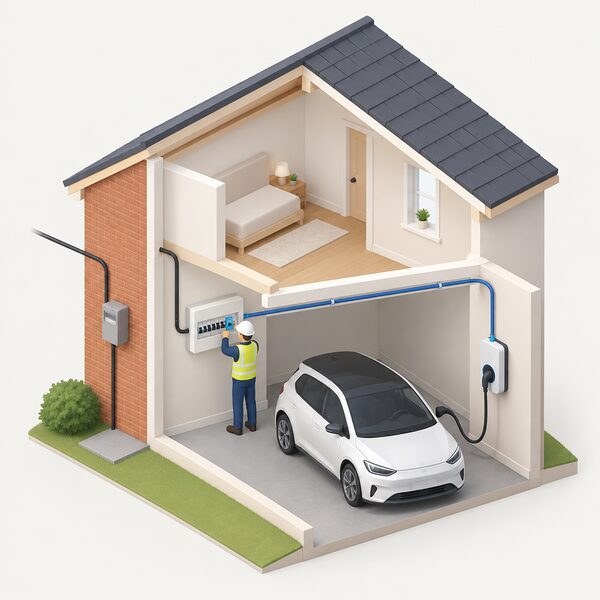
A charger draws a substantial load, and the question for many older homes is whether the existing supply can carry it. Load management is the answer to that: built-in systems such as Schneider Charge with SmartAmp let electricians complete installations within a home's available electrical capacity, which is the point of the approach21. The charger works within the capacity the house already has rather than demanding a supply upgrade first.
The electrical detail matters. Each charger needs a separate MCB or RCBO at the distribution board, with no other loads sharing it, and an EV charger is treated as an other use category for voltage drop calculation, where 5% applies22. That is a wiring requirement, not a planning one, and it applies in a conservation area exactly as elsewhere22.
Voltage behaviour is the limit to understand. If the voltage goes outside the charger's operating range, the charger stops working and shows an error, a safety feature protecting both charger and vehicle23. Recovery is usually simple: switching the charger off and on at the isolator switch restores it24. Network operators publish guidance on voltage changes in the property, which is the reference point when a charger trips repeatedly23.
Load management does not remove the need to tell the network operator about a new charge point, and it does not settle the question of a maximum power rating. A consultation response on permitted development rights argued that setting a maximum power rating for EV chargepoints should be avoided, preferring negotiation between the local authority, their charge point operator, their distribution network operator and the local community14. For a household, the practical effect is that load management widens the range of homes where a charger can be installed without a service upgrade, while the notification and wiring requirements remain21.
Paying for a charger in instalments
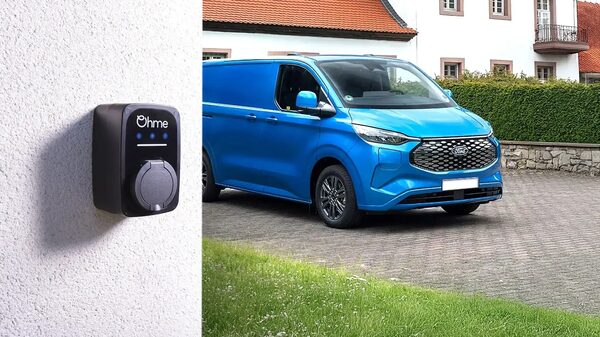
Instalment payment is a commercial option rather than a grant. Ohme announced in May 2026 that customers can pay for an EV charger in instalments through PayPal26. Pod Point has offered subscription arrangements with no upfront fee through partner schemes, including a £100 discount on a home charger outright for Jurni Group customers and a subscription route with no upfront fee27.
These arrangements sit with the individual maker and its partners, and the terms are theirs. They are separate from the government grants, which are paid as a contribution towards purchase and installation rather than as credit7. A household weighing the two can treat the grant as a reduction in capital cost and the instalment plan as a financing choice, and the two can apply to the same installation where the grant criteria are met7.
For a conservation area, none of this changes the planning position, but it does affect the total outlay. The grant reduces the cost of the hardware and installation, the 5% VAT applies to the electricity used at home, and an instalment plan spreads whatever remains7. Where a home is in a listed building or a conservation area and permission is required, the application cost and any design changes sit outside all of these1.

What the rules mean for a household's independence
A charger in a conservation area does more for a household's energy independence than the planning paperwork suggests. Charging at home at 5% VAT, from a dedicated chargepoint, is the cheapest way to charge an EV, and it removes the reliance on the public network and its 20% rate for the energy used18. The grant reduces the capital cost of getting there, at up to £500 under the schemes running to 31 March 20277.
The dependence that remains is real. The charger still draws from the grid, and the household still buys electricity from a supplier. Load management keeps the installation within the existing supply rather than removing the connection, and the network operator still needs to be told about the charge point21. Where the car is parked on the street, the cross-pavement channel depends on a Section 178 licence and on the local highway authority's consent, so the route to home charging runs through a public permission rather than around it5.
For flats and rentals, the grant is tied to a private off-street space accessible at all times, which many flats do not have6. Those households fall back on the on-street grant or the public network, and the Local Electric Vehicle Infrastructure fund improves the local option rather than the private one16. The honest position is that a conservation-area home with a driveway can reach a largely self-contained charging routine, while a conservation-area home without one depends on permissions, a channel and the public network for part of its charging1.
Sources27 cited
- Planning permission for electric vehicle charging, Planning Portal, 2026
- Electric vehicle charging: smart search, Planning Portal, 2026
- Electric vehicle charger installation and maintenance, NICEIC, 2025-08
- Electric vehicle charging: permitted development, Planning Portal, 2026
- Cross-pavement charging solutions, Energy Saving Trust, 2025-07-18
- Electric vehicle chargepoint grant: eligibility, GOV.UK, 2026-09-17
- Electric car charger grants rise to £500, Carwow, 2026
- Government grants for low emission vehicles, GOV.UK, 2026-04-01
- EVs: the facts, SMMT, 2025-09-22
- EV charging VAT, Zapmap, 2026-08-24
- EV charging VAT, Zapmap, 2026-08-24
- Electric Vehicle Chargepoint Grant for Renters and Flat Owners, Find Government Grants, 2026-09-18
- Do I need planning permission, Cornwall Council, 2026-09-09
- Various permitted development rights consultation response, Energy Saving Trust, 2025-10-08
- Funding schemes, OFTEC, 2026-09-20
- Electric Vehicle Chargepoint Grant for Households with On-Street Parking, Find Government Grants, 2026-09-17
- Residential landowners electric vehicle chargepoint scheme, Energy Saving Trust, 2025-09-22
- Charging electric vehicles, Energy Saving Trust, 2026-04-23
- Electric vehicle chargepoint and infrastructure grants, Department for Infrastructure, 2026-09-17
- Local Electric Vehicle Infrastructure scheme, Energy Saving Trust, 2026-09-08
- Electric vehicles for home charging, Electricity North West, 2026-09-04
- Section 722 EV charging complete guide, Elec-Mate, 2026-07-02
- Managing voltage changes in your property, Electricity North West, 2026-09-19
- Voltage changes in your home or business, UK Power Networks, 2026-09-17
- Product safety report: Easee One EV charger backplate, GOV.UK, 2026-05-06
- Ohme EV charger instalments, Ohme, 2026-05-12
- Pod Point electric car news, Pod Point, 2026-09
 Planning Permission for ChargersDo you need planning permission for a home EV charger, and does it change if you live in a listed building, a conservation area or a flat?
 Home Charger InstallationWho can fit a home EV charger, and does it need building regulations approval?
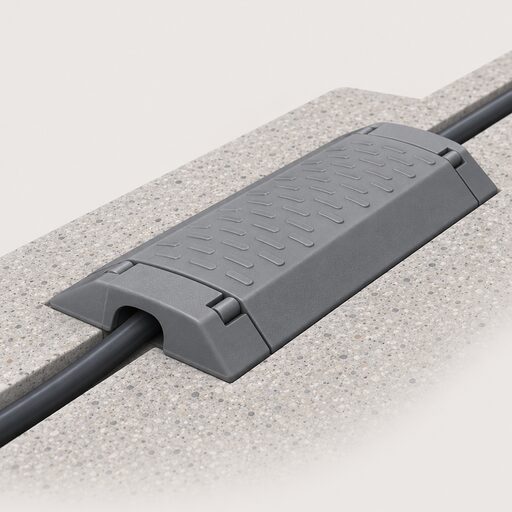 Charging Without a DrivewayParking on the street makes charging an electric car at home tricky.
 Electrical RequirementsWill your home need a bigger electricity supply before a charge point can go in?
 Charging by Home TypeHow the practical and legal position for home EV charging changes by property type: flats and leasehold consent, terraced homes without frontage, shared car parks and metering, rural properties with long cable runs, and listed or conservation area homes.
 Planning Permission in EnglandWhen a domestic battery or its enclosure falls within permitted development in England, when an application is needed, and how the position differs for outbuildings, listed buildings and conservation areas.