In this guide
A home EV charge point is fitted by a qualified, registered electrician, not by the householder. Industry and regulator-facing guidance is consistent: the work should always be done by a qualified and certified electrician1, installed in line with the current edition of BS 7671, the national standard for electrical installations2, and by someone with competence in the IET Code of Practice for Electric Vehicle Charging3. Building regulations approval is always required when installing an EV home charger4, whatever the planning position of the property.
The typical bill sits in a narrow band. One independent guide puts a typical domestic installation at £800 to £1,500 for the electrical work, excluding the charger unit3; Energy Saving Trust gives around £800 to £1,200 for a home charge point5; Which? reports £500 to £1,200 to buy and install, with 7kW units around £9006. Grants of up to £500 remain available to renters and flat owners through the Office for Zero Emission Vehicles route7, and separate grants exist for residential landlords and for households with on-street parking.
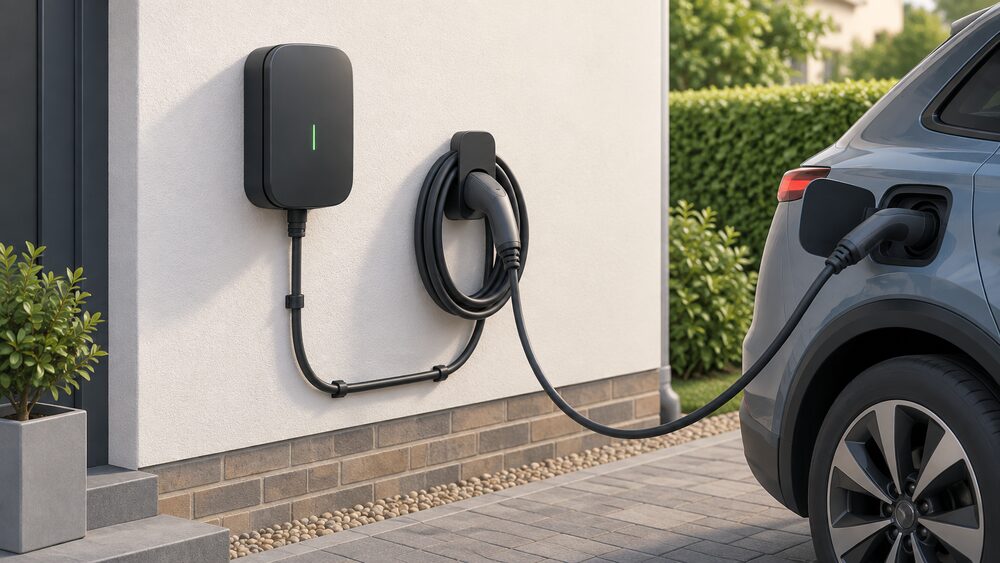
The sequence is: survey (often remote, from photographs), a check on supply capacity and earthing, an application to or notification of the Distribution Network Operator, the physical install of a couple of hours1, commissioning and connection to Wi-Fi, then the certificates. Almost all of the independence gain is real: a driveway charge point is the cheapest way to charge an EV8. What remains is dependence on the grid connection, on a network operator's consent to the load, on a supplier's tariff for cheap overnight rates, and on the charger maker's cloud for smart functions.
Who may install a home charge point
There is no route by which a householder self-fits a hardwired charge point and ends up with compliant, certified work. NICEIC's guidance is to hire an electrician registered with a recognised certification body2. Energy Networks Association guidance is to look for installers holding certifications from government-approved registering bodies, as a guarantee of competence11. Guidance aimed at homes combining a charger with solar adds that EV chargers should be installed by a qualified electrician with relevant experience, with compatibility between the charger, solar system and any battery storage considered from the outset12.
The technical competence expected is specific rather than general. Beyond BS 7671 itself, an installer needs competence in the IET Code of Practice for Electric Vehicle Charging3, which sets out the pre-installation duties: assess the adequacy of the supply capacity for the new EV load plus existing load, assess the adequacy of the earthing, and notify the network operator once the charge point is installed13. Most domestic installations are Mode 3, meaning a dedicated wall-mounted or post-mounted charger with a control pilot3.
A standard 3-pin socket is not an equivalent. Slow charging at home can be carried out from one, but a dedicated unit is strongly recommended for regular charging because of the higher current demands14, and a dedicated EV charge point over a standard household socket at 13A is recommended for faster speeds11. The difference between a 3-pin lead and a wallbox is one of sustained load, not just speed. For the case against DIY specifically, see installing a charger yourself.
Certification bodies and how to check a registration
NICEIC describes itself as the UK's largest certification body for electrical businesses, operating for almost 70 years and assessing electricians, plumbers, renewable energy installers, and gas and heating engineers15. Registration is not a one-off badge: a registered business is assessed annually by an experienced NICEIC assessor to ensure it meets stringent quality and technical requirements16. NICEIC's own find-a-contractor process returns only businesses that are NICEIC-registered17, and its householder guidance is to check that the certified contractor is registered with a government-approved competent person scheme18.
The practical consequence of scheme registration is self-certification. Electricians registered on a competent person scheme are deemed competent to self-certify their own work, saving householders time and money2 by removing the need for a separate local authority building control submission19. That certification pathway is why the choice of installer determines the paperwork route as much as the workmanship.
Verification runs in two directions:
- Before the work: confirm the business appears on the scheme's register, and that the scheme is government-approved18.
- After the work: in England and Wales, domestic electrical installation work notified by a NICEIC electrical contractor to the Local Building Control Body is searchable online through checkmynotification.com18.
NICEIC is not the only competent person scheme; NAPIT also publishes consumer guidance on what certificate should follow electrical work20. Charge point hardware itself can carry separate product certification, with testing and certification available for charge points for both home and commercial use21. Product certification and installer registration are different things, and a certified product does not make an uncertified installation compliant. Further detail sits on charge point safety, standards and certification.
The process from survey to certification
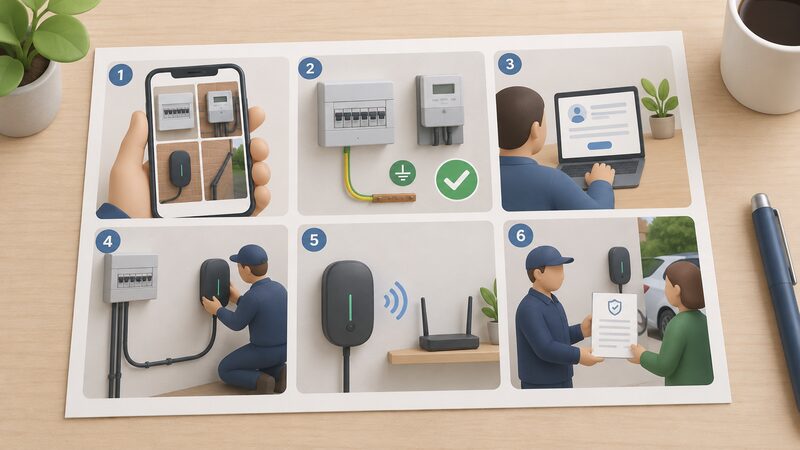
- Survey. Most installers begin remotely, with photographs of the consumer unit, the meter position, the intended charger location and the cable route. Suppliers offering a fixed-price package state that prices given include a standard installation, and that a survey may show more work is needed, which would be quoted at additional cost22.
- Supply and earthing assessment. The installer assesses the adequacy of the supply capacity for the new load plus existing demand, and the adequacy of the earthing, before installing the equipment23.
- Network operator step. Depending on the assessed maximum demand, this is either an application and wait for permission, or installation followed by retrospective notification24.
- Installation. Mounting the unit, running the dedicated circuit and protective devices, and routing the cable. This should only take a couple of hours or so, depending on charger type and location1.
- Commissioning and connection. The installer connects the charger to the home Wi-Fi network so it can access software updates and report energy usage25.
- Certification and notification. The BS 7671 certificate is handed over, and the work is notified to building control by the competent person route.
Where an upgrade to the incoming supply is needed, the network operator cannot quote a fixed timescale online, because price and timeframes are determined by the specific work required26. That is the main reason two households on the same street can wait very different lengths of time.
Cost: £800 to £1,500, and what moves it
The figures across independent sources cluster but are not identical, and they measure slightly different things.
| Source and date | Figure | What it covers |
|---|---|---|
| Elec-Mate, 2026-07-02 | £800 to £1,500 | Electrical work only, excluding the charger unit3 |
| Which?, 2026-02-25 | £500 to £1,200 | Buying and installing a home charger6 |
| Which?, 2026-02-25 | around £900 | A 7kW charger, bought and installed6 |
| Energy Saving Trust, 2025-09-22 | around £800 to £1,200 | Installing a home charge point5 |
| Zapmap, 2025-06-19 | £700 to £1,200 | A 7kW charge point fully installed9 |
| uSwitch statistics, 2025-12-15 | £1,000 average | Parts and labour, reported by Checkatrade27 |
| Planning Portal, 2026 | £450 to around £1,200 | Installation costs rising with power and capability28 |
The spread is explained by scope rather than disagreement: the highest band excludes the hardware, the lowest includes a basic unit. Price rises with the power and capabilities of the equipment28. Beyond the unit, the cost drivers are cable run length from the consumer unit to the parking space, whether the existing board has a spare way and adequate protective bonding, whether groundworks or civil works are needed to reach a detached garage, and whether the network operator requires a service or fuse upgrade first. A fuller breakdown is on what a home charge point costs, fitted.
Grants: up to £500 for renters, flat owners and on-street parking
The open grants are targeted, not universal. The Electric Vehicle Chargepoint Grant for renters and flat owners provides up to £500 towards the cost of installing a chargepoint at the property7. Energy Saving Trust describes the scheme as offering up to £350 per socket for residential landlords, people living in flats and people who rent8, and NICEIC's guidance states flat owners and renters may be able to get £350 or 75% off the cost of installing a charger, whichever is lower2. These figures are published by different bodies at different dates and do not reconcile; the £500 figure is the more recent official statement of the renters and flat owners grant.
| Grant | Who applies | Key condition |
|---|---|---|
| Chargepoint grant for renters and flat owners | The occupier | Supporting evidence needed, such as a rental agreement if renting29 |
| Chargepoint grant for residential landlords | The landlord | Cannot apply if the landlord lives in the property30 |
| Chargepoint grant for households with on-street parking | The householder | An OZEV approved installer must complete the installation31 |
Common to all routes: an OZEV-authorised installer and an eligible residential chargepoint must be used30. For the landlords' scheme, each parking space must be off-street, private and clearly defined, accessible to the tenant, and owned by the applicant or one they have a legal right to30. Applications are refused where the property is not residential, where a chargepoint was already installed before OZEV confirmed eligibility, where the property is used only for holiday accommodation, where there is no company or VAT registration number, or where the installation is being made because of a mandatory requirement30.
Scheme-by-scheme detail sits on the chargepoint grant for renters and flat owners, the landlords' grant and the cross-pavement charging grant.
Planning permission and where a charger may go
Installing a home charger is classified as development, so it is up to the householder to ensure the correct permissions are in place32. For a home with off-street parking, it is likely the installation will fall under permitted development rights, provided the limits are met33. Permission is usually required for on-street parking, conservation areas, listed buildings, areas where installation is restricted through Article 4 directions, and more than one upstand per parking space32. Exceptions also extend to world heritage sites and other protected buildings and landscapes34.
The permitted development limits are dimensional:
| Condition | Limit |
|---|---|
| Wall-mounted outlet and its casing | Must not exceed 0.2 cubic metres35 |
| Upstand, residential | Must not exceed 1.6 metres in height35 |
| Upstand, non-residential | Must not exceed 2.7 metres in height35 |
| Within an AONB | As above, and not on scheduled ancient monument land35 |
Two further triggers catch householders out. Planning permission is required if there is no off-street parking, and if the charger is installed less than two metres from the highway36. Permitted development rights do not extend to on-street parking, and an application is required in those circumstances28. For a pavement cable crossing, permission from the Highways Authority is required, and separate planning permission may be needed unless the crossing is owned by the Highways Authority, because such crossings sit outside the curtilage of the building and are unlikely to be covered by the householder permission for the charge point37.
Planning is devolved, and the rules quoted above are those published for England. Local authorities apply them, and councils state that the rules for installing charge points depend on whether the dwelling has off-street or on-street parking38. In Scotland, policy proposals require all dwellings with a parking space in new residential buildings to have at least one EV charge point socket with a minimum 7kW output power rating, and the same 7kW minimum applies to residential parking spaces in buildings undergoing major renovation, limited by post-renovation electrical capacity39. In England, requirements extend to all new-build homes having EV charge points installed4. See planning permission for a home charge point across the UK and charge point requirements for new build homes.
Whatever the planning answer, building regulations approval is required in all cases, achieved either through a competent person or through the local building control body28.
Electrical requirements: a dedicated circuit, capacity and earthing
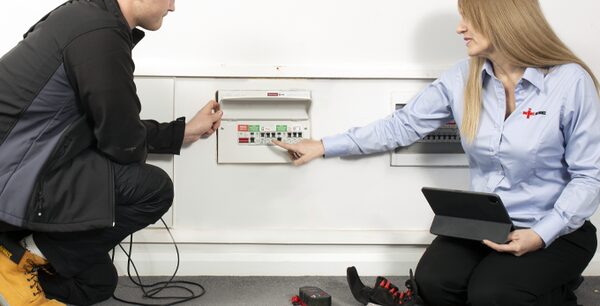
A charge point is a sustained, high-current load on a dedicated circuit, and the two questions an installer must settle before quoting are whether the supply can carry it and whether the earthing arrangement is suitable. Most local authorities specify that households install a dedicated EV charger with protective earth neutral (PEN) fault protection36. The IET Code of Practice duties are to assess the adequacy of the supply capacity for the new consumption plus existing demand, assess the adequacy of the earthing, and notify the DNO once the charge point is installed23.
Capacity thresholds decide the route. IET guidance states that where the maximum demand of the whole customer connection exceeds 13.8 kVA, the DNO must be contacted prior to connection10. Network operators express the same test in amps: under SSEN's Connect and Notify route, where the total demand of the property is 60 amps or less and there are no safety concerns, the installer does not need to apply in advance; where demand exceeds 60 amps or the property does not qualify, a Load Check applies, and the installer must apply and wait for permission before installing40. If the assessment shows the supply requires an upgrade, that upgrade must be completed before the charger is installed40.
Looped supplies are the most common physical obstruction. NIE Networks states that installing a home EV charger typically requires a fuse upgrade to 80 to 100 amps, which often cannot be done on a looped supply without overloading the shared cable41, and that homes sharing a looped cable with a neighbour need their own dedicated cable installed before the charger can go ahead42. Network operators recommend speaking to an electrician or installer first to check whether the wiring can support a charger43, and in the Electricity North West area the installer should contact the network before a charge point is installed44. Where a consumer unit needs replacing, that is work for an electrician or electrical contractor45.
More detail sits on electrical requirements for a home charge point and on load management and load balancing, which can sometimes avoid a supply upgrade.
Telling the network operator: who does it and when
Every time an installer or customer installs an EV charge point at an existing property, they must inform their network operator24. In practice the installer does it: network operators state plainly that only installers can notify on behalf of customers26, though anyone competent to install a charge point can submit the form, including an installer acting for the customer24.
Timing depends on the assessment made before the work:
- Retrospective notification. Where the installer assesses the addition as within the existing rating of the supply equipment and maximum demand is 60 amps or less, it can be installed and the network operator notified retrospectively within 28 days24. The IET Code of Practice requires notification within one calendar month of the installation for dedicated EV charging equipment at any site24.
- Prior application. Where maximum demand exceeds the threshold, or a safety concern or supply upgrade is identified, qualified installers need to obtain approval from the DNO before the work46, and installers or local authorities must apply before installing new EV charging equipment43.
Compliance is imperfect. Electrical Safety First reports that approximately a third of home EV charge point installations are not notified with the DNO47. An unnotified charger leaves the network operator without a record of the load on that part of the network, which matters for the local cable and transformer as more households electrify. This is treated at length on telling the network operator about a home EV charger.
Smart chargers, Wi-Fi and the data connection
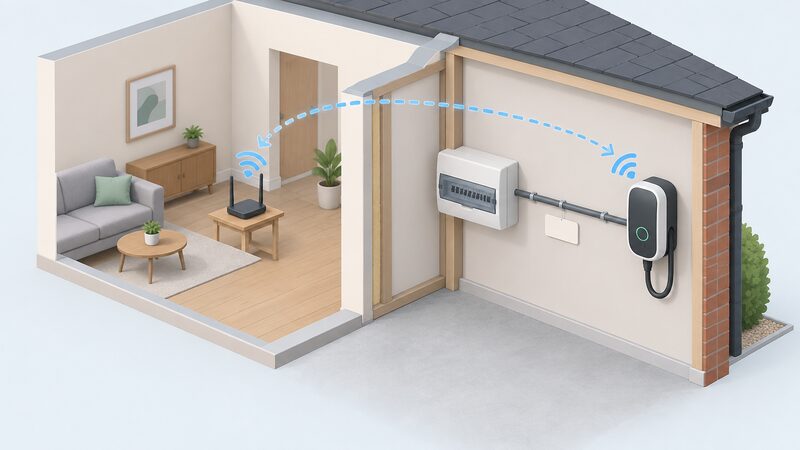
Modern domestic units are smart chargers, and connectivity is part of the install rather than an optional extra. The installer connects the charger to the home Wi-Fi network so it can access software updates and report energy usage25. At least one supplier makes a Wi-Fi connection at home an eligibility condition for its installation service, alongside owning the property and having off-street parking22. No signal-strength figure is published; the practical test is whether the network reaches the parking space, which for a detached garage or a long driveway often means it does not without an extender.
The dependence this creates is worth stating plainly. A smart charger's tariff scheduling, remote start and firmware updates run through the maker's platform, and an EV tariff generally requires a smart meter that works alongside the home charge point48. That places three parties between the household and its cheapest charging: the energy supplier, the network, and the charger manufacturer's cloud service. The physical charging still works when connectivity drops, but the cost optimisation does not. See what a smart EV charger is and how it works, charger apps, Wi-Fi, 4G and firmware and charger cybersecurity, data and remote control.
Where solar is present, compatibility between the charger, solar system and any battery storage should be considered from the outset12 rather than retrofitted; charging an EV from solar panels covers the pairing.
Standard installation and what counts as extra
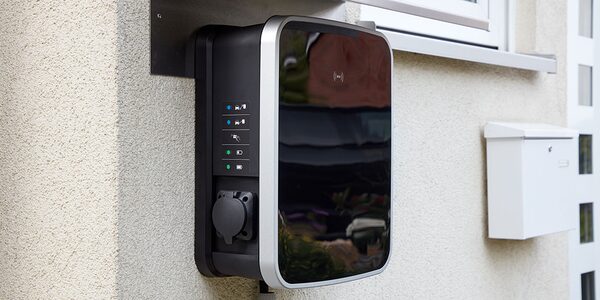
A fixed price is a price for a defined scope. One supplier's standard installation requires that existing electrical connections and protections within the home are in good condition, that all required main protective bonding is installed and adequately sized before installation, and that no groundworks, civil works, electrical remedial works or other trades are needed22. Anything the survey identifies beyond that is quoted at additional cost22.
Typically included in a standard installation:
- Mounting the unit on an external or garage wall within a stated cable distance of the consumer unit
- The dedicated circuit, its protective devices and PEN fault protection arrangement36
- Commissioning, Wi-Fi connection and app pairing25
- Network operator notification by the installer26
- BS 7671 certification and building regulations notification20
Commonly extra:
- Supply or fuse upgrades, and the dedicated cable required where the property is on a looped service41
- Consumer unit replacement or bonding upgrades45
- Trenching, ducting or other groundworks to reach a detached garage or a far parking space
- Pavement crossing works, which also need Highways Authority permission and may need planning permission37
Certificates and handover paperwork
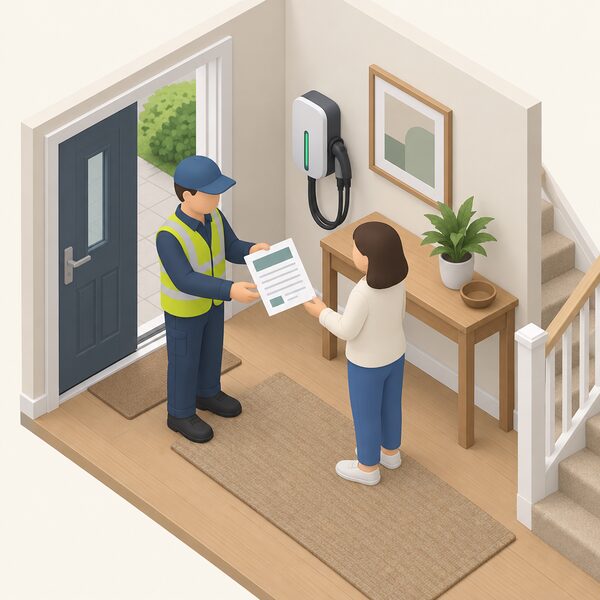
Two documents matter. The first is the BS 7671 certificate, which should be provided directly by the installer after the work is completed, entitled either an Electrical Installation Certificate (EIC) or a Minor Electrical Installation Works Certificate (MEIWC)20. Welsh Government guidance puts the purpose plainly:
"The competent person should also provide you with a completed Electrical Installation Certificate which shows that the work was tested for safety."
The second is the building regulations compliance certificate, proving the work complies with building regulations4. Where the electrician is on a competent person scheme, this follows from the self-certification route rather than from a separate application. NICEIC states that a completed certificate would generally be expected shortly after the electrician finishes the job15, and in England and Wales the notification itself can be checked online18.
These certificates are the household's only durable evidence that the circuit was designed, installed and tested correctly. They matter at resale, for insurance, and for any later warranty claim on the unit, which is covered on charge point warranties and aftercare.
What the installation does, and does not, do for independence
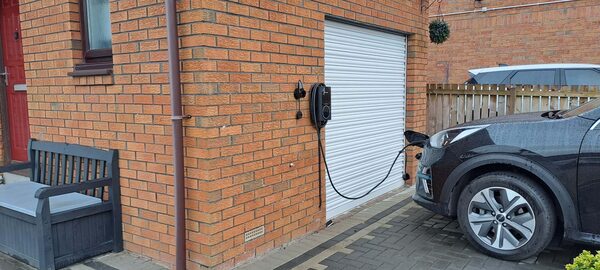
A driveway charge point is the cheapest way to charge an EV8, and it moves a household's fuelling from a forecourt and an oil supply chain onto its own meter, where it can be shifted to off-peak hours or, with a solar-aware unit, onto its own generation. That is a genuine and substantial gain, and it is the foundation of EV charging and household energy independence.
The dependencies that remain are structural rather than incidental. The installation is only permitted at the level the network can carry, so the DNO holds an effective veto on the power rating through the Load Check process40. Households on looped supplies cannot proceed without new network cable42. The cheapest tariffs require a smart meter and a compatible charger48. And unless the home has generation and storage, every kilowatt-hour still comes through the same grid connection as before, at the supplier's price. Independence here is a matter of control over when and at what cost the electricity is drawn, not of severing the connection. For households without a driveway at all, the routes are narrower and are set out on charging an EV without a driveway and EV charging by home type.
Sources49 cited
- EV charging guide, uSwitch, 2026-09-19
- Electric vehicle charger installation and maintenance, NICEIC, 2025-08
- Section 722 EV charging complete guide, Elec-Mate, 2026-07-02
- EV charging: building regulations, Planning Portal, 2026-09-17
- Electric vehicles: debunking myths, Energy Saving Trust, 2025-09-22
- Electric car charging at home, Which?, 2026-02-25
- Electric vehicle chargepoint grants, GOV.UK, 2025-04-08
- Charging electric vehicles, Energy Saving Trust, 2026-04-23
- Home charging guide, Zapmap, 2025-06-19
- Electric vehicle charging installations FAQs, IET, 2026-09-17
- Low carbon technology strategy, Energy Networks Association, 2026-09-17
- Can solar panels charge electric cars, CPA, 2026-04-15
- Single EV connections, Electricity North West, 2026-09-20
- EV buying guide, Zapmap, 2024-12-06
- Householders and landlords help hub, NICEIC, 2026-09-17
- Everything you need to know about choosing an electrician, NICEIC, 2025-11-21
- How to check if an electrician is NICEIC registered, NICEIC, 2026-06-19
- How to work with your tradesperson, NICEIC, 2026-09-17
- Wiring a shed: a guide for homeowners, NICEIC, 2026-09-17
- Consumer advice on electrical certificates, NAPIT, 2026-09-17
- EV charging Kitemark certification, BSI, 2026-09-17
- EV charger installation questions, OVO Energy, 2026-09-17
- EVs and heat pumps FAQs, NIE Networks, 2026-09-19
- Frequently asked questions about connecting to the networks, Energy Networks Association, 2026-09-17
- EV charger home installation process, uSwitch, 2022-02-03
- Electric vehicles: cost, time and what's involved, UK Power Networks, 2026-09-17
- EV charging statistics, uSwitch, 2025-12-15
- Electric vehicle chargers, Planning Portal, 2026
- Electric vehicle chargepoint grant: eligibility, GOV.UK, 2026-09-17
- EV chargepoint and infrastructure grants for landlords, Find Government Grants, 2026-09-18
- EV chargepoint grant for households with on-street parking, Find Government Grants, 2026-09-17
- EV charging: planning permission, Planning Portal, 2026
- Electric vehicle charging smart search, Planning Portal, 2026
- EV charger regulations in England: what's changed, NICEIC, 2026-08-19
- Permitted development for retrofit and energy efficiency, Cotswold District Council, 2026-09-17
- Cross-pavement charging solutions, Energy Saving Trust, 2025-07-18
- Approved pavement crossings, Planning Portal, 2026
- Do I need planning permission, Cornwall Council, 2026-09-09
- EV charge points for new buildings: policy proposals, Transport Scotland, 2026-09-20
- EV connections, SSEN, 2026-09-19
- Looped services, NIE Networks, 2026-09-19
- EVs and heat pumps, NIE Networks, 2026-09-19
- Existing electricity supplies, SSEN, 2026-09-19
- Electric vehicles for home: charging, Electricity North West, 2026-09-19
- Replacing an outdoor meter cubicle, NIE Networks, 2026-09-19
- Does a hybrid car need an EV tariff, uSwitch, 2025-07-02
- The EV charging landscape, Electrical Safety First, 2026-09-19
- EV energy tariffs, uSwitch, 2025-09-17
- Building regulations: electrics, Welsh Government, 2026-09-17
 Electrical RequirementsWill your home need a bigger electricity supply before a charge point can go in?
 Planning Permission for ChargersDo you need planning permission for a home EV charger, and does it change if you live in a listed building, a conservation area or a flat?
 Home EV Charger CostA home charge point usually costs between seven hundred and fifteen hundred pounds fitted, with most people paying around a thousand.
 Telling the Network OperatorWho tells the network operator you are having a home EV charger fitted, and when?
 New Build Charger RequirementsExplains the requirement for charge points and cable routes in new and materially altered homes, set by Part S in England and equivalent rules elsewhere in the UK.
 Public EV ChargingWhat does public charging really cost when you cannot plug in at home, and how do you pay for it?