
In this guide
For a household with only on-street parking, charging at home is not a matter of buying a charger and plugging it in. It is a matter of permissions. The three routes that exist are a cross-pavement channel cut into the footway under a council licence, a public on-street chargepoint within walking distance, and a shared or communal chargepoint serving a block or a street. Each depends on the local authority, and none is available everywhere.
The scale of the problem is documented. Around 20% of current EV drivers do not have access to a home charger1. In 2024, 24% of all households which do not have a driveway were within five minutes walk of a public charging device1. Those two figures sit awkwardly together: a fifth of drivers have no home charging, and roughly a quarter of non-driveway households have a public device close enough to use conveniently.
The cost penalty is structural rather than incidental. Public network charging carries 20% VAT, compared with the domestic rate for home electricity, so a household reliant on the public network pays the higher rate on every kWh2. A home chargepoint remains the cheapest way to charge an EV where one can be installed3. Everything below is about the conditions under which that becomes possible without a driveway.
What the options actually are
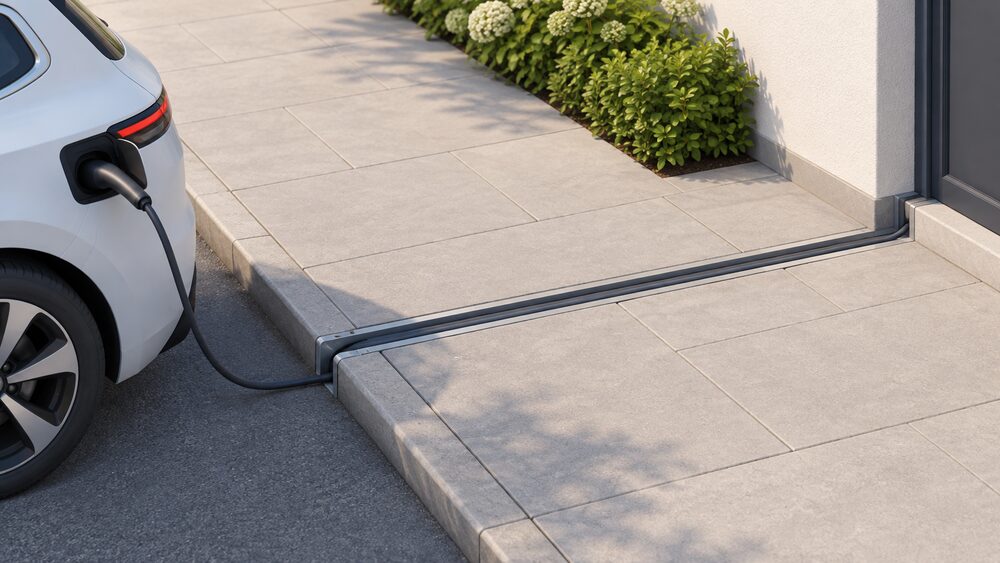
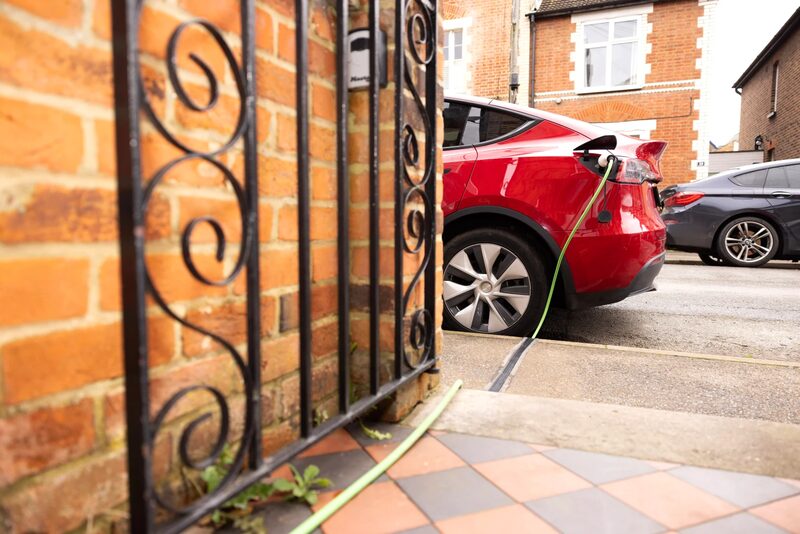
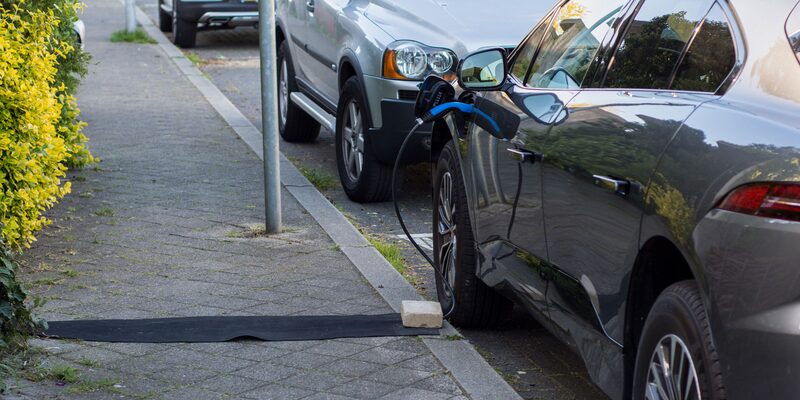
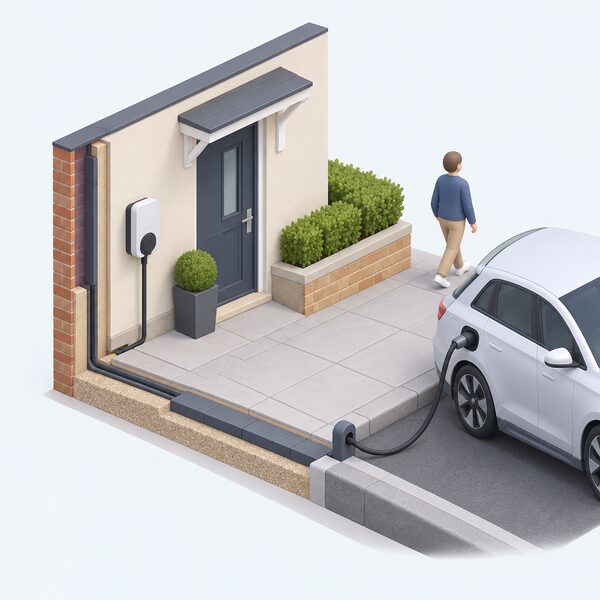
Cross-pavement charging solutions allow residents who do not have off-street parking to charge electric vehicles at home without trailing charging cables across the pavement7. That is the whole purpose: the cable runs in a channel or similar structure set into the footway, so the pavement stays clear and the trip hazard is removed. The solution is not a cable mat or a temporary cover. The English funding rules exclude temporary solutions such as cable mats, along with permanent under-pavement cables, charging bridges and arms8.
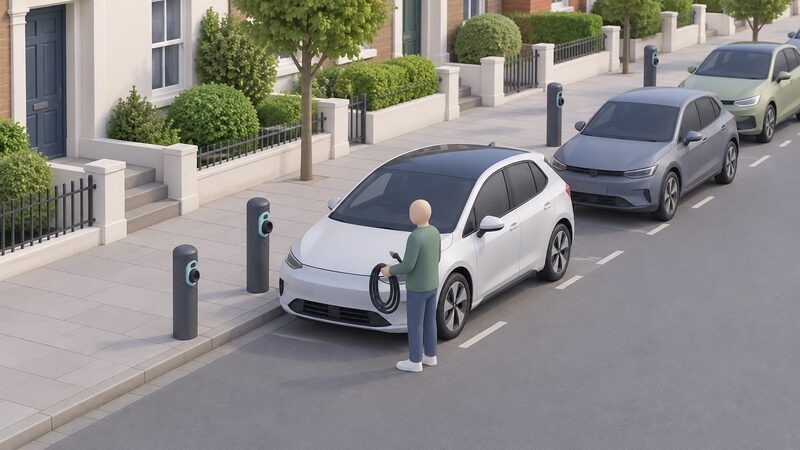
The second route is the public on-street chargepoint. These are usually not equipped with a charging cable, so drivers bring their own9. The lack of a cable is an intended feature, not only to keep streets tidy and free of trip hazards, but to allow almost any EV to charge without cable type being a restriction9. For a household with no driveway, that means carrying a Type 2 cable in the boot and accepting that the chargepoint is shared with neighbours.
The third route is shared or communal charging: a chargepoint installed for a block of flats, a terrace or a group of residents, funded through a local authority scheme rather than by an individual household. The On-Street Residential Chargepoint Scheme was the main vehicle for this, providing grant funding between 2017 and 2024 to local authorities to install residential chargepoints10. It closed to new applications in March 202411.
| Route | Who applies | What it gives the household | Status |
|---|---|---|---|
| Cross-pavement channel | Resident, via the council | A licensed channel from the property to the kerb | Live in England and Scotland6 |
| Public on-street chargepoint | Nobody; it is public infrastructure | A shared, usually untethered device within walking distance | 33% of UK public chargers, 1 July 20264 |
| Shared or communal chargepoint | Local authority | A chargepoint for a block or street | On-Street Residential Chargepoint Scheme closed March 202411 |
The figures behind the gap
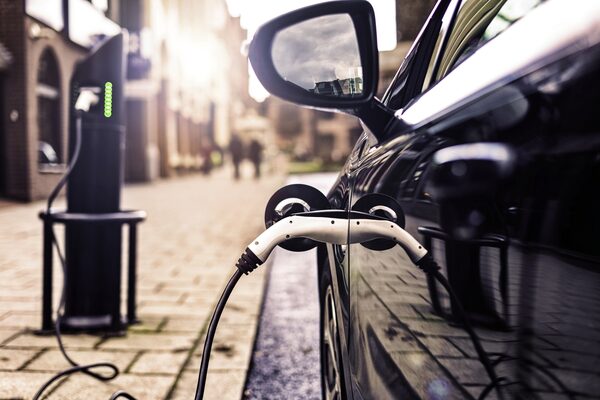
The infrastructure statistics give the shape of the public network. As of 1 July 2026, 33% of public EV chargers in the United Kingdom were classed as on-street chargers4. In England and Wales, 83.3% of public EV chargers were located in urban areas, compared with 82.4% of the population, and 16.7% were in rural areas, compared with 17.5% of the population4. The urban and rural split is close to the population split, which means the network broadly follows where people live rather than where charging is hardest.
The quality of that on-street provision varies. In January 2025, 57% of charging stations were between 3 and 8kW, which at best is slightly faster than an at-home charger and at worst would take nearly a full day to charge a typical EV, and just 36% were on-street chargers12. A 3 to 8kW public chargepoint is not a substitute for a 7kW home unit in convenience terms, because it is shared and because the vehicle has to be left on it.
Home charging, by contrast, is concentrated where driveways are. As of the end of 2025, there were around 1.4 million chargers installed at homes with driveways across the UK1. There is no official register of home charge devices in the UK, so that figure is an estimate rather than a count1. The asymmetry is the point: the million-plus home chargers sit behind driveways, and the households without them depend on a public network where only a third of devices are on-street.
What drives the cost and the difficulty
Three things drive the difficulty: the physical permission, the funding route, and the tariff.
The physical permission is the first barrier. A cross-pavement solution requires permission from the council or pavement maintainer, and the crossing itself may need separate planning permission. Unless the crossing is owned by the Highways Authority, separate planning permission is required, and pavement cable crossings are unlikely to be covered under householder permission for the EV charging point where the crossing is outside the curtilage of the building on highway pavement13. That is a planning question, not an electrical one, and it sits with the local authority.
The funding route is the second. The English Electric Vehicle Pavement Channels Grant is a £25 million capital fund for local authorities in England, available to all tier one local authorities including unitary, county or combined authorities8. It funds buying and installing eligible EV pavement channels, covering capital costs including hardware, installation, S50 licences and planning applications, up to an average of £1,200 per channel8. Residents do not apply directly: they contact their local authority for access8. The grant opened to eligible local authorities in August 2025 with a deadline of 31 October 20258.
The tariff is the third. Smart charging is mainly available to those who can plug in their electric vehicles on their driveway at home14. The Agile Streets project was set up to change that, giving EV users who do not have access to home charging points the opportunity to use off-peak tariffs through public smart charging on the street14. Until that kind of provision is widespread, a household without a driveway is largely buying electricity at the public rate, with 20% VAT attached2.
How it differs across the UK nations
The schemes are not UK-wide, and the differences matter more than the headline figures.
| Nation | Scheme | What it offers | Who applies |
|---|---|---|---|
| England | Electric Vehicle Pavement Channels Grant | £25 million capital fund, up to an average of £1,200 per channel6 | Tier one local authorities6 |
| Scotland | Cross-pavement charging grant | Up to £3,500, of which up to £400 for a charge point unit5 | Residents, via the permit process5 |
| Wales | Charging strategy target | One charge point per three EVs that cannot charge at home15 | A target, not a delivered figure15 |
| Northern Ireland | Cross-pavement provision | Cable protectors for homeowners without off-street parking who meet the criteria16 | Department for Infrastructure16 |
England. The Electric Vehicle Pavement Channels Grant is the live route, a £25 million capital fund for tier one local authorities, with combined authorities allocated and issued funding on behalf of authorities in their region and, in London, funding made available directly to boroughs6. The grant is administered through the LEVI support body6. The On-Street Residential Chargepoint Scheme, which ran from 2017 to 2024, installed 19,001 public charging devices comprising 23,677 charging sockets across local authorities, with a grant value of £64.9 million since its launch in 201711.
Scotland. The cross-pavement charging grant is funded by Transport Scotland and offers up to £3,500 to help install a cross-pavement charging solution5. Up to £400 of that can be allocated to installing a charge point unit at the home, provided the charge point installation has not begun or been completed5. East Lothian, Moray and Renfrewshire have confirmed they are open to accepting cross-pavement EV charging permit applications, and applications from areas where the local authority is not currently accepting permits will not be processed5. The public charging experience in Scotland is significantly different to the rest of Britain, with a greater variety of charge point operators and processes in Great Britain outside Scotland17.
Wales. The Welsh Government's charging strategy set out a view to installing on average one charge point for one in every three electric vehicles that cannot charge at home, across villages, towns and cities15. That is a target rather than a delivered figure.
Northern Ireland. The Department for Infrastructure has set out that, to help homeowners without off-street parking to charge their EV at home, it will make provision for cable protectors for homeowners without off-street parking who meet the criteria for cross-pavement charging16.
The rules that govern a cable across the pavement
The rules fall into three layers: planning, street works, and product regulation.
On planning, a domestic EV charger at a home with off-street parking is likely to fall under permitted development, with no planning application required, provided it meets the criteria18. Without off-street parking, planning permission is required7. For the pavement crossing itself, unless the crossing is owned by the Highways Authority, separate planning permission is required, and pavement cable crossings are unlikely to be covered under householder permission for the EV charging point where the crossing is outside the curtilage of the building on highway pavement13.
On street works, the English funding rules treat the S50 licence as an eligible capital cost, which confirms that a licence is part of the process rather than an optional extra8. The licence is the local authority's instrument for permitting work in the highway, and it is the council, not the householder, that decides whether a channel is acceptable on a given street.
On product regulation, the picture is narrower than it first appears. Charge points for electric vehicles are not covered by the consumer connectable product security regulations19. They are, however, covered by the Electric Vehicles (Smart Charge Points) Regulations 2021, and regulation 7 requires that a relevant charge point must remain capable of charging a vehicle even if it is not connected to an electronic communications network20. That matters for a household without a driveway: a chargepoint that depends on a cloud service to deliver a charge is not compliant, and an offline-capable chargepoint is the baseline.
"A relevant charge point must remain capable of charging a vehicle even if it is not connected to an electronic communications network."
The building regulations layer applies to new development rather than to retrofits. For buildings with more than 10 non-residential car parking spaces, 1 in every 2 non-residential parking spaces must have ducting installed, and 1 in every 10 must provide an EV charge point socket with a minimum 7kW output power rating21. For existing non-residential buildings with more than 20 spaces, the same ratios applied by 1 January 202521. Where all parking spaces are within a covered car park, the requirement to install an electric vehicle charge point does not apply, but cable routes must still be provided for a minimum of one in five parking spaces22. Where no associated parking spaces are provided, there is no requirement to install an electric vehicle charge point at all22. That last exemption is the one that bears on terraced housing without off-street parking: the regulations do not create a chargepoint where there is nowhere to put one.
What it means for energy independence
The honest answer is that a household without a driveway has less of it, and the gap is structural rather than a matter of effort.
A home chargepoint is the cheapest way to charge an EV, and it is the point at which a household can choose its own tariff, charge off-peak, and pair the car with solar or a home battery3. Without one, the household depends on a public network it does not control, at a VAT rate of 20% rather than the domestic rate for home electricity2. The dependence is on a charge point operator, a payment system and a parking space that may not be there when the car returns.
The schemes in this article are attempts to move households from that position to something closer to home charging. A cross-pavement channel does not give a household a driveway, but it does give it a dedicated connection to its own supply, which is the thing that makes off-peak tariffs and solar self-consumption possible. The English fund covers capital costs up to an average of £1,200 per channel, and the Scottish grant offers up to £3,500, which indicates the scale of the works involved8.
What remains is the pavement itself. The channel is licensed, not owned, and the permission sits with the council. A household that moves, or a council that changes its policy, changes the arrangement. The independence gained is real but conditional, and it is worth stating plainly that a cross-pavement solution is a permission-based route to home charging rather than a property right.
For the wider picture of how home charging, tariffs and flexibility fit together, the EV charging at home guide covers the full range of domestic options, and EV charging and household energy independence sets out what self-sufficiency means in practice. Households weighing a cross-pavement solution against a public chargepoint may also find the cross-pavement charging grant and public EV charging pages useful.
Sources22 cited
- Home and community charging, Zapmap, 2025
- New car market powers up as industry calls for VAT cut on EV public charging, Society of Motor Manufacturers and Traders, July 2023
- Charging electric vehicles, Energy Saving Trust
- Public electric vehicle charging infrastructure statistics, 1 July 2026, Department for Transport, 1 July 2026
- Cross-pavement charging grant, Energy Saving Trust, 14 September 2026
- Apply for the electric vehicle (EV) pavement channels grant, Department for Transport, 15 August 2025
- Cross-pavement charging solutions, Energy Saving Trust, 18 July 2025
- Electric Vehicle (EV) Pavement Channels Grant, Energy Saving Trust, 3 November 2025
- Tethered vs untethered, Zapmap, 23 February 2026
- On-street Residential Chargepoint Scheme, Energy Saving Trust, 17 September 2026
- Grant schemes for electric vehicle charging infrastructure statistics, 1 July 2026, Department for Transport, 1 July 2026
- Should I buy an electric car?, Which?, January 2025
- Approved pavement crossings, Planning Portal, 2026
- Agile Streets: future flexible charging report, Energy Saving Trust, 3 October 2025
- Electric vehicle charging strategy consultation document, Welsh Government, 2 December 2020
- Electric vehicles, nidirect, 17 September 2026
- Phase 1 EV publication, Ofgem, 6 July 2021
- Electric vehicle charging, Planning Portal, 2026
- Regulations: consumer connectable product security, Department for Business and Trade, 8 January 2024
- The Electric Vehicles (Smart Charge Points) Regulations 2021, legislation.gov.uk, 15 December 2021
- Electric vehicle charge points for new buildings: policy proposals, Transport Scotland, 20 September 2026
- Approved Document S: infrastructure for charging electric vehicles, Department for Levelling Up, Housing and Communities, 2021
 Charging With a Home BatteryHow a home battery and an EV charger share one supply, whether a battery can usefully charge a car, and how combined systems are controlled so the battery is not discharged into the vehicle at a loss.
 Charging by Home TypeHow the practical and legal position for home EV charging changes by property type: flats and leasehold consent, terraced homes without frontage, shared car parks and metering, rural properties with long cable runs, and listed or conservation area homes.
 Public EV ChargingWhat does public charging really cost when you cannot plug in at home, and how do you pay for it?
 Planning Permission for ChargersDo you need planning permission for a home EV charger, and does it change if you live in a listed building, a conservation area or a flat?
 Charging an EV from Solar PanelsCharging your car from solar panels means using the power your roof makes instead of sending it to the grid.
 Home Charger InstallationWho can fit a home EV charger, and does it need building regulations approval?