
In this answer
Short answer
Electricity used to charge an electric car at home is domestic electricity, and domestic electricity carries VAT at 5%. Electricity bought at a public chargepoint carries VAT at the standard rate of 20%. That is the whole of the rule, and it is the reason a driver with a driveway and a driver without one can pay different tax on the same kilowatt hour1.
The gap is a rate difference of four times, and the Society of Motor Manufacturers and Traders describes it in exactly those terms: public charging incurs VAT at four times the rate of private charging2. It is not a levy aimed at electric vehicles. It follows from how the tax system classifies the supply: a domestic supply to a home attracts the reduced rate, while energy sold at a chargepoint is treated as a business supply and attracts the standard rate3.
The practical consequence is a cost penalty for households that cannot plug in at home, sometimes called the pavement tax. In 2025 a UK driver reliant entirely on public charging was estimated to have paid £194 in VAT on charging costs over the year1. The rate itself is settled; whether it should change is a live argument, with the motor industry, the charging industry and consumer bodies all asking for alignment at 5%2.
The two rates: 5% at home, 20% in public
The reduced rate of 5% applies to domestic energy, and charging a car from a home supply is domestic energy use. Zapmap's statistics page states that VAT is charged at the lower 5% level for domestic energy, and that charging at home is subject to 5% VAT1. The SMMT puts it just as plainly: VAT on home charging is just 5%9. ChargeUK's comparison is that drivers who use public charging face a higher VAT rate than those who charge at home, 20% as opposed to 5%5.
The 20% figure is the standard rate, and it applies to energy drawn at a public chargepoint. Zapmap records the higher 20% rate for energy on public charging1, and ChargeUK states that drivers using public charging infrastructure are subject to VAT at the higher 20% rate10. NAPIT's summary of the position is that there is 5% VAT on electricity if vehicles are charged at home and 20% if charged away from home11.
Two things follow from this that are worth separating. The first is the rate: 5% against 20%. The second is the base the rate is applied to. Public charging unit prices are set by the operator and reflect the cost of buying electricity, running and maintaining the network and renting the site, so the 20% is charged on a larger number than the domestic equivalent. The VAT multiple and the cash difference are not the same measurement.
"VAT on home electricity is just 5%, compared with 20% at public chargers"
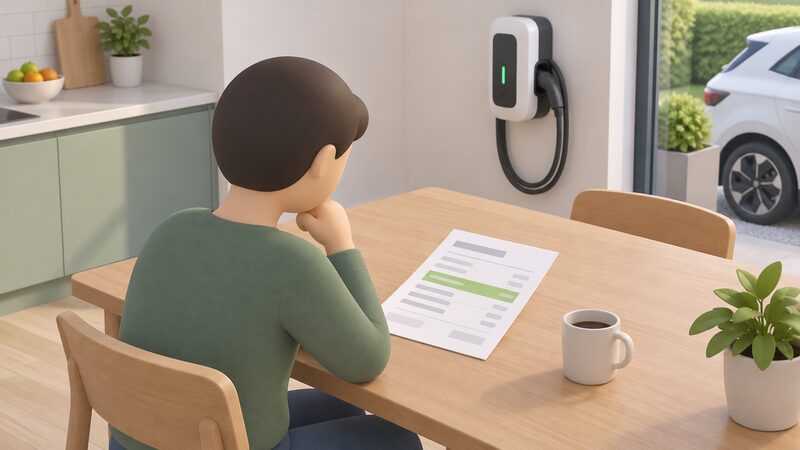
Why the difference: domestic supply versus energy sold at a charging point
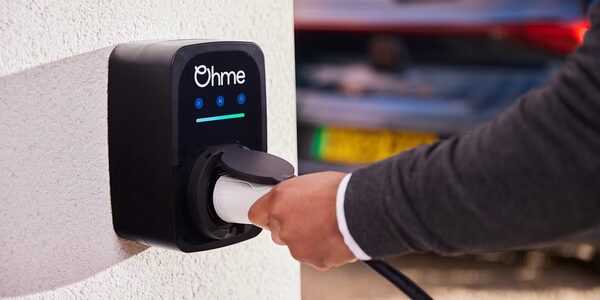
The distinction is written into the VAT rules rather than into energy policy. Electricity for domestic and residential use, or for non-business use by a charity, attracts the reduced rate; fuel for business use is usually standard-rated4. The published VAT rates guidance lists electricity for domestic and residential use or for non-business use by a charity among the reduced-rate items3. A public chargepoint operator is selling energy in the course of business, so the standard rate applies.
That reading is consistent with how household bills are described elsewhere. Energy bills include 5% VAT for domestic users and 20% for business users13. Ofgem's guidance on understanding electricity and gas bills shows VAT at 5% as a line on a domestic bill14, and its page on how a bill is calculated does the same16. Citizens Advice, explaining what a landlord can charge for energy, states that the VAT owed is 5% for energy17. The 5% is the domestic rate, and it is not specific to motoring.
The consequence for a household is that the tax treatment of charging follows the supply point, not the car. A home chargepoint connected to the domestic supply is charged at 5%, and the NICEIC notes that electric vehicle charging at home is likely to be cheaper than at a public EV station18. A driver buying the same electricity from a network pays 20%. Nothing about the vehicle changes between the two transactions.
The pavement tax: what it means for drivers without a driveway
The pavement tax is the informal name for the penalty that falls on drivers who cannot charge from a domestic supply. It is not a separate charge on a bill. It is the accumulated effect of buying electricity at public rates, with 20% VAT applied, because there is no driveway to plug into.
The scale of it is measurable. In 2025, a UK EV driver reliant entirely on public charging paid an estimated £194 in VAT on charging costs1. That figure is the tax alone, on top of the unit price. It is the clearest published number for what the rate difference costs a household with no off-street parking.
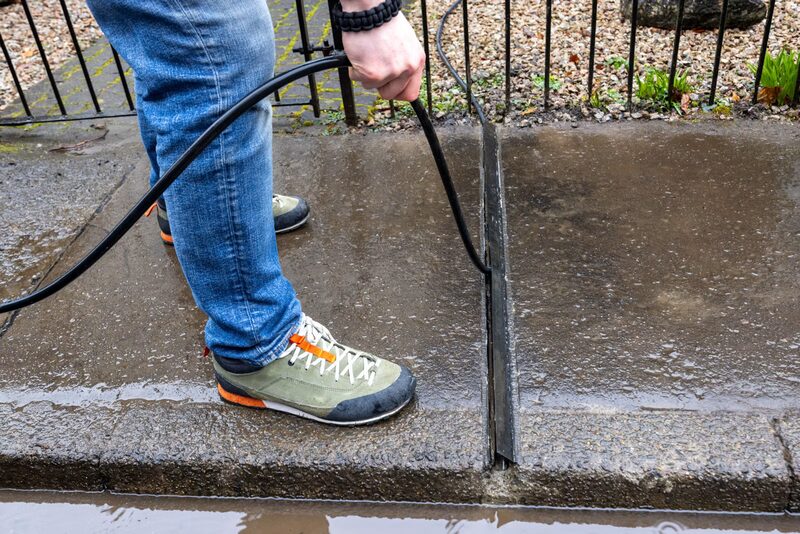
There are routes around the problem, and they are being formalised. Cross-pavement charging solutions allow residents who do not have off-street parking to charge electric vehicles at home without trailing charging cables across the pavement19. The Electric Vehicle (EV) Pavement Channels Grant funds buying and installing eligible pavement channels, covering capital costs including hardware, installation, S50 licences and planning applications20. The fund must benefit residents without off-street parking, who must have or commit to installing an EV chargepoint connected to a domestic energy supply20. Its stated objective is to increase EV uptake by supporting residents without off-street parking to charge at home and benefit from cheaper domestic tariffs21.
The conditions matter. Unless the crossing is owned by the Highways Authority, separate planning permission may be required, and a pavement cable crossing is unlikely to be covered by householder permission for the charge point where it sits outside the curtilage of the building on highway pavement22. In Northern Ireland, the Department for Infrastructure has said it will act to help homeowners without off-street parking charge their EV at home, subject to criteria for cross-pavement charging23. Grant allocation across Great Britain is weighted by the estimated number of vehicles without off-street parking, the availability of chargepoints per 100,000 population and deprivation levels20.
What the 20% against 5% gap costs in practice
The rate difference is easiest to see when it is separated from the unit price. A driver charging at home pays 5% on the electricity, at whatever tariff they are on. A driver charging in public pays 20% on the electricity, at whatever tariff the network sets. The tax rate is four times higher in public2, and the SMMT has described public chargepoint users as facing VAT on their use that is four times more expensive than in other sectors24.
The published estimate for the tax element alone, for a driver with no home charging at all, is £194 across 20251. That is the figure to hold on to, because it isolates VAT from the rest of the cost stack. It does not include the difference in unit price, which is separate and generally larger.
| Item | Home charging | Public charging |
|---|---|---|
| VAT rate on the electricity | 5%1 | 20%1 |
| Rate relative to the other | One quarter of the public rate2 | Four times the private rate2 |
| Estimated VAT paid in 2025 by a driver reliant wholly on public charging | Not applicable | £194 for the year1 |
For a household that can charge at home, the 5% rate is one of several advantages, and it is not the largest. Off-peak domestic tariffs are available to anyone with a home chargepoint, and an EV tariff requires a home charger to be useful at all25. Costs vary by region and household26, and the tariff market changes, so the rate is the stable part of the comparison while the unit prices are not.
For a household that cannot charge at home, the position is the reverse. The 20% rate is unavoidable on public energy, and the routes that restore access to the domestic rate, such as a pavement channel, depend on planning consent, a grant allocation and a chargepoint connected to the property20.
Calls to align public charging VAT with the 5% domestic rate
The argument for alignment has been made by the motor industry, the charging industry and consumer organisations, and it has been made repeatedly. The SMMT's position is that the high rate of 20% VAT on public charging should be reduced to align with the 5% VAT levied on home charging27, and its Budget submission called for equalising VAT on public charging to match the 5% home charging rate24. ChargeUK's open letter to the Chancellor sets out the same case, noting that drivers who use public charging face a higher VAT rate than those who charge at home, 20% as opposed to 5%5.
BEAMA's position paper states the ask directly: align VAT for public charging with the current VAT for domestic charging, which it gives as 5%6. Citizens Advice has requested a reduction of VAT on public charging costs from 20% to 5%7. Zapmap's guidance records that campaign groups such as FairCharge are lobbying the Government to reduce the VAT on public charging from 20% to 5% to bring it in line with domestic charging costs, and that the government has yet to decide8.
The counter-argument that appears in the same material is about the wider tax position of electric vehicles rather than about this rate. The SMMT notes that EVs benefit from reduced Vehicle Excise Duty taxation compared with their internal combustion engine counterparts9, and NAPIT records that electric vehicle drivers already pay tax, including VED along with 5% VAT on electricity11. Both points are made in the context of proposals for road pricing and other motoring taxes, not as a defence of the 20% rate.
What this means for household energy independence
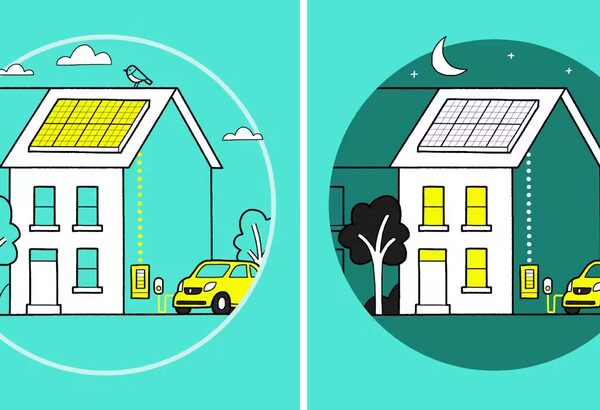
The VAT difference is a tax rule, but it maps onto something structural: whether a household can supply its own motoring energy or has to buy it. A home chargepoint connected to a domestic supply puts the household on the 5% rate, and it also puts the household in a position to use an off-peak tariff, a solar array or a home battery. Standard EV chargers draw electricity from the home supply without distinguishing between solar-generated power and grid electricity29, so the benefit of generation depends on the charger and the tariff rather than on the VAT rate, but the 5% applies to whatever the household draws.
The dependence that remains is the grid and a supplier. Even a household with solar and a battery buys some electricity, and the 5% rate applies to that purchase. The independence gained is not freedom from the network; it is access to the domestic rate and to time-of-use pricing, which a public chargepoint cannot offer.
For a household without off-street parking, the dependence is more complete. The energy comes from a network, at a price the network sets, with 20% VAT on top, and the household has no route to the domestic rate unless a cross-pavement solution is installed and approved20. The grant exists precisely because that gap is recognised: its objective is to let residents without off-street parking charge at home and benefit from cheaper domestic tariffs21. Where a home charger is installed, the grant position for landlords and flat tenants is up to £350, which can reduce the installation cost to as low as £65030.
The rate itself is the one part of the picture that a household cannot influence. It follows the supply point, and it changes only if policy changes. What a household can influence is which supply point it uses, and how much of the energy comes from its own generation rather than from the grid.
Sources30 cited
- EV charging VAT statistics, Zapmap, 2026
- Decarbonisation demands fair taxation, SMMT, 2024
- VAT rates on different goods and services, GOV.UK, 2026
- VAT: goods and services rates, HM Revenue & Customs, 2026
- Open letter to the Chancellor on EV charging, ChargeUK, 2025
- BEAMA EV position paper, BEAMA, 2024
- Response to the ECC Committee inquiry into electric vehicles, Citizens Advice, 2023
- Electric car charging costs, Zapmap, 2026
- EVs: the facts, SMMT, 2025
- Action on high energy costs needed to keep EV transition on track, ChargeUK, 2025
- Government urged to rethink pay-per-mile scheme, NAPIT, 2026
- Electric car charger grants rise to £500, Carwow, 2026
- How to read your energy bill, Confused.com, 2025
- Understand your electricity and gas bills, Ofgem, 2026
- How your electricity or gas bill is calculated, Ofgem, 2026
- Check if you are owed money on your energy bill, Ofgem, 2026
- What your landlord can charge for energy, Citizens Advice, 2026
- EV charger installation and maintenance, NICEIC, 2025
- Cross-pavement charging solutions, Energy Saving Trust, 2025
- Electric vehicle pavement channels grant, Energy Saving Trust, 2025
- Apply for the EV pavement channels grant, GOV.UK, 2025
- Approved pavement crossings, Planning Portal, 2026
- Electric vehicles, nidirect, 2026
- The clock's ticking to help consumers go electric, SMMT, 2024
- EV energy tariffs, Uswitch, 2025
- EV energy tariffs, Zapmap, 2024
- Incentive for electric vehicles, SMMT, 2025
- Electric car charging costs, Zapmap, 2026
- Can solar panels charge electric cars?, The CPA, 2026
- EV charging statistics, Uswitch, 2025
 Public EV Charging PricesCovers the published price series for public charging, how per-kWh rates differ by network and speed, and how they have moved over the past year.
 Cost to Charge an EV at HomeHow home charging cost is worked out from battery size, efficiency, the unit rate paid and the tariff behind it, with full-charge costs of about £8 to £17, cost per mile, annual running costs and what changes for EV owners from April 2028.
 Public EV ChargingWhat does public charging really cost when you cannot plug in at home, and how do you pay for it?
 Charging and Energy IndependenceCharging an electric car at home can cut your fuel costs, but how much does it really free you from the grid?
 Charging by Home TypeHow the practical and legal position for home EV charging changes by property type: flats and leasehold consent, terraced homes without frontage, shared car parks and metering, rural properties with long cable runs, and listed or conservation area homes.
 Electric Vehicle TariffsCharging an electric car at home can cost far less overnight, but only on special electricity plans.