
In this answer
Short answer
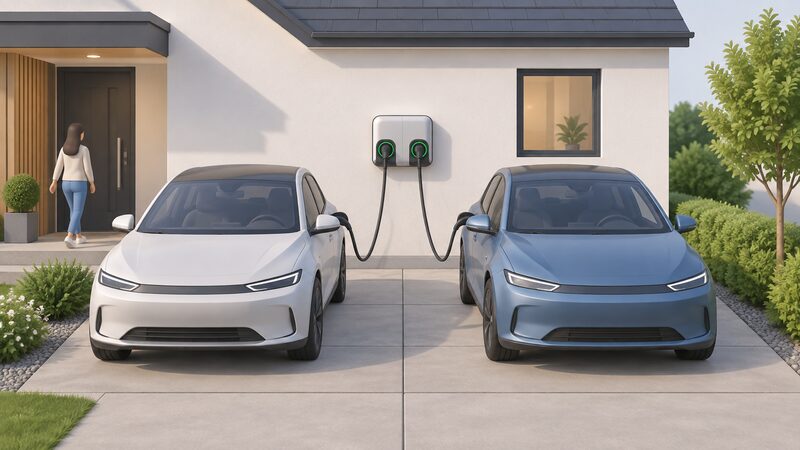
Two cars plugged into one home charging setup charge more slowly than one because the available power is shared between them. A dual EV charger lets two electric vehicles charge at the same time, and it splits the electricity between the cars when both are connected, a function called load balancing1. Some chargers split the power 50:50 between the two vehicles, even if this is not the most efficient approach2. Once one car is unplugged, the charger sends more electricity to the car that is still plugged in1.
The slowdown is not a fault. It is the charger holding the household's total draw within the limit of its electricity supply. Load balancing reduces charging output when overall energy consumption in the home is high and restores maximum speed when consumption is low, staying within the home's power limit3. Charging may also pause if voltage levels are too high or too low4.
What a household sees in practice is roughly half the speed per car while both are charging, and a return to full rate when one finishes or is unplugged. Whether that matters depends on how long the cars sit plugged in. Overnight charging usually absorbs the reduction, because a 7.4kW AC supply takes 7h 45m to take a 50kWh battery from 20% charged, and most homes have a longer cheap window than that5.
Why two cars share one supply: how load balancing works
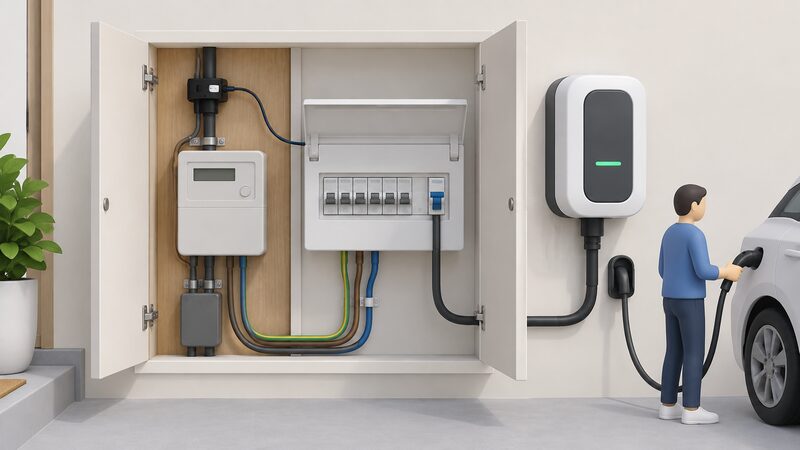
A home has one electricity supply with a fixed capacity. Adding a second car to the charging setup does not create a second supply; it adds a second load to the same one. Charging two electric cars at home needs two chargers and a way to share power safely between them, which is load balancing2. The alternative, letting both draw at full rate, would push the household's demand past what the incoming supply can carry.
Load balancing exists in several forms. Wallbox's Power Boost lowers charging speed when overall energy consumption is high and charges at maximum speed when it is low, staying within the home's power limit3. Alfen describes Active Load Balancing as allowing charging stations to distribute available energy among vehicles needing charging, reducing strain on the grid8. Ohme states that Load Balancing may reduce charging to protect the home's electrical supply, and that charging may pause if voltage levels are too high or too low, with the function built into all its chargers4. Power NI states that all its smart EV chargers come with load balancing to make charging two cars safe and easy2.
The same principle appears on public networks. Osprey Charging has load-balancing technology in its Kempower chargers, ensuring that enough power is safely drawn from the grid and distributing power based on the demands of individual vehicles so cars charge at their maximum rate9. Connected Kerb's Chameleon is a dual charger, meaning two EVs can charge at once via its two charging sockets10.
For a household, the independence point is straightforward. Load balancing is what allows two cars to charge from one existing supply without an upgrade, and it is also the reason the second car slows the first. The charger is not withholding power; it is rationing a fixed amount.
The charger splits its rated power between the cars
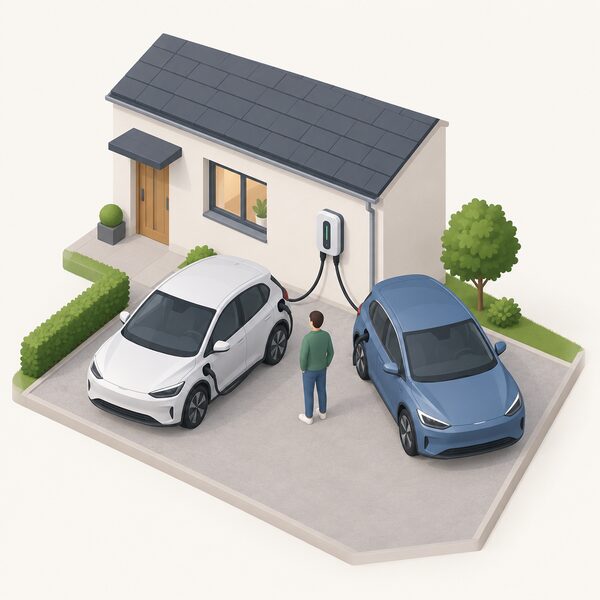
The mechanism is division. A charger has a maximum output, and when two vehicles are connected that output is apportioned. Zapmap gives a worked example: a 250kW-maximum car and a 50kW car sharing a 150kW device receive 75kW and 50kW respectively, a total of 125kW9. The first car takes half the device's maximum, the second takes only what it can accept, and the total is below the charger's rating because the second car cannot use more.
That example is from rapid public charging, but the arithmetic is the same at home in miniature. A domestic charger rated at 7kW shared between two cars gives each a fraction of 7kW. Some chargers split the power 50:50 between the two vehicles, even if this is not the most efficient approach2, which means a car capable of accepting more still receives only half.
Two further factors shape what each car actually receives. The first is the vehicle's own charging curve: chargers start charging slowly and gradually increase to maximum power output to protect batteries, and after reaching around 80% the charger reduces the output power6. The second is the car's onboard acceptance rate. A vehicle that cannot accept the full share will not use it, and the surplus is not automatically handed to the other car on a simple 50:50 split.
| Charger type | Typical power | What two cars share |
|---|---|---|
| Slow | 3kW | Around 3 kWh per hour in total11 |
| Fast (single-phase) | 7kW | The rated output divided between the vehicles2 |
| Fast (three-phase) | 22kW | 22kW where home wiring and vehicles support it1 |
A 22kW dual charger is available for faster charging, but the home wiring and the vehicles must both support it1. Where they do not, the charger falls back to what the supply and the cars can take.
What this means for charging times: roughly half the speed each
The practical effect is a longer wait, not a failed charge. Energy Saving Trust figures for a 7.4kW AC supply, assumed from 20% charged, are 3h 45m for a 25kWh battery, 7h 45m for 50kWh, 10h for 75kWh and 13h 30m for 100kWh5. Those are single-car times. Sharing the same supply between two cars roughly doubles them, so a 50kWh battery that would take 7h 45m alone takes in the region of twice that while a second car draws from the same supply.
The comparison with public charging shows how much is being given up. Rapid or ultra-rapid charging stations take around 40 minutes to go from 20% to 80%12, and ultra-rapid chargers can take many newer models from 20% to 80% in anywhere between 20 and 30 minutes9. Home charging at shared rates is an order of magnitude slower, which is the trade for charging at home, where it is likely to be cheaper than at a public EV station7.
Two other effects lengthen the wait. Charging slows significantly after about 80% to protect the battery and prolong its lifespan, so charging up to 80% is generally quicker than filling13. And charging takes longer in cold weather because extra power is needed to heat both the inside of the car and the battery14.
Ways to charge two cars faster: higher-rated supply or separate circuits
There are three routes to more speed, and each has a condition attached.
The first is a higher-rated charger. A 22kW dual charger gives faster charging, provided the home wiring and the vehicles can support it1. Three-phase supply is usually needed for 22kW, and many homes do not have it.
The second is a supply upgrade. EV chargers and other low-carbon technologies can push a home's electricity demand above the available supply, which may require an upgrade15. Homes sharing one electricity cable with a neighbour may not have a supply strong enough for an EV charger and need a dedicated cable installed before the charger can go ahead15. This is a network connection matter, handled with the distribution network operator, and it is the point at which a household's charging speed stops being a charger question and becomes an infrastructure one.
The third is separate circuits, which still requires load balancing to keep the combined draw safe. Two chargers and a way to share power safely between them is the stated requirement for charging two electric cars at home2.
The scale of the underlying constraint is worth stating. With typical 7kW domestic chargers, just 2% of these chargers switching on at the same time would generate a load step of between 1.7 and 3.6 GW, in a scenario of 12 to 26 million EVs in 203518. That is a system-level projection, not a household rule, but it explains why load management is built into domestic charging rather than left to the driver.
When slower charging is fine: overnight charging usually covers both cars
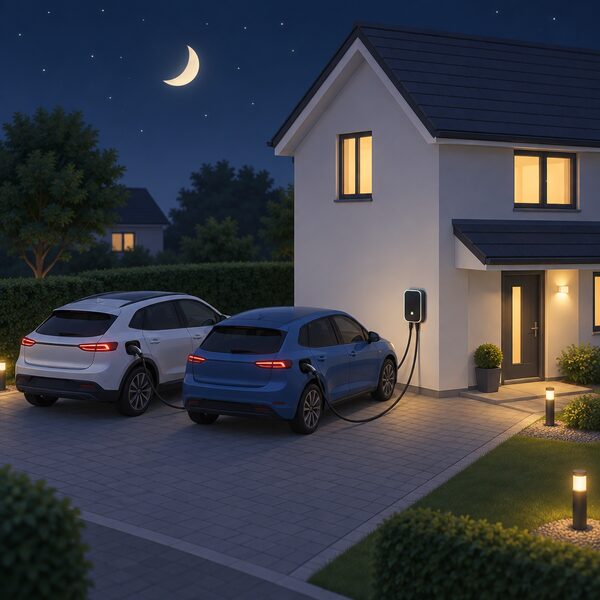
For most two-car households, the shared rate is not a problem, because the cars are parked for far longer than they need to charge. Slow chargers are used mainly for overnight charging at home19, and fast charging takes hours and is suitable for longer stays or overnight charging20. The advice from Energy Saving Trust is to charge EVs overnight so that each day starts with a full battery21.
The tariff structure reinforces this. There are several EV tariffs available, most of which involve a lower rate for charging overnight5, and an attractive overnight rate will often be the best option22. Some energy providers offer smart charging tariffs that make it cheaper to use electricity at night, or at times of low electricity demand7. A household with solar and a home battery can go further: one case study describes using a cheaper off-peak electricity tariff at night to charge both the EV and the battery23.
Behaviour matters as much as equipment. Participants who home charge tended to leave their car plugged in overnight, but start their charge in the evening when they get in24. Starting in the evening puts the charge into the peak window rather than the cheap one, and with two cars sharing a supply it also means both are drawing at the slower shared rate during the hours when electricity is dearest.
The independence picture is mixed, and worth being plain about. Charging at home keeps the household off public networks and off forecourt pricing, and it is likely to be cheaper than a public EV station7. But the home still depends on the grid for the electricity, on a supplier for the tariff, and on the charger's manufacturer for the load-balancing firmware that decides how the two cars share. A dual charger that splits power 50:50 is making that decision in hardware2; a smart charger making it in software depends on an app, a connection and continued support. Where a household has solar and a battery, some of the supply dependence falls away, but the charger's own logic remains the household's to live with.
Sources24 cited
- Dual EV chargers, E.ON Next, 2026
- How to charge your electric car at home, Power NI, 2025
- Home energy management, Wallbox, 2026
- Intelligent Octopus Go 6-hour smart charging FAQs, Ohme, 2026
- Charging electric vehicles, Energy Saving Trust, 2026
- EV charger support, E.ON Next, 2026
- Electric vehicle charger installation and maintenance, NICEIC, 2025
- EV charging at home, Alfen, 2026
- How long does it take to charge an electric car, Zapmap, 2026
- On-street charging, Zapmap, 2026
- What is kWh of electricity, Power NI, 2026
- Should I buy an electric car, Which?, 2026
- Electric car charging guide, Carwow, 2025
- How long to charge an electric car, Uswitch, 2024
- If your electricity supply can't cope with the new equipment, NIE Networks, 2026
- Connecting to the networks: LCT strategy, Energy Networks Association, 2026
- Electric vehicle charging, SMMT, 2025
- Resilient electric vehicle charging, Energy Systems Catapult, 2035
- Electric vehicles for home charging, Electricity North West, 2026
- Clean energy boost, Low Carbon Hub, 2024
- Electric vehicle battery basics, Energy Saving Trust, 2025
- Tariffs for renewable technology, Energy Saving Trust, 2026
- Beth Martin story: solar panels and electric vehicle, Energy Saving Trust, 2025
- Phase 1 EV publication, Ofgem, 2021
 Load Management for ChargersWill a home charger trip the main fuse when the oven, shower and car all draw power at once?
 Charging With a Home BatteryHow a home battery and an EV charger share one supply, whether a battery can usefully charge a car, and how combined systems are controlled so the battery is not discharged into the vehicle at a loss.
 EV Tariffs and Home ChargingHow EV-specific import tariffs and charging bolt-ons work, including supplier-controlled charging where the energy company decides when the car draws power, which charge points each scheme supports, and what a household needs in place.
 EV Charging Speeds and TimesHow long an electric car takes to charge depends on the charger and the car together, so a faster charge point will not always speed things up.
 Charging by Home TypeHow the practical and legal position for home EV charging changes by property type: flats and leasehold consent, terraced homes without frontage, shared car parks and metering, rural properties with long cable runs, and listed or conservation area homes.
 Charging and Energy IndependenceCharging an electric car at home can cut your fuel costs, but how much does it really free you from the grid?