
In this answer
Short answer
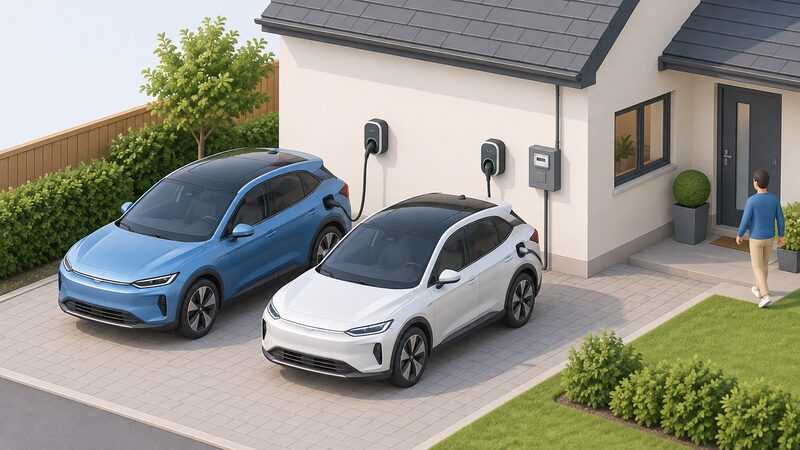
There is no separate product called a two-car EV tariff. An EV tariff is a supply tariff for the whole property, and Power NI states plainly that its electric vehicle tariffs cover the electricity consumption for the whole house and electric car1. A second car does not need a second tariff, a second meter or a second account: it charges on the same rates as the first, through the same supply.
What changes with two cars is the volume of energy drawn in the cheap window, and the electrical load on the supply. EV tariffs typically charge a cheaper rate for electricity used at night2, and most involve a lower rate for charging overnight3. With an off-peak tariff, a full charge can cost less than £104. Two cars means two of those, inside the same overnight period.
The practical questions are therefore about capacity, scheduling and eligibility conditions, not about finding a tariff that permits two vehicles. The published conditions are about owning or leasing a plug-in vehicle, not about how many5.
What a two-car household actually needs from an EV tariff
The core requirement is a tariff with a cheap window long enough and large enough to cover both vehicles' daily mileage. Home EV drivers benefit from accessing lower tariffs at times when demand for electricity is lower10, and that benefit scales with the number of cars drawing on it.
The second requirement is that the cheap rate applies to the whole home, not only to the charge point. This is where tariff structures diverge. An EV tariff usually applies the lower rate only to EV charging, not to the rest of the home's electricity use, when compared with a standard time-of-use tariff11. By contrast, on many multi-rate tariffs the off-peak rate applies to the entire home electricity consumption during that window, not just the car charger6. For a two-car household running washing, drying and dishwashing overnight as well, the second structure captures more.
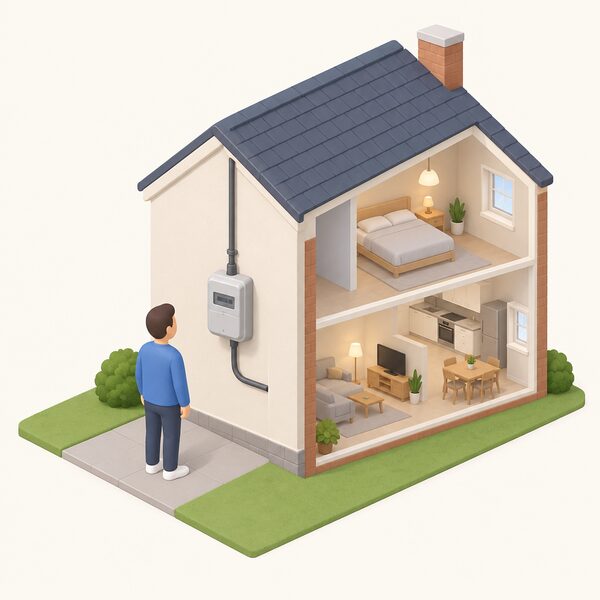
The third requirement is a working smart meter. For many EV-specific tariffs, particularly smart or time-of-use tariffs, a working smart meter is required8. A smart meter is not needed simply to charge an EV, but without one some EV-specific tariffs are not accessible8. Octopus states that a smart meter is needed to sign up to most, if not all, EV tariffs, because suppliers need certainty about when charging happens7.
Beyond that, the conditions are modest. You must own or lease an EV vehicle12. Power NI's EV tariffs are exclusive to households that own or lease a plug-in electric vehicle5. Nothing in those conditions counts vehicles.
Single tariff versus separate tariffs per car: which fits which household
A household cannot hold two electricity supply tariffs on one meter, so the real choice is between tariff structures, not between suppliers per car. Electricity-only tariffs, also known as single fuel tariffs, exclusively provide electricity to a home13. A dual fuel arrangement adds gas. Some suppliers offer a discount for having both fuels with them, so it can work out cheaper to be on a dual fuel tariff, but in some cases separate suppliers could be cheaper14. Most suppliers offer a discount for dual fuel tariffs that make them cheaper than separate gas-only and electricity-only tariffs15.
For a two-car household, the structural choice is between a two-rate EV tariff and an add-on arrangement. Add-on EV tariffs let consumers keep their existing household tariff but receive separate EV charging discounts, credits or other benefits8. Octopus's Charge Anytime is described as an add-on to existing tariffs rather than a standalone tariff16. EDF Energy has other tariffs available for heat pumps and electric vehicles17.
| Arrangement | How it works | Fits |
|---|---|---|
| Two-rate EV tariff | Cheaper off-peak rate overnight, higher on-peak rate during the day18 | Households able to shift most charging into the cheap window |
| Add-on EV tariff | Existing household tariff kept, with separate EV charging discounts or credits8 | Households unwilling to move their whole supply onto a time-of-use structure |
| Standard time-of-use tariff | Cheaper off-peak rates overnight, higher on-peak rate during the day18 | Homes with an EV, heat pump or battery, where smart tariffs are much more valuable19 |
A two-car household is closer to that profile than most, but the fit still depends on how much of the load can genuinely move overnight. An EV tariff usually applies the lower rate only to EV charging, not to the rest of the home's electricity use, whereas on many multi-rate tariffs the off-peak rate applies to the entire home electricity consumption during that window20.
How dual-vehicle charging changes the maths on off-peak rates
The headline figure is that a full charge on an off-peak tariff can cost less than £104. Two cars charging regularly means that figure applies twice, and the saving against peak-rate charging compounds with every charge.
The mechanism is straightforward. EV tariffs typically have lower unit costs overnight when there is less demand on the national grid, a renewable energy promise and some offer-added benefits for the EV driver18. They are typically two-rate tariffs, where it is cheaper to use energy at night20. Cheaper overnight electricity on a two-rate tariff means the cheap power can also be used for other appliances21.
That last point is what changes the arithmetic most for a two-car household. If the off-peak rate covers the whole home during the window6, then the dishwasher, washing machine, tumble dryer and immersion heater all run cheaply alongside two cars. The value of the tariff is no longer just the motoring cost.
Independent analysis of support for low-income households puts the annual saving from electric vehicle chargers on a time-of-use tariff at £680, where EV ownership is required22. That figure is modelled for a single-charger household and is not a two-car figure, but it indicates the order of the benefit that a time-of-use structure delivers.
Costs vary by region and household18, so the same two cars on the same tariff will produce different bills in different parts of the UK. With an off-peak tariff, a full charge can cost less than £1018, and off-peak overnight charging works out at under £3 per 100 miles18. Any single per-charge figure is indicative only, because it depends on the tariff window, the region and how much of the home's load moves overnight.
Smart charging and scheduling two cars on one supply
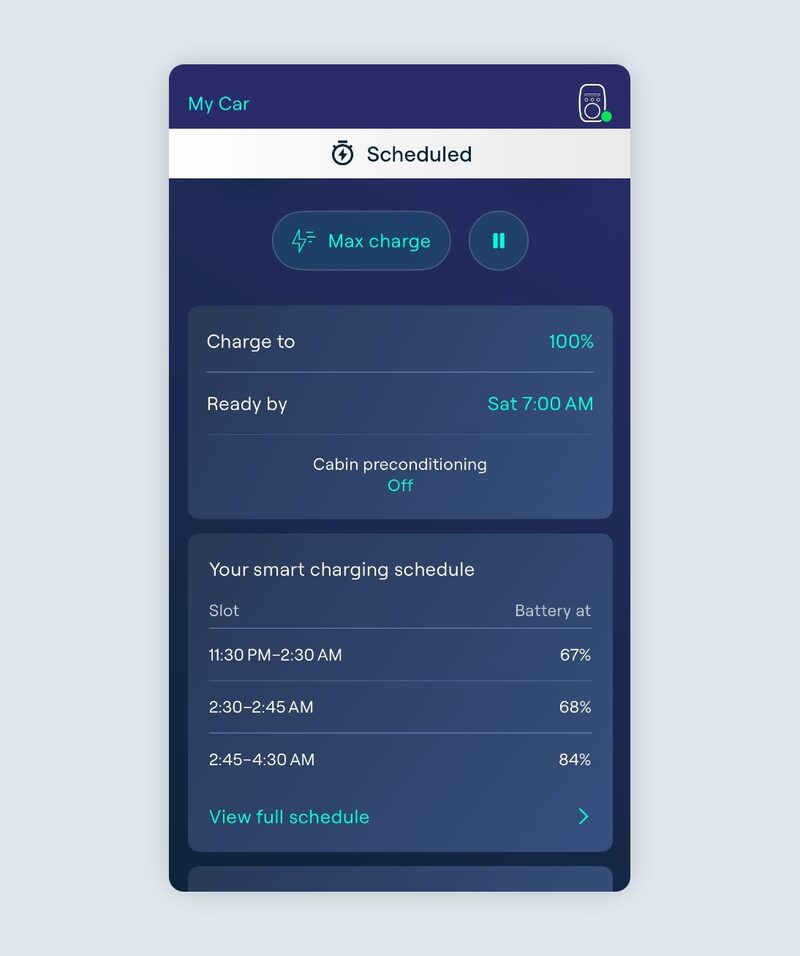
Smart charging is what makes a two-car household workable on a single cheap window. Energy flexibility through smart EV charging lets a car charge when electricity is cheapest and greenest, often overnight, without changing routine23. Zapmap's smart charging product charges at the cheapest time based on the existing tariff and preferences24.
For two vehicles, scheduling matters more than for one. A single five-hour window may not accommodate two full charges simultaneously, but it will usually accommodate two partial charges sequenced one after the other. Most electric cars are limited to a 7.2 to 11kW maximum AC charge rate9, so the constraint is the window length and the supply capacity, not the vehicles. A smart charger can be programmed to charge during off-peak hours when rates are lower9, and smart tariffs use automated scheduling where the supplier's app or platform communicates directly with the car or smart charger9.
Where two cars share one charger with multiple connectors, some EV chargers split the power 50:50 between the two vehicles, even if this is not the most efficient approach25. A worked example from the same guidance: a 250kW-maximum car and a 50kW car sharing a 150kW device receive 75kW and 50kW respectively, a total of 125kW25. That example is written for rapid charging, but the sharing logic is the same principle that load management applies at home.
Where two-car tariffs fall short
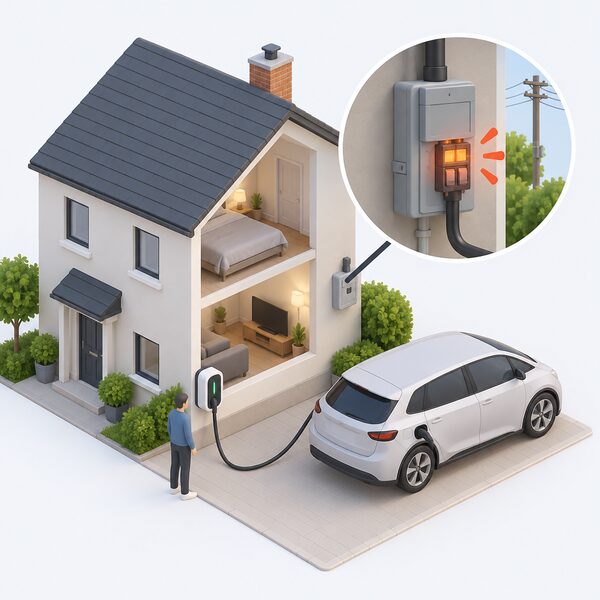
The first limit is electrical, not commercial. EV chargers and other low-carbon technologies can push a home's electricity demand above the available supply, which may require an upgrade26. Two cars charging at once on one supply is exactly the scenario that triggers this. Northern Ireland Networks advises on what happens if a supply cannot cope with new equipment26, and the assessment is a matter for a qualified installer.
The second limit is that the tariff does not control the charger. A tariff sets prices by time; it does not sequence two vehicles. That requires a smart charger, an app, or both. Where a household has two standard charge points and no scheduling, both cars may draw simultaneously in the cheap window and exceed the supply's capacity.
The third limit is that the surrounding incentives are aimed at acquisition, not at multi-car households. The electric car grant is only for new cars, so it will not impact the second-hand market27, which is where many second cars are bought. EVs benefit from reduced Vehicle Excise Duty taxation compared with their internal combustion engine counterparts28, and company car tax for pure EVs was 2% from 2022 to 2025, compared to up to 33% for petrol vehicles and 37% for diesel vehicles29. None of these is a two-car tariff measure.
The fourth limit is regional. In Northern Ireland, home charging is the least expensive way to charge an electric vehicle because lower home electricity tariffs can be used30. Power NI's EV tariffs are exclusive to households that own or lease a plug-in electric vehicle5, and the tariff covers the whole house and car1. Elsewhere in the UK the structure is similar but the named products differ, and costs vary by region and household18.
"EV chargers (and other low-carbon technologies) can push your home's electricity demand above the available supply."
Independence, and what remains dependent
A two-car household on an EV tariff gains real control over its motoring energy cost. The cheap window is predictable, the rate is published, and both cars draw from the same supply. Where the off-peak rate covers the whole home6, the household also shifts domestic load into the same window.
What remains is dependence on the grid and on a supplier. The tariff is a contract with a company, not a generating asset. The cheap rate depends on the supplier continuing to offer it, on the smart meter continuing to report, and on the charger continuing to schedule. A household with solar and a home battery reduces that dependence further, and a time-of-use tariff becomes much more valuable alongside an EV charger, heat pump or home battery19. Without generation or storage, the two-car household is buying the same units more cleverly, not buying fewer of them.
Sources30 cited
- Do the electric vehicle tariffs provide energy for everything in my house?, Power NI, 2026-09-20
- Benefits for Britain, Smart Energy GB, 2026-04-24
- Charging electric vehicles, Energy Saving Trust, 2026-04-23
- Should I buy an electric car?, Which?, 2026-04-16
- Who is this tariff available to?, Power NI, 2026-09-20
- EV smart charging at night, E.ON Next, 2026-09-17
- Octopus EV energy tariffs, Uswitch, 2025-10-09
- EV tariffs and home charging: what consumers need to know, Energy Ombudsman, 2026-09-11
- How to use electric car charging points, Which?, 2026-05-20
- Agile Streets: future flexible charging report, Energy Saving Trust, 2025-10-03
- Does a hybrid car need an EV tariff?, Uswitch, 2025-07-02
- Electric cars and energy bills, Uswitch, 2026-04-27
- Electricity only, Confused.com, 2026
- Energy tariffs explained, Uswitch, 2026-02-17
- Gas only, Confused.com, 2026
- OVO EV energy tariffs, Uswitch, 2025-10-09
- EDF Energy, Energy Helpline, 2026-09-20
- EV energy tariffs, Zapmap, 2024-05-14
- Should I switch to a time of use tariff?, Energy Saving Trust, 2026-01-23
- Understanding energy flexibility, Smart Energy GB, 2026-08-17
- Time of use tariffs explained, Which?, 2026-04-23
- Clean heat: supporting low-income households, Energy UK, 2026-06-11
- What is flexibility?, Flex Assure, 2026-09-19
- Smart charging, Zapmap, 2026
- How long does it take to charge an electric car?, Zapmap, 2026-04-15
- If your electricity supply can't cope with the new equipment, Northern Ireland Networks, 2026-09-19
- NAPIT response to Chancellor's Budget, NAPIT, 2025-11-27
- EVs: the facts, SMMT, 2025-09-22
- Grants and incentives, Electricity North West, 2023-04-25
- Electric vehicles, nidirect, 2026-09-17
 Electric Vehicle TariffsCharging an electric car at home can cost far less overnight, but only on special electricity plans.
 EV Tariffs and Home ChargingHow EV-specific import tariffs and charging bolt-ons work, including supplier-controlled charging where the energy company decides when the car draws power, which charge points each scheme supports, and what a household needs in place.
 EV Charging Bolt-OnsCan you get cheap electricity for your car without changing the tariff for the rest of your home?
 Charging With a Home BatteryHow a home battery and an EV charger share one supply, whether a battery can usefully charge a car, and how combined systems are controlled so the battery is not discharged into the vehicle at a loss.
 Home EV Charger ManufacturersWhich home EV charger brands are worth considering, and how do you choose between them?
 Cost to Charge an EV at HomeHow home charging cost is worked out from battery size, efficiency, the unit rate paid and the tariff behind it, with full-charge costs of about £8 to £17, cost per mile, annual running costs and what changes for EV owners from April 2028.