In this guide
EDF sells three broad kinds of domestic tariff: fixed price deals with a set term, a standard variable tariff that moves with the price cap every three months, and specialist products for electric vehicles, heat pumps and solar export1. The fixed range is where most households start, and it is also where the exit fee question lives: most fixed tariffs carry an exit fee for each fuel if the contract is left early, and EDF's own Simply Fixed page states plainly that exit fees apply2.
The numbers a householder is most likely to want are the unit rates. A sample EDF bill shows electricity at 27.84p per kWh and gas at 6.994p per kWh4. On the EV side, EDF's overnight tariff averages 8.00p per kWh across all distribution regions5. For solar households, EDF's export products include variable tariffs with no fixed end date, and the standard variable and heat pump tariffs carry no exit fees at all6.
What follows sets out each part of the range, the conditions attached to it, and what each one means for a household's grip on its own energy costs.
EDF tariffs at a glance
EDF's domestic range divides along two axes: how long the price is held, and what the household is being supplied for. On length, the choice is between a fixed term and a variable rate with no end date. On purpose, the range splits into standard supply, EV charging, heat pumps and export.
The bill itself is the reference document. EDF bills carry the tariff name, end date, payment method, exit fees and estimated annual consumption at the bottom, which is where a householder can confirm which product is actually running4. That matters because tariff names are not always self-explanatory, and a standard variable rate can be identified by words such as Simpler, Flex, Basic, Standard or Variable in the name7.
Ofgem groups domestic tariffs into three main types: fixed rate, standard variable tariff and multi-rate8. EDF's range maps onto that structure, with the multi-rate end covered by time-of-use products for EV charging and by export tariffs for solar. EDF also offers other tariffs for heat pumps and electric vehicles beyond the standard supply products1.
One structural point is worth holding onto. Time-of-use pricing is not compulsory: a supplier cannot charge a household based on when energy is used unless that household specifically chooses such a tariff9. An EV or heat pump tariff is therefore an opt-in, not a default, and a household that does nothing stays on a single-rate product.
| Tariff family | Price basis | End date | Exit fees |
|---|---|---|---|
| Fixed price (Simply Fixed) | Set unit rates for the term | Defined term | Apply3 |
| Standard Variable | Moves every 3 months with the price cap | None1 | None6 |
| EV overnight | Lower rate in the early hours | Defined term | Not stated |
| Heat pump | Specialist rates | Defined term | None6 |
| Export (SEG) | Paid per kWh exported | Variable products have none10 | None6 |
Fixed tariffs: certainty, with exit fees where they apply

A fixed tariff holds the unit rate for a defined period. What it does not do is hold the direct debit: a fixed tariff does not protect a household from the direct debit amount increasing or decreasing, because the amount collected is a payment plan against estimated use, not a price guarantee on the bill total2. That distinction catches people out when a fixed deal is described as certainty.
Exit fees are the other condition. Most fixed tariffs include exit fees for each fuel, payable if the household switches to a different deal before the contract ends2. The typical figure is often £100 per fuel11. EDF's Simply Fixed product states that exit fees apply3. The rule is not absolute, though: exit fees only apply to fixed-term deals, including some tracker tariffs, and cannot be charged in the last 49 days of the tariff11. EDF's own position matches this, stating that with 49 days or less left on a contract, a tariff change can be made without paying exit fees6.
Awareness of the rule is uneven. In Ofgem research, 88% of consumers knew that exit fees may apply when leaving a fixed contract before it ends, but only 57% could identify that they may still apply when moving to another deal with the same supplier12. That second figure is the one that matters for a household weighing an internal switch.
For a household's independence, a fixed tariff buys price certainty for a period but ties the household to one supplier's terms for that period. The trade is straightforward: predictability in exchange for a fee if circumstances change. More on the mechanics sits in fixed-rate energy tariffs and exit fees and tariff contract terms.
Variable tariffs: no end date, prices that move
EDF's Standard Variable tariff uses variable unit rates that change every three months in line with the price cap, with no end date1. That three-month rhythm follows the cap period rather than any decision by the supplier, and it means the rate a household pays in one quarter is not the rate it pays in the next.
The price cap does not cover everything. Some green tariffs and special time-of-use tariffs sit outside it13. A household on an EV or specialist product should therefore not assume the cap is doing any work on its behalf.
Variable products are not confined to standard supply. EDF's export range includes several variable tariffs with no fixed end date, including Export Variable, Export and Earn Flex, Export Variable Value, Export and Earn Plus, Next Flex Export and Solar Saving10. Variable export rates move with the market in the same way import rates do, which cuts both ways for a solar household: a rising export market lifts the payment, and a falling one reduces it.
The absence of an end date is the defining feature. There is no renewal date to diarise and no exit fee to trigger, because there is no term to leave early. What replaces the term is exposure: the household carries the price risk that a fixed deal would have transferred to the supplier.
For independence, a variable tariff is the least committed position. A household can leave at any time without charge, but it also has no protection if wholesale costs rise into the next cap period. The comparison between the two approaches is set out in fixed vs variable energy tariff.
EV tariffs: off-peak rates from 6.49 to 6.99p/kWh
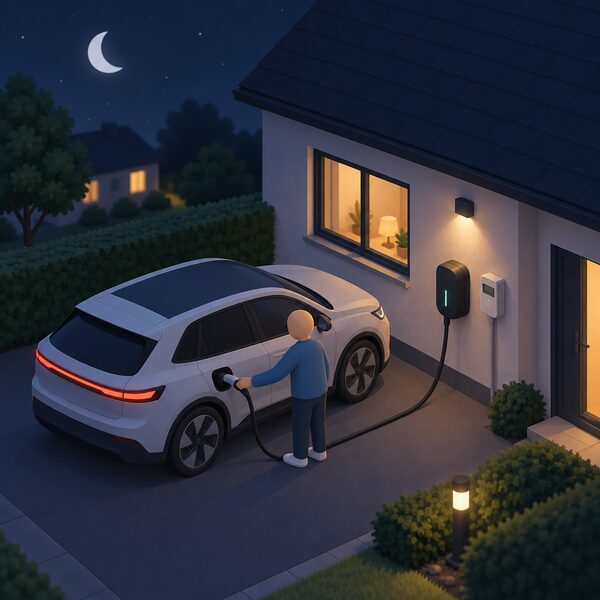
EV tariffs work by splitting the day. Most EV tariffs involve a lower rate for charging overnight, and the cheap period is typically one block of very cheap electricity in the early hours of the morning for charging a vehicle14. EDF's overnight tariff for EV owners offers an average nighttime electricity unit rate of 8.00p per kWh across all distribution network operator regions5.
The scale of the difference is what makes the product worth understanding. Against the sample standard electricity rate of 27.84p per kWh on an EDF bill, an 8.00p overnight rate is a substantial reduction for any load that can be moved into the window4. The saving is not automatic: it depends on how much consumption actually falls inside the cheap hours rather than outside them.
Charging cost at home is already low relative to the public network. With an off-peak tariff, a full charge can cost less than £1016. A comparison table of public charging prices lists home off-peak electricity at 3.59 pence per kWh, which is the cheapest line in that table17. The gap between home off-peak charging and public charging is the main financial argument for charging at home where a household can.
Two conditions shape whether an EV tariff delivers. The first is a smart meter, since time-of-use pricing requires half-hourly measurement. The second is a charger or vehicle that can be scheduled, because a household that plugs in at 6pm and charges immediately pays the peak rate for most of the session. The tariff choice and the charging behaviour have to match. More detail is in EV tariffs and is it cheaper to charge an electric car at night.
Export and SEG tariffs: no exit fees for solar households
Export tariffs pay a household for electricity sent to the grid, under the Smart Export Guarantee. A fixed SEG tariff pays a set rate per kWh exported over the length of the contract18. There are no set SEG rates: the only requirement is that the tariff must always be greater than zero18. That is a floor, not a benchmark, and it means export rates vary widely between suppliers and products.
EDF's export range reflects that variety. Variable export products include Export Variable, Export and Earn Flex, Export Variable Value, Export and Earn Plus, Next Flex Export and Solar Saving, all with no fixed end date10. A household with solar panels only is generally best off looking for the best SEG rate export tariff rather than a bundled product15.
Two rules govern the scheme. A household must choose one scheme for export payments and cannot be paid by both the SEG and the Feed-in Tariff for the same energy sent to the grid19. And where an installation has a capacity under 30kW with no export meter, or where exported electricity cannot be properly measured, deemed export payments apply instead of metered ones20. Under the older Feed-in Tariff arrangement, a deemed export rate estimates that 50% of generated energy is exported19.
"You must choose one scheme for your export payments. You can't be paid by both SEG and the Feed-in Tariff for the same energy you're sending to the grid."
Exit fees are not a feature of this part of the range. EDF's standard variable tariffs carry no exit fees, and its heat pump tariffs state no exit fees with freedom to switch whenever6. For a solar household, that means the export arrangement can be changed without a penalty, which matters because export rates move. The wider picture is in the Smart Export Guarantee and SEG export rates.
Exit fees and switching: what EDF's 14% no-exit-fee share means

Exit fees are the main friction in switching, and the share of tariffs that avoid them is small. Across the market, 14% of EDF's tariffs have no exit fees, against 12% of E.ON's5. That is a minority of products in both cases, and it means the default assumption for a fixed deal should be that a fee applies.
The fee itself is not the whole calculation. Where an exit fee exists, it is worth comparing it with the savings that switching could produce, since moving to a cheaper tariff could still save money overall21. A £100 per fuel charge is a one-off; a unit rate difference compounds across a year of consumption.
The switching process is handled by the incoming supplier, and the outgoing supplier may charge an exit fee if the household was on a fixed rate tariff and left before it ended22. The fee-free window is the final 49 days of the contract, and a provider cannot charge exit fees if a switch happens within 49 days of the current deal ending23. Some suppliers describe the same rule as applying where a switch occurs more than four weeks before the tariff end date23.
Ofgem research shows how much the fee changes behaviour. Among consumers who thought they had an exit fee on their current contract, 93% would switch to a no-exit-fee deal, while 70% would switch to a deal carrying a £300 exit fee12. The fee does not stop switching, but it reduces it, and the effect is largest at the higher figure.
For independence, exit fees are a lock-in mechanism. They do not prevent a household from changing supplier, but they price the decision, and that price is set by the contract rather than by the market. The full rules are in exit fees and tariff contract terms.
Loyalty, referral and collective switch offers
EDF runs several routes that reduce the cost of supply without changing the underlying tariff structure. The Refer a Friend promotion ran from 14 September to 6 October 2026, with rewards of £100 for the referrer and £75 for the referred friend per successful referral, and no limit on the number of referrals5. The offer has now closed, and a household reading this after 6 October 2026 cannot claim it.
The Flextras loyalty scheme launched on 7 September 2026, rewarding flexible electricity use with free electricity hours, tastecard membership and referral credits through the EDF app5. EDF's EV tariffs also offer entry to Flextras, unlocking free electricity plus other rewards through Power Perks6. Free electricity hours are a reward structure rather than a rate change: the household still buys its supply at the tariff rate and receives a benefit for shifting use.
EDF's switching arrangements are backed by the Energy Switch Guarantee6. Collective switches are a separate route: the USWCSS-AUG26-01 scheme ran from 11 to 17 August 2026, with EDF Energy's EDF Collective Switch Aug28v3 as the winning tariff5. Collective switches pool households to negotiate a rate, and the winning tariff is then offered to participants.
There is also a support route for households in difficulty. The EDF Customer Support Fund helps EDF customers who are experiencing financial difficulties and struggling with their energy bills24. That is distinct from a tariff discount: it is a grant scheme, not a rate.
For independence, these offers are marginal. They reduce a bill at the edges without changing where the energy comes from or who supplies it. A household that wants to cut its exposure to supplier pricing needs a different lever, which is generation or load shifting rather than a referral credit.
Deemed tariffs: the rates that apply when you haven't chosen
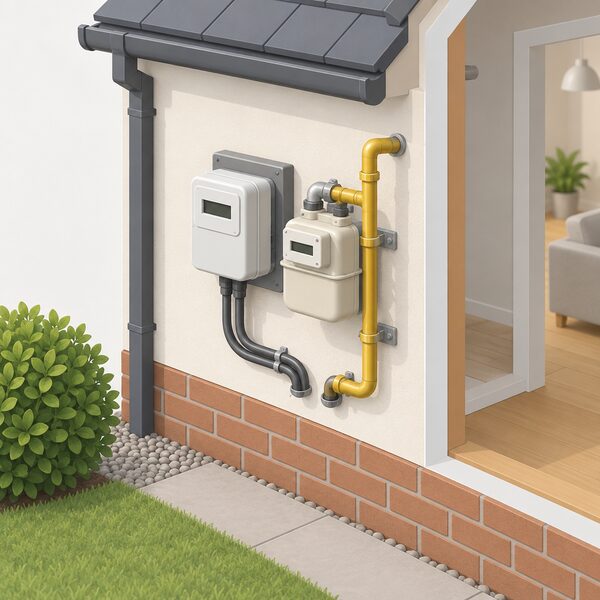
A deemed tariff applies when a property takes supply without an agreed contract. It is usually the same as the supplier's standard variable tariff and often the most expensive option available25. The situation arises most commonly on moving into a new home, or when a fixed deal ends and nothing is chosen in its place.
The reason deemed rates sit higher is structural. Suppliers are not able to purchase gas or electricity in advance for these customers and instead must pay the market rate at the time energy is consumed13. Without a forward contract, there is no hedge, and the price reflects that.
EDF publishes deemed tariff prices effective from 1 October 2026, with electricity VAT at 0% and gas VAT at 5%5. The VAT treatment is worth noting because it differs between the fuels, and a household comparing a deemed rate with a fixed quote should check whether VAT is included on both sides.
Standard variable rates are the usual landing point. A household is probably on a standard tariff if it has never switched supplier, has not switched for a year or more, has had a fixed deal end, or is on a tariff whose name includes words such as Simpler, Flex, Basic, Standard or Variable7. Recognising the position is the first step; the second is choosing a product deliberately rather than by default.
For independence, a deemed tariff is the weakest position in the range. The household has no price certainty, no negotiated rate and no forward purchase behind its supply. It is the point at which the supplier holds all the information and the household holds none. The routes out are covered in what happens if I do nothing when my fixed deal ends and energy tariffs.
Sources25 cited
- EDF Energy tariffs, Energy Helpline, 2026-09-20
- Energy tariffs explained, Uswitch, 2026-02-17
- Fixed price energy, EDF Energy, 2026
- How do I read my EDF Energy bill?, Uswitch, 2025-11-21
- Tariff Watch, End Fuel Poverty Coalition, 2026-09-20
- Change energy tariff, EDF Energy, 2026
- Standard rate tariffs, Uswitch, 2026-08-26
- Understand your electricity and gas bills, Ofgem, 2026
- Smart Energy GB FAQs, Smart Energy GB, 2025-08-08
- Smart Export Guarantee, Solar Energy UK, 2026-05-12
- How to switch energy supplier, Which?, 2026-05-15
- Understanding consumers' energy tariff choices, Ofgem, 2025-07
- Deemed contracts and rates, Energy Ombudsman, 2026-09-20
- Charging electric vehicles, Energy Saving Trust, 2026-04-23
- Tariffs for renewable technology, Energy Saving Trust, 2026-08-12
- Should I buy an electric car?, Which?, 2026-04-16
- Reduced public charging prices could boost EV sales, ChargeUK, 2026-07-31
- Smart Export Guarantee, Energy Saving Trust, 2026-05-20
- Feed-in Tariff, Uswitch, 2026-07-13
- Feed-in Tariffs: generators, Ofgem, 2026-09-17
- How to check your energy tariff and switch, British Gas Energy Trust, 2026-07-30
- Switch your home energy supplier, Ofgem, 2026
- Understanding energy bills, StepChange, 2026-09-20
- EDF Customer Support Fund, Charis Grants, 2026-09-17
- Moving house energy checklist, Energy Saving Trust, 2026-05-01
 EDF Smart Meters and Smart Pay As You GoHow do you top up an EDF smart meter when you pay as you go, and what happens if the credit runs out?
 EDFEDF is one of the big six energy suppliers in the UK, owned by the French government.
 EDFEDF is one of the Big Six suppliers, serving around 5 million UK households.