
In this comparison
The Feed-in Tariff (FIT) and the Smart Export Guarantee (SEG) are not two versions of the same deal. FIT was a subsidy scheme that paid for every unit of electricity a qualifying installation generated, plus a smaller amount for what it exported. SEG is an export-only obligation on larger suppliers, paying only for electricity that actually leaves the property. FIT closed to new applicants on 1 April 2019 and has been replaced by the SEG, which came into force on 1 January 2020 under the Smart Export Guarantee Order 20191.
For a household already on FIT, the practical question is whether to give up the export half of the legacy payment in exchange for a SEG tariff. The generation half is not at stake: generators do not have to opt out of FIT generation payments to receive SEG export payments4. What is at stake is the export rate, and the decision is one-way. Once you have switched to a SEG tariff you cannot switch back to FIT export payments, although your generation tariff remains unaffected5.
The two schemes also pay on different bases. FIT export payments are often deemed, estimated as a percentage of the generation meter reading rather than measured, while SEG payments are calculated from export meter readings and require a smart or export meter capable of half-hourly measurement6.
What the Feed-in Tariff paid and how it worked
FIT was introduced in 2010 to encourage UK households to invest in renewable generation, and ran from June 2010 until March 2019, when it closed to new applications8. It was designed to guarantee an income for electricity generated by microgeneration technologies, and it required FIT licensees to make fixed tariff payments for electricity generated and exported to the National Grid10.
Payments came in two parts. The generation tariff paid a sum based on the total amount of electricity generated, whether or not the household used it. The export tariff was a smaller amount, loosely based on how much electricity was exported back to the grid5. Ofgem sets the rates, and a household's rate was set when the installation was registered and rises in line with inflation each year8. The payment agreement runs for up to 25 years, with payments continuing until the end of the initial 20-year period8.
The generation side is where the legacy value sits. Generation payments, paid on every unit created whether used or not, can be as high as 60p or more per unit for legacy customers, which is why FIT holders are reluctant to disturb the arrangement8. The export side is much smaller: around 5 to 7p/kWh, fixed but rising with inflation5.
In scheme year 13, FIT payments included £1.63 billion in generation payments and £80.7 million in export payments12. The actual value of the exported electricity was significantly higher than the price paid for it under the scheme, which reduced the overall cost of FIT and was beneficial to consumers12. That gap between the market value of export and the FIT export rate is the origin of the current choice facing FIT holders.
The Feed-in Tariff is closed to new applicants: what that means
The FIT scheme is closed to new applications but still operates for existing arrangements13. Installations already accredited under the scheme continue to receive payments7. The closure date is given as 1 April 2019 in most Ofgem reporting, with the scheme closed to new applicants from 31 March 2019 subject to several time-limited extensions and grace periods12. The government closed FIT to new applicants to reduce costs and focus the budget on other sustainable initiatives8.
Closure does not mean the scheme has ended. It means the population of accredited installations is fixed and slowly running down. Any active contracts will end on their designated closure dates and will not be renewable under the FIT scheme16. Ofgem still publishes quarterly and levelisation reporting on the scheme: the Feed-in Tariff Levelisation Report for April to June 2026 details the total FIT payments made by FIT licensees for that quarter17.
For a household, closure has two consequences. First, no new installation can join, so a home without an accredited FIT installation has no route into the generation tariff at any price. Second, the remaining FIT income is a wasting asset tied to a contract end date, which matters when a FIT home changes hands.
The Smart Export Guarantee: how the replacement differs
The SEG is a support mechanism that ensures people who generate their own electricity are paid for electricity they export to the grid18. It replaced FIT, but it pays only for export19. It does not offer upfront payments, and unlike FIT it is a legislative obligation rather than a publicly funded scheme: no public funding is required, and no fee is added to consumer bills20.
The design was set out in a 2019 consultation. Suppliers would be obliged to provide at least one export tariff, and suppliers would determine the tariff per kWh for remuneration and the length of the contract22. That is the structural difference from FIT, where rates were determined by the government23. Under the SEG, licensees determine the rate, contract length and other terms which generators will receive24.
Two rules protect the household from a nominal payment. Every SEG tariff must pay a rate greater than 0p/kWh at all times, and the tariff must offer an above zero pence rate per kilowatt hour of export at all times3. There is no ceiling and no floor beyond zero, so rates vary widely by supplier.
The scheme has grown. In SEG year 5, 337.8 GWh (76.2%) of export was on tied tariffs, which are only available if specific conditions are met, for example if import electricity is purchased from the same supplier, or the generator purchases or uses certain products. The remaining 105.3 GWh (23.8%) was on untied tariffs, worth £7.73 million (13.6%) compared with the tied total3. A household choosing a SEG tariff is therefore choosing between a higher rate with conditions attached and a lower rate without them.
Legacy FIT rates vs SEG rates: what each pays per kWh
The rate structures are not comparable line for line, because FIT pays on generation and SEG pays only on export. A FIT holder comparing the two is comparing a small export rate against a supplier-set export rate, while keeping the generation payment untouched.
| Feed-in Tariff | Smart Export Guarantee | |
|---|---|---|
| What is paid | Generation and export payments8 | Export payments only8 |
| Who sets the rate | Ofgem sets the rates8 | SEG licensees determine the rate, contract length and other terms24 |
| Export rate | Around 5 to 7p/kWh, fixed but rising with inflation5 | Supplier-set; must be greater than 0p/kWh at all times3 |
| Illustrative rate | Not applicable | 12.5p/kWh assumed in a 2025 government revenue estimate9 |
| Contract length | Set for up to 25 years, rising yearly with inflation8 | Determined by the supplier24 |
| Inflation link | CPI, with the indexation moved on 1 April 20268 | Not applicable |
The 12.5p/kWh figure is an assumption used to estimate revenue raised through the SEG in a 2025 government consultation, not a rate any supplier is obliged to pay9. It is useful only as an indication of the order of magnitude that official modelling has used. Actual rates vary by supplier, so the Energy Saving Trust advises shopping around for the best deal19.
The FIT export rate of around 5 to 7p/kWh is the number a FIT holder is giving up5. Where a SEG tariff pays more than that, the export half of the arrangement improves; where it pays less, the household has traded a known, inflation-linked rate for a supplier-set one. The generation payment continues either way, and it is usually the larger part of the total.
Switching from FIT export payments to a SEG tariff: the rules and the point of no return
The exclusivity rule is absolute. You cannot receive both SEG payments and FIT export payments for the same electricity1. You must choose one scheme for your export payments, and you cannot be paid by both SEG and the Feed-in Tariff for the same energy you are sending to the grid8. Generators intending to claim SEG payments must not be in receipt of an FIT export tariff for the same generation capacity4.
The process is therefore sequential. In order to register for the SEG, you must first opt out of FIT export payments for your installation by contacting your FIT licensee1. You then apply directly to a SEG tariff supplier to get paid20. The SEG tariff supplier does not need to be the same as the energy supplier that provides your import electricity20.
Two conditions shape the timing. You can only opt in or out of FIT export payments once a year, so the request has to be made in the right window8. And the move is irreversible: once you have switched to a SEG tariff, you will not be able to switch back to FIT export payments, although your generation tariff remains unaffected5. If you have a deemed or estimated FIT export rate, you will not be able to go back to it once you have a smart meter8.
"You can't get both FIT export and SEG payments. But you can opt out of your FIT (export) payments and get SEG payments instead while continuing to receive FIT generation payments"
There is one route to holding both, and it requires separate equipment. You can receive SEG payments for an installation when you already receive FIT export payments for a different installation, as long as the installations are completely separate with distinct import and export meters and different import and export MPANs7. That is a rule about two installations, not two payments for one array.

Smart meters, deemed export and meter readings under both schemes
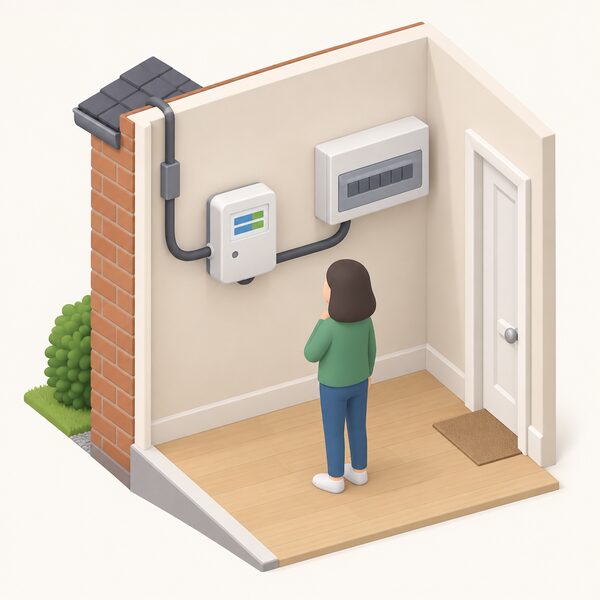
FIT export payments have historically been estimated rather than measured. Under deemed export, export is estimated as a percentage of the generation meter reading, rather than being based on an export meter reading6. The common assumption is that 50% of all the electricity generated is exported5. Metered export, by contrast, is paid according to export meter readings12.
The SEG works only on measurement. SEG payments are calculated by using export meter readings, and generators must have a smart meter to monitor exports24. Most accredited FIT installations will be eligible for the SEG, provided they have a smart or export meter installed, and the meter must be capable of taking measurements at half-hourly intervals1. The Energy Saving Trust states the requirement as a registered smart meter that records your exported electricity, even if you are not signing up to a smart tariff18.
The consequence of fitting a smart meter while on FIT is specific and worth stating plainly. If you currently receive deemed export payments, then these will stop and you will instead receive export payments for the amount of electricity recorded by the meter exported to the grid1. A household that exports less than half of what it generates would see its export payment fall on that change; one that exports more would see it rise. The deemed assumption is replaced by the household's own measured behaviour.
For generation payments under FIT, a generation meter is required and readings must be sent by agreed deadlines8. SEG payments are exclusively an export tariff, based solely on how much electricity is exported back to the grid, as recorded by the smart meter5.
Owning a FIT or SEG home: selling, switching supplier and keeping payments running
FIT and SEG payments are administered by suppliers, not government. The government does not make FIT or SEG payments: energy suppliers who have signed up to either scheme are responsible for administering the scheme and making payments5. Under FIT, all energy suppliers with over 250,000 customers must be part of the scheme, while suppliers with fewer than 250,000 customers can apply to be part of it8. Only those with 250,000 or more must provide FIT payments5.
Switching import supplier does not disturb a FIT rate. Switching energy suppliers will not change your Feed-in Tariff payment rate, and you can switch to a new energy provider without taking your FIT with you8. Your old supplier is required to continue making FIT payments5. FIT payments are usually quarterly, based on meter readings submitted by FIT generators to their FIT licensee, though the frequency varies by supplier23.
SEG arrangements behave differently. Your SEG does not need to be the same as your standard energy supplier, and you can move to another supplier without moving your SEG tariff, but you may find yourself moved to a less generous export rate by your old supplier23. Because SEG rates vary by supplier, the export side of the arrangement is worth reviewing periodically in a way that a FIT export rate never was19.
On a house sale, the FIT payments can transfer. The previous owner should inform Ofgem they no longer own the solar panels due to the house sale, after which the buyer can apply for the remaining FIT payments19. Because payments continue until the end of the initial 20-year period, a FIT installation carries a remaining income stream with a known end date5. A buyer taking on a SEG arrangement inherits a supplier-set rate with no such certainty.
For the household's energy independence, the distinction is straightforward. FIT generation payments are a fixed, inflation-linked income tied to a closed scheme and a contract end date, and they reduce reliance on the import supplier for part of the household's overall energy cost. SEG payments are a market rate for a measured export, set by whichever supplier the household chooses, and they depend on a smart meter, a supplier and a contract that can be renegotiated. Neither scheme removes the household's dependence on the grid for the times it cannot generate, and neither pays anything for electricity the household uses itself.
Sources26 cited
- Feed-in Tariffs (FIT) generators, Ofgem, 2026-09-17
- Feed-in Tariffs scheme closure, Ofgem, 2026-09-17
- Smart Export Guarantee Annual Report Year 5, Ofgem, 2025-12
- FIT Guidance for Licensed Electricity Suppliers V17.1, Ofgem, 2024-09-06
- Can I switch energy supplier if I have solar panels?, Uswitch, 2026-06-04
- Feed-in Tariffs: tariffs and payments, Ofgem, 2026-09-17
- Guidance for FIT Generators V18, Ofgem, 2024-09
- Feed-in Tariff guide, Uswitch, 2026-07-13
- Solar carparks and EV charging call for evidence, GOV.UK, 2025
- Feed-in Tariffs guide to commissioning, Ofgem, 2023-06-09
- Feed-in Tariff FAQ, Ofgem, 2016-07
- Feed-in Tariffs Annual Report Scheme Year 13, Ofgem, 2023-12
- Feed-in Tariffs, Energy Ombudsman, 2026-09-20
- Feed-in Tariffs Quarterly Report Issue 57, Ofgem, 2024-09-30
- Smart Export Guarantee Order 2019 explanatory memorandum, legislation.gov.uk, 2019-06
- Smart Export Guarantee guide, Energy Helpline, 2026-09-20
- Feed-in Tariff Levelisation Report April to June 2026, Ofgem, 2026-08-31
- Smart Export Guarantee, Energy Saving Trust, 2026-05-20
- Buying a house with solar panels, Energy Saving Trust, 2026-08-13
- Smart Export Guarantee: earn money for exporting renewable electricity, GOV.UK, 2020-01-01
- New laws to guarantee payment for solar homes, GOV.UK, 2019-06-09
- The future for small-scale low-carbon generation, BEIS, 2019-01
- Energy customers who produce renewable energy get £800,000 compensation, Ofgem, 2022-11-14
- Smart Export Guarantee scheme rules, Ofgem, 2026-09-17
- Guidance for SEG licensees, Ofgem, 2019-12
- POSTnote: Smart Export Guarantee, Parliamentary Office of Science and Technology, 2026-06-25
 Export Tariff ApplicationsHow the Smart Export Guarantee application works, how export readings are collected, and how often payments are made.
 Solar Export PaymentsIf you have solar panels, how do you actually get paid for the electricity you send back to the grid?
 Solar and Battery Import TariffsWhat does a special import tariff actually get you when you have solar panels or a home battery?
 Export Rates Per kWhHow much will your supplier pay you for the solar power you send to the grid, and why do rates vary so much from one company to another?
 The Full Tariffs GuideWhich energy tariff suits how you live, and will switching really save you money?
 Green Energy TariffsDoes a green tariff really mean greener electricity comes into your home, or just that your supplier buys renewable certificates to match what you use?