
In this comparison
tado° and Hive are the two smart thermostats most often weighed against each other in the UK, and the choice turns less on the hardware than on what each one asks of the household afterwards. tado° is a Munich company founded in 2011, selling a retrofit thermostat designed for DIY fitting and a subscription called AI Assist at £3.99 per month1. Hive is the smart heating brand sold by British Gas, with thermostats from £79 and £119 and a subscription, Hive+, at £3.99 a month or £39.90 a year3.
The practical differences are these. tado° supports room-by-room zoning through smart radiator valves and, on the tado° X range, uses Matter, the open smart home standard, so it works with Google Home, Apple Home, Amazon Alexa and Samsung SmartThings6. Hive supports Alexa, Google Home and Apple Home but does not currently support Matter6. tado° states that its thermostats work with gas boilers, oil heating, heat pumps, district heating and air conditioning heating systems; Hive does not offer air conditioning control6.
Both are cloud-connected products. Neither is a route to energy independence on its own: each depends on a manufacturer's servers, an app and, for most functions, a live internet connection. What they change is how precisely a household can decide when heat is produced, and how much of that decision sits on the device rather than in a data centre.
tado° vs Hive at a glance
The two systems overlap on the basics and diverge on protocol, zoning and subscription structure. tado° has spent 15 years on smart heating and describes itself as the market leader in Europe, with over 1 million homes using its products1. Hive's thermostat is described by its maker as its best-selling product, and British Gas sells smart thermostats, smart plugs and smart light bulbs under the Hive brand5.
| tado° | Hive | |
|---|---|---|
| Origin | Munich, founded 20111 | Smart heating brand sold by British Gas5 |
| Thermostat price | Installer and offer dependent1 | From £79 (Mini), from £1193 |
| Subscription | AI Assist, £3.99 per month2 | Hive+, £3.99 a month or £39.90 a year4 |
| Smart home standard | Matter on the tado° X range6 | No Matter support6 |
| Voice assistants | Alexa, Google Home, Apple HomeKit, Samsung SmartThings via Matter6 | Alexa, Google Assistant, Apple HomeKit, Siri Shortcuts and IFTTT3 |
| Room-by-room zoning | Yes, via smart TRVs6 | Radiator valves available; Saver Mode and Schedule Assist not compatible with multiple zones or Hive Radiator Valves4 |
| Air conditioning control | Yes, via Smart AC Control9 | No6 |
| Heat pumps | Thermostats plus Heat Pump Optimizer X6 | Heating and hot water control |

Who makes each thermostat: tado° of Munich and Hive of British Gas
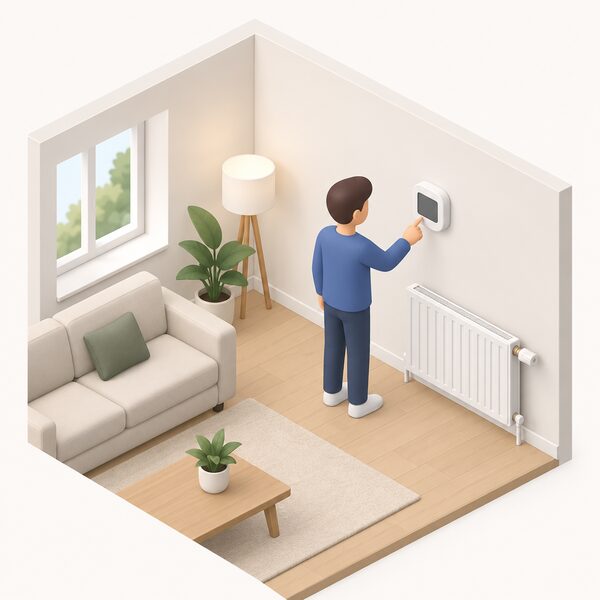
tado° was founded in Munich in 2011 and describes itself as a smart heating pioneer from that city, with 15 years spent perfecting smart heating1. It launched in the UK in October 2013, having operated in Germany and other European countries beforehand10. The company states that it is the market leader in Europe and that its app carries top ratings from more than 36,000 reviews in the App Store1.
Hive is a different kind of business: a brand owned and sold by British Gas, which offers smart thermostats, smart plugs and smart light bulbs under it5. That ownership matters to a household in two ways. First, support and warranty run through a large energy supplier rather than a standalone technology firm. Second, Hive+ bundles British Gas discounts alongside its heating features, with terms stating that the discounts are subject to fair use and standard British Gas terms, are for UK customers only, are available to new Hive+ customers only, and cannot be used on pre-existing orders or with any other offer4.
The distinction is not about quality but about dependence. A tado° household depends on a Munich manufacturer's cloud and app; a Hive household depends on a brand inside one of the UK's largest energy suppliers. Neither dependence disappears if the household switches energy supplier, but the Hive relationship sits closer to the gas and electricity account.
Savings claims: up to 28% against Hive+'s £18 a month
Both makers publish savings figures, and both are maker claims rather than independently audited outcomes for an individual home. tado° points to a 2022 Fraunhofer Institute for Building Physics study, which compared the energy demand of typical homes using weather forecast and absence detection heating control against conventional control and confirmed savings of up to 28%1. Separately, tado° states that its AI Assist subscription can save up to 55% more energy than with the basic tado° app2.
Hive's claim is expressed in pounds rather than percentages. Hive states that Hive+ can cut cold weather bills by up to an extra £18 a month, and that the top 30% of monthly savings were £17.99 or more across every customer and all months from October 2020 to November 20234. That is a distribution, not a promise: it describes the best-performing third of a customer base over three years, and the maker's own wording is "up to".
"The top 30% of monthly savings were £17.99 or more across every customer and all months since October 2020 - November 2023"
Independent reporting puts tado°'s claimed bill saving at up to 31%, attributed to the manufacturer10. For context on what a percentage is worth, independent analysis of fixed tariffs found one 12-month fix saving £262 against the real cost of the price cap, and a British Gas deal was reported as offering a £229 saving11. Those figures describe tariff choice, not thermostat performance, and the two should not be conflated.
Subscriptions: what Hive+ costs and what tado°'s AI Assist adds
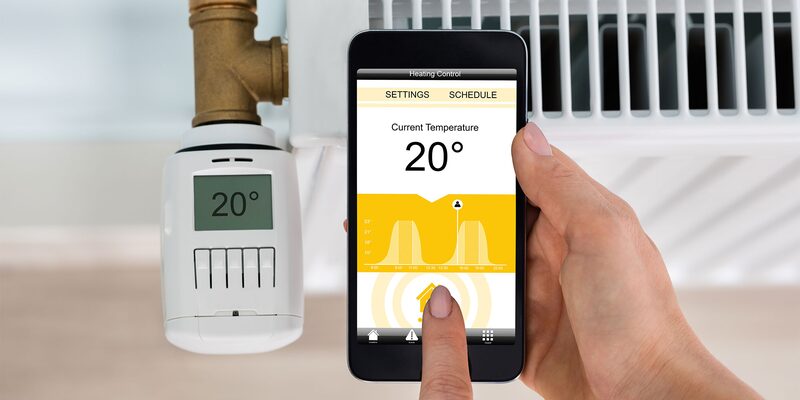
Both systems work without a subscription, and both put their more automated behaviour behind one. tado° AI Assist costs £3.99 per month, and the maker also publishes an annual price of £29.99; the two figures are not reconciled in the same document2. A single AI Assist subscription for tado° X, or Auto-Assist for V3+ and older generations, covers every property under a user's admin account, and subscribers unlock automated Geofencing, Open Window Detection, Adaptive Heating and more across all their homes simultaneously13.
Hive+ is priced at £3.99 a month or £39.90 a year on the thermostat page, while the Hive+ product page gives £19.95 a year or £3.99 a month3. The two published prices disagree and the discrepancy is unresolved. What the subscription funds is listed as Away Mode, Saver Mode, Budget Tracker, Schedule Assist and Remote diagnostics, alongside Schedules, Quick Actions, Heating History, an extended warranty, technical support, Hive discounts, British Gas discounts and free delivery4.
Two conditions are worth noting. Saver Mode and Schedule Assist are not currently compatible with multiple heating zones or Hive Radiator Valves, which limits the subscription's value in a zoned home4. And selecting professional installation brings a whole year of Hive+ free, auto-renewing after 12 months and cancellable at any time4.
Smart home compatibility: Matter and voice assistants
This is the clearest technical split between the two. The tado° X range uses Matter, the open smart home standard, so it works with Google Home, Apple Home, Amazon Alexa and Samsung SmartThings6. tado° also states that Matter support enables future compatibility as the standard develops6. Hive supports Amazon Alexa, Google Home and Apple Home, but does not currently support Matter6. Hive's own product page lists Alexa, Google Assistant, Apple HomeKit, Siri Shortcuts and IFTTT3.
Both tado° and Hive have official Home Assistant integrations, which matters to households running local, open-source control rather than a manufacturer's app alone6. That is the point at which a smart thermostat stops being purely a cloud device: Home Assistant can hold schedules and logic locally, though the thermostat's own connection to the maker's servers remains.
For a household thinking about independence, the protocol question is the one to weigh. Matter is a standard, not a service, and a Matter-certified device can be commissioned into more than one ecosystem. A Zigbee-based Hive thermostat, by contrast, connects to its own hub and ecosystem. Neither arrangement removes the need for the maker's cloud for the features sold with the product.
Zoning and scheduling: room-by-room control compared
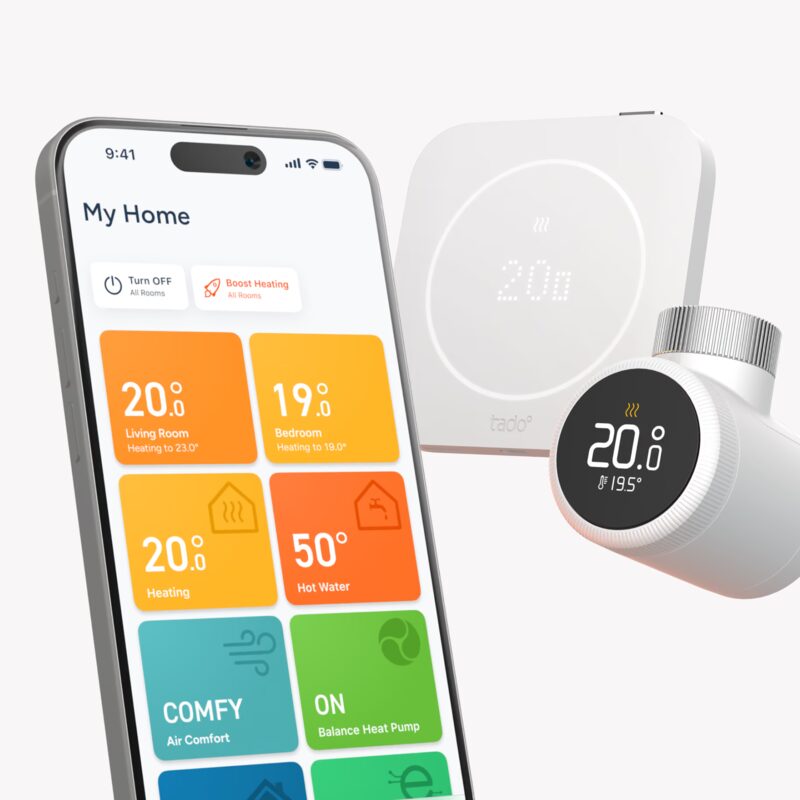
tado° is built around room-by-room control. Manual scheduling runs by room and day, down to 15-minute blocks6. Smart radiator valves let a household set individual temperatures and schedules for each room2. tado° also offers Room Link, an integration between its room thermostats and the boiler that activates the boiler only when a room actually demands heat6.
Hive's zoning is narrower. Hive+ features include Schedules, Quick Actions and Heating History, but Saver Mode and Schedule Assist are not currently compatible with multiple heating zones or Hive Radiator Valves4. The thermostat's temperature precision is 1°C and its connectivity protocol is Zigbee6.
Independent guidance is consistent that zoning is where the control benefit lies. Zone controls heat different rooms at different times of day automatically through separate programmable heating circuits14. Underfloor heating zoning allows individual room temperatures to be controlled, with smart programmable thermostats keeping the home on a schedule to minimise bills15. Electric space heating can treat each room as a separate zone and control it individually16. The recommended minimum set of controls for any home remains a time-controlled programmer, at least one room thermostat, thermostatic radiator valves where radiators are fitted, and a cylinder thermostat where there is a hot water cylinder14.
Heat pumps and other heating systems each supports
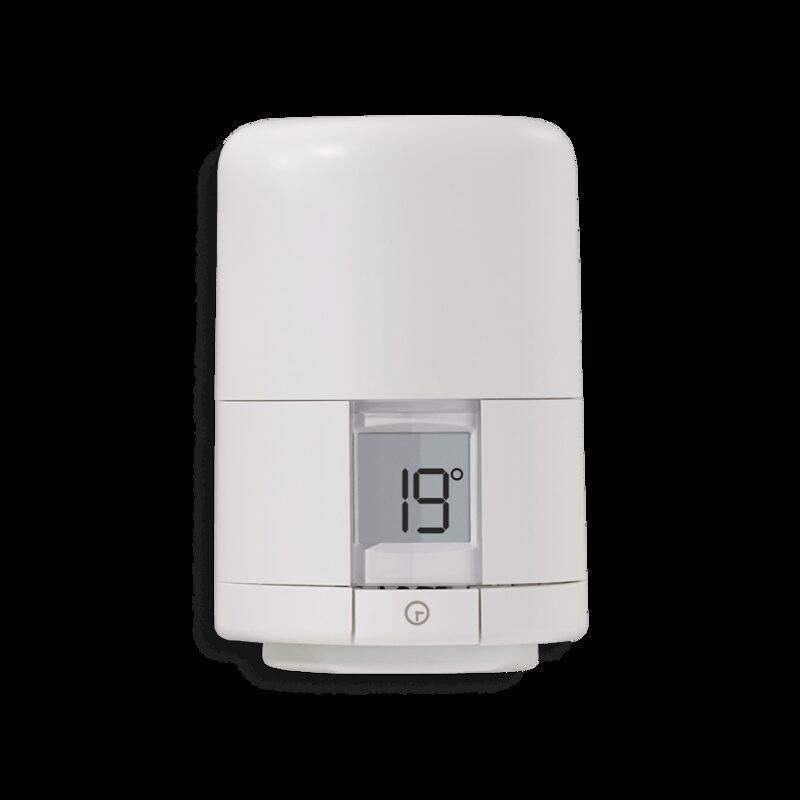
tado° states that its thermostats work with gas boilers, oil heating, heat pumps, district heating and air conditioning heating systems7. For heat pumps it offers a dedicated Heat Pump Optimizer X that works with the heat pump without replacing its control unit, and is compatible with air-to-water, water-to-water and brine-to-water heat pumps, including units not connected to a thermostat9. The maker lists compatibility with major European heat pump brands including Vaillant, Daikin and Panasonic6.
The Smart AC Control extends the same approach to cooling. It works with air conditioners and air-to-air heat pumps that have an infrared remote showing current settings such as mode, temperature and fan speed, covering split, multi-split and portable systems, and replaces that remote so temperature, fan speed and mode are controlled from a phone8. Where the remote has a heating mode, tado° can control that too8. It also has inbuilt open window detection, and with Auto-Assist it pauses cooling automatically8.
Hive does not offer air conditioning control6. Both systems share one limitation: neither supports electric underfloor heating or standalone electric heaters6. That matters in homes heated by panel heaters, storage heaters or electric underfloor systems, where the control choice sits elsewhere. Heat pumps themselves can work with radiators or underfloor heating, and some types can work without either17.

Installation: DIY retrofit versus professional fitting
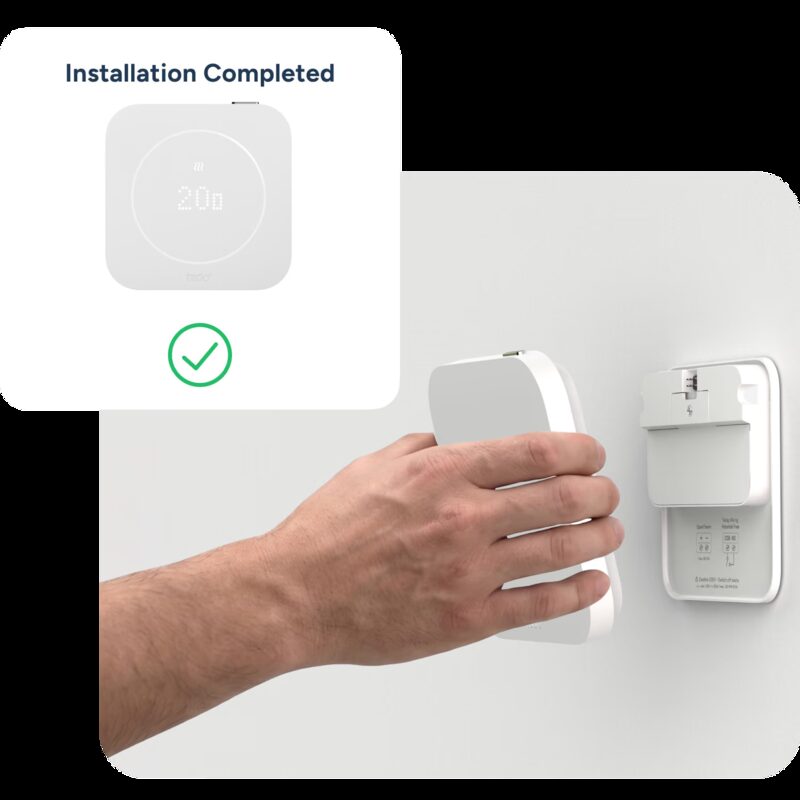
tado° is designed for easy DIY installation and describes itself as the perfect retrofit solution whether a household owns or rents1. Hive recommends finding a local tradesperson to install the smart thermostat, describing it as a task that can be more involved than it looks10. That is the practical dividing line: tado° is sold on self-fitting, Hive on professional fitting, with a free year of Hive+ attached to the pro-install route4.
For any retrofit, the general principle from independent guidance is that a qualified professional assesses the home first, and that fees, independence, qualifications, funding rules and installer standards should be checked before committing18. The same caution applies to controls as to other retrofit work: DIY is viable for some jobs and not others, and the dividing line is usually whether the work touches fixed wiring or the fabric of the building20.
Rented homes face a further constraint. tado° markets itself as suitable whether a household owns or rents, and battery-powered radiator valves avoid new wiring entirely1. A wired thermostat replacement, by contrast, alters the landlord's equipment and normally needs consent, with the property restored at the end of the tenancy.
Sources20 cited
- tado° UK homepage, tado°
- tado° smart radiator thermostats, tado°
- Hive smart heating, Hive
- Hive+ membership, Hive
- How to choose the best energy company, Which?, 2026-01-19
- tado° vs Hive, tado°
- tado° connects over 5.5 million smart thermostats, tado°, 2026-03-26
- tado° Smart AC Control, tado°
- tado° heat pumps, tado°
- tado vs Hive: which smart thermostat is best, Energy Helpline, 2026-09-20
- Whatever day you fixed your energy deal last year you beat the variable rate, Uswitch, 2026-09-07
- British Gas introduces energy deal to beat Ofgem's price cap, IGEM, 2024-02
- tado° multiple homes under one account, tado°, 2026-04-22
- Thermostats and heating controls, Energy Saving Trust, 2026-02-10
- Underfloor heating systems, NICEIC, 2026-09-17
- Electric space heating, BEAMA, 2026-09-19
- Heating your home, Energy Saving Trust, 2026-05-19
- Retrofit your home, TrustMark, 2026-09-20
- Simple guide to retrofit services, Home Energy Scotland, 2026-08
- DIY vs professional home insulation, Uswitch, 2026-08-28
 Heating Control ManufacturersWhich heating controls are worth buying, and who actually makes them?
 Controls, Thermostats and TRVsWhich heating controls actually cut your bills, and what does each one do?
 The Full Heating Controls GuideA room thermostat, a programmer and valves on your radiators are the basics.
 Smart Heating Security and DataHow safe is your smart thermostat from hackers, and who sees the data it collects about your heating?
 OpenTherm Protocol ExplainedOpenTherm lets a smart thermostat and a boiler from different makers work together properly, so the boiler can run gently instead of switching on and off.
 The Full Brands GuideWhich boiler, heat pump or solar brand can you trust, and who actually owns it?