

In this guide
Hive is a smart heating brand owned by Centrica, sold through British Gas and direct from Hive, and it has been in UK homes since the first Hive smart thermostat launched in 20131. Hive describes the thermostat as its best-selling product and the brand as the UK's favourite smart thermostat brand, claims made by the maker rather than by an independent tester1.
The range is built around two thermostats. The Hive Thermostat has manual controls on the device plus app control, while the Hive Thermostat Mini is app control only3. Both work with most gas and LPG boilers, with oil boilers that already have a thermostat or programmer, and with electric boilers that have a standard room thermostat or programmer4. Neither works with storage heaters or plug-in electric room heaters5.
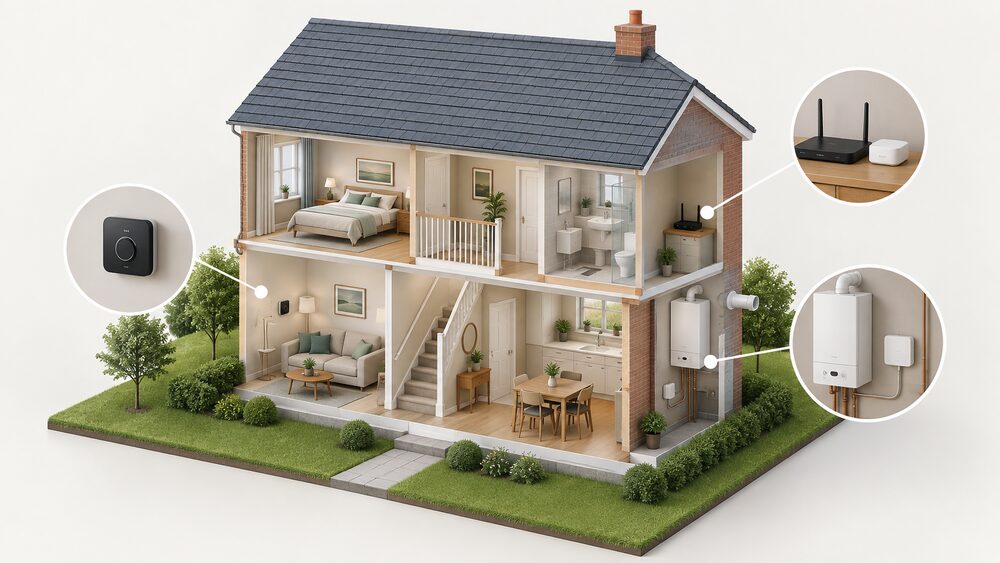
A Hive system is three parts: a hub connected to the broadband router, a receiver wired into the heating system, and the thermostat itself5. The thermostat and receiver talk to each other locally over Zigbee, so heating continues if the internet drops; what stops is app control4. That split, local control that survives an outage and remote control that does not, is the central fact about owning Hive.
What Hive makes and where the brand stands
Hive's product line has widened well beyond the thermostat. The shop carries smart heating, smart home devices, radiator valves, sensors and air-to-water heat pumps, and the company states it does not sell ground source heat pumps because it focuses on air-to-water systems as a better fit for most UK homes7. Heat pump installation runs through three named partners: British Gas, Glow Green and 21 Degrees8.
The thermostat remains the anchor product. Hive says the smart thermostat is its best-selling line and that the brand has grown to become the UK's favourite smart thermostat brand, both maker claims1. Independent recognition exists too: Hive states the Hive Smart Thermostat is recommended by Which? experts, and Which? testing of smart thermostats from Hive, Honeywell, tado°, Worcester Bosch and others scored its highest model at 77% and its lowest at 55%9. Those two figures describe the spread across the whole test group, not Hive alone.
The brand's position matters for a household because it determines the support horizon. Hive has retired products at the end of fixed support periods: the Nano 1 Hub was deactivated in August 2023, the Hive Leak Sensor lost support in September 2023, and the Hive View Camera and Hive HomeShield both ended support in August 202511. The Hub 360 sound detection add-on stopped in December 202211. Hive states its smart thermostats and radiator valves will still be supported into 202610. That is a commitment with a stated end point, not an open-ended one, and it is the pattern to weigh against any connected heating device.
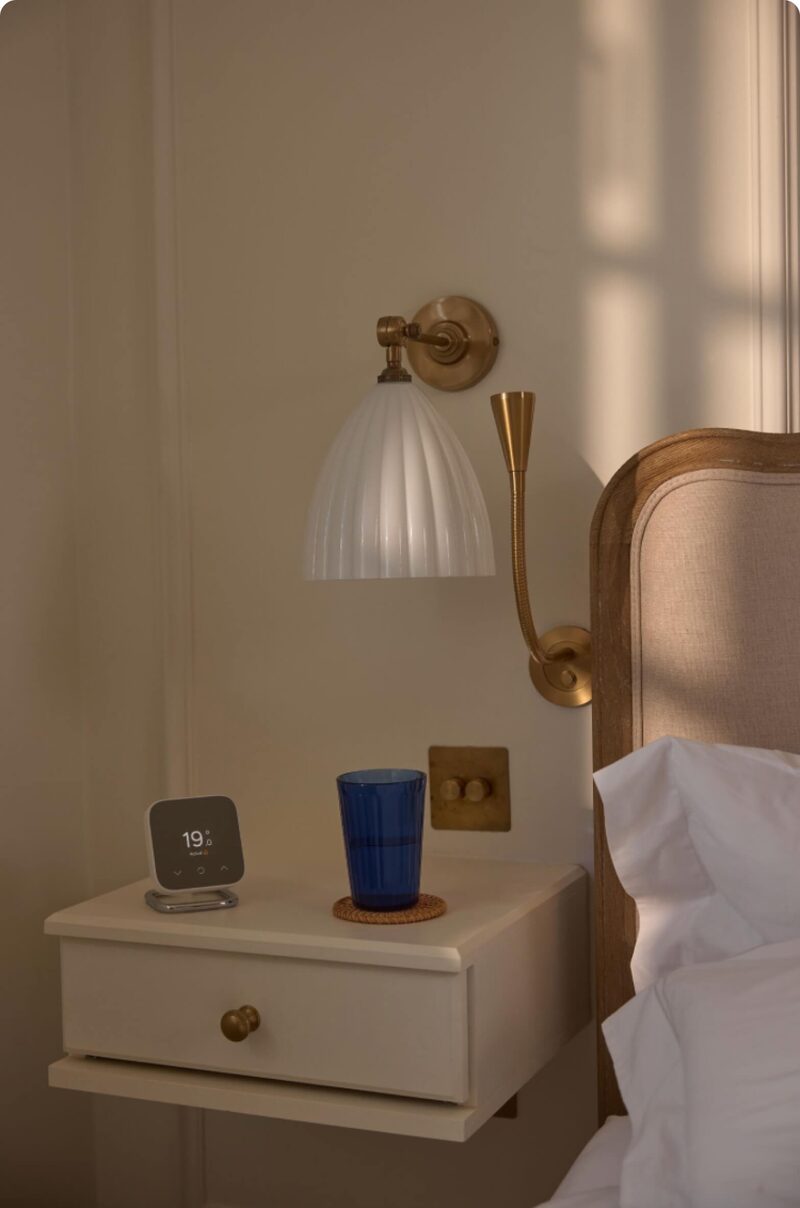
Hive Thermostat and Thermostat Mini: which model suits which home
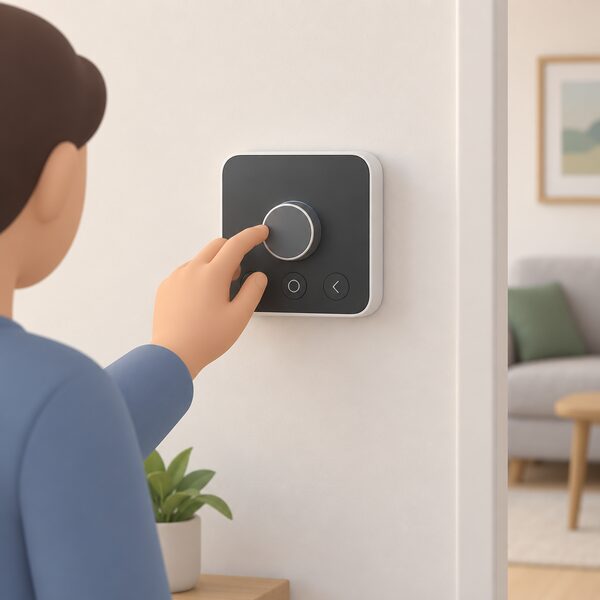
The two thermostats differ mainly in how they are operated. The Hive Thermostat carries classic manual controls on the device alongside app control; the Hive Thermostat Mini is full app control only3. For a household where someone wants to turn the heating up at the wall without reaching for a phone, that difference decides the choice. For a household already living in an app, the Mini does the same job.
Both models share the core feature set: frost protection, holiday mode, heating boost and geolocation alerts3. Geolocation sends an alert if the householder leaves with the heating on, and a second notification if they are on the way back and the home is colder than the set temperature1. Independent guidance lists the Hive Thermostat V4 as able to control hot water, with frost protection, GPS tracking, programme modes and a child lock, and the Mini V4 with the same list minus the child lock12.
Hot water control is the practical dividing line for homes with a cylinder. The Hive Thermostat can turn hot water on or off, set a schedule, or boost it from 5 minutes up to 6 hours on conventional systems with a hot water tank4. A combi household has no cylinder to schedule, so that capability goes unused.
There is also a stand accessory. The Hive Thermostat Stand has a weighted zinc base with non-slip feet and a chrome-plated, smudge-resistant finish, and clicks the thermostat into place with no wall mounting or DIY14. It fits only the Hive Active Heating 2 Wireless Thermostat and will not fit the wired version or the Hive 1 Thermostat, so the model matters before buying14.
| Model | Control | Hot water | Notable features |
|---|---|---|---|
| Hive Thermostat | Manual on device plus app3 | Yes, schedule and 5 min to 6 hour boost4 | Frost protection, holiday mode, boost, geolocation3 |
| Hive Thermostat Mini | Full app control only3 | Not stated | Frost protection, holiday mode, boost, geolocation3 |
Compatibility: which boilers and heating systems work with Hive
Hive's compatibility rule is simple and worth stating plainly: if a boiler works with a standard room thermostat or programmer, Hive can control it5. The product page sets out the same position in more detail, covering most gas and LPG boilers, oil boilers with an existing thermostat or programmer, and electric boilers with a standard room thermostat or programmer4.
The exclusions matter as much as the inclusions. Hive does not work with storage heaters or individual plug-in electric room heaters5. It is incompatible with Honeywell SmartFit Controls and the Vaillant VR 65 Control Centre, both of which form part of an existing control system rather than the boiler itself4. The product page also lists a set of Worcester Bosch models that Hive Active Heating will not work with, identified by model and GC number, so a householder with an older Worcester Bosch boiler should check the list before ordering4.
Beyond boilers, Hive thermostats work with wet underfloor heating systems2. They are OpenTherm enabled, but only with compatible combi boilers, which is the route to modulating control rather than simple on and off switching3. Hive Radiator Valves work with multizone installations where each zone has its own thermostat, and can be linked to a specific thermostat; Heat on Demand requires a Hive Thermostat and enabling in the Hive app9.
Heat pumps are covered through the Works With Hive programme. Daikin air-to-water heat pumps are compatible with the Hive ecosystem, and heating and hot water can be controlled through Hive even without a Hive thermostat installed15. That is a different arrangement from the boiler case, where the Hive thermostat is the control.
Features and specifications: dimensions, power, connectivity and zones
The Hive Thermostat measures 95.9mm wide, 95.9mm high and 46.2mm deep including the dial, or 31.4mm without it, and weighs 265g with batteries or 172g without4. The receiver is 90mm by 90mm by 36.8mm, weighing 159g for the single channel version and 166g for the dual channel version including the back plate4. The thermostat runs on four AA batteries, included, with the receiver on 230V mains4. Hive's support guidance confirms the four AA batteries when replacing them17.
System requirements are modest: an internet connection of 1.5Mbps or higher, an iOS or Android device running an up-to-date operating system, and the Hive app4. The hub needs a broadband router with a spare Ethernet port, and Hive recommends setting it up over Ethernet first, then removing the cable and connecting wirelessly over WiFi8. All Hive heating devices use Zigbee for local communication4.
Zoning is where the range extends. Adding more thermostats allows control of up to 6 zones of heating where an existing multizone heating system is in place4. Hive describes multizone heating as control of multiple zones within the house, and the Hive active heating thermostat comes with geofencing technology alongside that multi-zone capability2. Temperature precision is 1°C18.
Voice and platform support is broad but not universal. Hive thermostats work with Alexa, Google Assistant, Apple HomeKit, Siri Shortcuts and IFTTT, and the Hive Hub carries the same list3. Hive supports Amazon Alexa, Google Home and Apple Home but does not currently support Matter18. The Hive app is also compatible with Philips Hue19. Matter's absence means integration runs through Hive's own platform links rather than a cross-brand standard, which is a consideration for a household building a mixed smart home.

Cost: prices, Hive+ membership and installation
Hive sells direct, and the published prices sit behind a membership tier. The Hive Thermostat is listed at £119, or £101.15 for Hive+ members6. The Hive Thermostat Mini is listed at £101.15 for Hive+ members on the product page, while the price list gives £79 with a member price of £67.154. The two documents disagree on the Mini, and both figures are shown here as published. Hive+ membership itself is listed at £19.95, reduced from £39.906.
Accessories follow the same pattern. The Hive Thermostat Stand is £24.65 for Hive+ members, a 15% saving, and the Hive Window and Door Sensor is £24.65 for members6. A winter promotion running from 14 September 2026 to 5 October 2026 offers 50% off Hive+ and 15% off selected products for members4. Free standard delivery applies on orders over £100, taking 3 to 5 business days4.
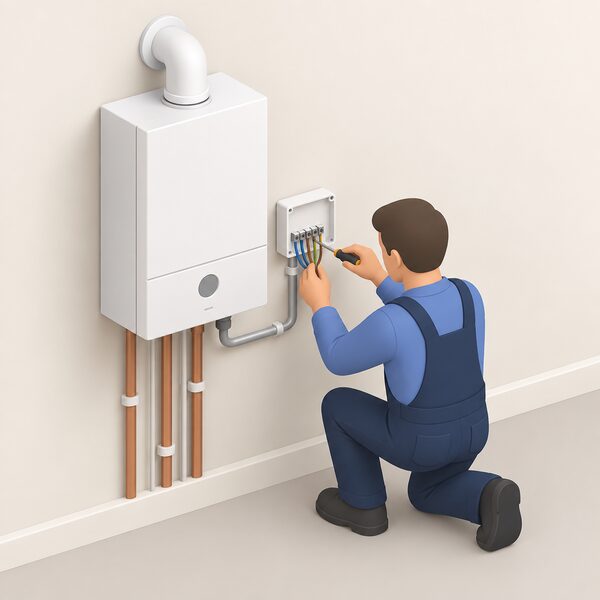
Installation is the part Hive does not price on the page. Hive recommends professional installation of its smart thermostats, and independent guidance repeats that recommendation for both the Thermostat V4 and the Mini V412. The installation sequence is: set up the hub, wire the receiver to the heating system, then finish setup in the Hive app20. Because the receiver is wired into the boiler, this is not a plug-in job, and the cost is installer-quoted rather than published. One energy supplier has run a promotion offering a free Hive Mini Smart Thermostat with a boiler installation under a promotional code, which is a bundled offer rather than a standalone price21.
Savings claims: what the figures are based on
Hive's headline claim is a saving of up to £167 a year on bills, and the product page gives the basis: a saving of £167.12 based on the Ofgem medium annual gas consumption4. The price list gives a different figure and a fuller method: a saving of £158.40 based on the Ofgem medium annual gas consumption of 11,500 kWh at the April 2026 UK average unit price of 5.739 pence per kWh including VAT6. The two documents disagree, and both are maker figures rather than independent measurements.
The OpenTherm claim is separate. Hive states that with compatible combi boilers, OpenTherm control gives up to 12% extra energy savings and can reduce gas emissions by up to 12%4. That applies only where the boiler supports OpenTherm, so it is not a general figure for the range.
Independent and official figures on thermostat savings are broader and less specific to Hive. East Hertfordshire Council states that reducing the thermostat by 1°C could save up to 25% of heating bills and associated carbon22. Smart Energy GB reports that turning the thermostat down by 1°C could save money each year on energy bills, varying by location and energy price23. Which? notes that savings figures of this kind are calculated from a weighted average of projected, current and recent energy price caps by the Energy Saving Trust24.
The Energy Saving Trust's own work on smart homes describes thermostats that interpret inputs such as preferred room temperature, learn from behaviour, react to data like weather forecasts, and in some cases predict behaviour from how the heating is set and how the home is occupied25. Independent guidance notes that some thermostats learn from heating habits until adjustment becomes rare26. What none of these sources establish is a measured saving for a Hive thermostat in a particular home. The maker's figure is a modelled saving against a standard consumption profile, and the household's own result depends on the schedule it replaces.
Warranty, returns and support status
Hive products carry a 1-year standard warranty4. That is short by the standards of the boiler market, where warranties run for years, and it reflects the fact that the thermostat is an electronic control rather than a heat source. Hive+ membership extends it: joining Hive+ gives ongoing warranty on all Hive devices13. The membership is listed at £19.95, reduced from £39.906.
Returns run to 14 days from the day the products are received, or from the point of installation where a British Gas engineer installed them4. Refunds are processed within 5 working days of the product being received4.
Support status is the more consequential question for a connected device. Hive has a record of retiring products at the end of a three-year support period: the Hive Leak Sensor in September 2023, and the Hive View Camera and Hive HomeShield in August 202511. The Nano 1 Hub was deactivated in August 2023 and stopped connecting to Hive servers, which is the clearest illustration of what end of support means in practice: a hub that no longer reaches the servers cannot deliver app control11. Hive states its smart thermostats and radiator valves will still be supported into 202610.
The comparison with the wider market is instructive. Google has stated it will no longer launch new Nest thermostats in Europe, a decision reported in May 202527. That is a different company and a different product, but it shows that platform commitment in this category is not permanent. For a household, the practical question is how long the app, the servers and the replacement parts will be there, and Hive's own product news page is the place that record is kept.
What owning a Hive thermostat means for household energy independence
A Hive thermostat changes how a household operates its heating, not where the heat comes from. The boiler still burns gas, oil or electricity from a supplier, and the home remains connected to the grid and to a fuel supply. What Hive adds is scheduling, zoning and remote control on top of that.
The dependence it creates is specific and worth naming. The hub connects to the broadband router, and remote control, energy monitoring and scheduling from away all run through Hive's servers and the Hive app8. If the internet drops, the thermostat keeps switching the heating as normal, but app control is unavailable until the connection returns4. The most common cause of a Hive thermostat failing to connect is the home WiFi not working17. So the household keeps local control at the wall and loses remote control, which is a better position than a system that stops heating entirely, but it is still a cloud dependence for the features people buy the product for.
There are further limits. Independent guidance notes that smart thermostats such as Hive and Nest can be expensive and carry an installation cost, and that having one means tracking only the heating, so electricity and gas usage are not covered28. Smart meters cover that ground separately, and Smart Energy GB notes that many homes already have one29. The warranty position adds a second dependence: the longest cover runs through Hive+ membership, and the standard term is 1 year4.
Moving home settles the question of ownership. The receiver, thermostat and signal booster form part of the heating system and stay with the property, and Hive's guidance is that a householder wanting to continue using a Hive Thermostat needs to buy it for the new home if one is not already installed there11. The hardware is tied to the house, and the account is tied to the household.
For a household weighing independence, the position is straightforward. Hive delivers local heating control that survives a broadband outage, and remote control that does not. It keeps the home on its existing fuel and supplier, adds a dependence on broadband, Hive's servers and the Hive app, and carries a support horizon the maker has stated only into 2026. Households wanting to compare the alternatives can look at Nest vs Hive, tado° vs Hive and Drayton Wiser vs Hive, or read the wider picture in Heating Controls and Energy Independence.
Sources29 cited
- How to use a smart thermostat, Hive, 2025-12-17
- What is multizone heating, Hive, 2025-12-15
- Hive Thermostat, Hive, 2026-09-17
- Smart heating, Hive, 2026-09-17
- How does a smart thermostat connect to a boiler, Hive, 2025-12-17
- Hive shop, Hive, 2026-09-17
- What are ground source heat pumps, Hive, 2025-10-17
- Hive Hub, Hive, 2026-09-17
- Hive radiator valves explained, Hive, 2025-12-17
- How to buy the best smart thermostat, Which?, 2026-09-17
- Moving home with Hive, Hive, 2025-12-17
- How to buy the best smart thermostat, Which?, 2026-09-17
- Hive Radiator Valve, Hive, 2026-09-17
- Hive Thermostat Stand, Hive, 2026-09-17
- Works with Hive, Daikin, 2026-09-17
- Which smart thermostat should I buy, Viessmann, 2022-05-31
- Wireless thermostat not working, Hive, 2026-05-14
- tado vs Hive, tado°, 2026-07-09
- tado vs Hive: which smart thermostat is best, Energy Helpline, 2026-09-20
- How to save money with smart home devices, Hive, 2025-11-20
- New boiler, Uswitch, 2025-03-21
- Home and business grants, schemes and advice, East Hertfordshire Council, 2026-09-17
- Turning down thermostats, Smart Energy GB, 2026-04-22
- Cavity wall insulation costs and savings, Which?, 2026-05-05
- Smart homes, lower carbon footprint, Energy Saving Trust, 2026-01-21
- How a smart thermostat can save you money this winter, ivie, 2025-11-18
- Google withdrawing support for older Nest thermostats, Which?, 2025-05-13
- Ultimate energy saving tips guide, Smart Energy GB, 2026-04-24
- Do I already have one, Smart Energy GB, 2026-03-16
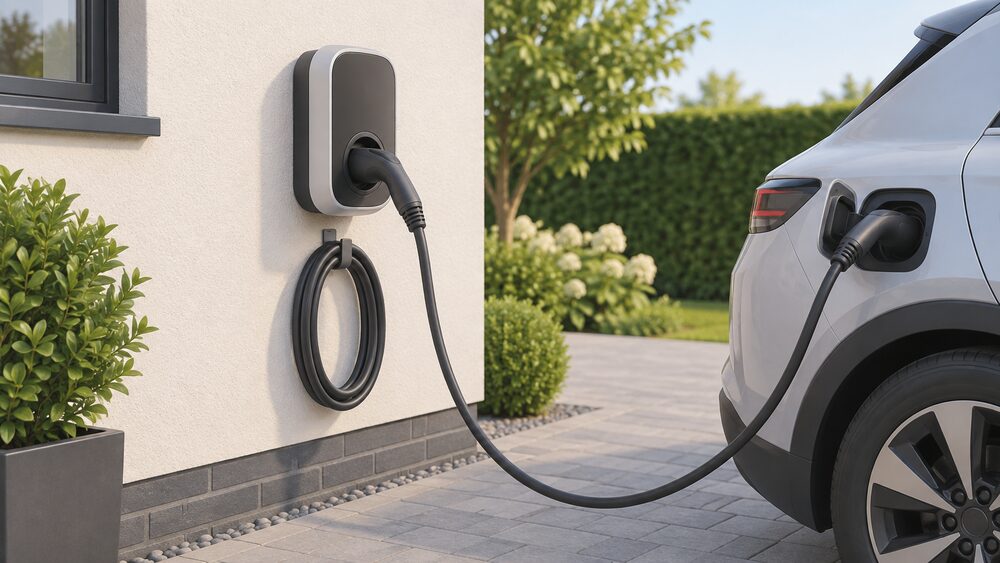 Hive EV ChargerCan you still buy the Hive EV charger, and is it still supported if you already own one?
 Hive ThermostatThe Hive Thermostat in the UK: what it controls, which boilers it suits, what is in the box, Hive+ membership, installation, warranty and returns.
 Hive Smart HomeHive is a widely installed UK smart-home brand covering heating, plugs, sensors and security through one app, with a hub at the centre and a paid Hive+ tier on top.