In this guide
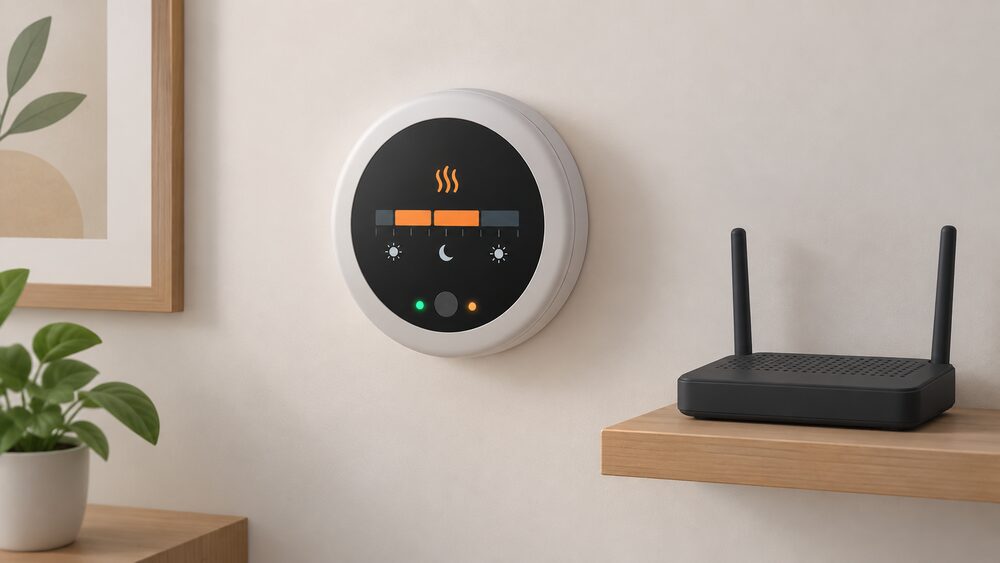
A smart thermostat is an internet-connected thermostat that gives digital control over a home's central heating1. That definition carries the whole problem of energy independence in one line: the control sits in the home, but the intelligence that drives it often sits in a manufacturer's data centre, reached through a broadband line the household does not own and cannot guarantee. When the connection drops, what remains is whatever the device can do on its own.
The distinction that matters is not smart versus dumb, but where the schedule lives. A wireless thermostat is not always smart, and a smart thermostat usually adds app control, internet connectivity and automation on top of ordinary time and temperature control1. Some products keep their running schedule on the device itself. tado° states that Smart Schedules on its Smart Radiator Thermostat X continue to run when there is no internet connection because they are saved locally on the device2. Others depend on the maker's servers for scheduling, so a broadband outage removes app control and any cloud-based automation at the same moment.
Smart meters sit in a different category altogether. They do not use the internet to share data and need no internet connection to work3. Readings travel over the secure smart data network, a closed system used only for smart meters, which does not use the public internet or home Wi-Fi4. A household can therefore lose broadband entirely and still have accurate, automatic metering, which is a genuine independence gain, while a cloud-tied heating control on the same broadband line stops responding to the app.
What a smart thermostat without internet actually means
The phrase describes a device that keeps heating the home on a schedule when the broadband, the router or the manufacturer's cloud service is unavailable. It does not mean the thermostat stops being a thermostat. A room thermostat, smart or not, still switches the boiler or zone valve on and off against a temperature setpoint; what disappears in an outage is remote control, app-based scheduling, learning algorithms that run server-side, and any automation that depends on an outside service.
Energy Saving Trust draws the line clearly: the main difference is that smart controls are connected to the internet and offer more functionality than conventional controls, including the ability to turn the system on or off and change the temperature from a smartphone when away from home9. That remote capability is exactly what a broadband failure removes. The local capability, a setpoint and a schedule held on the device or the wall unit, is what survives.
Why this matters for independence is straightforward. A household that has cut gas use, added solar or a battery, or moved to a time-of-use tariff is trying to run heating on its own terms. If the schedule that delivers those savings lives on a server the household does not control, then the savings depend on a third party's continued operation, its continued support for that model, and a working internet connection. A local schedule depends on none of those.
Local control versus cloud control: where the difference lies

Local control means the decision to heat is taken inside the home: by a wall thermostat, a programmer, a radiator valve, or a hub on the same network as the boiler. Cloud control means the decision is taken, or at least relayed, through a server outside the home. Many smart systems are hybrid, holding a schedule locally while offering app access through the cloud, which is why the same product can behave very differently in a brief outage and a long one.
The practical test is what happens during a broadband failure. If the schedule is stored on the device, heating continues as programmed and only the app goes dark. If the schedule is stored in the cloud, the system may fall back to a default, to the last commanded state, or to nothing at all, depending on the maker. The manufacturer's documentation, not the marketing, is the place to check.
There is a second dependence that is easy to overlook: the manufacturer itself. A cloud service costs money to run, and a product line that is discontinued can take its app and its servers with it. The same question applies to any hub-based system, where the hub is the single point of failure for every radiator valve and room sensor in the home. A household assessing independence should ask three things of any control: does it hold a schedule locally, does it speak a protocol other devices can use, and does it keep working if the maker's servers are switched off.
"The main difference is that smart controls are connected to the internet and offer more functionality."
Matter: the open standard built for local control
Matter is an open interoperability standard, and its significance for heating is that it lets a controller talk to devices from different makers over a local network rather than through each maker's cloud. That reduces the number of apps and accounts a household needs, and it reduces the number of servers that must stay online for the heating to work.
The evidence in the UK market is still thin, and it is worth being precise about what is documented. Which? lists the Habi Wireless Smart Thermostat as supporting Matter, alongside multi-zone heating, hot water control, frost protection, manual and frost modes and a child lock, with professional installation recommended10. The same listing records that the Google Nest Smart Thermostat E offers self or professional installation, modulating and learning control and frost protection, but no hot water control10. Those two entries show the shape of the choice: a Matter-capable control that handles hot water, or a learning thermostat that does not.
Matter does not by itself guarantee offline operation. A Matter device can still be commissioned through a maker's app and still rely on that app for scheduling. What Matter changes is the ceiling on dependence: a household is no longer locked to one vendor's ecosystem for every device, and a controller from one maker can, in principle, drive a valve or sensor from another. For a home that intends to keep its heating controls for a decade or more, that portability is the point.
Zigbee: a mesh network that keeps working when the internet is down
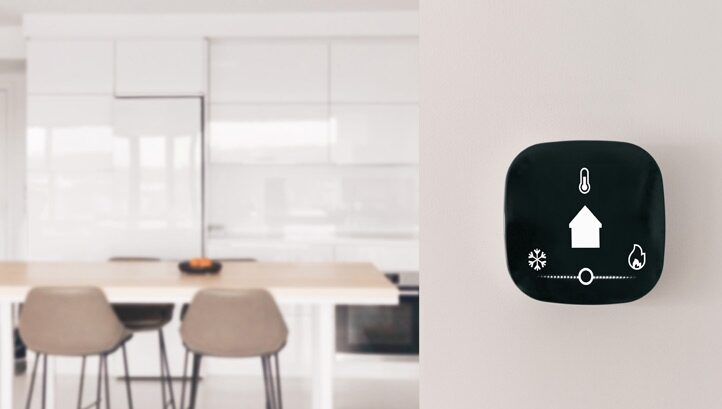
Zigbee is a low-power mesh radio protocol used by many radiator valves, sensors and hubs. Its relevance to independence is stated plainly by the Connectivity Standards Alliance: this consistent and responsive local connectivity still works if the internet is down and does not require connection with or communication to the cloud6.
That is a stronger claim than most smart heating products can make. A Zigbee mesh routes messages between devices in the home, so a valve can be commanded by a hub on the same mesh without any message leaving the building. The mesh also extends range, because each mains-powered device can relay for its neighbours, which matters in a house where the boiler is at one end and the furthest radiator at the other.
The limit is that Zigbee describes the radio link, not the intelligence. A Zigbee hub can still be designed to require a cloud account for scheduling, in which case the local mesh is present but the schedule is not. The protocol removes one dependence, the internet link between devices, and leaves another, the maker's service, untouched. Households weighing protocols will find the trade-offs set out in Zigbee, Matter, KNX and Wi-Fi: protocols for heating controls.
Lightwave devices: offline behaviour and wireless range
Lightwave sits in the same broad category as other Wi-Fi-linked smart heating brands. Smart thermostats such as Hive and Nest connect to Wi-Fi so the household can control heating and hot water through a phone, tablet or desktop11. That is the model Lightwave follows, and it means the app experience depends on the broadband line and on the maker's service.
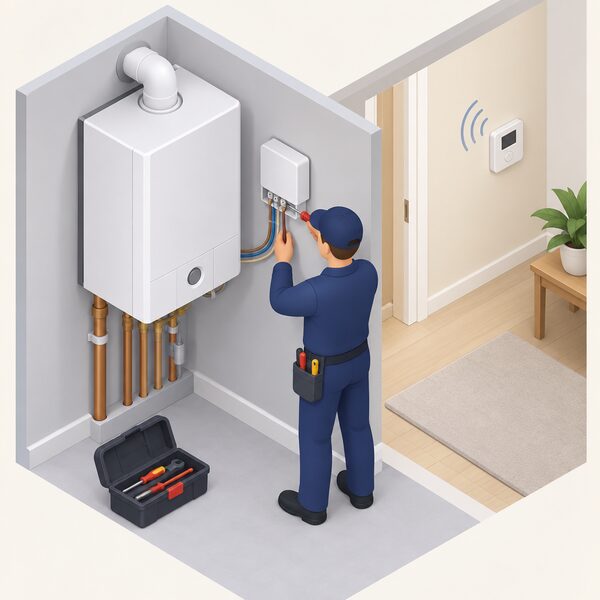
The installation reality is worth stating, because it affects both reliability and warranty. A lot of boilers are not Wi-Fi-enabled, so many smart or wireless thermostat systems still include a wired element: a receiver or hub that must be wired to the boiler, with the wiring done by a trained professional1. That receiver is what actually switches the boiler, and it is usually the part that keeps working when the internet does not. The app is the part that stops.
Wireless range is the other practical constraint. A receiver wired at the boiler and a thermostat on a hallway wall must stay in radio contact, and a hub that also has to reach radiator valves across a large or solid-walled house can struggle. Zigbee mesh devices mitigate this by relaying through mains-powered nodes6; single-point Wi-Fi links do not. For a household in an older or larger property, the number of radio hops between controller and boiler is a design question, not a detail.
Smart meters: a separate system that does not use your home Wi-Fi
Smart meters are frequently confused with smart heating controls, and the confusion runs the wrong way. A smart meter automatically sends electricity and gas meter readings to the supplier12. It does not need home Wi-Fi, broadband, a router or an internet package to do so5. It does not use Wi-Fi, does not connect to the router and does not affect broadband speed5. Smart meters do not use the internet at all: they have their own closed, dedicated communications system4.
That system is the secure smart data network, used solely for smart meters, which does not use the internet or home Wi-Fi13. Because the meter does not use Wi-Fi, it should not cause delays or issues with a home's Wi-Fi connection3. The practical consequence is that metering independence and heating-control independence are separate questions. A household can have fully automatic, accurate metering through a broadband outage, while a cloud-tied thermostat on the same premises is unreachable.
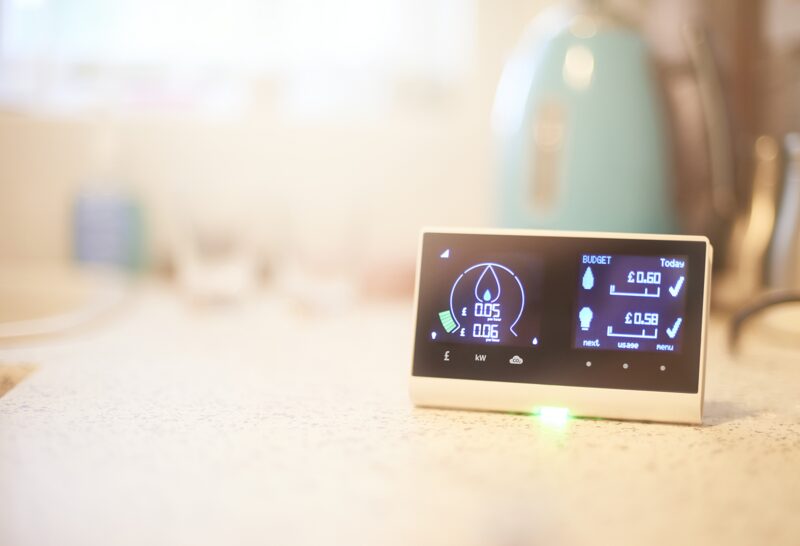
What the meter delivers is a set of capabilities that support independence in a different sense: bills based on accurate readings rather than estimates, access to more flexible tariffs including dual-rate tariffs, automatic credit top-up in prepayment mode, and up-to-date information on energy use that can show where money is being spent12. The in-home display shows how much energy is being used during the day14. None of that requires the household's internet connection.
What each technology can and cannot do offline
The table below sets out what the documented evidence supports for each technology, and where the limits lie.
| Technology | Works offline | What stops in an outage | What it depends on |
|---|---|---|---|
| Local schedule on device (tado° Smart Radiator Thermostat X) | Yes, Smart Schedules saved locally2 | App access and any cloud features | The device itself |
| Zigbee mesh | Yes, local connectivity works with the internet down and needs no cloud6 | Anything the hub routes through a cloud account | The hub and its design |
| Wi-Fi smart thermostat (Hive, Nest and similar) | Partly: the wired receiver still switches the boiler1 | App control and remote scheduling11 | Broadband and the maker's service |
| Matter-capable control (Habi Wireless Smart Thermostat) | Depends on the implementation, not the standard10 | Varies by maker's app design | Local network plus maker's app |
| Smart meter | Yes, entirely independent of home broadband5 | Nothing in the home | The dedicated smart meter network |
Two further points belong in this comparison. First, a smart thermostat's financial case is not a property of the hardware: any cost benefit comes from reducing wasted heating rather than from the thermostat itself, so results vary from home to home1. Second, remote monitoring and remote control of heating plant is a long-established technique in solar thermal systems, where the technical literature treats remote measurement and control as a defined engineering activity rather than a consumer feature16. The lesson from that older field is that remote control is an addition to a system that must work locally first.
Choosing between Matter, Zigbee and hub-based systems
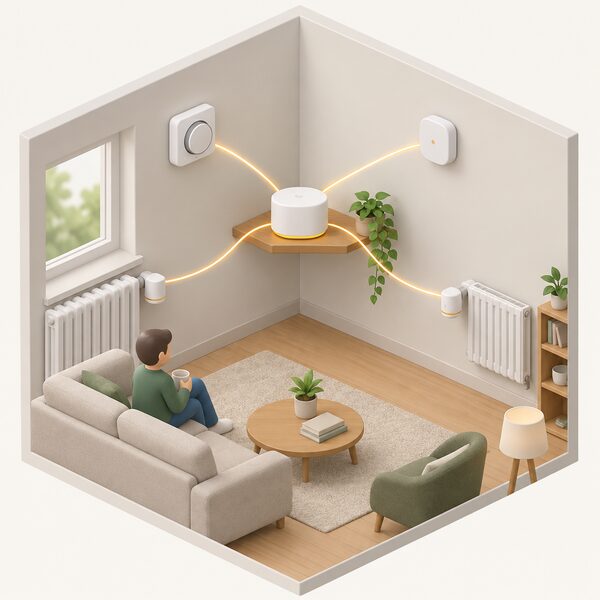
The choice is not about which protocol is best in the abstract. It is about how many single points of failure a household is prepared to accept, and how long it expects the controls to last.
A hub-based system concentrates control in one box. Every valve, sensor and thermostat depends on that hub, and the hub in turn may depend on a cloud account. The advantage is coordination: zoning, per-room schedules and hot water control can be managed together. The disadvantage is that one failed or discontinued hub can strand a whole house's worth of devices.
A Matter-based system spreads the risk across vendors. Devices from different makers can be controlled through a common standard, so replacing one component does not require replacing the ecosystem. The documented UK example, the Habi Wireless Smart Thermostat, combines Matter support with multi-zone heating, hot water control, frost protection, manual and frost modes and a child lock, with professional installation recommended10. A household that wants hot water control alongside Matter support has at least one documented option.
A Zigbee mesh is the strongest local option at the radio level, because it keeps working with the internet down and needs no cloud connection6. It is also the option most dependent on how the hub is designed, since the protocol does not dictate where the schedule is stored.
For households comparing specific products, the practical questions are the same in each case: is there a wired receiver at the boiler that works without the internet, is the schedule held on the device or in the cloud, and does the system speak a protocol that other makers' devices can join? Related reading sits in smart thermostats: how they work and what they do and in smart TRVs: radiator thermostats with app and zone control.
How local control fits a household energy independence plan
Heating is the largest single energy load in most UK homes, so control over when it runs is control over the household's largest variable cost. Local control supports independence in three ways: it keeps the schedule running when the broadband fails, it allows the heating to respond to on-site generation and storage without a round trip to a server, and it removes the household's exposure to a maker's decision to withdraw a service.
Zoning is the mechanism that makes this practical. Zoning allows the temperature of individual rooms to be controlled, and smart, programmable thermostats can keep a home heated on a schedule to help minimise bills17. A zoned home can heat one room in the evening rather than the whole house, which is what makes self-consumption of solar or battery power meaningful: the load is small enough and timed well enough to be met from on-site generation rather than from the grid.
The dependence that remains is worth naming. A gas boiler still depends on the gas network and on imports. A heat pump still depends on the electricity grid, and on a supplier for the tariff. A cloud-tied control still depends on the maker's servers and on a broadband line. Local control removes the last of these and reduces the household's exposure to the others by shifting load into periods it chooses. It does not remove the grid, the supplier or the fuel.
Smart meters, switching and solar: the practical questions
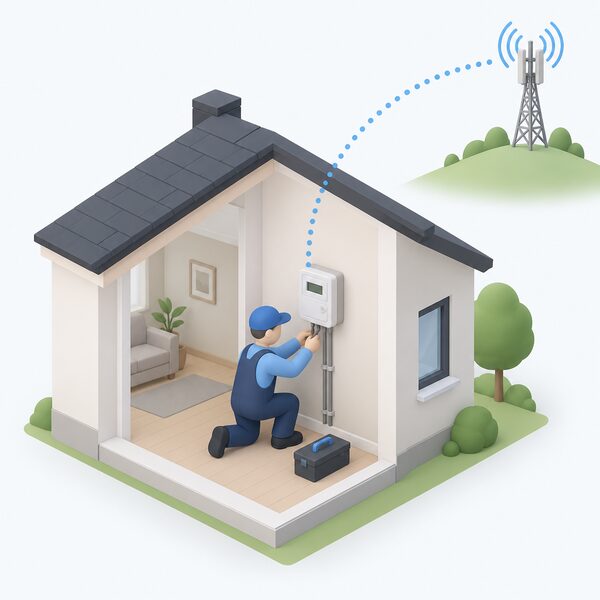
Smart meters are not compulsory. It is not compulsory to have one installed, and a household can refuse if the supplier offers it8. There is currently no requirement for suppliers to install a smart meter on request, though a household that wants one can contact its supplier7. Installation is arranged by the energy supplier at no extra cost7, and there is no direct cost for the meter itself: any expenses are recouped through energy bills over time20.
Switching supplier is unaffected. Having a smart meter does not stop a household switching supplier21, and smart meters should make switching quicker because information can reach a new supplier instantly22. A second-generation meter keeps all smart functions with no interruption, while a first-generation meter may lose some smart functionality23. First-generation meters do not always allow a consumer to change supplier without losing the ability to send meter readings automatically24, though the majority have now been reconnected to the smart meter network22. A new supplier might not offer all smart services, such as remote readings, and the meter may need replacing25. Only under exceptional circumstances would a supplier be expected to change a smart meter back to a traditional meter, and the supplier may charge the costs if it agrees26.
Readings can still be submitted manually. A smart meter usually sends readings automatically, but there are times when manual readings are needed, such as switching supplier, checking usage or resolving an account issue27. Sending a meter reading does not require an internet connection, because smart meters work over the dedicated network24.
Solar households are not excluded. A household can get a smart meter if it has solar panels, and in most cases solar panels do not stop it getting one5. Some suppliers are not yet ready to supply smart meters to customers with solar panels23. Generation payments under a Feed-in Tariff are not affected by having a smart meter28.
Sources28 cited
- What is a smart thermostat?, Smart Energy GB, 2026-08-19
- Smart Radiator Thermostat X, tado°, 2026
- Does a smart meter need Wi-Fi?, Smart Energy GB, 2026-03-16
- Protecting data on the smart meter network, Smart DCC, 2026
- How do smart meters work?, Smart Energy GB, 2026-08-27
- Zigbee FAQ, Connectivity Standards Alliance, 2026
- How accurate are smart meters?, Smart DCC, 2026
- Smart meters: your rights and expectations, GOV.UK, 2025-08-08
- Thermostats and heating controls, Energy Saving Trust, 2026-02-10
- How to buy the best smart thermostat, Which?, 2026-09-17
- Ultimate energy saving tips guide, Smart Energy GB, 2026-04-24
- Get help with your smart meter, Ofgem, 2026-09-17
- Smart Energy GB FAQs, Smart Energy GB, 2025-08-08
- Get help with your smart meter, Ofgem, 2026
- Underfloor heating system, NICEIC, 2026-09-17
- Technical Study Report on Measuring, Remote Monitoring and Remote Controlling for Solar Thermal Systems, Solar Heat Europe, 2017
- ECO4 innovation approved innovation measures, Ofgem, 2026-02
- Do you have to have a smart meter by law?, Smart DCC, 2026
- Getting a smart meter installed, Citizens Advice, 2026-09-17
- Smart meters, Welsh Government Climate Action, 2026
- Problems with services, Isle of Anglesey County Council, 2025-10
- Guide to smart meters, Energy Saving Trust, 2026-07-15
- Myth-busting smart meter problems, Smart Energy GB, 2026-09-17
- Smart meter performance, Ofgem, 2026
- What is a smart meter?, Which?, 2026-04-07
- Smart meters, Energy Ombudsman, 2026-09-20
- How to get a smart meter, Smart DCC, 2026
- How do smart meters save energy?, Smart DCC, 2026
 Local Control vs the CloudCan your solar, battery or charger still work if the maker's app or servers disappear?
 App Subscriptions and CloudWill you have to pay a monthly fee for the app that comes with your heat pump, boiler or solar setup?
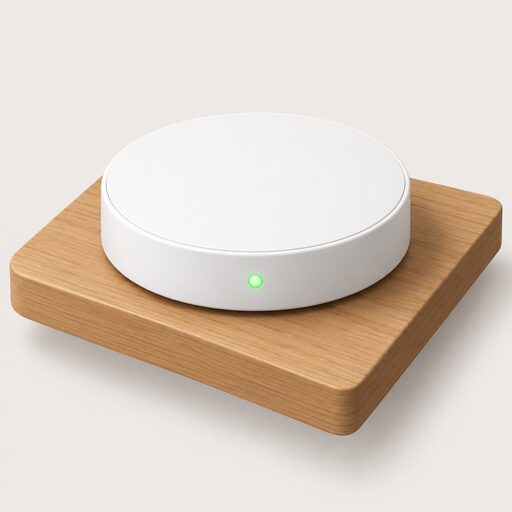 Zigbee, Matter, KNX and Wi-FiWill your smart thermostat and radiator valves keep working if the broadband goes down, and can gear from different brands talk to each other?
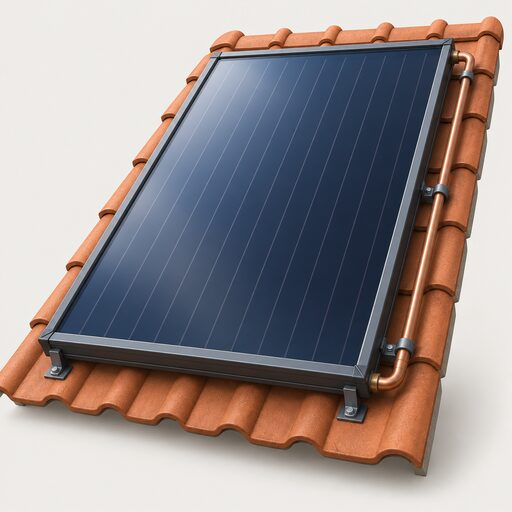 Heating and Energy IndependenceCan you heat your home without relying on gas or oil, and what would that take?
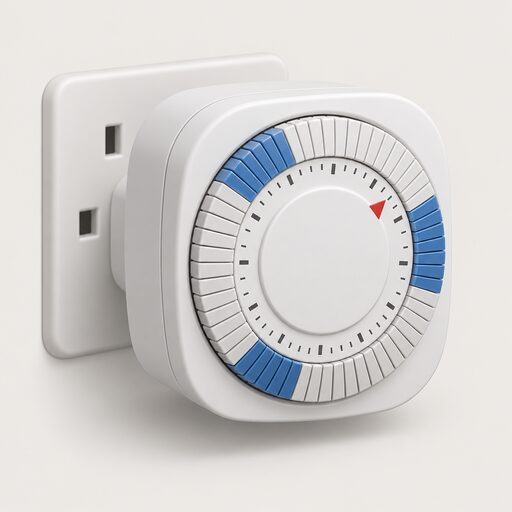 Controls and Time-of-Use TariffsCheaper electricity at night only saves money if your heating actually uses it then.
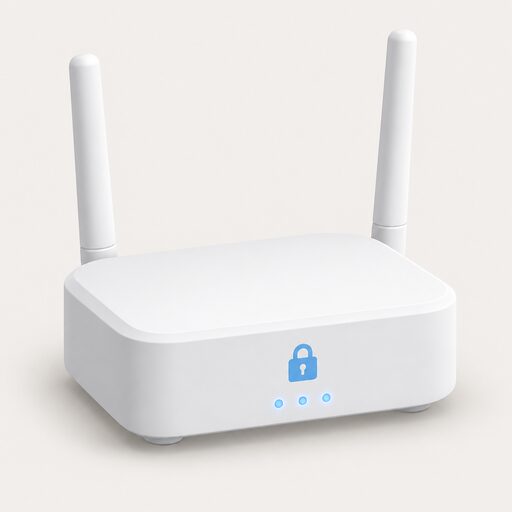 Smart Heating Security and DataHow safe is your smart thermostat from hackers, and who sees the data it collects about your heating?