
In this answer
Short answer
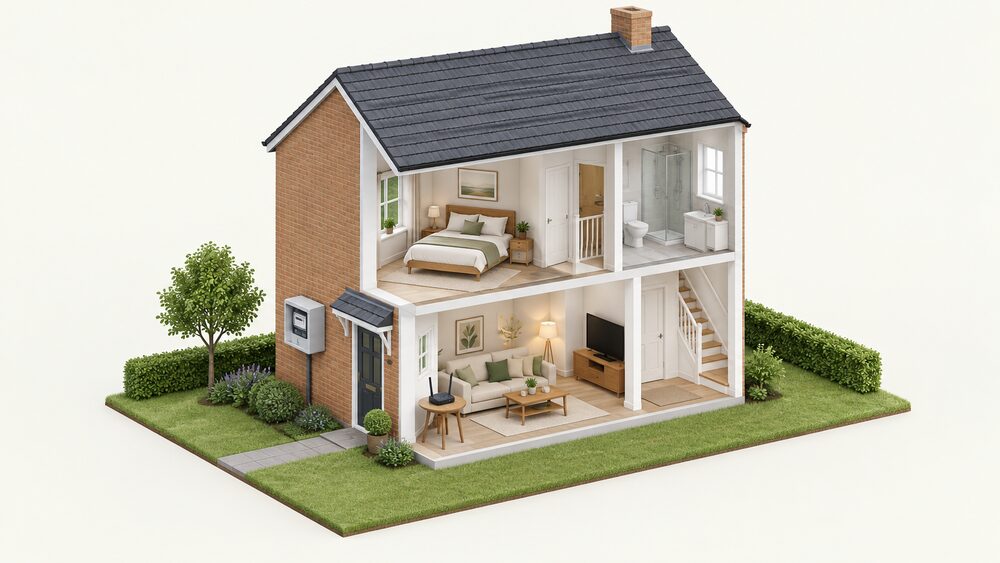
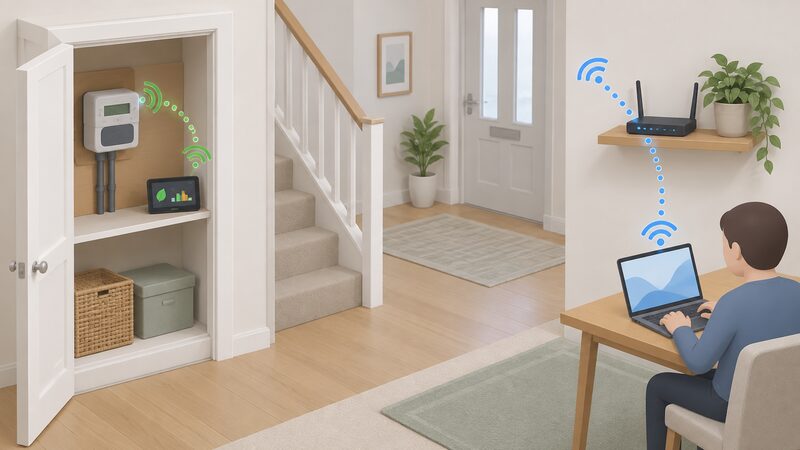
A smart meter does not slow down your broadband. It does not use your Wi-Fi, it does not connect to your router, and it does not touch your internet connection at all. A smart meter "does not use your Wi-Fi, connect to your router or affect your broadband speed"1. The meter sends its readings over a separate, closed communications network built for metering, so there is no shared path between the meter and your connection for anything to slow down.
The practical consequence is that a household can have no broadband at all and still have a fully working smart meter. "You do not need home Wi-Fi, broadband, a router or an internet package for a smart meter to send readings"1. Readings travel automatically and wirelessly to the supplier at least once a month over that dedicated network2.
What people usually mean when they ask this question is that their broadband felt slower around the time a meter was fitted. The two events are almost always unconnected. The one genuine interruption is the installation visit itself, when the router may be switched off; once it is switched back on, the meter has no effect on the connection2. The rest of this page sets out how the meter connects, what actually causes slow broadband in a smart-meter home, and what the Data Use and Access Act means for the data the meter produces.
How a smart meter connects: why it bypasses your Wi-Fi
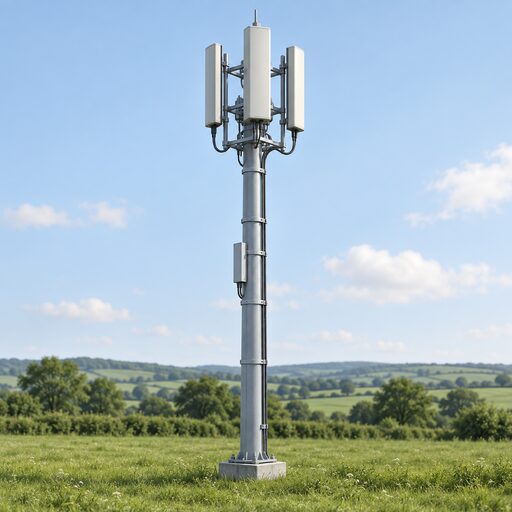
The reason a smart meter cannot slow your broadband is structural rather than a matter of good behaviour. The meter is not a device on your network. It sits on a separate communications system, and the two systems do not meet.
Smart meters "do not use the internet, and they have their own closed, dedicated communications system"4. That system carries metering data and nothing else. The meter "doesn't need, or connect to the public internet or your home Wi-Fi"5. Readings go to the supplier over the secure smart data network, which is solely for smart meters and does not use the internet1.
The network is operated by the Data Communications Company (DCC), which manages the secure data network that meters use to send readings automatically and wirelessly6. Because the path is dedicated, the meter's traffic never enters your router, never consumes your bandwidth and never competes with streaming, video calls or downloads.
Installation follows the same logic. "You also do not connect a smart meter to wifi during the installation process either"2. There is no step in the visit where the meter is paired to your home network, and no password is needed. Even supplier-branded meters follow this pattern: British Gas smart meters "typically don't connect directly to your home Wi-Fi network" and use the specialised wireless network designed for smart meters7.
The in-home display is separate again. It receives data from the meter over the Home Area Network, "a secure network" that is local to the home and independent of broadband8. That is how the display can show near real-time changes in household energy use without a router being involved9.
What can actually cause slow broadband in a smart-meter home
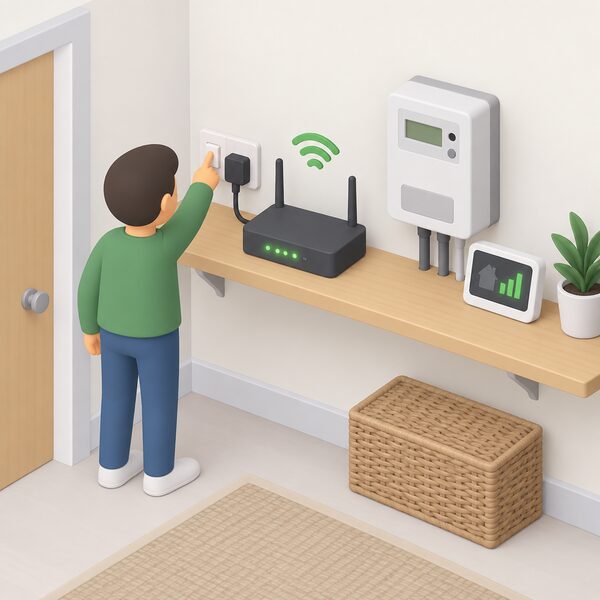
If broadband is slow, the cause lies somewhere other than the meter. The honest answer is that the meter is not a plausible candidate, and the useful work is in ruling it out and looking at the things that do change connection quality.
The one real, temporary effect is the installation visit. During the work "your wifi router will be turned off during this time, but once it's switched back on, your smart meter will not impact your wifi connection"2. A router that has been power-cycled can take a few minutes to re-establish its connection and retrain its line, which is why the slowdown appears to coincide with the visit. It does not persist.
Radio exposure is a related worry, and the evidence points the other way. Smart meters do emit radio waves, but "it's a much lower amount than other everyday devices such as your mobile phone, or your Wi-Fi router"3. Exposure to radio waves from smart meters is "much lower than from other electronic appliances, such as mobile phones and wi-fi equipment"10. A device emitting less than the router beside it is not a credible source of interference to that router.
Where a meter does lose its connection, the symptoms are about metering, not broadband. A meter may "stop recording the energy you use, or may no longer send readings to your supplier"11. When communications are lost, "your bills may temporarily become estimated", manual readings may be needed, and the in-home display may stop updating correctly6. None of those is a broadband fault, and none of them touches your internet speed.
One genuine connectivity risk is physical rather than electronic. Where a gas meter is moved, the work "may result in the wireless connectivity of the meter being lost"12. That affects the meter's own link to its network, not your broadband.
Data Use and Access Act: what it means for your meter data
The Data Use and Access Act 2025 passed into law, and it makes changes to data protection law, but it does not remove the consent requirement for energy data sharing14. For a household, the position on meter data is unchanged in the ways that matter: the data is about energy, it travels on the metering network, and the household controls who sees it.
You "have control over who can access the energy use data from your smart meter; including how often and for what purpose", except where access is required for regulated purposes such as billing15. The data itself is used to bill you for the energy you use, to offer new products and services such as new tariffs where permission has been given, and to help make the energy system more efficient by recording demand more accurately16.
The network that carries it is built for the purpose. It "uses two layers of encryption, and the most important data passes over our network without us h"4. Through that network, smart meter data can be shared securely between authorised users to support smart energy services and innovation across the energy sector17.
For energy independence, the picture is mixed and worth stating plainly. The meter gives the household a near real-time view of its own consumption through the in-home display, which is a genuine step towards understanding and controlling use9. But the data path runs to the supplier and the DCC, not to the household alone, and the meter depends on that external network to function in smart mode. A household that wants its energy data to stay inside the home has other options, including consumer access devices and local data access.
"The data provided by your smart meter puts you in control of your energy usage, meaning you can take energy-saving steps"
What a smart meter does and does not do for the household
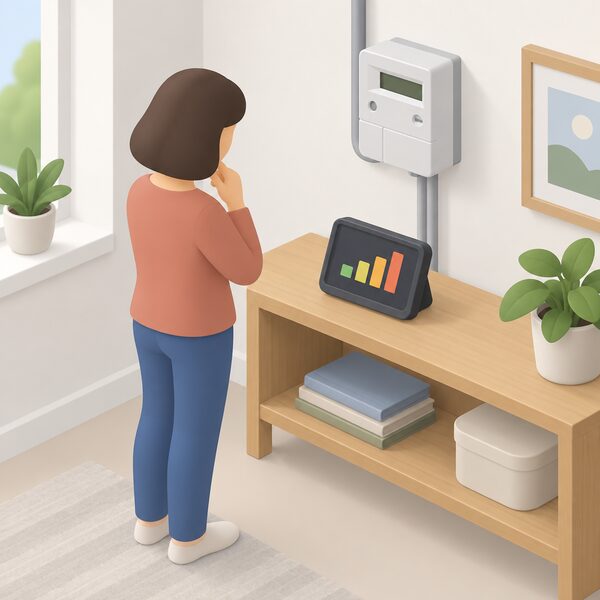
It is worth separating the broadband question from the wider claims made for smart meters, because the two get tangled. A smart meter measures gas and electricity use and sends the readings to the supplier automatically18. It offers two-way communication, so it can wirelessly send and receive information19. It does not, on its own, reduce a bill: "A smart meter won't automatically save you money"20, and it "does not automatically save energy or money; practical changes are needed to save energy"21.
What it does provide is information. The in-home display helps a household keep track of how much energy is being used22, and it can show changes in household energy use in near real-time9. Smart meters also allow suppliers to offer incentives to households that can reduce energy use during peak hours, helping to balance supply and demand and reduce pressure on the grid23.
On the broadband question specifically, the answer does not vary across the four nations. The metering communications network is national infrastructure, and the same separation from home broadband applies in England, Scotland, Wales and Northern Ireland. Welsh government guidance describes the meter sending usage data to the supplier "using a secure network"18, which is the same arrangement described by the network operator for the UK as a whole4.
For a household thinking about energy independence, the meter is a monitoring and settlement device, not a self-sufficiency device. It depends on the grid for the energy it measures, on a supplier for billing, and on the DCC network for its smart functions. What it adds is visibility, and visibility is the precondition for any decision about reducing reliance. Households that want to go further can pair the meter with home energy management systems or standalone home energy monitors, which keep more of the data and control inside the home.
If you would rather not have one
Refusal remains available. It is your right to refuse the installation of a smart meter, though replacement options may be limited if a traditional meter is faulty or unsafe19. Where a customer cannot get a smart meter or does not want one, suppliers "may offer to install smart meter technology but disable the communications function, so it won't send readings automatically"24. A meter in that state still measures energy usage accurately, working like a traditional meter11.
That option is the direct answer for anyone whose concern is the meter's communications rather than its measurement. It removes the wireless link to the supplier while keeping a functioning meter in place. The trade-off is that automatic readings stop, so bills rely on readings submitted by the household, and the in-home display's usefulness is reduced.
Sources24 cited
- How do smart meters work?, Smart Energy GB, 2026-08-27
- Smart meters and WiFi: does a smart meter need WiFi?, Smart Energy GB, 2026-03-16
- Smart meters and health, Smart Energy GB, 2026-03-16
- Protecting data on the smart meter network, Data Communications Company, 2026
- Does a smart meter need Wi-Fi?, Data Communications Company, 2026
- Smart meters vs home energy monitors, Smart Energy GB, 2026-08-17
- How to bleed a radiator, Uswitch, 2026-09-04
- Smart meter data access and privacy, Smart Energy GB, 2026-03-16
- Kettle running costs, Smart Energy GB, 2026-08-17
- Myth-busting smart meter problems, Smart Energy GB, 2026-09-17
- Smart meters not working, Smart Energy GB, 2026-03-16
- Connections FAQ, SGN, 2026-09-17
- Smart meter performance, Ofgem, 2026
- Consumer consent impact assessment, Ofgem, 2025
- Smart meters: your rights and expectations, GOV.UK, 2025-08-08
- Get help with your smart meter, Ofgem, 2026-09-17
- Smart meters and decarbonisation, Data Communications Company, 2026
- Getting a smart meter installed, Citizens Advice, 2026-09-17
- Smart meters, Energy Ombudsman, 2026-09-20
- What is a smart meter?, Which?, 2026-04-07
- How carers could prepare for higher energy bills, Smart Energy GB, 2026-03-16
- Smart meter benefits, Smart Energy GB, 2026-03-16
- How does tidal energy work and how could it impact your energy use, Smart Energy GB, 2026-08-19
- RTS meter switch-off, Energy Saving Trust, 2026-05-08
 How Smart Meters CommunicateSmart meters send readings without using your home wifi or broadband, so they still work if your internet goes down.
 Can a Smart Meter Be Hacked?Can someone break into your smart meter, see your personal details or switch off your power?
 The Full Smart Meters GuideDo smart meters really save you money, and how do you use one to cut your bills?
 How a Smart Meter WorksHow a British smart meter measures gas and electricity, how the in-home display and the DCC's secure network fit together, what data leaves the house, what it costs, and where smart mode goes wrong.
 Meters and Time-of-Use TariffsDo you need a smart meter for a time-of-use tariff, and does it have to send readings every half an hour?
 In-Home DisplaysWhat does the little screen that came with a smart meter actually tell you, and what can you do when it stops working?