
In this guide
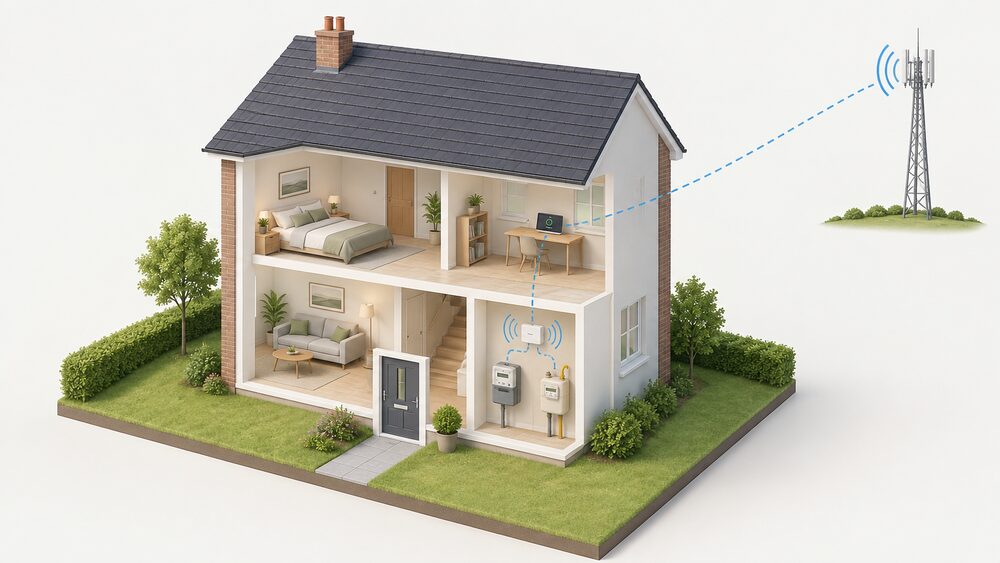
Smart meters in Great Britain do not use wifi. They do not connect to a home router, they are not set up with a wifi password during installation, and they do not use the public internet at all: they send data through their own dedicated communications system, operated by the Data Communications Company (DCC)1. A household with no broadband can still have a fully working smart meter, and a broadband outage has no effect on whether readings reach the supplier.
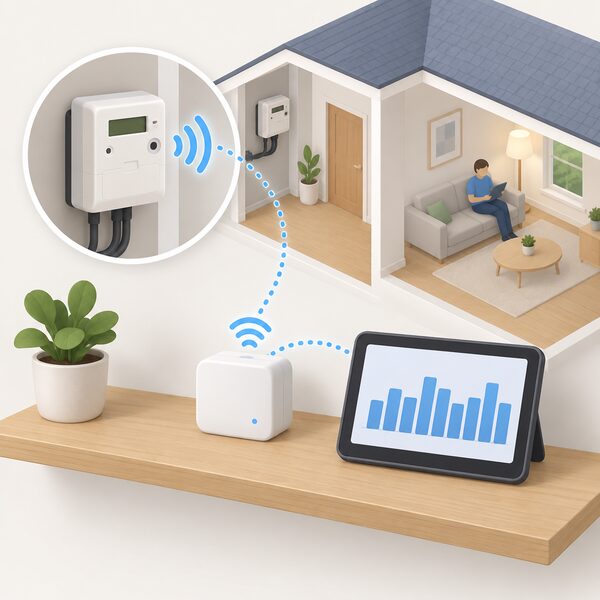
Two separate wireless networks are involved. Inside the property, a communications hub creates a short-range Home Area Network (HAN) that links the electricity meter, the gas meter and the in-home display. Outside the property, a Wide Area Network (WAN) made up of mobile phone or radio masts carries readings from the hub to the supplier, wrapped in two layers of encryption4. The technology used for that outdoor leg differs by region: central and southern Great Britain uses cellular and wireless mesh technology provided by Virgin Media O2, and 4G cellular communication hubs are now being installed nationwide as a further way to connect4.
Coverage is high but not universal. The DCC network is reported to reach 99.3% of properties across the country, with more than half of all homes in Britain now connected to it6. That leaves a residual 0.7% of properties where a smart meter will not operate effectively8. The DCC network covers Great Britain; Northern Ireland sits outside it and is covered separately in our page on smart meters in Northern Ireland.
No, smart meters do not use wifi or broadband
The point is stated flatly by the operator of the network and by the consumer campaign body alike. Smart meters do not use the internet, and they have their own closed, dedicated communications system3. They do not use wifi to send data, and a smart meter does not use a home router or affect broadband speed1.
"smart meters don't use the internet to share data, so they don't need any kind of internet connection to work."
Nor is wifi involved at setup: a smart meter is not connected to wifi during the installation process11. The installer does need the power off for part of the visit, which will turn a wifi router off during that time, but once the router is switched back on the smart meter does not affect the wifi connection11. That distinction matters because it is the commonest source of the belief that the two are linked.
Because there is no shared radio channel with home wifi, a smart meter should not cause delays or issues with a wifi connection11. Smart meters do emit radiation, but a much lower amount than everyday devices such as a mobile phone or a wifi router12. The broader question of exposure is dealt with in our page on smart meter health risk.
How the system works: two-way, wireless, and separate from the internet
Smart meters differ from traditional meters in that they offer two-way communication, meaning they can wirelessly send and receive information13. Sending is the obvious half: readings go to the supplier automatically. Receiving matters just as much, because it allows remote firmware upgrades of meters, unlocking new functionality as it is developed, and it is what allows a meter to be switched between credit and prepayment mode without a new meter being installed5.
Transmission uses radio waves, in a similar way to the sending and receiving of text messages on a mobile phone12. The messages themselves are small: how much energy was used, and when.
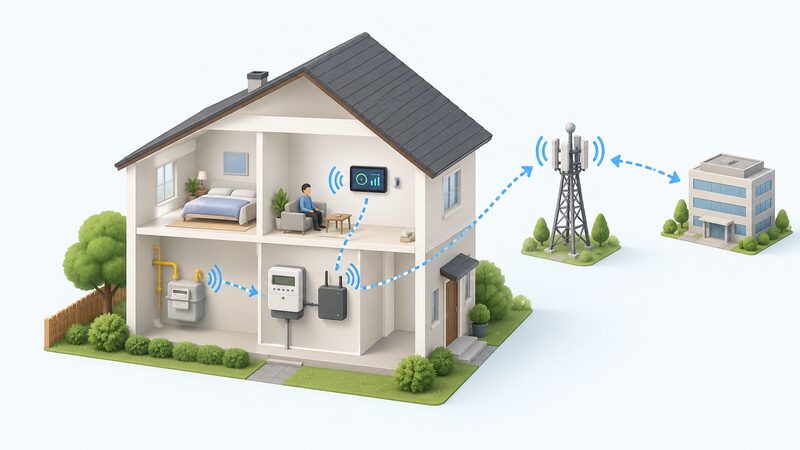
The two networks in the property: HAN and WAN
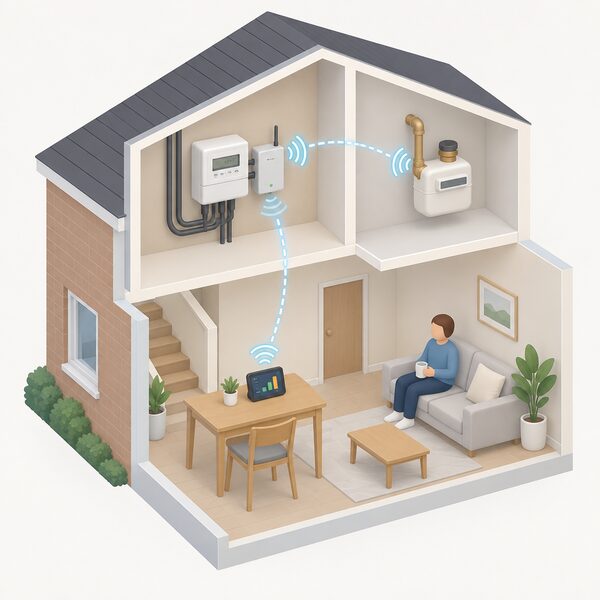
Smart meters use two secure networks to communicate15. The Home Area Network links devices inside the property to each other: the communications hub creates it, and it connects the in-home display with the smart meters11. The gas meter, which is battery powered and has no mains connection, reaches the electricity meter's hub over this short-range link.
The Wide Area Network is the outdoor leg. Readings are transmitted from the home to a wide area network made up of mobile phone or radio masts, and from there to the supplier5. This is the part that varies by region and the part that fails when a property is in a poor-signal area.
| Layer | What it links | Technology |
|---|---|---|
| Home Area Network | Electricity meter, gas meter, in-home display, via the communications hub11 | Short-range secure wireless created by the hub11 |
| Wide Area Network | Communications hub to the DCC and on to the supplier5 | Mobile phone or radio masts; cellular and wireless mesh in central and southern regions4 |
For households wanting to read the same data locally rather than waiting for the supplier, the home area network can also feed a consumer access device.
The DCC: the secure national network behind every second-generation meter
The DCC operates the secure national network that connects smart meters across Great Britain17. It is not a supplier and not an internet service: the network uses two layers of encryption and operates entirely separately from the potential pitfalls of the public internet5. Data is wrapped in those two layers before being sent over the dedicated communications system, in line with governance and data protection standards7.
The network also carries more than billing. Through it, smart meter data can be shared securely between authorised users, supporting smart energy services and innovation across the energy sector17. The remote firmware service means a meter's capabilities can change without anyone visiting the property5.
Its regulated communication service providers for the wide area network are Arqiva, Vodafone and Virgin Media O218. More detail on the organisation itself sits on our page about the Data Communications Company.
Coverage: 99.3% of properties, and the gap that remains
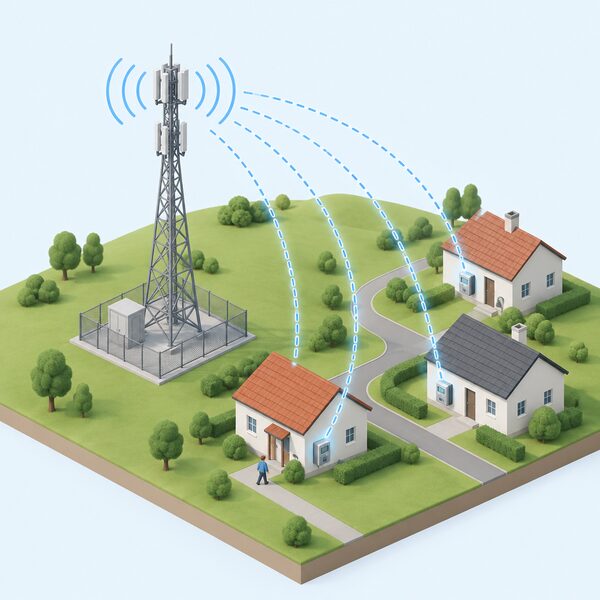
The headline figure is consistent across independent and official sources: the DCC wide area network reaches 99.3% of properties across the country19, a figure repeated by Energy UK20 and by Which?6. One supplier states the dedicated wireless network provides coverage to at least 99.25% of premises in Great Britain22. The figures are close but not identical, and they are all statements about network reach rather than about whether every individual meter is currently communicating.
Reach and connection are different things. More than half of all homes in Britain are now connected to the DCC's secure network7. Where a property falls in the remaining 0.7% not connected to the national network, a smart meter will not operate effectively8. Energy UK notes that even within the covered area, certain locations may have limited or no coverage20. Suppliers can install additional aerials to boost signal6, which is often what resolves a thick-walled, rural or deep-basement installation.
Practical causes of weak signal are physical. Moving a gas meter, for example when a supply pipe is altered, may result in the wireless connectivity of the meter being lost23. Flats and mid-terrace meter cupboards are common trouble spots, discussed further in why you might not be able to get a smart meter.
A meter that is not communicating is not a meter that has stopped counting. Ofgem is explicit that a smart meter not operating in smart mode will still record energy usage accurately24. The failure modes to expect are that the meter may stop recording energy use, or may no longer send readings to the supplier25. The second is much more common than the first, and leaves the household submitting readings by hand.
Cellular links: 4G communication hubs on the Vodafone network
In central and southern regions, smart meter data has been transmitted using 2G and 3G cellular and wireless mesh technology provided by Virgin Media O210. That dependence on older mobile generations is the reason for the largest piece of work now under way on the network.
Since December 2024, new 4G communication hubs have been installed, developed and deployed with Vodafone, Toshiba, Arqiva and CGI10. The DCC has signed a 15-year agreement with Vodafone to bring 4G connectivity to Britain's smart meter network, and states the hubs will be supported by a network that can provide services for many years to come10. Which? reports that since July 2025, 4G cellular communications are being introduced across all regions6. The DCC describes the 4G hubs as a further way to connect to the network, nationwide, rather than a replacement for radio4.
The scale of the swap-out is considerable. Second-generation smart meters that rely on 2G or 3G will require a replacement communications hub in order to communicate with 4G networks10. The Public Accounts Committee reported an estimated seven million communications hubs will need to be replaced because they will lose functionality when the 2G and 3G mobile networks are closed, to be replaced with an equivalent module communicating over 4G26.
No visit is needed for the household to request this work; hub replacement is arranged through the supplier. The household is not charged separately for the hub, though the cost of the programme sits within the wider rollout costs covered in how much does a smart meter cost.
The mesh: how hubs relay signals between themselves
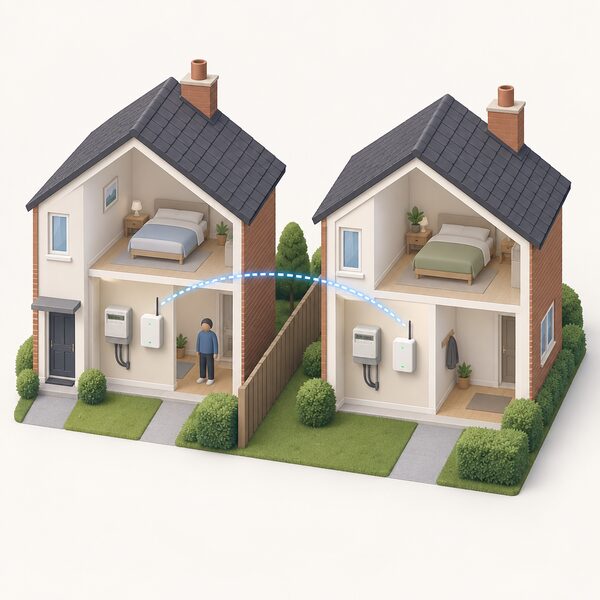
In central and southern areas, the network uses cellular and wireless mesh technology16. A mesh matters for coverage because not every communications hub needs its own usable cellular connection to a mast: hubs can relay through each other, so a meter in a basement or behind dense masonry may reach the network through a neighbouring property's hub rather than directly.
That has two consequences worth understanding. The first is that density helps: as more meters are installed in a street, the mesh generally improves for the properties that were marginal. The second is that a marginal property may communicate intermittently rather than reliably, producing the pattern of occasional missed readings and estimated bills rather than an outright failure. The northern part of Great Britain is served on a different basis, with Arqiva among the three communication service providers for the wide area network18, and long-range radio masts form part of the WAN described by the DCC5.
Security: encryption reviewed by the National Cyber Security Centre
The smart meter network was designed with security at its core, alongside the National Cyber Security Centre (NCSC), part of GCHQ3. The DCC states its network has been built to the highest security standards and has been reviewed by the NCSC28, and that it operates to security levels endorsed by the NCSC5. Smart Energy GB describes GCHQ and the NCSC as leading the security process that all smart meters have to go through29.
Two layers of encryption are applied to meter data, on a system that does not touch the public internet3. Data is encrypted to prevent hackers accessing the information14.
On visibility, the rules are narrow:
- Only the energy supplier and the local network operator can decrypt information sent by a smart meter, and without permission they may use it only for specific regulated purposes such as billing30.
- The DCC can access consumption data only with explicit permission28.
- Only how much energy is used and when is sent; suppliers cannot see what appliances are plugged in31.
- Consumers can authorise other DCC users, such as switching websites, to access their consumption data directly from meters via the DCC32.
- Network operators may access smart meter data under the Data Access and Privacy Framework provided it is anonymised and used only for regulated purposes33.
Consumers control who can access their energy use data, how often and for what purposes, except where it is required for regulated purposes such as billing34. The choice of monthly, daily or half-hourly reading frequency is part of that control9. More detail sits on smart meter data and smart meter security.
SMETS1 and SMETS2: two different ways of reaching the supplier
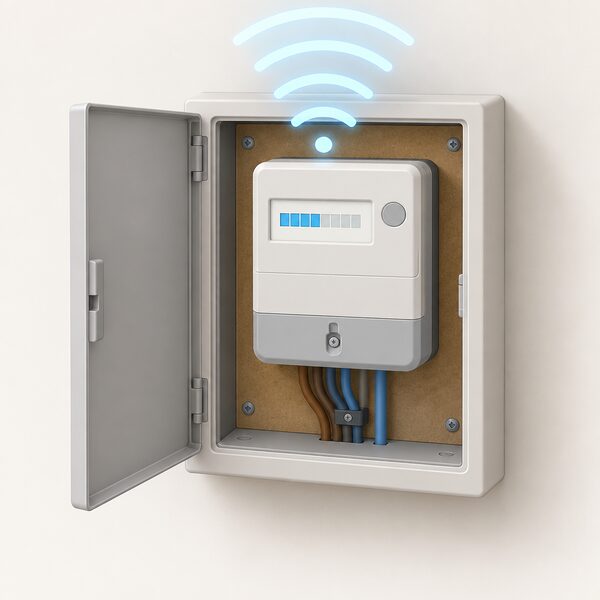
The generation of meter determines which network carries the readings, and this is the single biggest cause of confusion about smart meter communications.
| SMETS1 (first generation) | SMETS2 (second generation) | |
|---|---|---|
| Rolled out from | 201335 | After the DCC's national network became available28 |
| Communications | Third-party communications network13; mobile network36 | Direct connection to the DCC's secure national network28 |
| On switching supplier | May temporarily lose smart functionality and stop sending data, requiring manual readings37 | Should switch without interruption to readings, bill payments or supply37 |
| Mobile signal at the property | Relevant, as a mobile network is used36 | Not required, as the bespoke DCC network is used36 |
SMETS1 meters were installed before the DCC's national smart metering network became available, which is why some could lose smart functionality when a consumer switched supplier28. That problem is being retired rather than left in place: about 12 million first-generation smart meters have now been connected to the DCC's network7, through a migration programme that enrolled millions of meters remotely28. The reconnection is done by over-the-air software update, without an installer visit or any action from the household36. Which? reports most SMETS1 meters are now connected to the central network and have regained smart functions, and that those which cannot be connected need replacing30.
Switching supplier does not require a new smart meter38. With a second-generation meter, all smart functions are kept across suppliers13, though a household with a first-generation meter may find a new supplier does not offer every smart service. Throughout any loss of smart functionality, the meter is still accurately measuring energy use38. See SMETS1 and SMETS2 meters explained.
Reading frequency: monthly minimum, half-hourly by choice
Readings are sent automatically and wirelessly to the supplier at least once a month9[26 is not used here]. Monthly is the minimum; daily or half-hourly are optional and chosen by the household9. The DCC describes automatic readings as providing suppliers with monthly, weekly, daily or even half-hourly data7.
The frequency chosen has practical consequences. Half-hourly data is what makes time-of-use pricing and flexibility schemes workable, and it is the basis of the detailed consumption picture an in-home display or app presents. Monthly data is enough for accurate billing and nothing more. Suppliers use the data to bill for energy used, to offer products and services such as new tariffs where permission has been given, and to help make the energy system more efficient by recording demand more accurately25. Even with automatic readings, manual readings are occasionally needed, for example when switching supplier, checking usage or resolving an account issue39.
What this means for a household's independence
The honest position is mixed. A smart meter removes one dependency and adds others. It removes the need for a broadband contract, a router and an internet connection for metering to work, and it removes the manual reading and the estimated bill that follow from their absence1. The data it produces puts the household in a position to see its own consumption and act on it, providing real-time information that helps avoid waste and estimated bills40.
What remains is dependence of a different kind. The meter reports to the supplier, over a network run by a single national body, using masts operated by three commercial communication service providers18. A household cannot choose its region's network technology, cannot install its own aerial, and cannot resolve a 4G hub replacement itself. Where coverage fails, as it does for the 0.7% outside the DCC network8, the household is back to reading its own meter, and the smart functions it was offered simply do not arrive.
The one lever that genuinely sits with the household is the data. Reading frequency is a choice, third-party access requires permission, and a consumer access device on the home area network can deliver the same half-hourly figures to the household's own systems without going through the supplier's app. That is where the practical independence lies: not in the communications, which are fixed, but in what the household does with what the communications carry. See smart meters, monitoring and energy independence and the pillar guide at /smart-meters-hems/.
Sources40 cited
- Myth busting smart meter problems, Smart Energy GB, 2026-09-17
- How do smart meters work, Smart Energy GB, 2026-08-27
- Protecting data on the smart meter network, Smart DCC, 2026
- Does a smart meter need wi-fi, Smart DCC, 2026
- How do smart meters send readings, Smart DCC, 2026
- What is a smart meter, Which?, 2026-04-07
- How to get a smart meter, Smart DCC, 2026
- Plug-in solar batteries and UK smart meters, Jackery, 2026-07-25
- What is a smart meter, Smart Energy GB, 2026-08-10
- Do smart meters use 3G, Smart DCC, 2024
- Smart meters and wifi, Smart Energy GB, 2026-03-16
- Smart meters and health, Smart Energy GB, 2026-03-16
- Smart meters guidance, Energy Ombudsman, 2026-09-20
- Data access and privacy, Smart Energy GB, 2026-03-16
- The truth about smart meters, OVO Energy, 2026-09-17
- WAN and HAN explained, OVO Energy, 2026-09-17
- How do smart meters help the environment, Smart DCC, 2026
- Smart Meter Guaranteed Standards of Performance, Ofgem, 2025-03-28
- DCC and Vodafone win Alliance of the Year, Smart DCC, 2024
- Energy UK explains smart meters, Energy UK, 2024-11-14
- Energy UK explains the smart meter network switch and RTS, Energy UK, 2024-05-22
- Smart meters, E.ON Next, 2026-09-17
- Connections FAQ, SGN, 2026-09-17
- Smart meter performance, Ofgem, 2026
- Get help with your smart meter, Ofgem, 2026-09-17
- Update on the smart meter rollout, Public Accounts Committee, 2023-10-20
- Delayed smart meter programme fails to hit targets, Public Accounts Committee, 2023-10-20
- Upgrading Britain's first-generation smart meters, Smart DCC, 2026
- Smart meters are safe, Smart Energy GB, 2026-03-16
- Smart meter problems and solutions, Which?, 2026-08-24
- Smart meters and carers, Smart Energy GB, 2026-08-19
- Written evidence on smart meters, UK Parliament Science and Technology Committee, 2016-06
- Data sharing in a digital future: consumer consent, Ofgem, 2023
- Smart meters: your rights and expectations, GOV.UK, 2025-08-08
- A guide to smart meters, Age UK, 2026-08-24
- Do I already have a smart meter, Smart Energy GB, 2026-03-16
- Smart meters explained, Uswitch, 2026-07-29
- Switching supplier with a smart meter, Smart Energy GB, 2026-03-16
- How can I read a smart meter, Smart Energy GB, 2026-08-17
- Smart meters and decarbonisation, Smart DCC, 2026
 How a Smart Meter WorksHow a British smart meter measures gas and electricity, how the in-home display and the DCC's secure network fit together, what data leaves the house, what it costs, and where smart mode goes wrong.
 Can a Smart Meter Be Hacked?Can someone break into your smart meter, see your personal details or switch off your power?
 In-Home DisplaysWhat does the little screen that came with a smart meter actually tell you, and what can you do when it stops working?
 The Full Smart Meters GuideDo smart meters really save you money, and how do you use one to cut your bills?
 Zigbee, Matter, KNX and Wi-FiWill your smart thermostat and radiator valves keep working if the broadband goes down, and can gear from different brands talk to each other?
 Monitoring in Flats and RentalsCan you get a smart meter in a rented flat, and who decides?