In this guide
Smart meters are replacing analogue gas and electricity meters across Great Britain as part of a national infrastructure upgrade, and the programme applies to England, Scotland and Wales1. For a Scottish household the practical position is shaped by three things: the rollout is running behind England, a large number of homes still depend on the Radio Teleswitch Service to switch their heating and hot water, and the advice and funding landscape is distinct, with its own national advisory body.
The gap is measurable. Domestic electricity smart meter coverage in Scotland is 13% lower than in England2. By the end of March 2023, in England, Scotland and Wales combined, only 57% of all electricity and gas meters were smart3. More recently, over 60% of British homes have a smart meter installed4. The Scottish Government's position is that all households should have access to smart meters as soon as possible regardless of household heating technology or geography5.
The Radio Teleswitch Service is the sharper issue. As of January 2025, there were still 146,302 RTS consumers in Scotland who need to have their meters replaced6, and the service is a significant issue affecting more than 200,000 households in Scotland with electric heating7. Smart meters are the only replacement, and residents must contact their energy supplier to arrange an upgrade8.
What a smart meter does and what it costs
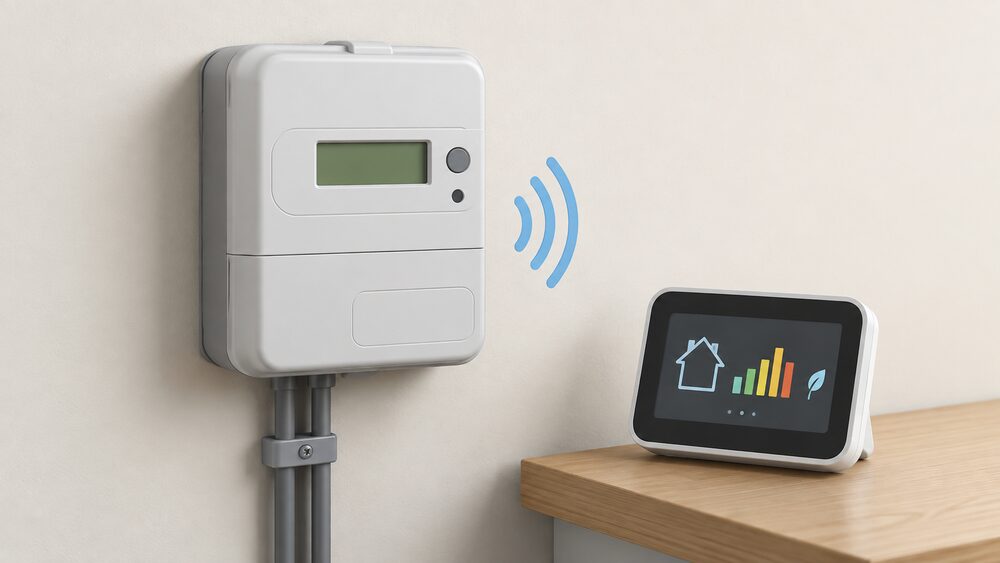
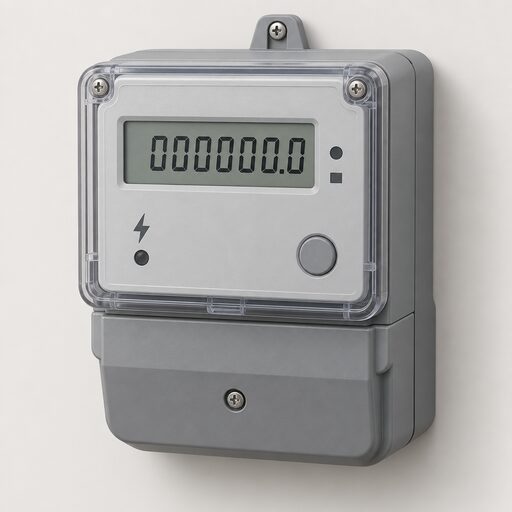
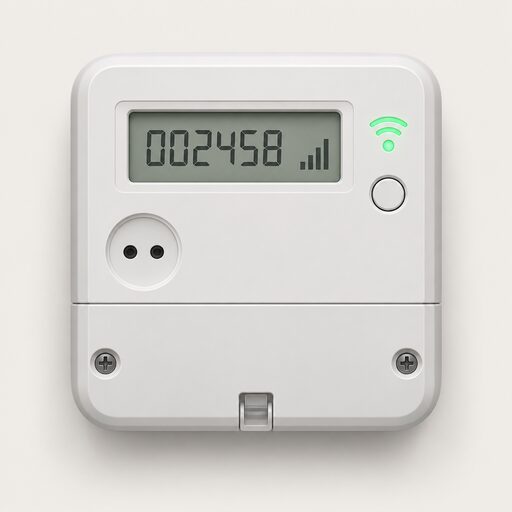
A smart meter replaces the analogue meter and adds two-way communication, so it can wirelessly send and receive information rather than simply register consumption11. That is the technical difference that matters: the meter reports readings without a visit, and it can receive signals, which is what allows it to take over the switching role that radio teleswitch meters perform today.
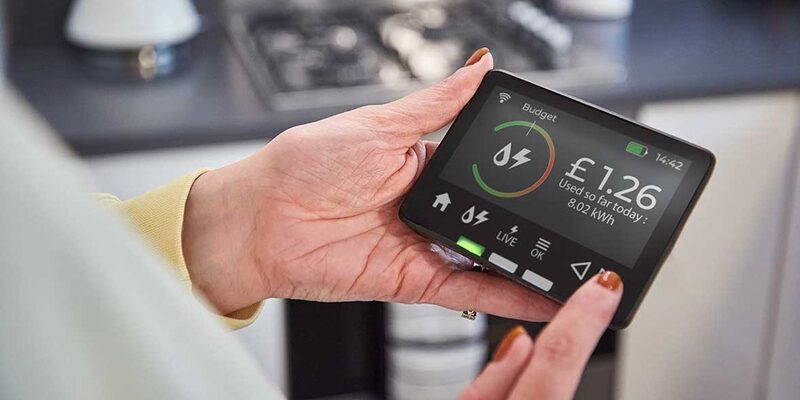
The stated household benefit is control. The data a smart meter provides puts a household in control of its energy usage, so that energy-saving steps can be taken to reduce CO2 emissions12. Smart meters also integrate with smart home systems, enabling automated adjustments in response to usage patterns13. The rollout is part of a national government programme to replace all old meters with new smart meters, including prepayment versions14.
On cost, the position is straightforward: a smart meter is installed by the energy supplier at no extra cost9. There is no separate installation charge to the household. The cost of the programme is recovered through the energy system rather than billed as a one-off job, and the supplier is the party that arranges the work.
What a smart meter does not do is remove dependence on the grid or on a supplier. It measures and reports; it does not generate. A household with a smart meter is still supplied by a company, still connected to the network, and still exposed to wholesale prices. What changes is the quality of the information and the ability to take part in tariffs and schemes that reward shifting load. For a household in an electrically heated Scottish home, that distinction is the whole point of the upgrade: the meter is the device that lets an off-peak heating regime continue after the radio signal is withdrawn.
The rollout timetable: when every Scottish household will be offered one
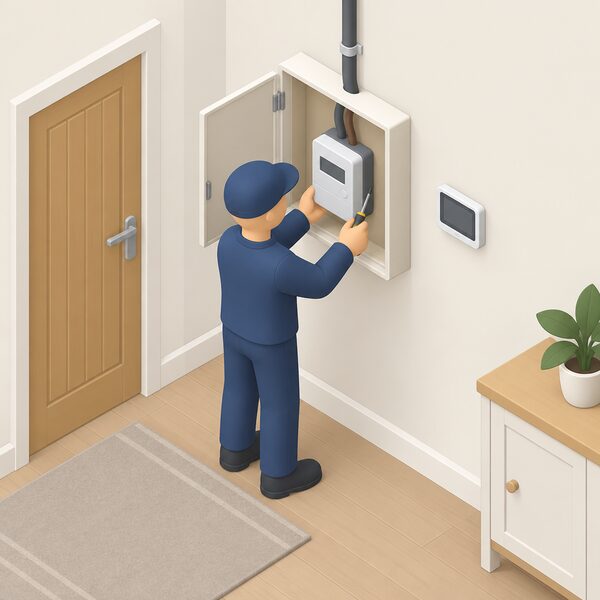
Energy suppliers aim to provide every home and business in England, Scotland, and Wales with free smart meters in the near future16. The framework that governed the middle of the decade ran between 1 January 2022 and 31 December 20257. The current expectation is later: suppliers are required to take all reasonable steps to install smart meters in all remaining domestic premises by the end of 20307.
That end date is a supplier obligation, not a household deadline. The distinction matters in Scotland because the coverage gap means the offer arrives later for many properties than it does south of the border. A household that has not been offered a meter is not behind; it is in the part of the queue that the 13% gap describes2.
Progress across the period has been uneven. The Public Accounts Committee noted that by the end of March 2023, in England, Scotland and Wales combined, only 57% of all electricity and gas meters were smart3. The more recent figure, over 60% of British homes with a smart meter installed, shows the direction but not the Scottish share4.
| Measure | Figure | Date | Source |
|---|---|---|---|
| Scottish domestic electricity coverage against England | 13% lower | 2025 | Ofgem2 |
| Smart meters as a share of all electricity and gas meters, England, Scotland and Wales | 57% | End of March 2023 | Public Accounts Committee3 |
| British homes with a smart meter installed | Over 60% | 2024 | Smart DCC4 |
| Supplier installation obligation end date | End of 2030 | Current | Scottish Government7 |
For a Scottish household the practical timetable is set by the supplier's schedule, not by a national date. The Scottish Government has said all households should have access to smart meters as soon as possible regardless of household heating technology or geography5, which is a statement of intent about rural and electrically heated properties in particular. Where a property has been passed over, the route is to ask the supplier directly, and to use the rollout progress page for the national picture.
Radio Teleswitch Service: the meter upgrade many Scottish homes cannot ignore
The Radio Teleswitch Service switches meters and off-peak tariffs by a long-range radio signal. It is concentrated in homes with electric heating, which is why Scotland carries a disproportionate share of the problem: the service is a significant issue affecting more than 200,000 households in Scotland with electric heating7.
The numbers on replacement are specific. As of January 2025, there were still 146,302 RTS consumers in Scotland who need to have their meters replaced6. Ofgem's data from suppliers shows that between October 2024 and January 2025 around 18,700 RTS meters were replaced in Scotland6. At that rate the remaining population is large relative to the work done in a four-month window.
The consequence of inaction is stated plainly: heating or hot water may stop working properly, or bills could increase8. That is not a billing inconvenience. In a home where storage heaters or an electric heating system is switched by the teleswitch signal, losing the signal means losing the off-peak regime that makes the heating affordable.
The replacement is a smart meter, arranged through the supplier. There is no separate teleswitch successor product for a household to buy. The RTS switch-off page covers the mechanics of the changeover, and the communications page explains how the replacement signal reaches the meter.
How to tell if you have an RTS meter and what happens if you do not upgrade
The reliable test is the supplier's record, not the appearance of the meter. Ofgem's guidance is direct: contact your supplier to arrange to have a new smart meter installed17. The same instruction appears across the regulator's consumer pages18.
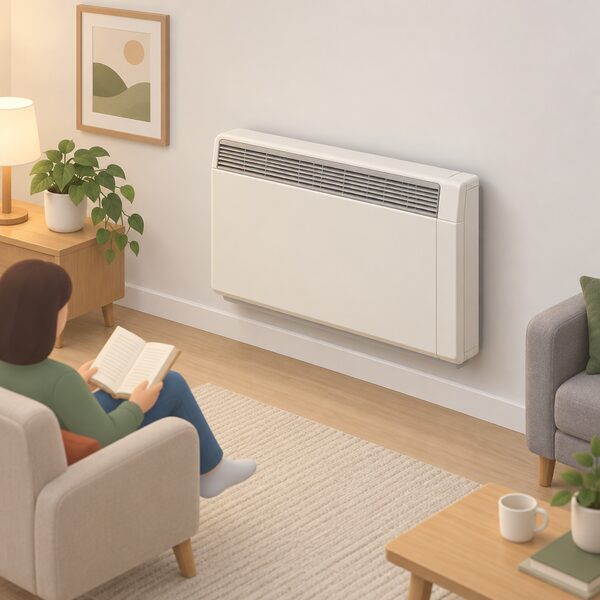
The practical indicators are the tariff and the heating system. A home on an off-peak electric heating tariff, with storage heaters or a teleswitched hot water arrangement, and a meter with no in-home display and no digital communications, is the profile. Homes with a modern gas boiler and a single-rate tariff are unlikely to be affected.
If the meter is not replaced, the risk is that heating or hot water stops working properly, or bills increase8. The mechanism is the loss of the switching signal: without it, the meter may default to a single rate, and an electrically heated home loses the cheap overnight window that its heating depends on.
First-generation smart meters are also being dealt with. Those with SMETS1 meters will be upgraded to the new SMETS2 smart meters in due course if they have not been already15. That is a separate track from the RTS replacement, and it affects households that adopted early rather than those still on analogue or teleswitch equipment. The SMETS1 and SMETS2 page sets out the difference.
ScottishPower and how suppliers handle smart meter billing
The obligation on suppliers is not merely to install a meter but to make it work. Energy suppliers must take all reasonable steps to ensure that smart meters automatically send them your gas and electricity meter readings19. That is the standard against which a household can judge a supplier: a meter that is not sending readings is a supplier problem to fix, not a household one.
For a Scottish household, the practical consequence is that estimated bills on a smart meter are a fault, not a normal state. The supplier is required to take reasonable steps to keep the meter reporting. Where it does not, the faults and troubleshooting page covers the checks, and the estimated bills page explains why they appear.
Smart meters also travel with the household when the supplier changes. The simplest way to check a meter's status is to use the smart meter checking tool on the Citizens Advice website14. That tool reports whether a meter is operating in smart mode, which is the question that matters when switching.
The dependence that remains is worth stating. A smart meter keeps a household tied to a supplier for the communications service, and to the national network for the signal. It does not give a home independence from the grid, and it does not remove the need for a supply contract. What it does is make the household's own consumption visible and make the meter's switching function independent of a radio service that is being withdrawn.
Where Scottish households can get free, impartial advice

Scotland has a dedicated national advice service. Home Energy Scotland provides free, independent and impartial energy advice to householders, community groups and businesses throughout Scotland20. It is funded by the Scottish Government and provides free and impartial advice and support21, and it can give free impartial advice on energy efficiency and renewable energy in Scotland10.
The service is reachable by phone and online. Advisors can be reached on 0808 808 2282, and calls are free from landlines and most mobile networks10. Phone lines are open Monday to Friday 8am to 8pm, and 9am to 5pm on Saturdays22. There is also a Funding Finder to search for funding and support on improving a home's energy efficiency, reducing energy bills and making a home warmer23.
Home Energy Scotland also offers free advice on improving the energy efficiency of a home23, and it acts as a referral partner for area-based scheme eligibility enquiries21. Local authority area-based schemes operate across Scotland, including in Glasgow20, Edinburgh23, Argyll and Bute21 and West Lothian22, and Home Energy Scotland is the route into eligibility questions for them.
A household can also make contact on someone else's behalf. Home Energy Scotland states that a person can contact it on behalf of someone else, but that the permission of that person is needed so the advice can be tailored to them24. Organisations can refer people who need support through a secure online portal, and Home Energy Scotland supports events, shares resources and offers free training and workshops24.
For energy supply problems rather than energy efficiency, Energyadvice.scot runs a free service for Scottish citizens with questions about their energy supplier, wanting to understand their supplier's complaints process, or with problems with their energy bills25. It can be reached on 0808 196 866025.
Home Energy Scotland Grant and Loan: funding alongside your meter upgrade
The Home Energy Scotland Grant and Loan can provide interest free loan funding for energy efficiency measures or to install renewable measures such as heat pumps or battery storage, and grant funding may also be available21. That is the funding stream that sits alongside a meter upgrade rather than replacing it: the meter changes how energy is measured and switched, while the grant and loan support changes how the home is heated and insulated.
The combination matters most in electrically heated Scottish homes, which are the same homes most exposed to the RTS withdrawal. A household replacing a teleswitch meter and considering a heat pump or battery storage is looking at two separate processes with two separate routes: the meter through the supplier, the measures through the funding scheme.
Home Energy Scotland's role in this is as the advice and referral point. It provides free and impartial advice and support to help households21, and its Funding Finder searches for funding and support on energy efficiency, bills and warmth23. The heat pump sizing page explains how a year of smart meter data can inform the choice of measures, which is the practical link between the two.
Consumer Scotland: where to turn when things go wrong
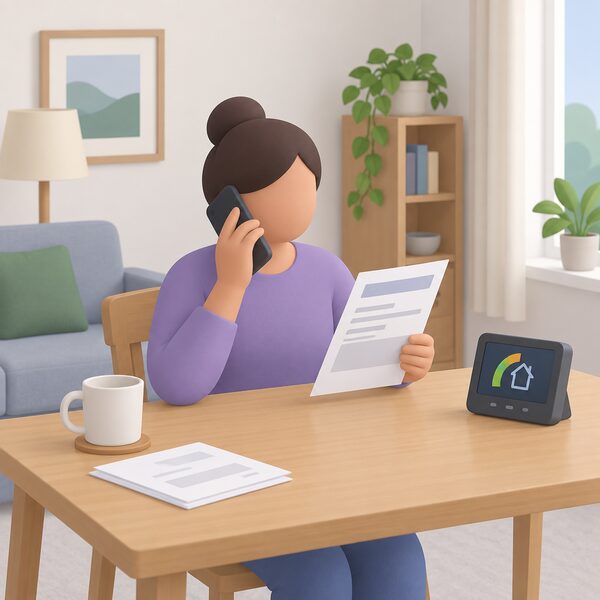
For heat network consumers in Scotland, the relevant consumer advice bodies are Citizens Advice Scotland and Consumer Scotland, and any related, qualifying consumer advice bodies26. That is the formal advocacy route where a household's complaint is not resolved by the supplier.
The general complaint route runs through the supplier first. Ofgem sets out how to complain about an energy supplier or network operator25, and separately how to complain about an energy supplier27. Where a smart meter is the subject, the Energy Ombudsman handles smart meter disputes11.
The guaranteed standards are the lever. Ofgem has consulted on a Smart Meter Guaranteed Standard, which sets expectations for how quickly suppliers must act2. The guaranteed standards page covers what those standards require.
The pattern across all of this is that Scotland has a fuller set of named bodies than the rest of Great Britain: a national advice service in Home Energy Scotland, a national consumer body in Consumer Scotland, and a separate energy advice line in Energyadvice.scot. For a household dealing with a failed RTS replacement or a meter that has stopped reporting, the sequence is supplier first, then the ombudsman, with Consumer Scotland and Citizens Advice Scotland available where the issue is systemic rather than individual.
Sources27 cited
- Smart meters: your rights and expectations, GOV.UK, 2025-08-08
- Smart Meter Guaranteed Standard Statutory Consultation, Ofgem, 2025-08-08
- The UK Smart Meter Rollout: Progress and Targets, Public Accounts Committee, 2023
- Smarter, greener, fairer: maximising the use of the smart meter system to tackle fuel poverty, Smart DCC, 2024
- Heat in Buildings Strategy, Scottish Government, 2021-10-07
- Protection for energy customers ahead of RTS switch-off, Scottish Government, 2025
- Tackling fuel poverty in Scotland: periodic report 2021-2024, Scottish Government, 2025-04-22
- Act now: RTS switch-off could affect heating and hot water, Rent Smart Wales, 2026-06-15
- Do you have to have a smart meter by law?, Smart DCC, 2026
- Who to contact, Ofgem, 2026-09-17
- Smart meters, Energy Ombudsman, 2026-09-20
- Smart meters and decarbonisation, Smart DCC, 2026
- How do smart meters reduce my bills?, Smart DCC, 2025
- What happens to my smart meter when I change supplier?, Smart DCC, 2023
- Does a smart meter need WiFi?, Smart DCC, 2026
- How to get a smart meter, Smart DCC, 2026
- Get help with your smart meter, Ofgem, 2026
- Getting a smart meter, Ofgem, 2026
- Smart meter performance, Ofgem, 2026
- Area Based Schemes, Glasgow City Council, 2026-06-08
- Home energy efficiency, Argyll and Bute Council, 2026-09-17
- Energy Efficient Scotland: Area Based Schemes, West Lothian Council, 2026-09-17
- Financial help for energy efficiency and low carbon heating improvements, City of Edinburgh Council, 2026-09-20
- How we help people in fuel poverty, Home Energy Scotland, 2025-11
- Complain about your energy supplier or network operator, Ofgem, 2026
- Heat networks regulation: consumer protection guidance decision, Ofgem, 2026-01-13
- Complain about your energy supplier, Ofgem, 2026
 Smart Meters in WalesCan you get a smart meter fitted free in Wales, and will it work if you live in a rural area or an older home?
 Suppliers in ScotlandWho do you contact in Scotland when something goes wrong with your supplier, whether that is British Gas, ScottishPower, SSE or another big name?
 Smart Meters in Northern IrelandWhen are smart meters coming to Northern Ireland?
 Monitoring in Flats and RentalsCan you get a smart meter in a rented flat, and who decides?
 The Full Smart Meters GuideDo smart meters really save you money, and how do you use one to cut your bills?
 Meter Standards and AccuracyHow UK smart meters are certified for accuracy, how their readings become a bill, what happens when a meter stops communicating, and how a metering or billing dispute is escalated to a supplier and then to the Energy Ombudsman.