
In this guide
Export limitation is the arrangement that stops a generating installation pushing more power onto the distribution network than the connection agreement allows. It exists because a network operator may limit how much electricity you can export, usually to protect the grid from overload in areas with high renewable electricity generation1. Where a limit applies, the practical options are to fit a smaller inverter or to fit an export limiter1.
The limit is not the same thing as the meter. Export metering records what leaves the property and underpins payment; export limitation caps what can leave in the first place. An export meter is always located at the point where the installation connects into the distribution or transmission network and must measure export separate from any other energy source, unless pro-rating is available2. The Smart Export Guarantee requires an export or smart meter capable of taking measurements at half-hourly intervals, and the meter must have an associated export MPAN3.
For a household, the two arrangements pull in opposite directions. Metering is what makes exported electricity worth something; limitation is what can make it worth less, because the ceiling is set by the network rather than by the size of the array. For domestic customers, the maximum amount of permitted generation will typically be between 5kW and 15kW5.
Why export limitation exists: the DNO connection agreement
A distribution network operator may limit how much electricity you can export, usually to protect the grid from overload in areas with high renewable electricity generation1. The constraint is local. Where many roofs in one area generate at the same time, the low-voltage network can carry only so much power back up the line before voltage rises beyond statutory limits or equipment is stressed.
Export Limitation Schemes prevent overloading the network, voltage issues, and protect both the network and customer equipment from damage7. That framing matters: the scheme is a safety measure as much as a commercial one, and it protects the household's own equipment as well as the network.
The permitted generation figure is not arbitrary. It is set at 125% of your import or export agreement, whichever is greatest5. A second rule caps it at the amount of exported power required to cause the voltage at any customer's point of supply to exceed the statutory voltage limit by 1%5. Whichever of those produces the lower figure governs.
For domestic customers, the maximum amount of permitted generation will typically be between 5kW and 15kW5. That range is wide because it depends on the local network, not on the property. Two identical houses on different streets can be offered different ceilings.
Where a limit applies, the installer's options are to fit a smaller inverter or to fit an export limiter1. A smaller inverter accepts a lower peak output permanently; an export limiter allows a larger array but curtails output when the export threshold is reached. The choice affects how much of a system's theoretical generation a household can actually use or sell.
The connection agreement is the document that binds all of this. It records the import and export capacity the network will accept, and the limitation scheme is the mechanism that keeps the installation inside those figures. Nothing about the household's own consumption changes the ceiling; only a revised agreement does.

EREC G100: the standard that governs export limitation
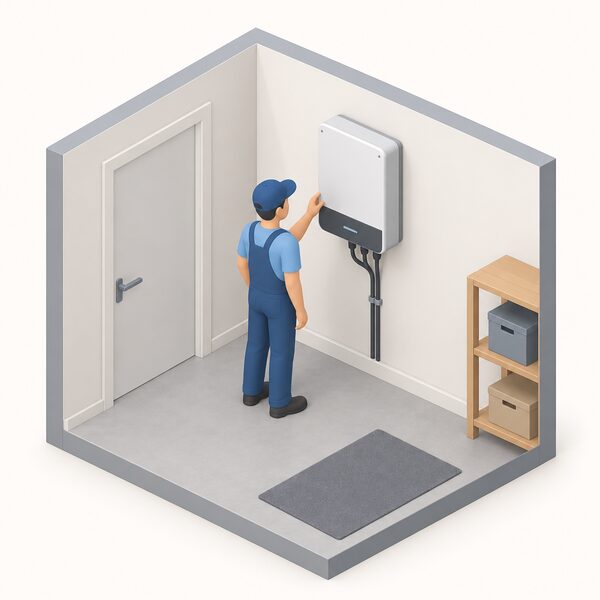
All export limitation schemes must be G100 compliant7. EREC G100 is the engineering recommendation that sets out how a limitation scheme must be designed, sensed and tested so that the network operator can rely on it.
There is one important exception. An EREC G100 Export Limitation Scheme is not required where the export capacity limitation of the inverter is set by the manufacturer of the equipment7. In that case the limitation is a property of the hardware rather than a scheme bolted on beside it. The distinction matters for a household because it determines what evidence the network operator will want and who is responsible for the setting.
The term for a factory-set figure is Registered Capacity, defined as the export limit set by the manufacturer7. Where limitation is achieved this way, the inverter cannot exceed the figure regardless of conditions, which is a stronger guarantee than a controller that measures and reacts.
Where a separate scheme is used, it must sense export at the point of connection and act to hold the installation at or below the agreed figure. The published guidance does not set out the internal architecture in domestic terms, but the compliance requirement is absolute: the scheme must be G100 compliant7.
Metering used for measuring generation and export from FIT installations must be approved to set standards8. That is a separate approval from G100 and applies to the measurement side rather than the limitation side, but the two often sit in the same installation and are commissioned together.
G99 applications and when limitation is required
The application route depends on size. G99 applies above 3.68kW6. Applications for installations exceeding 3.68kWp require prior approval from the distribution network operator9. Below that threshold, the smaller G98 route applies.
| Threshold | Application route | Prior approval |
|---|---|---|
| Up to 3.68kW per phase | G98 | Not required |
| Above 3.68kW | G99 | Required from the DNO9 |
| Above 3.68kWp | G99 | Required10 |
In Northern Ireland, a G98 limit of 11.04 kWp applies to buildings other than dwellings11. That is a different figure from the GB threshold and reflects separate arrangements.
An export limitation scheme is needed if you plan to install generation but do not want to export power to the grid, unless your generation capacity is lower than your minimum demand12. It is also needed if you install generation without wanting to export, unless the total capacity of the generation connected to your property is less than your minimum demand5. Conversely, if you plan to export some generated power and there is enough network capacity to accommodate it, you will not need an Export Limitation Scheme12. If you plan to export power to the grid and the network operator confirms there is enough spare capacity, no scheme is required5.
The threshold for needing a scheme at all is therefore not simply a capacity figure. If the total capacity of generation connected to your property is not greater than 3.68kW then you do not need an Export Limitation Scheme5. Above that, the question becomes whether the local network can accept the export.
Both G98 and G99 were brought into line with the existing G59 fast track process13. The same revision introduced a fast track process for storage applications of less than 16 Amp per phase13. Storage therefore follows a parallel route to generation, which matters for households adding a battery alongside solar.

Devices that can act as export limiters
An export limiter is a controller that measures power flow at the point of connection and curtails generation when export approaches the agreed ceiling. The published guidance describes the function rather than naming a single approved product, and the compliance requirement is that the scheme as a whole is G100 compliant7.
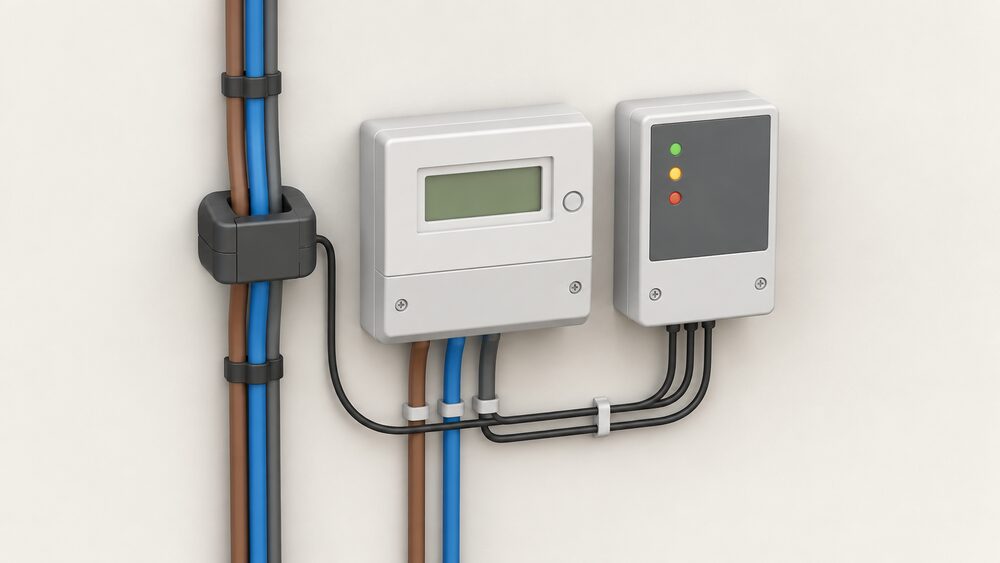
The sensing position is the defining feature. Because the controller must know what is leaving the property, it measures at the point where the installation connects to the network, the same location as the export meter2. A current transformer clamped around the incoming supply is the usual sensing method, and it is the reason a limitation scheme is installed at the meter position rather than beside the inverter.
Where the export capacity limitation is set by the manufacturer of the equipment, no separate scheme is required7. That covers inverters with a factory-set export limit, and it is the simplest arrangement for a household because there is no additional controller to commission or maintain.
The practical difference between the two approaches is what happens under changing conditions. A factory-set limit is fixed in the hardware. A separate controller can be set to a figure agreed with the network operator and can be adjusted if the agreement changes, though any change to the agreed figure requires the operator's agreement rather than a settings change alone.
How limitation is set and enforced in practice
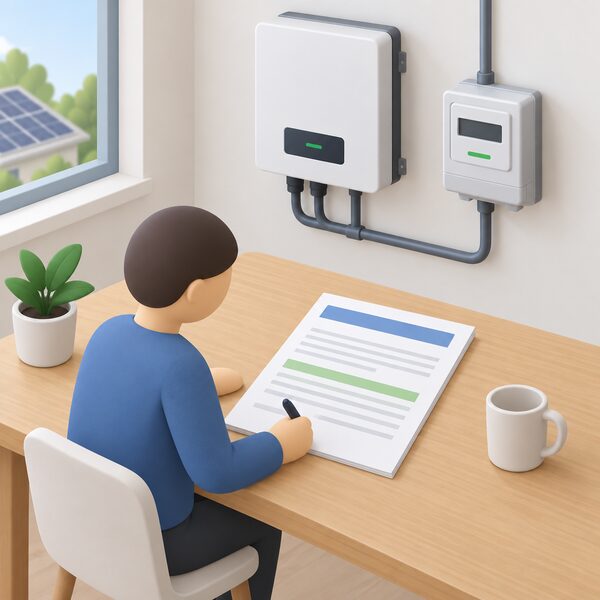
The process starts with the connection application. An Export Limitation Scheme can be included in the connection application, or the network operator's design team will include the requirement in the connection offer5. Either route ends with the requirement written into the agreement.
The figures that govern the setting are the two rules already described: 125% of your import or export agreement, whichever is greatest, and the export level that would push a customer's supply voltage 1% beyond the statutory limit5. The lower of the two applies.
Enforcement runs through the connection offer and the evidence that follows commissioning. Most suppliers will require a DNO Response in order to apply for an export tariff5. That response is the email from the network operator confirming commissioning documents are logged and the system is compliant with G98 or G995. Without it, the export tariff application stalls even where the hardware is installed and working.
The Smart Export Guarantee itself requires licensed electricity suppliers to offer export tariffs to anaerobic digestion, hydro, onshore wind and solar generators14. Suppliers must be satisfied that exporters' installations are suitably safe15. That safety judgement is where the compliance evidence feeds in.
Ofgem administers the SEG on the government's behalf, in line with the policy design16. FIT licensees must put in place arrangements to capture and record the amount of electricity being exported during the payment period where settled export meters are used17. The published guidance does not describe a routine domestic inspection regime for limitation schemes, so the checkpoints are the connection offer, the commissioning evidence and the DNO Response.
Export limitation versus export metering
These are two different jobs and households often conflate them. Limitation caps what can leave; metering records what did leave and underpins payment for it.
Metered export, as distinct from deemed export, means export payments made on the basis of export meter readings. Under the Feed-in Tariffs scheme, metered export is the amount of renewable electricity exported from an eligible FIT installation, recorded by a meter capable of taking half-hourly measurements18. A generator with the ability to export has to make an initial choice whether to receive the guaranteed export payment or sell exported electricity on the open market2.
Deemed export is only available within limits. Generators of installations with a TIC of 30kW or less are eligible to receive deemed export payments where it is not possible or practical to measure the export by way of export meter readings2. Deeming is permitted for accredited FIT installations with a total installed capacity of up to 30kW18. A generation meter cannot be used to claim FIT export payments, though the generation reading could be used to claim deemed export payments if eligible18.
Commissioning an export meter changes the position. If an accredited installation with a total installed capacity of 30kW or less has an export meter commissioned, the export can no longer be deemed, subject to a stated co-located storage exception2. An accredited FIT installation with a total installed capacity of over 30kW must have an export meter to receive export payments from the FIT licensee19.
A generation meter cannot be used to claim FIT export payments, though the generation reading could be used to claim deemed export payments if eligible2. Where an installation exports all its electricity, a separate generation meter is not required but a compliant export meter is19. Where storage or EV charging is added, the meter must be able to measure the amount of electricity generated or exported from the installation separately from any other source, unless pro-rating is allowable2.
| Arrangement | What it does | Key condition |
|---|---|---|
| Export limitation | Caps power leaving the property | G100 compliant scheme, or factory-set limit7 |
| Export meter | Records export for payment | Located at the point of connection2 |
| Deemed export | Estimates export for payment | 30kW or less, no export meter fitted2 |
| Export MPAN | Identifies the export metering point | Required for SEG payment4 |
The Smart Export Guarantee requires an export or smart meter capable of taking measurements at half-hourly intervals3. Generators must have a smart meter to monitor exports in order to qualify20. The meter must have an associated export MPAN4 and be capable of measuring export at half-hourly intervals4. Exports under the SEG must be metered on a half-hourly basis and registered for settlement, though they will not be required to be settled on a half-hourly basis15.
An eligible installation must have an export MPAN to manage exported electricity volumes to the SEG licensee21. An export meter must be capable of taking measurements at half-hourly intervals in relation to the exported electricity volumes for which the SEG generator seeks payment21.
What limitation means for household energy independence
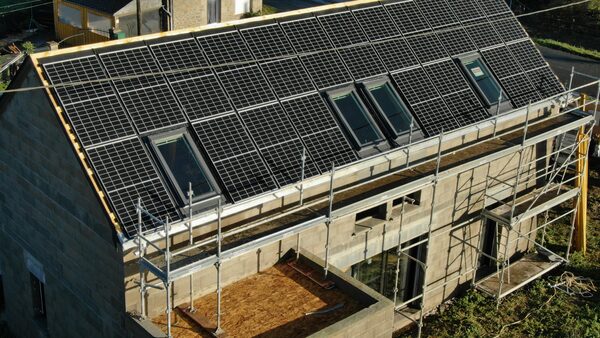
Limitation is the clearest example of a household's export independence being bounded by the network rather than by its own equipment. The array may be capable of more, but the connection agreement sets the ceiling, and for domestic customers the maximum amount of permitted generation will typically be between 5kW and 15kW5.
The dependence that remains is threefold. It is a dependence on the network operator's assessment of local capacity, on the connection agreement that records it, and on the compliance evidence that keeps an export tariff available. None of those is within the household's control, and none is removed by adding generation or storage.
There is a measurement caveat worth knowing. The Energy Saving Trust solar panel calculator assumes no export limits, so actual earnings may differ1. A household estimating export income from a tool that assumes no limit may find the real figure lower where a limit applies.
The direction of travel in policy is toward more generation, not less. The limitation that solar equipment can generate up to 1MW of electricity was removed for non-domestic buildings22. The Community and Smaller-scale Electricity Export Guarantee Scheme covers exporting sites generating low carbon electricity with a capacity below 5MW23. Those are larger scales than a domestic roof, but they show the framework being widened rather than narrowed.
For a household, the practical position is that limitation protects the network and the local supply quality, and in doing so it caps the household's own export. Where a limit applies, the options are a smaller inverter or an export limiter1, and the ceiling itself is a matter for the connection agreement. Monitoring what the system actually exports, and comparing it with the agreed figure, is the only way to know whether the limit is biting. Pages on solar and battery system monitoring and smart meters and solar export MPAN cover the measurement side in more detail.
Sources23 cited
- New calculator shines a light on solar panels, Energy Saving Trust, 2026-08-17
- Guidance for FIT Generators V18, Ofgem, 2026-04-01
- Smart Export Guarantee: scheme closure, Ofgem, 2026-09-17
- Guidance for SEG licensees, Ofgem, 2019-12
- Installations above 3.68kW per phase but 50kW or less, SSEN, 2026-09-17
- Building regulations renewables guidance, Bedford Borough Council, 2026-09-17
- G99 Fast Track Process, Electricity North West, 2026-09-19
- Feed-in Tariffs Guidance for renewable installations V16, Ofgem, 2021-12-13
- Revision of Engineering Recommendations EREC G98 and G99, Ofgem, 2018-11-30
- Notice builder file, Sell2Wales, 2026-06-15
- Smart Export Guarantee: electricity suppliers, Ofgem, 2026
- Installations up to 3.68kW per phase at a single premises, SSEN, 2026-09-19
- POST note: electricity storage, Parliamentary Office of Science and Technology, 2026-06-25
- Smart Export Guarantee guidance for generators, Ofgem, 2019-12-12
- Feed-in Tariffs determinations: Year 16, GOV.UK, 2026-02-26
- The Electricity and Gas (Market Integrity and Transparency) (Amendment) Regulations 2019, legislation.gov.uk, 2019-03-08
- Guidance for Suppliers v14, Ofgem, 2021-08
- Feed-in Tariffs Guidance for Licensed Electricity Suppliers V15.0, Ofgem, 2023-04-03
- FIT Guidance for Licensed Electricity Suppliers V17.1, Ofgem, 2024-09-06
- Feed-in Tariffs, Energy Ombudsman, 2026-09-20
- Smart Export Guarantee Order 2019 explanatory memorandum, legislation.gov.uk, 2019-06
- ECO4 Guidance: New Measures and Products, Ofgem, 2023-06-22
- UK Solar Roadmap, DESNZ, 2025-06
 Export Limitation and G100Your solar panels can be set to stop sending power to the grid once they reach a certain level.
 Solar Export PaymentsIf you have solar panels, how do you actually get paid for the electricity you send back to the grid?
 Export Tariff EligibilityTo get paid for solar power you send to the grid, you need a certified installer, your network operator told about the connection, and a meter that records what you export.
 The Full Solar Panels GuideHow much do solar panels cost, and what could they save you each year?
 Solar and Battery Import TariffsWhat does a special import tariff actually get you when you have solar panels or a home battery?
 Deposits and Staged PaymentsHow much deposit should you pay for solar panels or a heat pump, and what happens to your money if the installer goes bust?