
In this answer
Short answer
Yes. Take a meter reading as soon as you hear your supplier has ceased trading, keep a dated record of it, and give it to the new supplier once your account is set up. Ofgem's guidance is to take a meter reading as soon as you can and keep a record so you are billed correctly by the new supplier1. Independent guidance is blunter: take readings as soon as you are aware the supplier has ceased trading, because the new supplier will need them2.
Nothing else is required of you. Ofgem states plainly that you do not need to do anything if your current supplier goes out of business, that you will be moved automatically to a new supplier, and that your energy supply will not be interrupted3. Your gas and electricity stay on throughout2.
The reading is not a formality. It is the boundary between two billing regimes: it fixes what you owe the failed supplier and what you owe the new one, and it is the evidence behind any credit balance you are owed back. If you want a credit refund, you will need to give your supplier an up-to-date meter reading so it can calculate the actual amount of credit you are entitled to4.
Why a meter reading matters when your supplier ceases trading
A supplier failure creates a seam in your billing history. Everything up to the failure belongs to the old company's estate; everything after belongs to the supplier Ofgem appoints. A reading taken at the seam is the only figure both sides can work from, and it is the figure that decides whether your final bill is based on what you actually used or on an estimate.
Estimates are the default when no reading exists. Where a household sends no meter readings, the supplier has to estimate how much energy has been used, which could lead to the household being charged more than it should be7. The same principle applies on heat networks, where the supplier is allowed to estimate if it cannot take a meter reading, for example if it cannot get to the meter or no reading has been given in a while8. An estimate is not misconduct; it is what happens in the absence of a number.
The reading also anchors your credit. Credit balances are the money most at risk in a failure, and the calculation of what you are owed runs off an up-to-date reading4. Without one, the figure is reconstructed from the old supplier's records, which may be the very systems that have gone offline.
For a household's energy independence, this is a small but real point. You cannot control whether a supplier fails, and you cannot choose the replacement. What you can control is the accuracy of the boundary. A dated reading, photographed and kept, is the one piece of evidence in the process that belongs to you rather than to either company.
What to do the day you hear the news
The sequence is short. Take the reading, record it, and wait to be contacted.
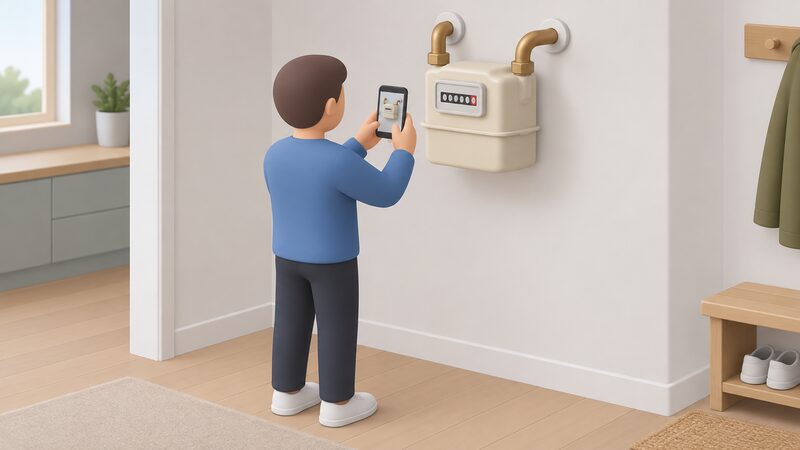
- Read both meters, gas and electricity, and write down the figures with the date.
- Photograph the meter displays and keep the images.
- Keep any recent bills, which carry your account number and the supplier's contact details.
- Do not cancel the Direct Debit yet, and do not attempt to switch supplier while the account is being moved.
- Wait for the new supplier to make contact and set up the account.
Independent guidance for households preparing for supply disruption is to work from a checklist covering what to do if an energy supplier goes out of business9. One specific meter type needs faster action: if you have a radio teleswitch (RTS) meter, phone your supplier as soon as possible, using the number on your bill, to avoid issues at the switch10.
If your account is being moved to a new supplier, do not switch tariff or supplier while that transfer is in progress11. There is no requirement to stay with a Supplier of Last Resort once the account is set up, but it is best to wait until it is set up before switching2.
How the Supplier of Last Resort process uses your reading
Ofgem runs a competitive process to choose the Supplier of Last Resort. The supplier must show it has the ability to take on the new customers quickly and efficiently, and without significantly impacting its existing customers, that it can secure enough gas and electricity without significant cost, and whether it will voluntarily reimburse customers' credit balances2. Those three tests explain why the appointed company is usually a larger one with spare operational capacity.
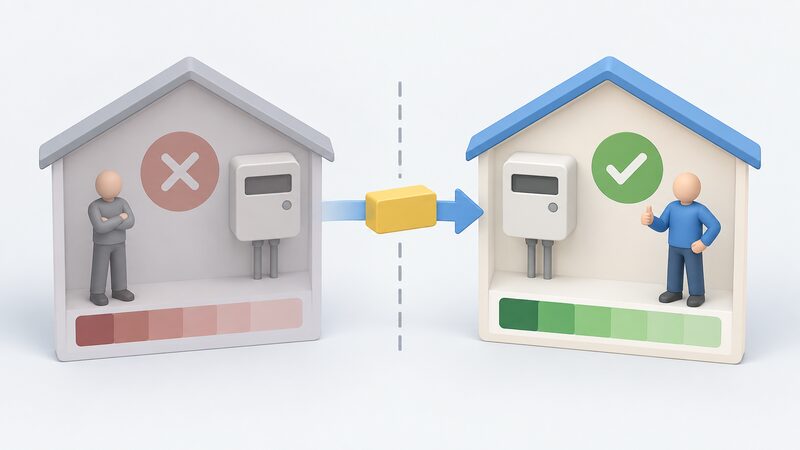
Your reading enters the process as the opening position on your account. The new supplier takes over the supply, sets up the account, and reconciles what you have used against what the failed supplier billed. Ofgem's own summary of the safety net is that you are automatically switched to a new supplier and your supply continues uninterrupted5.
There is one wrinkle for households mid-switch when a supplier fails. If the switch had been completed, the customer goes to the Supplier of Last Resort for the supplier they switched to; if it had not, they go to the Supplier of Last Resort for the supplier they were leaving2. A reading taken at the point you hear the news covers either outcome.
Not every household is in the domestic market in the same way. Residents paying a landlord or site owner by meter readings or estimates do not have the right to switch suppliers themselves12, so the Supplier of Last Resort route does not apply to them in the same form. Where a household is on a heat network rather than a gas or electricity supply, the supplier arrangements differ again.
What happens to your account and balance under the new supplier
Your supply continues, but your access to information may not. Once a supplier has stopped trading, you may not be able to access your account details online1. That is the practical reason to keep your own copy of the reading and your recent bills rather than relying on a portal that may close.
Complaints do not disappear with the supplier. You can discuss the problem with your new supplier when they contact you, and they will review the complaint and check whether it is still relevant or whether it can be closed1. If you suspect an issue with your smart meter, or the supplier identifies one, they should promptly investigate it and resolve it themselves or with third parties, keeping you informed13.
On payment, the Direct Debit needs rebuilding rather than continuing. When you switch supplier, you will be asked to set up your Direct Debit ahead of the date the new supplier takes over, and the old Direct Debit should be cancelled after the final bills are paid14. Stopping a Direct Debit can cost you a discount you currently hold for paying that way15, so the order matters: new instruction first, old one cancelled once the final bill clears.
A debit balance does not trap you. If your account is in debit or you still owe money to your old supplier, you can still switch energy suppliers, though you will receive a final bill which must be paid in full16. Suppliers also review current payments and debt repayments when circumstances change17.
Does a smart meter change anything if your supplier goes bust?
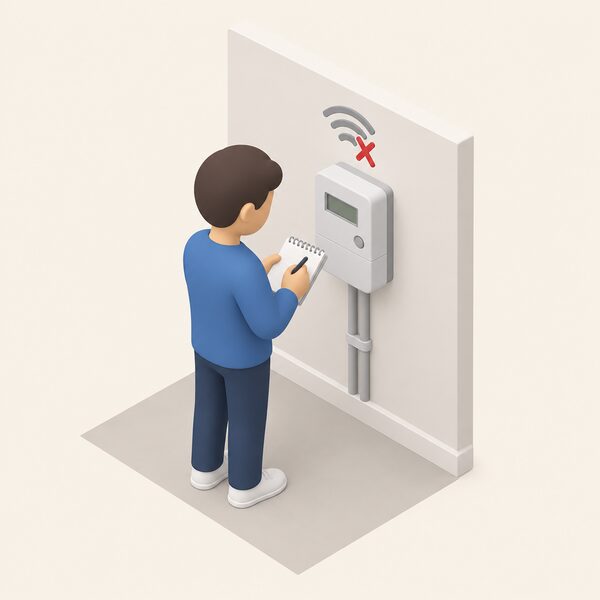
It can, and not always in your favour. Ofgem's guidance is explicit that your meter may not work in smart mode when you move to the new supplier, and that you may need to take meter readings manually and submit them to your new supplier instead1. The same failure modes recur across Ofgem's smart meter help pages: the meter may stop recording the energy you use, or may no longer send readings to your supplier18.
SMETS1 meters are the most exposed. They could temporarily go dumb and lose their ability to send automatic meter readings after you switch energy supplier21. With a SMETS1 meter you might need to send your meter readings to your old and new energy suppliers when you switch22. Newer SMETS2 meters are designed to keep working across suppliers, and having a smart meter does not stop you switching at all; smart meters should make switching quicker because they can send information to a new supplier instantly23.
Where the meter does keep working, readings are sent automatically by the smart meter to the energy supplier13, and because the meter sends readings automatically the household should get more accurate bills and does not need to submit readings manually24. If it stops working, the supplier is the point of contact: suppliers are responsible for maintenance and will fix or replace the meter as needed25.
The independence point is worth stating plainly. A smart meter ties your billing accuracy to a working communications link and to a supplier's systems. When the supplier changes, that link can break, and the household falls back on manual readings. The meter still measures; what is lost is the automatic reporting.
What if I can't submit a reading before the systems go offline?
Keep your own record regardless. A dated note or photograph is evidence even if there is nowhere to submit it, and it can be produced later to the new supplier.
Suppliers have their own fallback. If you have not submitted a reading for a long time, or you are unable to take your own meter readings, your supplier may send someone to your property to read the meter, and may also visit to check everything is working7. That visit is the mechanism that restores an accurate figure when the household cannot supply one.
If the meter itself is faulty, there are deadlines. For a credit meter fault, the supplier has 5 working days to investigate, take action to fix it and offer written confirmation, counted from the day you tell them6. Under the smart meter rules, within 5 working days of receiving a notification the supplier must complete an initial assessment, take appropriate action and offer to confirm in writing27. Where a meter is being tested for accuracy, the supplier may take daily meter readings over 7 days to check your usage6.
Where no reading has been submitted for a long time, or where the household is unable to take its own readings, the supplier may send someone to the property to read the meter, and may also visit to check everything is working10. On heat networks the same gap is filled by estimation: the supplier is allowed to estimate if it cannot take a meter reading, for example if it cannot get to the meter or no reading has been given in a while8.
Will my direct debit continue with the new supplier?

No. The instruction sits with the failed company, and a new one has to be set up with the supplier that takes over. Set up the Direct Debit with the new supplier ahead of the takeover date, and cancel the old one after paying the final bills14.
The timing carries a cost if it is done in the wrong order. You may lose any discount you currently have for paying by Direct Debit if you stop15. Cancelling first, before the new instruction is live, risks both the discount and a gap in payment arrangements that the new supplier has to resolve.
Prepayment customers have a different sequence. Do not switch tariff or supplier while your account is being moved to the new supplier11. Prepayment credit already loaded onto the meter can be used as normal, and the new supplier sends new keys or equipment as a priority2.
Where the process leaves the household
The reading is the household's only active contribution to a process that otherwise runs without it. Ofgem appoints the replacement, the supply continues uninterrupted5, and the account is rebuilt under a company the household did not choose. What the reading buys is accuracy at the seam: a final bill based on use rather than estimate, and a credit refund calculated on a real figure rather than a reconstructed one4.
The dependence that remains is structural. The household depends on the grid, on a supplier it did not select, and, where a smart meter is involved, on a communications link that may drop to manual mode during the transfer1. A dated reading, kept by the household, is the one part of the record that survives the failure intact.
Sources27 cited
- What happens if your energy supplier goes out of business, Ofgem, 2026
- Energy supplier out of business, Uswitch, 2026-05-29
- Switch your home energy supplier, Ofgem, 2026
- What happens to credit if I switch?, Uswitch, 2026-05-29
- Energy: your questions answered, Confused.com, 2026
- Find out if your energy meter is faulty, Citizens Advice, 2026-09-20
- How to submit a meter reading, Uswitch, 2026-04-23
- Struggling to pay your heat network bills, Citizens Advice, 2026-09-17
- Get prepared, National Energy Action, 2026-06-02
- RTS: what you need to know, Act on Energy, 2026
- You can't afford to top up your prepayment meter, Citizens Advice, 2026-09-17
- Alternative homes energy guidance, Ofgem, 2026
- Smart meters: your rights and expectations, GOV.UK, 2025-08-08
- Direct Debit, Uswitch, 2025-10-22
- What if you can't pay your energy bill, Centre for Sustainable Energy, 2026-06
- Get help with your energy bills, Ofgem, 2026-09-17
- The Electricity and Gas (Energy Company Obligation) Order 2015, legislation.gov.uk, 2015
- Get help with your smart meter, Ofgem, 2026
- Get help with your smart meter, Ofgem, 2026
- Get help with your smart meter, Ofgem, 2026-09-17
- How do you know if you have a smart meter?, Smart DCC, 2026
- What is a smart meter? Easy read, Smart Energy GB, 2026-03-16
- What is a smart meter?, Which?, 2026-04-07
- Gas and electricity meter reading, Uswitch, 2026-04-23
- Smart meters, Welsh Government Climate Action, 2026
- Smart meters, Energy Ombudsman, 2026-09-20
- Domestic RHI: Guide to metering, Ofgem, 2022-03
 Submit Meter ReadingsThe routes for sending readings, by app, online account, phone and automated line, and the timing that gets them onto the right bill.
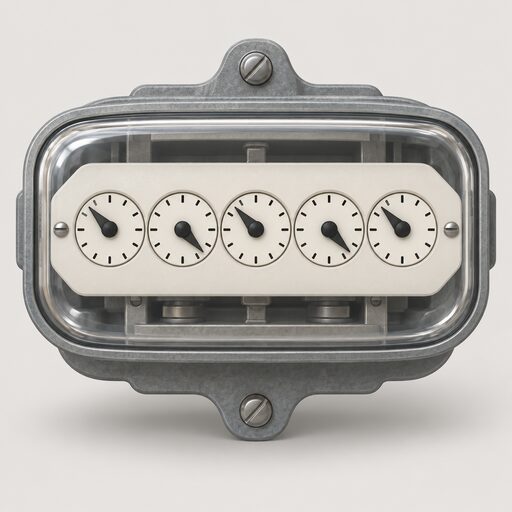 Meter Readings and EstimatesWhy is my energy bill estimated, and how often should my meter be read?
 Smart Meter Faults and FixesYour smart meter has stopped working.
 Supplier Apps and AccountsWhat can you actually do in your supplier's app?
 Take a Meter ReadingWhich numbers do you actually read on a gas or electricity meter, and which ones do you ignore?
 Get a Reading From a Smart MeterHow to bring up a meter reading on a smart electricity or gas meter when a manual reading is still needed, and the difference between the meter itself and the in-home display.