
In this guide
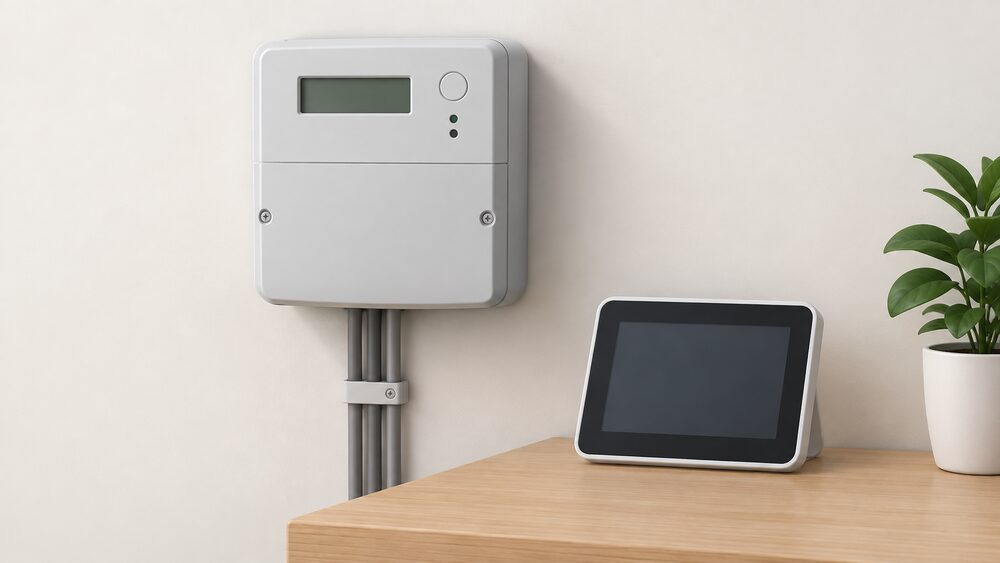
A smart meter fault usually shows itself in one of two ways: the meter stops recording the energy you use, or it stops sending readings to your supplier1. Either can leave a household on estimated bills, with an in-home display showing stale or blank figures, and with the meter quietly running in non-smart mode rather than doing the job it was installed for.
The scale is not marginal. As at March 2023, 3 million smart meters were not working properly, equating to 9% of installed meters2. The Public Accounts Committee put the same figure at around 3 million, or 9%, of smart meters not working properly at March 20233. Ofgem's own consumer research found that only 1 in 3 (33%) direct debit customers with a smart meter reported an issue, and smart meters were the second most common reason for complaints (29%) among those who contacted their supplier4.
What follows is the practical map: what a fault looks like, what the display does and does not tell you, the 12-month display warranty, the checks worth making before you call, the 8-week rule that governs the supplier's responsibility, how escalation to the Energy Ombudsman works, and what the rollout timetable means for older equipment.
What a smart meter fault looks like in practice
The failure modes are narrower than the phrase "smart meter problems" suggests. Ofgem's guidance is blunt about the two core ones: your smart meter may stop recording the energy you use, or may no longer send readings to your supplier1. The first is a metering fault; the second is a communications fault. They look similar on a bill, because both push the account towards estimates, but they are diagnosed and fixed differently.
A meter that has stopped operating in smart mode can get there by several routes. Ofgem lists the causes: it loses connection with your supplier, it loses connection after you change supplier, or it has been installed without being connected to the national communication system10. The middle one is the most common surprise. A meter may not work in smart mode when you move to a new supplier, and you may need to take meter readings manually and submit them to your new supplier instead11.
The scale of the problem has been documented at the highest level. The Public Accounts Committee reported that around 3 million (9%) of smart meters were not working properly at March 20233, and the National Audit Office figure cited in the same period was 3 million smart meters not working properly, equating to 9% of installed meters2. Those are dated figures from 2023 and the position has moved since, but they set the order of magnitude: roughly one meter in eleven.
For a household, the practical consequence is a split between what the meter does and what the account shows. A meter that records but does not communicate still measures consumption accurately; the readings simply have to be supplied another way. A meter that has stopped recording is a different matter, because the supplier has no reliable basis for the bill at all. The two faults carry different urgency and different remedies: a smart meter may stop recording the energy used, or may no longer send readings to the supplier3, and a meter that has gone dumb, particularly an older model, prevents automatic readings2.
The in-home display: what it shows and how it connects
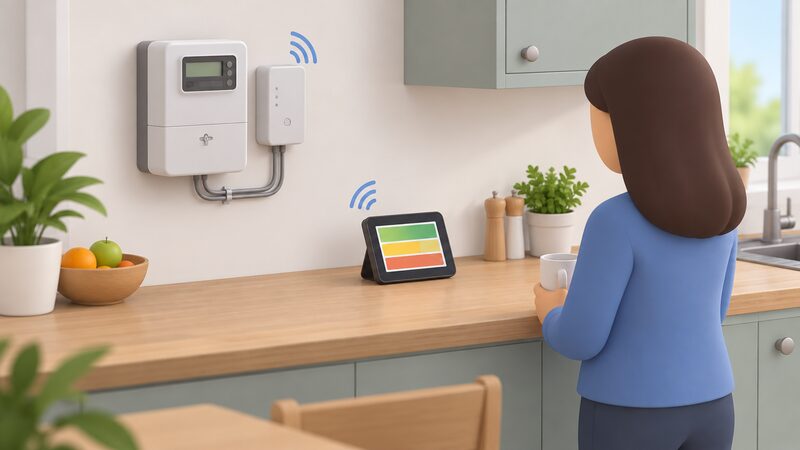
The in-home display is the part of the system a household actually looks at. Smart meters are accompanied by an in-home display, a portable touchscreen device that shows near real-time energy usage data12. Every smart meter installation includes one: with every smart meter installation, the customer is provided with an in-home display13. Ofgem's consumer guidance describes the same arrangement, noting that smart meters come with a useful In-Home Display (IHD) so consumers can see and manage energy use to save money on bills14.
What it shows is consumption, during the day. The meter's in-home display also shows you how much energy you're using during the day15. That is the whole of its function: near real-time usage, so a household can see what a kettle, a shower or a tumble dryer does to the reading. It is not a control device, it does not change tariffs, and it does not manage anything.
The connection is worth understanding because it explains most display faults. The display talks to the meter locally, not over the internet, which is why a smart meter does not need your home broadband to work13. A display that has lost its pairing to the meter, or has been moved out of range, will show nothing useful even though the meter itself is fine. That is a display fault, not a meter fault, and it is fixed differently.
In-home display warranty: 12 months of free repair or replacement
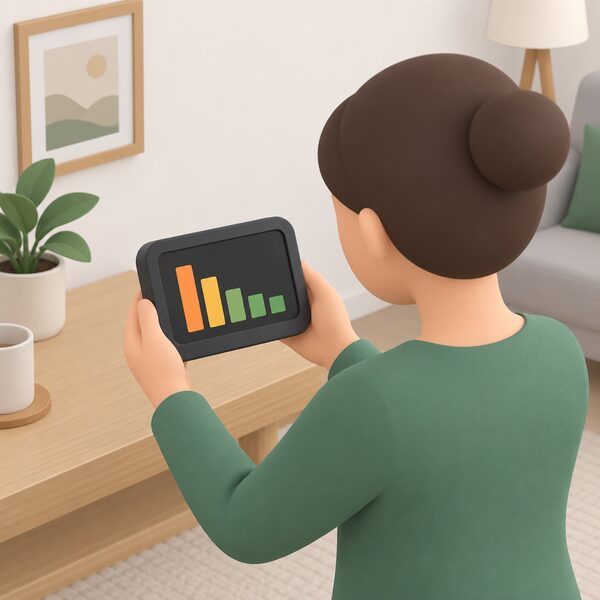
The display carries a defined warranty period, and it is short. If you report a fault with the in-home display within 12 months of the date of installation, and your supplier is satisfied the fault is not due to customer failure to keep the IHD in good working order, the supplier must repair or replace it free of charge6. The condition is explicit: the obligation covers faults that are not the household's own doing.
Which? states the same rule in consumer terms: if you've had your smart meter monitor for less than 12 months and it has broken or isn't working as it should be, your supplier should fix or replace it free of charge, though you may pay if you damaged it7. The independent guidance and the Ombudsman's wording agree on the 12-month boundary and on the exclusion for customer damage.
The warranty is not the whole of the household's position, because the meter itself is separate. If your smart meter stops working, contact your supplier: they are responsible for maintenance and will fix or replace your meter as needed16. The meter has no 12-month limit of that kind; the display does.
Common faults and first troubleshooting steps
Most reported faults fall into a small number of categories, and the checks that matter are the ones that establish which category you are in before you call.
- No readings reaching the supplier. The meter has lost connection with the supplier, lost it after a supplier change, or was installed without connection to the national communication system10. Check whether the display still shows live usage: if it does, the meter is recording and the fault is communications.
- Display blank, frozen or unpaired. The display has lost its local link to the meter. This is a display fault, and the 12-month warranty applies6.
- Gas showing but not electricity, or the reverse. A single-fuel communications problem rather than a whole-system failure.
- Meter in non-smart mode after switching. Your meter may not work in smart mode when you move to the new supplier, and you may need to take meter readings manually and submit them to your new supplier instead11.
- Installation that did not complete. If a smart meter installation fails due to a fault within the energy supplier's control, the consumer will receive compensation17.
The reporting route is the same in every case. Contact your supplier, who is responsible for maintenance and will fix or replace the meter as needed16. Suppliers are already required to take all reasonable steps to fix smart meters that are not working as they should8, and if you suspect an issue with your smart meter, or your energy supplier identifies an issue, they should promptly investigate it, resolve it themselves or with third parties, and keep you informed14.
The response deadline is now defined. Since 23 February 2026, if you report a problem with your smart meter, your supplier must tell you how it plans to resolve it within five working days; if it does not, it owes you £40 compensation, under new rules from energy regulator Ofgem7. The repair itself has an outer limit: suppliers will have no more than 90 days to repair faulty smart meters8.
When the fault is the supplier's responsibility: the 8-week rule
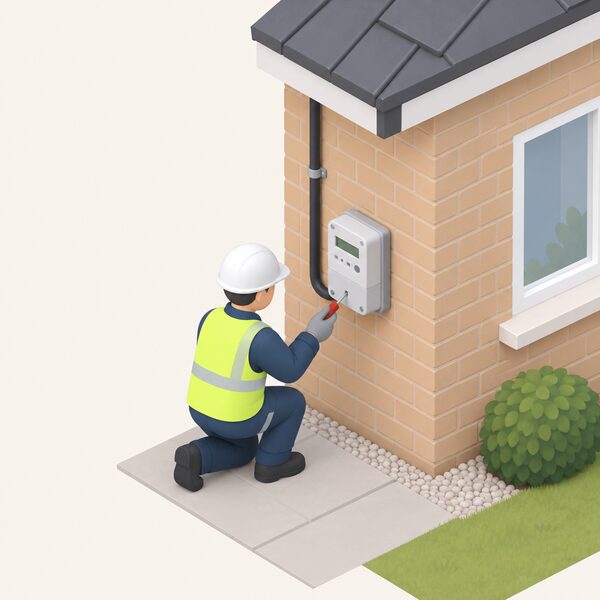
The supplier's obligation to fix the meter and its obligation to resolve a complaint run on different clocks, and the second is the one that opens the door to escalation. Your energy supplier must try to fix any problems you reported within 8 weeks and resolve the complaint18. That is the deadline that matters for a household stuck with a meter that will not communicate and a supplier that has not put it right.
The guaranteed standards sit underneath this. Ofgem's final decision sets out the first three new smart meter Guaranteed Standards of Performance (GSOPs), covering smart meter installation timeliness, installation quality and issue resolution19. GSOP 3, on investigating smart meter operational issues, requires that the energy supplier must complete an initial assessment, take an appropriate action and offer to update the consumer, within 5 working days17. GSOP 2 covers failed installations: if a smart meter installation fails due to a fault within the energy supplier's control, the consumer will receive compensation17, and the standard applies to all smart meter installation appointments, whether that be a first-time installation or the replacement of an existing smart meter, including work by third-party engineers contracted through Meter Operators17.
A further standard addresses meters that will not go smart. If a consumer's smart meter is not operating in smart mode for over 90 days, the consumer will receive compensation17. The scope is drawn tightly: the proposed standard covers a smart meter not operating in smart mode where there is no action of another party, other than the respective energy supplier, required to provide a resolution, the consumer has not agreed the smart meter to not operate in smart mode, and there is a solution that will resolve the issue20. Where a fix depends on another party, or where no solution exists, the standard does not bite.
Escalating to the Energy Ombudsman: eligibility, awards and outcomes
The Energy Ombudsman is the next step when the supplier has not resolved the issue. It provides an independent service, separate to Ofgem, if you are having problems with an energy supplier, an energy broker, a network operator or a heat network supplier18. It handles issues with your energy supplier, energy broker, network operator, green deal or heat network supplier21, and it can process complaints for both domestic and small business consumers in the energy sector21.
Eligibility has two gates. It's been at least 8 weeks since I first raised the issue with the supplier, or I have received a Deadlock Letter22. A deadlock letter is the supplier's written confirmation that it cannot resolve the complaint, and it short-circuits the wait: you must escalate your dispute within 12 months of receiving the letter23. Without one, the 8-week clock applies, and if after 8 weeks your issue is still unresolved, the Ombudsman can then investigate23.
Once a case is accepted, the process is defined. The Ombudsman will ask you to send information and evidence relating to your complaint, review evidence from you and your energy company, inform you of their decision within 6 weeks, and give the energy company a set of actions to resolve the problem18. You have up to 14 days to upload evidence to support your case23, and on average most disputes are resolved within 6 weeks of the Ombudsman receiving evidence from both parties9.
The remedies are practical rather than punitive. The Ombudsman can tell suppliers to take practical action (for example credit or cancel an account, or change your tariff), make an apology, or offer a financial award, or a combination of these, and recommendations may be made to prevent issues happening again9. Financial awards are based on the cost of putting things right, such as ensuring you've been charged accurately, clearing unfair charges or fixing faults9. The ceiling is up to £10,000 for domestic energy disputes or up to £20,000 for small business disputes9, and the level of maximum financial award may vary depending on the type of energy company and the Terms of Reference that cover that scheme9. The most common financial award is around £50, sometimes referred to as a Time & Trouble Award23.
Where to get free advice: Citizens Advice in England and Wales
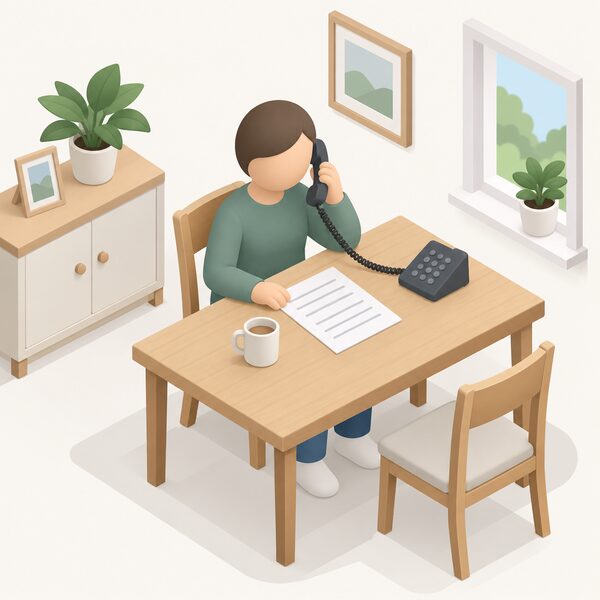
For households in England and Wales, the first port of call outside the supplier is the statutory consumer service. If you live in England or Wales, Citizens Advice's free consumer service can help you if you have problems with your energy bills or supply18. It is free, independent of the supplier, and can advise on the complaint route before it reaches the Ombudsman.
The position differs across the four nations. The Citizens Advice consumer service covers England and Wales specifically18. Scotland and Northern Ireland have their own arrangements, and a household outside England and Wales should use the equivalent national service rather than the England and Wales line. The Ombudsman itself handles disputes involving suppliers trading in Britain23, which is a separate territorial limit from the advice services.
The Ombudsman's own contact route is straightforward. For energy complaints, call 0330 440 162423. For heat networks enquiries the same number applies, pressing option 3 for heat networks when prompted24, and where a heat network supplier cannot be found, call 0330 440 1624 and press option 3 for heat networks when prompted25. To register a dispute, search for the name of your energy supplier to get started25.
What the rollout timetable means for older meters and 2G/3G equipment
The rollout framework that governed the last few years has closed, and the next phase has a different shape. The four-year obligation ran between 1 January 2022 and 31 December 2025 and has now concluded26. Suppliers are now required to complete the rollout by the end of 20308.
That timetable has a direct bearing on older equipment, because part of the installed base depends on mobile networks that are being switched off. An estimated seven million communications hubs, part of the electricity smart meters, will need to be replaced because they will lose functionality when the 2G and 3G mobile communications networks are closed3. The replacement is scheduled rather than optional: communications hubs using 2G or 3G, and associated metering devices as relevant, will need replacement with 4G-capable devices by the end of 203327.
For a household, this reframes what counts as a fault. A meter that stops communicating because its communications hub has lost its network is not a random failure; it is a predictable consequence of a network shutdown, and the fix is a hub replacement rather than a repair. The distinction matters when a supplier is deciding what to do and how quickly.
What this means for a household's energy independence
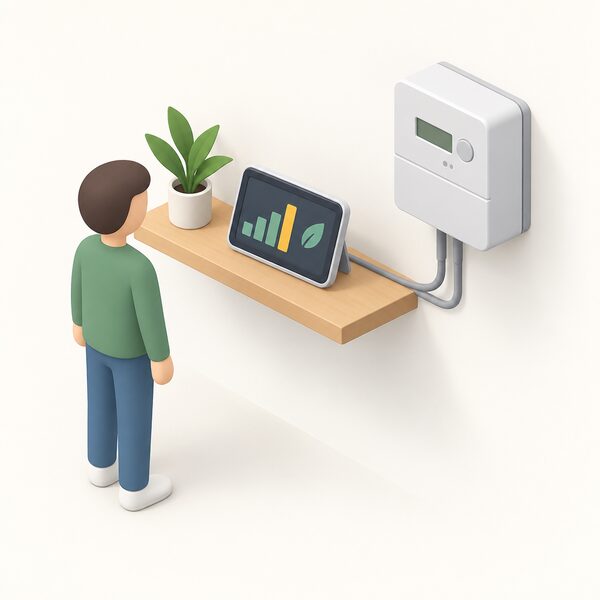
A smart meter is a monitoring and reporting device, and its failure modes are failures of monitoring and reporting rather than of supply. The meter keeps the lights on whether or not it communicates. What a fault removes is the household's own visibility: the near real-time consumption figure on the in-home display, and the automatic reading that keeps the bill accurate without manual effort.
That is the dependence the system carries. The meter depends on a communications network, on a supplier to maintain it, and on a national communication system to carry the data. When any of those fails, the household falls back on manual readings and estimated bills, and the monitoring benefit that justified the installation is suspended until the fault is fixed. The 12-month display warranty, the five-working-day response deadline, the 90-day repair limit and the 8-week complaint rule are the structure that limits how long that suspension can last.
For a household that wants to keep its own view of consumption independent of the supplier's system, a consumer access device or a standalone monitor drawing on the meter's data is the alternative route, and it does not depend on the in-home display's warranty. The meter's own accuracy is unaffected by any of these faults; what is at stake is who can see the data and how quickly.
Sources27 cited
- Get help with your smart meter, Ofgem, 2026
- Delayed smart meter programme, UK Parliament, 2023
- Delayed smart meter programme fails to hit targets, UK Parliament, 2023
- Energy Consumer Satisfaction Survey Findings Report, Ofgem, 2024
- Smart meter Guaranteed Standards of Performance Draft Impact Assessment, Ofgem, 2025
- Smart meters, Energy Ombudsman, 2026
- Smart meter problems and solutions, Which?, 2026
- Tough new rules force suppliers to fix faulty smart meters, GOV.UK, 2026
- What to expect, Energy Ombudsman, 2026
- Smart meter performance, Ofgem, 2026
- What happens if your energy supplier goes out of business, Ofgem, 2026
- Smart meters and decarbonisation, Smart DCC, 2026
- Does a smart meter need Wi-Fi?, Smart DCC, 2026
- Smart meters: your rights and expectations, GOV.UK, 2025
- Getting a smart meter, Ofgem, 2026
- Smart meters, Welsh Government, 2026
- Final decision on smart meter GSOPs, Ofgem, 2026
- Complain about your energy supplier or network operator, Ofgem, 2026
- How we're working to support customers to address non-communicating smart meters, Smart DCC, 2026
- Smart Meter Guaranteed Standards of Performance, Ofgem, 2025
- We may be able to help resolve your energy dispute, Energy Ombudsman, 2026
- Raise a dispute, Energy Ombudsman, 2026
- FAQs, Energy Ombudsman, 2026
- Metropolitan Infrastructure Limited, Energy Ombudsman, 2026
- Your Energy Matters, Energy Ombudsman, 2026
- Supplier smart metering installation targets, Ofgem, 2026
- Deemed contracts and rates, Energy Ombudsman, 2026
 Meter Standards and AccuracyHow UK smart meters are certified for accuracy, how their readings become a bill, what happens when a meter stops communicating, and how a metering or billing dispute is escalated to a supplier and then to the Energy Ombudsman.
 Meters and Energy IndependenceDo smart meters really save you money, and can you still get one fitted for free?
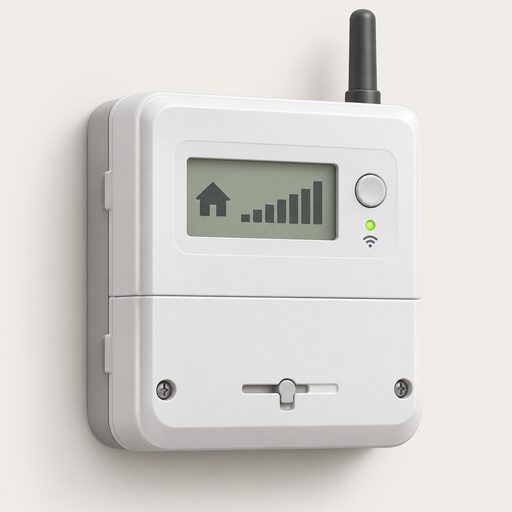 Smart Meter InstallationCan your supplier make you have a smart meter, and how long should you wait for an appointment?
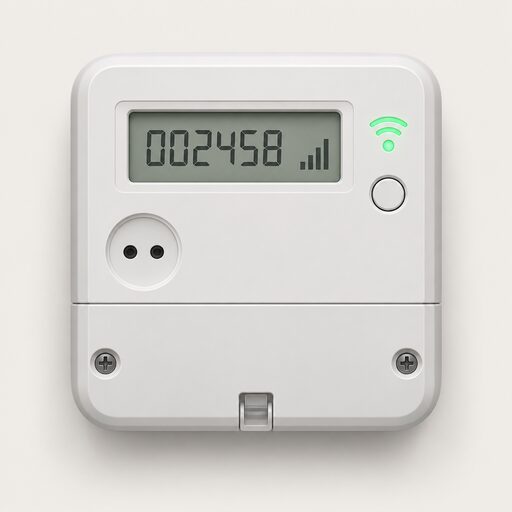 The Full Smart Meters GuideDo smart meters really save you money, and how do you use one to cut your bills?
 Why You Cannot Get a Smart MeterWhy can some homes not have a smart meter fitted, and what counts as a good enough reason?
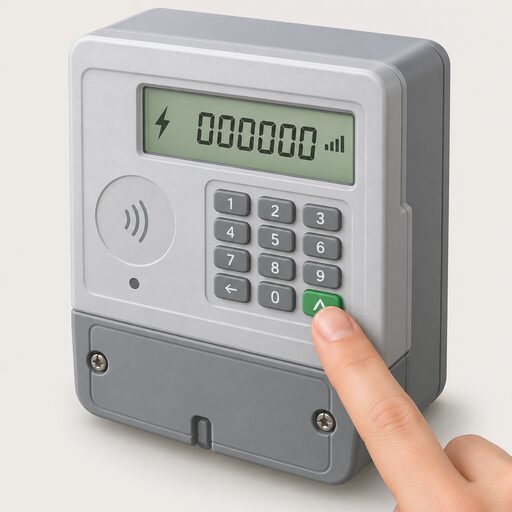 Get a Reading From a Smart MeterHow to bring up a meter reading on a smart electricity or gas meter when a manual reading is still needed, and the difference between the meter itself and the in-home display.