
In this guide
Smart meters in Wales sit inside the Great Britain framework: the same supplier obligation, the same national communications network and the same free installation apply in Wales as in England and Scotland. The official statistics release on the roll-out states its territorial extent plainly as England, Scotland and Wales1, and the guidance on getting a meter says energy suppliers aim to provide every home and business in England, Scotland, and Wales with free smart meters2. Installation is free for UK energy customers3.
What differs in Wales is the housing and the landscape. Rural and valley areas, off-gas-grid homes, storage heater properties and older housing stock shape how the rollout is experienced, and the Radio Teleswitch Service, the 1980s system that switches many electric heating tariffs, has now reached the end of its life. Ofgem's guidance is direct: support for RTS meters has now ended, and if you still have one, it may no longer work as expected4. The recommended action is to contact your supplier to arrange to have a new smart meter installed4.
The practical answer for a Welsh household is therefore the same as for the rest of Great Britain, with two additions: a Welsh language advice route through Citizens Advice, and Welsh Government support for home energy bills that sits alongside metering rather than replacing it.
Smart meters in Wales: where the rollout stands
The smart meter programme is a single national programme, not four national ones. The quarterly statistics collection covers the roll-out of smart meters in Great Britain, covering meters operating and meters installed1, and the September 2023 release applies to England, Scotland and Wales1. There is no separate Welsh installation target, no separate Welsh meter specification and no separate Welsh communications network. A household in Gwynedd is on the same footing as one in Greater Manchester.
The scale of the programme was set early. The 2020 government announcement described installing over 50 million smart meters over the next seven years7, and the accompanying guidance described over 50 million meters to be installed in 30 million premises7. By June 2020 the government reported 21.5 million smart and advanced meters already in homes and small businesses across Great Britain7. Those figures are dated and describe the position at the time they were published; they are not a current count.
For Wales specifically, the energy context is worth setting beside the metering programme. In 2023, 109 MW of new renewable electricity capacity was installed in Wales, alongside 67 MW of new heat technologies8. That is generation and heat capacity, not metering, but it explains why metering matters more in Wales than the meter itself suggests: a household with a heat pump, solar or a battery needs half-hourly data to make any of it pay, and the meter is what produces that data.
What a Welsh household should expect in practice is a supplier-led process. The supplier decides the schedule, the engineer and the communications hub. The household's role is to ask, to be present for the appointment, and to raise a fault if readings stop arriving. The independence gain is real but partial: the meter gives the household its own consumption data, while the connection to the grid, the supplier relationship and the national communications network all remain outside the household's control.
What a smart meter does and why it matters for household independence
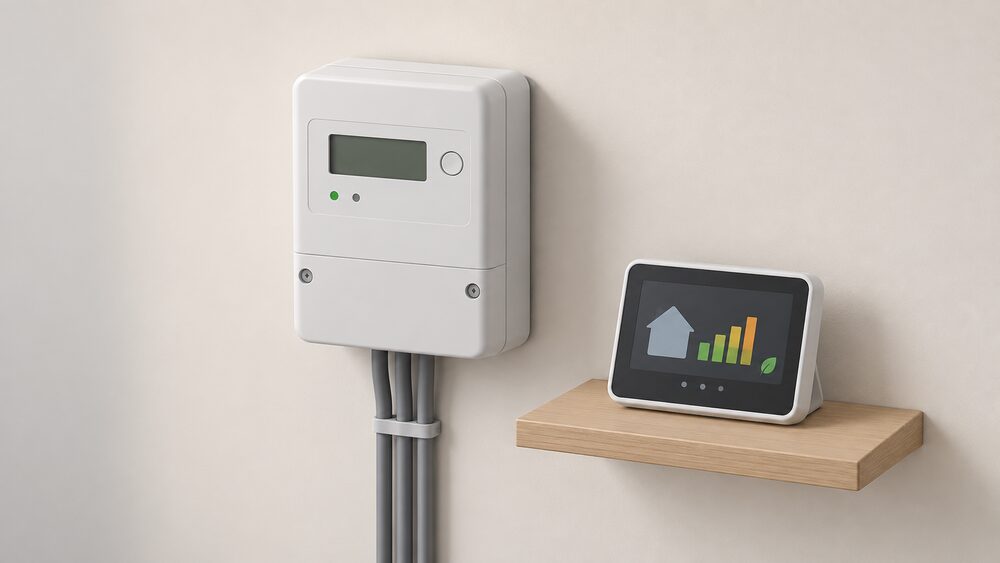
A smart meter differs from a traditional meter in one structural way: it offers two-way communication, which means it can wirelessly send and receive information9. That single change is what makes everything else possible. The data provided by your smart meter puts you in control of your energy usage, meaning you can take energy-saving steps to reduce your CO2 emissions10, and smart meters help provide that visibility, enabling consumers, energy suppliers and other organisations to better understand how energy is being used10.
For a household's energy independence, the honest position is that a smart meter is a data instrument, not a generation asset. It does not reduce dependence on the grid, on a supplier or on imported gas. What it does is remove one layer of blindness. The data you share through your smart meter is used to bill you for the energy you use, to offer you new products and services such as new tariffs if you have given permission, and to help make the energy system more efficient by recording demand more accurately4. The environmental framing from the network operator is that you can take energy-saving steps to reduce your CO2 emissions and play your part in Britain's journey to Net Zero11.
The dependence that remains is worth naming. The meter talks to a national network, not to the household's own systems, and the household's access to its own data runs through the supplier, an in-home display or a consumer access device. The meter is also the property of the supplier, not the household. Independence here means knowing what you use and being able to act on it, not owning the infrastructure.
Is having a smart meter installed compulsory?
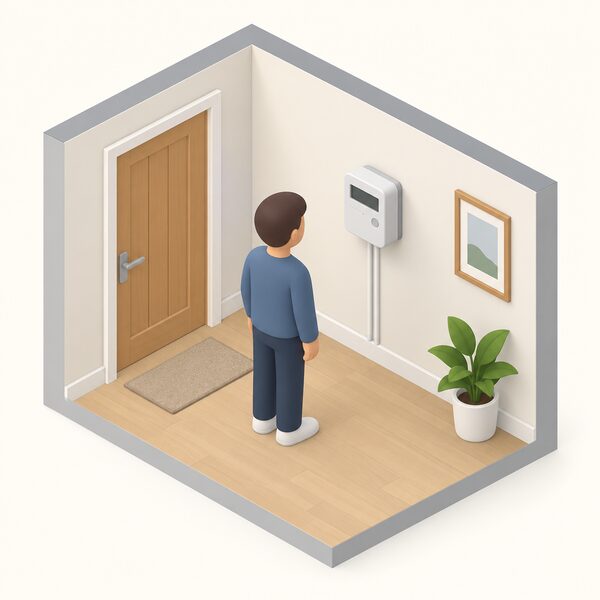
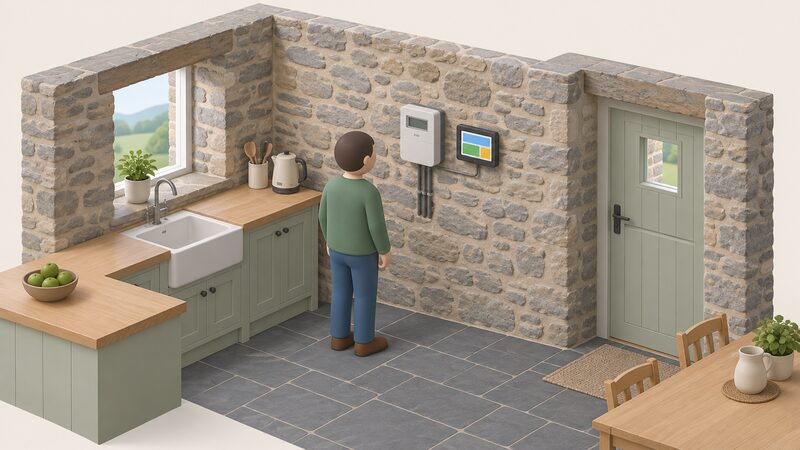
No. There is no legal obligation on a household to accept a smart meter, and the campaign body's own explainer on the law addresses the question directly12. The Energy Ombudsman's guidance is equally clear: while it is your right to refuse the installation of a smart meter, if your traditional meter needs to be replaced due to being faulty or unsafe, replacement options may be limited13.
That qualification matters more than the headline right. A refusal is straightforward while the existing meter is serviceable. It becomes complicated when the meter fails, because the supplier has a duty to keep metering safe and accurate, and the practical replacement may be a smart meter whatever the household's preference.
Going the other way is harder still. Only under exceptional circumstances would an energy supplier be expected to change a smart meter to a traditional meter, and the supplier may charge the costs if it agrees13. A household that accepts a smart meter and later wants it removed should not assume removal is available.
There is a further wrinkle for households that switch supplier. Your meter may not work in smart mode when you move to the new supplier, and you may need to take meter readings manually and submit them to your new supplier instead14. That is the SMETS1 legacy problem, and it is not specific to Wales, but it bites harder in areas where the original installation wave was early.
Radio Teleswitch Service meters: the legacy system being phased out
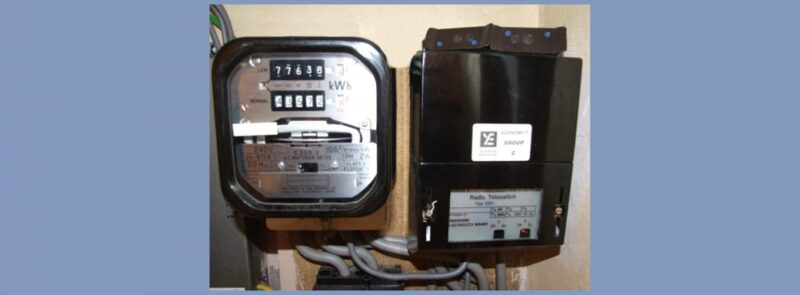
The Radio Teleswitch Service is a system introduced in the 1980s in the UK to manage electricity meters6. It is provided by your electricity supplier6, and it works by broadcasting a radio signal that switches meters and heating systems between peak and off-peak operation. It is the mechanism behind many Economy 7, Economy 10 and Total Heat Total Control tariffs, and it is concentrated in exactly the kind of property common in rural and valley Wales: electrically heated homes with storage heaters and no gas supply.
The service is being switched off because it is reaching the end of its operational life, and the equipment that produces the radio signal can no longer be adequately maintained6. Ofgem's consumer guidance states that support for RTS meters has now ended and that if you still have one, it may no longer work as expected4. Without the RTS signal, systems may become unpredictable, potentially not working or turning on or off at incorrect times6.
The switch-off date is not settled across the published guidance. One independent guidance page gives 30 June 20256, while another gives 30 June 20265. A household relying on an RTS meter should treat the exact date as uncertain and act on the supplier's own notification rather than on either published date.
How to tell whether you have one
The identification criteria are specific and can be checked at home. If your property matches any of these criteria, you may have a Radio Teleswitch meter5:
- A separate switch box near the meter, often labelled Radio Teleswitch
- A property heated using electricity or storage heaters
- No gas supply to the area, including rural areas and high-rise flats
- A tariff that is Economy 7, Economy 10 or Total Heat Total Control
What happens to an Economy 7 tariff
Some older Economy 7 meters use the RTS service and will be affected, but not all Economy 7 meters do5. That distinction is the one households most often miss. An Economy 7 meter with a built-in time clock is unaffected by the radio switch-off; one that relies on the broadcast signal is not. The only reliable way to establish which applies is to ask the supplier.
Who is replacing RTS meters, and with what
The replacement route is narrow and supplier-led. Smart meters are the only replacement for RTS meters, and residents must contact their energy supplier to arrange an upgrade15. Suppliers are required to proactively contact customers who currently use RTS meters to inform them about the upcoming switch-off date and the need to upgrade to a smart meter to avoid disruptions6, so a household should expect to be contacted rather than to have to chase.
Contact with the supplier is what moves a replacement forward. Ofgem's guidance is that households should contact their supplier to arrange for a new smart meter to be installed4, and the same guidance notes that suppliers provide support with any meter upgrades needed, with further guidance published on the Ofgem website6.
There is no alternative replacement on offer. A household that wants to keep a radio-switched tariff cannot do so once the signal ends, because the equipment that produces it can no longer be adequately maintained6. The choice is between a smart meter and an unswitched meter, and the smart meter is the one that preserves any form of time-of-use pricing.
The communications network behind your meter, and the 2G and 3G switch-off
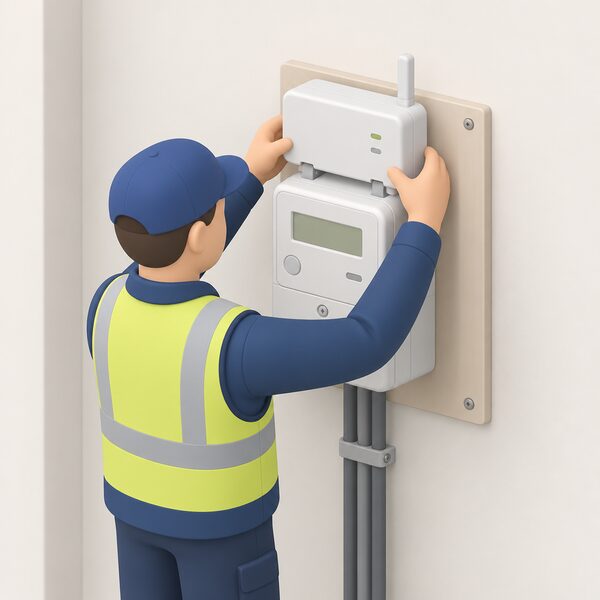
Smart meters do not use the household's broadband, and they do not depend on the household's mobile phone signal. They run on a dedicated national network. In central and southern regions, smart meter data is transmitted using 2G/3G cellular and wireless mesh technology provided by Virgin Media O214. Wales falls within that footprint, and the mesh element is what extends coverage into streets and valleys where a single cellular signal would not reach every meter.
The 3G switch-off does not break a smart meter. Your smart meter will continue to operate as normal following the 3G switch-off, as smart meters will switch seamlessly to the 2G network14. The longer transition is to 4G, and it has a cost. Second-generation smart meters that rely on 2G/3G will require a replacement Communications Hub in order to communicate with 4G networks14, and the government has required suppliers to replace all smart meters that are still connected to 2G and 3G before the services are switched off by 203315.
The cost accounting for that transition is separated from the original rollout. The costs related to the 2G/3G to 4G transition are excluded from the original rollout figures, and the benefits for 2034 are reduced to reflect the 2G/3G switch-off16. In plain terms, the upgrade is treated as a distinct programme with its own costs, and the projected benefits of the whole system were revised down because of it.
For a Welsh household the practical implication is that a meter installed today will need a communications hub replacement at some point before 2033, at no direct cost to the household, and that a period of manual readings is possible during the transition. The dependence on a national network, and on the supplier's maintenance of it, does not go away.
Smart Energy GB: what the campaign body does and does not do
Smart Energy GB is the not-for-profit campaign helping everyone in Britain understand the importance of smart meters and their benefits to people and the environment17. That description is consistent across the network operator's own pages17, and it defines both the body's remit and its limits.
What Smart Energy GB does is explain the programme, publish consumer-facing guidance on topics such as the Radio Teleswitch switch-off, and run the national awareness campaign. What it does not do is regulate, install, or resolve disputes. It is not an ombudsman, it has no powers over suppliers, and it cannot compel a supplier to act on a complaint. A household with a metering problem that Smart Energy GB cannot fix needs a different route.
The routes that do have teeth are these. Ofgem publishes guidance on getting help with your smart meter4 and on complaining about your energy supplier or network operator18. The Energy Ombudsman handles smart meter disputes that the supplier has not resolved13. Consumer protection rights apply across the board19. The supplier's own obligations are set out in the rights and expectations guidance, which states that if you suspect an issue with your smart meter, or your energy supplier identifies an issue, they should promptly investigate it, resolving it themselves or with third parties, and keeping the consumer informed20.
Citizens Advice and where Welsh households can get help

Wales has a distinct advice route, and it is worth knowing before a problem arises. If you live in England or Wales, Citizens Advice's free consumer service can help you if you have problems with your energy bills or supply21. The service covers information and support on struggling to pay bills, problems with your energy supplier or supply, saving energy at home and getting a better energy deal22.
The contact details are specific. You can call Citizens Advice on 0808 223 113323, open Monday to Friday, 9am to 5pm19. There is a Welsh language line on 0808 223 114419. In England there is also a separate number, 0808 144 884419, which does not apply in Wales.
| Route | Number | Applies to | Hours |
|---|---|---|---|
| Citizens Advice consumer service | 0808 223 1133 | England and Wales | Monday to Friday, 9am to 5pm19 |
| Citizens Advice Welsh language line | 0808 223 1144 | England and Wales | Monday to Friday, 9am to 5pm19 |
| Citizens Advice (England only) | 0808 144 8844 | England | Not stated19 |
Beyond the helpline, the Welsh Government publishes its own help with home energy bills for households in Wales22, and the same route is listed again in Ofgem's guidance on getting help with home or business energy bills22. These sit alongside metering rather than depending on it: a household can seek bill support whether or not it has a smart meter.
There is also a Welsh scheme worth knowing about. Green Homes Wales will not be means tested24, and it works in conjunction with collective purchasing schemes being organised by a number of local authorities in Wales25. That combination, a non-means-tested scheme plus local authority collective buying, is a Welsh-specific structure rather than a Great Britain one.
Wales & West Utilities and the gas meter rollout
The gas side of the rollout is often overlooked in Wales, where a significant share of homes are off the gas grid entirely. For homes that are connected, the same national logic applies. Smart meters are replacing analogue gas and electricity meters as part of the national infrastructure upgrade to improve and modernise Great Britain's energy system20. The gas meter is replaced alongside the electricity meter in a single visit in most cases, and the gas reading is transmitted over the same communications hub.
The distribution network operator for Wales and the south west, Wales & West Utilities, is not the body that installs domestic smart meters. Installation is the supplier's responsibility, and the network operator's role is the pipe network itself. A household with a gas supply problem, as distinct from a metering problem, is dealing with a different organisation from the one that owns the meter.
For off-gas-grid homes, which are concentrated in rural Wales, there is no gas meter to replace and no gas reading to transmit. The electricity meter carries the whole load, and the household's consumption profile is dominated by whatever provides heat: storage heaters, an oil boiler, LPG, or a heat pump. That is precisely the household type most exposed to the RTS switch-off, and precisely the household type for which half-hourly electricity data has the most value.
What smart meters enable: time-of-use tariffs, export and the smarter grid
The value of a smart meter to a Welsh household is concentrated in what it enables rather than in the meter itself. The data you share through your smart meter is used to bill you for the energy you use, to offer you new products and services such as new tariffs if you have given permission for this to happen, and to help make the energy system more efficient by recording demand more accurately4. Time-of-use tariffs, export payments and demand flexibility all depend on that half-hourly record.
The supplier obligation behind this is explicit. Energy suppliers must take all reasonable steps to ensure that smart meters automatically send them your gas and electricity meter readings20. That obligation is monitored: the smart meter performance statistics cover suppliers with over 150,000 customers across England, Scotland and Wales26. A household whose readings have stopped arriving is therefore not asking for a favour when it reports the fault; it is reporting a breach of a monitored obligation.
The environmental case is stated by the network operator rather than by government: the data provided by your smart meter puts you in control of your energy usage, meaning you can take energy-saving steps to reduce your CO2 emissions10, and you can take energy-saving steps to reduce your CO2 emissions and play your part in Britain's journey to Net Zero11. Those are the operator's claims, and they rest on the household actually acting on the data.
The limits are worth stating as firmly as the benefits. A smart meter does not generate anything, does not store anything and does not insulate anything. It does not reduce dependence on the grid, on a supplier or on imported fuel. It does not guarantee a time-of-use tariff, an export payment or a flexibility reward; it makes them possible. And it introduces a new dependence of its own, on a national communications network and on the supplier that maintains the meter and the hub. For a Welsh household, particularly one off the gas grid with electric heating, that trade is usually worth making, but it is a trade rather than a gain in independence.
Sources26 cited
- Smart meters in Great Britain, quarterly update September 2023, GOV.UK, 2023-11-30
- How to get a smart meter, Smart DCC, 2026
- Does a smart meter save money?, Smart DCC, 2024
- Get help with your smart meter, Ofgem, 2026-09-17
- The Radio Teleswitch Service (RTS) switch-off, Smart Energy GB, 2026-04-24
- Radio Teleswitch Service, Electricity North West, 2026-09-19
- Government sets out plans to drive up smart meter installations, GOV.UK, 2020-06-18
- Energy generation in Wales 2023, Welsh Government, 2023
- How do smart meters send readings?, Smart DCC, 2026
- Smart meters and decarbonisation, Smart DCC, 2026
- How do smart meters help the environment?, Smart DCC, 2026
- Do you have to have a smart meter by law?, Smart DCC, 2026
- Smart meters, Energy Ombudsman, 2026-09-20
- Do smart meters use 3G?, Smart DCC, 2024
- Tough new rules force suppliers to fix faulty smart meters, GOV.UK, 2026-03-10
- Smart Metering 2025 Costs and Benefits Report, Parliament, 2025
- Protecting data on the smart meter network, Smart DCC, 2026
- Complain about your energy supplier or network operator, Ofgem, 2025-08-08
- Consumer protection rights, GOV.UK, 2026-09-17
- Smart meters: your rights and expectations, GOV.UK, 2026
- Getting help if you can't afford your energy bills, Ofgem, 2026-09-17
- Get help with your home or business energy bills, Ofgem, 2026
- Complain about your energy supplier, Ofgem, 2026
- Green Homes Wales, Development Bank of Wales, 2026-09-17
- £5 million to help Welsh households invest in greener homes, Welsh Government, 2026-03-05
- Smart meter performance, Ofgem, 2026
 Smart Meters in ScotlandWhen will you get a smart meter in Scotland, and what happens if yours still runs on the old radio signal that switches heating and hot water?
 The Full Smart Meters GuideDo smart meters really save you money, and how do you use one to cut your bills?
 Meters and Energy IndependenceDo smart meters really save you money, and can you still get one fitted for free?
 Monitoring in Flats and RentalsCan you get a smart meter in a rented flat, and who decides?
 Radio Teleswitch Switch-OffIs your storage heating or hot water still run by an old radio-controlled meter?
 SMETS1 and SMETS2 MetersIs your smart meter an old first generation model or a newer one, and does it matter?