In this guide
Smart Energy GB is the not-for-profit campaign helping everyone in Britain understand the importance of smart meters and their benefits to people and the environment1. It is not a government department, not a regulator and not an energy supplier. It does not install meters, does not set the rules and cannot act on an individual complaint. Its function is persuasion and explanation: it exists to move the national rollout forward by giving households a reason to say yes.
The rollout it campaigns for is well advanced but unfinished. As of March 2025, 67% of all meters in Great Britain were smart or advanced meters, with 35 million (61%) operating in smart mode2. Government guidance describes smart meters as replacing analogue gas and electricity meters as part of the national infrastructure upgrade to improve and modernise Great Britain's energy system3. The consultation proposes that suppliers complete installation in remaining domestic premises by the end of 20304.
For a household, the practical position is simple. The meter is free to have fitted, it is requested from your supplier rather than from Smart Energy GB, and the campaign body's role ends at the point where you decide to book one. What follows here is what the body is, who funds it, what the evidence says about whether it works, and what a smart meter does and does not change about a home's energy independence.
A campaign body, not a supplier or regulator
The clearest way to understand Smart Energy GB is by what it cannot do. It cannot install a meter, change a tariff, adjust a bill or rule on a complaint. Those functions sit with suppliers, with Ofgem as regulator, and with the Energy Ombudsman for disputes. The Ombudsman is an independent service, separate to Ofgem, for problems with an energy supplier, an energy broker, a network operator or a heat network supplier8. It is approved by Ofgem to handle service disputes in the energy sector9.
The Ombudsman's own limits are worth knowing, because they are often confused with the campaign body's. It states plainly that it cannot punish companies, dictate how companies operate or issue fines10. A household with a billing dispute, a faulty meter or an unresolved installation problem therefore has a route, but it runs through the supplier and then the Ombudsman, not through Smart Energy GB.
Government has its own boundary. In the context of grant-funded efficiency schemes, the department states that it cannot intervene in disputes between consumers, local authorities, delivery partners or installers11. That is a useful marker of how far any public body will go in a domestic case.
Smart Energy GB's own description of itself is consistent across the pages it publishes: the not-for-profit campaign helping everyone in Britain understand the importance of smart meters and their benefits to people and the environment1. That is a communications remit. It is a statutory-style consumer campaign, funded to explain a national infrastructure programme, and it should be read as a source of explanation rather than of redress.
How it is funded, and why that matters to your bill
Smart Energy GB is a company funded by mandatory contributions from energy suppliers5. That single fact explains most of the questions households ask about it. It is not funded by government, not by advertising and not by the meter manufacturers. The money comes from suppliers as a condition of operating, and suppliers recover their operating costs through the prices they charge.
The practical consequence is that the campaign is ultimately paid for by energy bill-payers, domestic and business. It is not a levy shown as a separate line on a bill, and no published figure in the official record breaks out the per-household cost of the campaign. What can be said is that the funding mechanism is compulsory rather than voluntary, which is why the body can run national advertising on a scale individual suppliers would not fund alone.
This matters for how a household reads its output. A campaign funded by the industry it promotes is not a neutral consumer advocate in the way a charity or an ombudsman is. That does not make its factual claims wrong, and much of what it publishes is drawn from government and Ofgem material, but it does mean its purpose is to encourage take-up. Where a household wants an independent view of costs, savings or standards, the Ofgem and government publications are the stronger references.
For context on how energy policy costs reach bills, the Committee on Climate Change has previously estimated that low-carbon policies accounted for a small part of bill increases, with a £45 share of the 2004 to 2012 increase due to support for investment in energy efficiency improvement12. That is a historical figure for a different set of policies, but it illustrates the principle: scheme costs are recovered through bills rather than charged separately.
The rollout it campaigns for: where Britain stands
The numbers have moved steadily. At the end of December 2024, approximately 66% of all meters in homes and small businesses across Great Britain were smart or advanced meters6. By March 2025 the figure was 67%, with 35 million (61%) operating in smart mode2. The gap between the two percentages is the important part: a meter can be smart or advanced in type while not operating in smart mode, which means it is not sending readings automatically.
Ofgem sets out the causes. A meter may not be operating in smart mode because it loses connection with your supplier, loses connection after you change supplier, or has been installed without being connected to the national communication system13. Suppliers are required to take all reasonable steps to ensure that smart meters automatically send them your gas and electricity meter readings13. Where they do not, the supplier should promptly investigate, resolve the issue themselves or with third parties, and keep the consumer informed3.
The direction of travel is set. The consultation proposes that suppliers complete installation of smart meters in remaining domestic premises by the end of 20304. The National Audit Office has reported on the rollout's progress and the challenges of completing it14. For a household, the practical reading is that the offer will reach every home, and that the remaining question is not whether but when, and whether the meter that arrives stays connected.
What the research says about behaviour and savings
The evidence on whether smart meters change household behaviour is mixed, and the figures differ in emphasis rather than in substance. Ofgem's consumer survey work found that around half (52%) of consumers said they had a smart meter, and that problems with smart meters accounted for 23% of complaints in Q2 202115. In the same period, 51% of those with smart meters reported monitoring their energy use16.
The most striking figure in the record is a negative one. In a 2021 survey, 50% of GB energy consumers said they definitely would not install a smart meter16. That is a measure of resistance, not of experience, and it sits alongside the finding that fully electric vehicle owners were far more likely to have one: 81% had a smart meter against 50% on average16. Ownership of smart heating controls stood at 12%16.
On savings, the official estimates are modest and specific. Ofgem's draft impact assessment estimates a saving of £45.80 per year for a dual-fuel domestic customer, based on the latest price cap unit costs6. Government figures state that households with smart meters saved an estimated £700 million on their bills in 20257. The two figures operate at different scales: one is a modelled per-household estimate, the other an aggregate across all households with smart meters.
The wider case rests on system benefits rather than household ones. Government guidance states that a smart flexible energy system could deliver benefits of up to £40 billion by 205017. That is a national figure, not a household one, and it depends on demand shifting and network efficiency rather than on individual bill reductions.
"The data provided by your smart meter puts you in control of your energy usage, meaning you can take energy-saving steps to reduce your CO2 emissions"
How to check whether you can get a smart meter
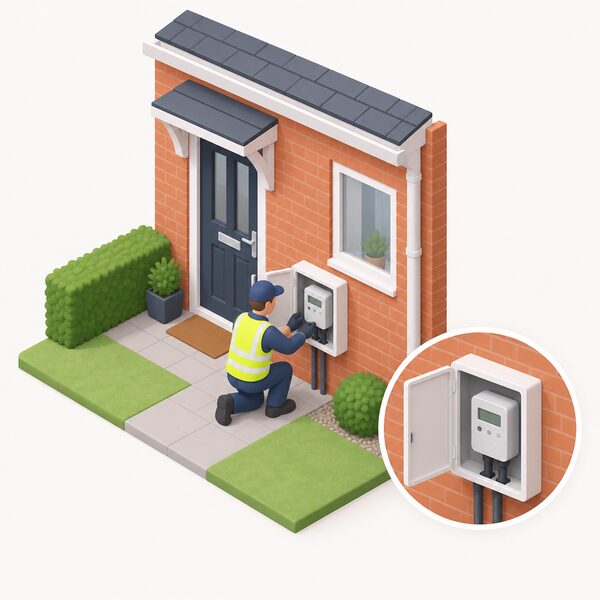
The route does not run through Smart Energy GB. Ofgem's guidance is to contact your supplier to get a smart meter for free19, and the installation is at no extra cost when fitted by your energy supplier20. If you have not already been offered a smart meter, you can request one from your supplier20.
Suppliers carry the obligation. They must take all reasonable steps to install smart meters in remaining domestic premises, and the proposed completion date for that work is the end of 20304. In practice, availability depends on your supplier's scheduling, on the communications signal at your address, and on the type of property. Flats, rented homes and properties with difficult meter locations are the cases where installation is most often delayed.
Once a meter is in, the standards that protect you are Ofgem's. The Guaranteed Standards of Performance set out what suppliers must do and how quickly, and Ofgem intends to review the outcomes of standards GSOP1 to GSOP4 in Q1 20276. Government has also introduced rules requiring suppliers to fix faulty smart meters7. Where a meter is not working as it should, the supplier is the first point of contact, and the Ombudsman is the escalation route if the dispute remains unresolved8.
For households wanting to understand the installation itself, smart meter installation covers what happens on the day, and why you might not be able to get a smart meter sets out the common blockers. The wider picture of progress and targets is at the UK smart meter rollout.
Support for vulnerable, low-income and prepay customers
Smart Energy GB has a duty to ensure consumers in vulnerable circumstances are not 'left behind', and has a specific team focused on vulnerable consumers, working with partners including Carers UK5. That duty is a formal part of its remit rather than a marketing position, and it shapes the material it produces for people who may struggle with the technology or the switch.
The support landscape around it is broader. The British Gas Energy Trust is a registered charity that helps individuals and families in poverty, suffering or other distress who are struggling to pay their gas and/or electricity debts21. Local authority cost-of-living pages, such as Anglesey's, list help with household costs21. These are separate from Smart Energy GB and are the routes that actually provide money or debt relief.
For prepayment customers, the smart meter changes the mechanics rather than the tariff. A smart prepay meter can be topped up remotely, and the data it produces is what makes flexible and time-of-use arrangements possible. The Smart DCC has argued that maximising use of the smart meter system can help tackle fuel poverty22. That is an industry position, and the household-level benefit depends on whether the supplier passes through the savings.
The independence question is sharpest here. A smart prepay meter reduces the need to visit a shop or a meter, but it does not reduce dependence on the supplier, and it does not change the standing charge or the unit rate. What it changes is visibility: a household can see what it is spending before the credit runs out, which is a real advantage for anyone managing a tight budget.
What a smart meter means for your energy independence
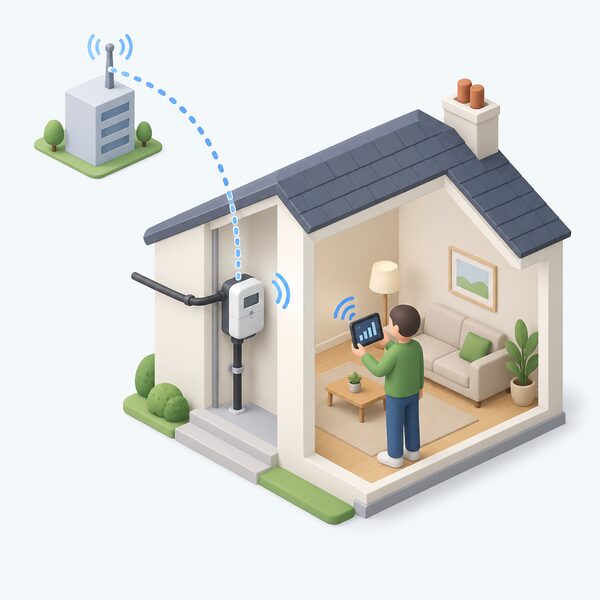
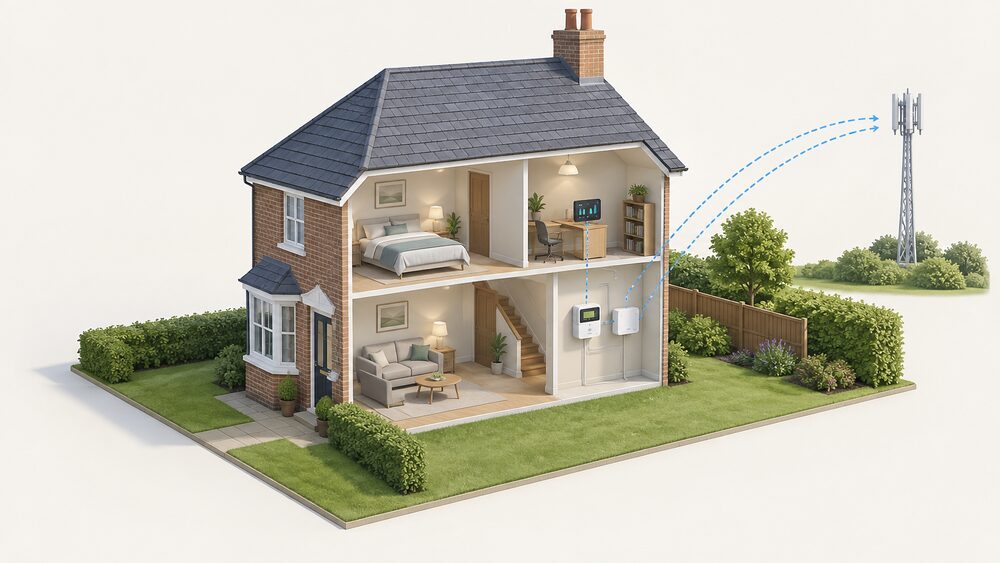
A smart meter does not make a home independent of the grid. It makes the home's relationship with the grid measurable. The meter records consumption and, where export is set up, generation, and it sends that data to the supplier automatically. The household gains information; the supplier gains the same information. Both sides see the same numbers.
The dependence that remains is specific. The meter depends on the national communications network to send readings, which is why a meter can fall into dumb mode when it loses connection13. It depends on the supplier for installation, for fault resolution and for the standards that govern repair times6. It depends on the Data Communications Company and the wider smart metering system for the communications layer. And it depends on the 2G and 3G networks being replaced in time: government guidance states that suppliers must replace all smart meters still connected to 2G and 3G before the services are switched off by 20337. A meter that loses its connection may stop recording the energy you use, or may no longer send readings to your supplier19.
What the household gains is the data layer that everything else is built on. Time-of-use tariffs, demand flexibility schemes, export payments and accurate bills all rest on half-hourly or regular readings. Without a smart meter, a home can still monitor its own consumption with a standalone device, but it cannot participate in the supplier-side arrangements that reward shifting load. The distinction between the meter and a home energy management system is set out at smart meters and home energy management, and the data question specifically at smart meter data.
Read plainly: Smart Energy GB campaigns for a device that increases a household's information and its participation in the market, while leaving its dependence on the grid, the supplier and the communications network intact. That is the trade the rollout offers, and it is worth understanding before booking an installation.
Sources22 cited
- How do smart meters send readings?, Smart DCC, 2026
- Smart meter Guaranteed Standards of Performance: Draft Impact Assessment, Ofgem, 2025
- Smart meters: your rights and expectations, GOV.UK, 2025
- Smart metering policy framework post-2025 consultation document, Department for Energy Security and Net Zero, 2025
- Update on the rollout of smart meters: summary, Public Accounts Committee, 2023
- Smart meter Guaranteed Standards of Performance, Ofgem, 2025
- Tough new rules force suppliers to fix faulty smart meters, GOV.UK, 2026
- We may be able to help resolve your energy dispute, Energy Ombudsman, 2026
- Energy Ombudsman FAQs, Energy Ombudsman, 2026
- What to expect, Energy Ombudsman, 2026
- Smart meters: unlocking the future, Department for Energy Security and Net Zero, 2018
- CCC analysis: low carbon policies account for only a small part of energy bill increases, Committee on Climate Change, 2013
- Smart meter performance, Ofgem, 2026
- Update on the rollout of smart meters: summary, National Audit Office, 2023
- Consumer Perceptions of the Energy Market Q2 2021, Ofgem, 2021
- Consumer Survey 2021: Decarbonisation and home energy use, Ofgem, 2021
- Electric vehicle smart charging: smart meter demonstration project, GOV.UK, 2026
- Smart meters and decarbonisation, Smart DCC, 2026
- Getting a smart meter, Ofgem, 2026
- How accurate are smart meters?, Smart DCC, 2026
- Help with household costs, Isle of Anglesey County Council, 2026
- Smarter, greener, fairer: maximising the use of the smart meter system to tackle fuel poverty, Smart DCC, 2024
 The Data Communications Company (DCC)Who actually runs the network that lets your smart meter send readings without anyone knocking on your door?