
In this comparison
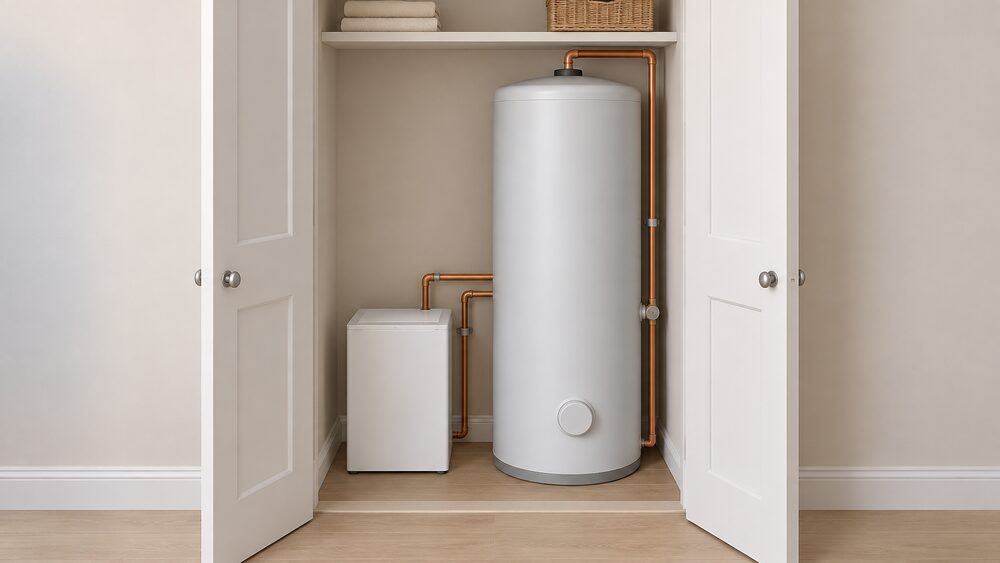
If you are moving off gas, or fitting a heat pump, one problem follows you: heat pumps do not produce instant hot water the way a combi boiler does, so you need somewhere to store it1. The traditional answer is a hot water cylinder, which holds a large volume of water hot all day whether you need it or not. Two UK products attack that standing loss from opposite directions. Sunamp's Thermino heat battery does not store large volumes of water at all: it stores heat in a compact, high energy density material and transfers that heat to mains water when you turn on a tap2. Mixergy keeps the cylinder but changes how it heats: instead of heating the whole volume, the Mixergy system heats water from the top down, so you only heat what you will use3.
The two approaches suit different households. A heat battery is about physical size and eliminating stored water; a smart cylinder is about control, tariffs and using your own solar generation. Neither is a like-for-like swap for the other, and neither removes your dependence on electricity, whether from the grid or from your own generation.
How the Sunamp heat battery works
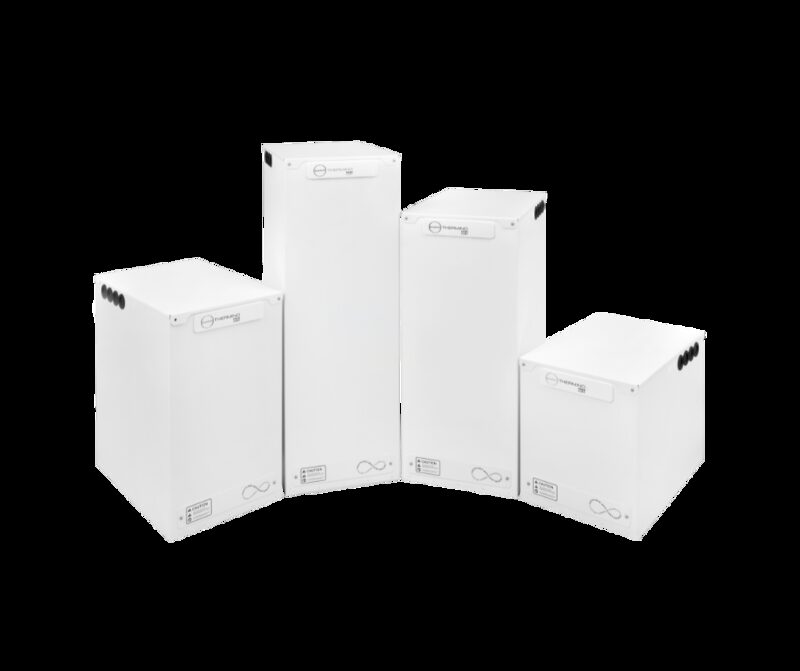
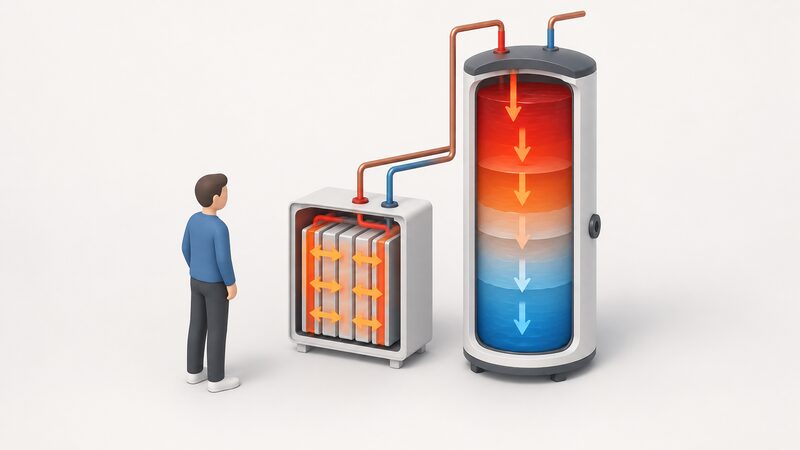
A Sunamp heat battery is a thermal store built around a patented phase change material called Plentigrade. The material absorbs, stores and releases large amounts of latent heat as it changes state between solid and liquid: heat is absorbed when it melts, and released again when it solidifies10. Charging the battery melts the material; drawing a hot tap pulls heat back out of it and into mains pressure water passing through. Unlike a lithium-ion battery, a Thermino stores heat, not electricity11, so there is no battery chemistry to degrade and no inverter in the cupboard.
Sunamp states that its phase change materials store 4 to 10 times more energy than conventional materials, which is what lets a small box replace a large cylinder4. The batteries are modular and scalable: units can be linked in parallel to increase heat storage capacity if a household's demand grows12. On the input side they are flexible, working with:
- heat pumps, wind and solar
- grid and microgrid electricity
- waste heat
- combined heat and power and boilers10
For a household's energy independence, the significance is that hot water storage stops being a standing loss you pay for every day. The trade-off is that the battery still needs a heat source, and if that source is grid electricity, the home remains dependent on the grid and its prices. The independence gain is in efficiency and space, not in self-sufficiency.
How the Mixergy smart cylinder works
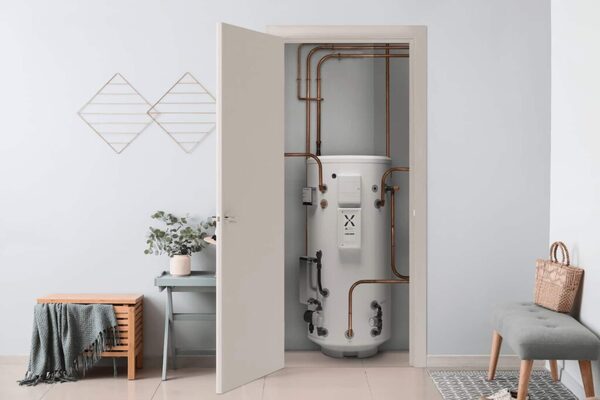
Mixergy keeps the familiar shape of a hot water cylinder but changes the physics inside. Conventional cylinders heat all or nothing: the whole volume is heated whether you need one shower or four. The Mixergy smart tank heats water from the top down, so only the water you actually need is heated3. The Energy Systems Catapult has described this as an innovative design that allows consumers to heat only the water they need, in contrast to conventional tanks13.
The intelligence sits on top of the stratification. Because the tank measures its own state of charge, it can skip a reheat entirely when there is already enough stored hot water for the next day14. Mixergy claims its patented stratified heating technology delivers up to 40% hot water energy savings6, and reports up to 10x faster reheat times than a conventional cylinder7. Across the range, the cylinders offer:
- smart tariff integration
- machine learning optimisation
- cloud-connected fleet monitoring and remote diagnostics
- Legionella cleansing cycles7
Mixergy states that its cylinders are currently the only ones on the market which can be "Grid-enabled" for use with smart energy tariffs from your utility company15. That is the heart of the product's independence case: the cylinder becomes a device that buys electricity when it is cheap, or free from your own roof, rather than when you happen to want a shower. The counterweight is that the smart features depend on a cloud connection and the maker's platform, so a household is trading one form of dependence, on gas, for another, on a connected service.
Heat pump compatibility: Thermino with R290 heat pumps
Both products are built for the heat pump era, but they sit in different places in the system. Sunamp thermal batteries are charged by renewable energy from an air source or ground source heat pump5, and the battery replaces the cylinder the heat pump would otherwise need. In 2025 Sunamp announced a series of integrations with R290 heat pumps: the Thermino xPlus, using its Optimino technology, connects to the Haier Monobloc GT R290 heat pump16. Sunamp describes the Optimino key as:
"a seamless communication channel between Sunamp's Thermino xPlus and Haier's R290 heat pump"
allowing installers to deliver "optimised, plug-and-play solutions with confidence"16.
Mixergy's approach is compatibility rather than replacement. Mixergy X connects to gas, direct electric or heat pump systems17, and the Mixergy X Direct Standard cylinders are listed as heat pump compatible18. The iHP X goes further: it is an all-in-one heat pump cylinder with a small integrated R290 heat pump sitting on top, dedicated to hot water, which the maker says dramatically reduces electricity use compared with standard electric cylinders20. Installation is comparable to a standard cylinder, and a detachable head-unit design simplifies servicing20.
For a household weighing a heat pump, the practical difference is this. With Sunamp, the heat pump and the heat battery are separate units that talk to each other, and the battery removes the need for a cylinder. With Mixergy, you keep a cylinder, either heated by your heat pump or, with the iHP X, by a small dedicated heat pump of its own. More detail on pairing storage with a heat pump is on our heat batteries with heat pumps page.
Efficiency and response: thermal battery versus stratified water
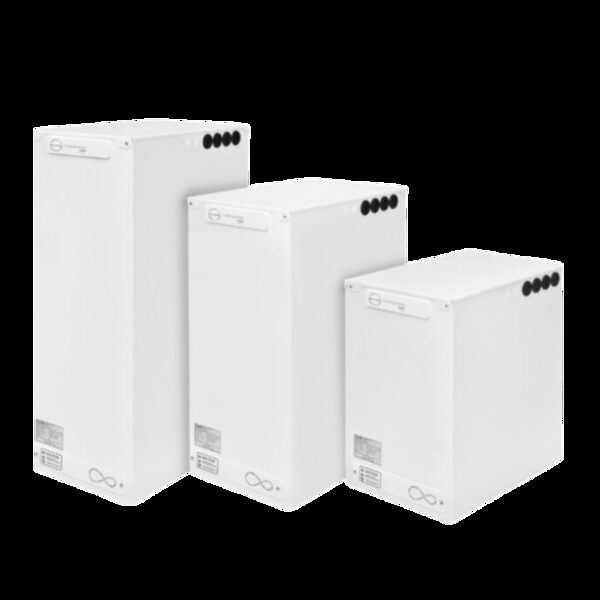
The efficiency claims of the two products come at the problem from different ends. Sunamp's argument is about storage density: phase change materials store 4 to 10 times more energy than conventional materials4, and Thermino's material is described as much more efficient at storing energy than water11. Because each battery holds less than 5 litres of water5, there is very little water standing hot and cooling in a cupboard.
Mixergy's argument is about not heating what you will not use. The stratified, top-down design means a partial reheat is possible: heat only the water needed, not the whole cylinder3. The maker claims up to 40% hot water energy savings from this6, and up to 10x faster reheat times7, because a small top layer heats quickly rather than a full tank. The state-of-charge measurement means the tank can skip a reheat altogether on days when stored water is sufficient14.
| Sunamp Thermino | Mixergy smart cylinder | |
|---|---|---|
| What is stored | Heat in a phase change material, less than 5 litres of water5 | Hot water, heated top down3 |
| Energy density claim | 4 to 10 times more energy than conventional materials4 | Up to 40% hot water energy savings6 |
| Reheat | Not stated as a reheat time; heat released on demand from the material10 | Up to 10x faster than a conventional cylinder7 |
| Standing loss | Very little stored water to cool5 | Whole tank not heated when not needed14 |
On running costs, the Energy Saving Trust's guidance on what really cuts energy bills notes that batteries are better paired with heat pumps than with solar panels, when combined with an appropriate tariff21. That finding is about electrical batteries, but it points at the same logic both products use: store energy when it is cheap or free, use it when you need it. Neither maker's efficiency figures are independently verified here; both are the makers' own claims, and a household should treat them as such.
Space, weight and installation differences
Space is where the two products diverge most sharply. Sunamp thermal batteries are up to 4 times smaller than the equivalent hot water cylinder12, and the maker describes them as fitting neatly in a cupboard5. Because each battery holds less than 5 litres of water5, the weight and the water damage risk of a failing cylinder largely disappear. Sunamp also argues that removing the cylinder lets heat pumps be installed where they would not normally fit22.
Mixergy cylinders are conventional in form. The maker states that a Mixergy is as simple to install as a conventional cylinder23, so a retrofit into an existing airing cupboard is a like-for-like swap in the same position. The Cube X variant is aimed at homes where space is at a premium: it can be integrated into utility frame solutions accommodating other appliances, saving more space24. The iHP X installs like a standard cylinder, with a detachable head unit that simplifies delivery, installation and servicing20.
Both can be retrofitted. Mixergy designs its models for any build type, from retrofit homes to new developments and commercial estates6. Sunamp's social housing work shows the same pattern, with batteries replacing cylinders in existing properties5. The choice is less about whether either fits, and more about what the household wants the cupboard to contain: a sealed heat store with almost no water, or a familiar cylinder with intelligence in the lid.
Sunamp vs Mixergy: which suits which home
Neither product is a general-purpose winner; each answers a different problem. Sunamp suits homes where the cylinder is the obstacle: small flats, cupboards that cannot take a large unvented cylinder, or heat pump installations where there is nowhere sensible to put a tank. Sunamp's own positioning is as a low carbon, reliable, space-saving alternative to traditional hot water cylinders25, and its housing development and social housing pages show it used at scale in both new build and retrofit5.
Mixergy suits homes where the household wants active control of hot water costs. The Mixergy X works with an external heat source such as a heat pump, gas boiler or solar PV15. The Solar X stores surplus solar energy as hot water, cutting bills and emissions, and reduces the amount of solar PV needed to meet SAP compliance18. The iHP X is aimed at low heat demand homes and is fully aligned with Future Homes Standard and Home Energy Model requirements20, while Solar X is engineered for SAP 10.2 and Future Homes Standard compliance18. For developers and landlords, the SAP-optimised design uplifts scores and helps meet SHDF and Future Homes compliance6.
| Sunamp Thermino | Mixergy | |
|---|---|---|
| Best suited to | Homes short of space; heat pump installs with no room for a cylinder22 | Homes wanting tariff control and solar self-use15 |
| Heat pump pairing | Charged by air source or ground source heat pump; xPlus integrates with R290 models5 | Mixergy X heat pump compatible; iHP X has its own R290 unit18 |
| Solar | Charged by solar among other sources10 | Solar X stores surplus PV as hot water18 |
| New build positioning | Space-saving cylinder alternative25 | SAP 10.2 and Future Homes Standard compliance18 |
| Dependence left behind | Stored water and annual maintenance5 | Gas, replaced by cloud and tariff dependence7 |
In independence terms, the Sunamp route reduces physical and maintenance dependence: no cylinder of stored water, no regulatory annual maintenance5. The Mixergy route reduces cost dependence but adds digital dependence: smart tariffs, machine learning and cloud monitoring all rely on the maker's connected platform7. A household that values simplicity leans one way; a household that wants to squeeze value from solar panels and time-of-use tariffs leans the other.
Maintenance, installers and UK availability
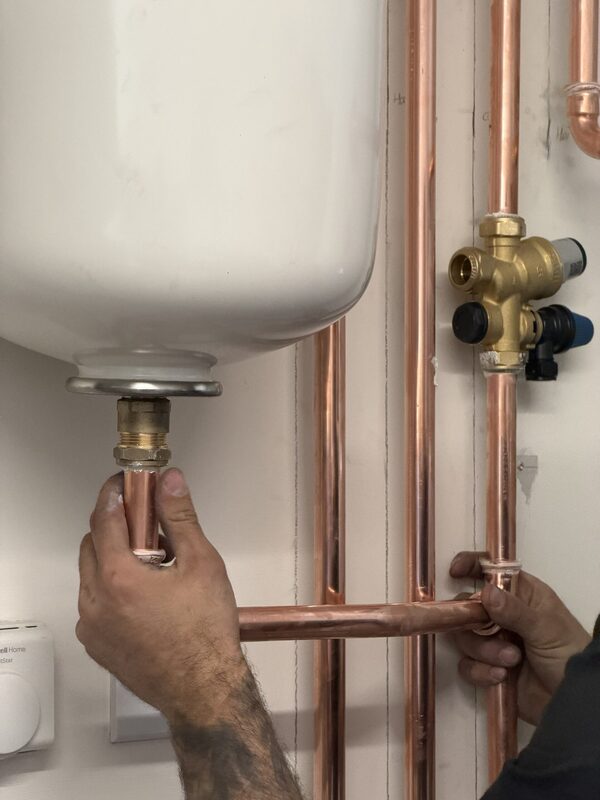
Maintenance is one of the clearest differences. Sunamp states that thermal batteries require no regulatory annual maintenance, unlike domestic gas boilers and unvented cylinders5, and the Thermino range is listed with no mandatory maintenance26. The battery must, however, be fitted with a set of mandatory plumbing components27:
- heat battery isolation valve
- mains cold water pressure reducing valve
- expansion relief valve
- expansion vessel or shock arrestor
- hot water thermostatic mixing valve
- a water conditioner in hard water areas
- on indirect models, an auto-bypass valve and a primary circuit expansion vessel
Installer requirements also differ. Sunamp says installers need no mandatory qualifications or certifications specific to its products, unlike renewables systems, but the fitter must be a qualified plumber or electrician with knowledge and experience equivalent to unvented hot water cylinder installation28. Sunamp offers free online training, which is a requirement for listing on its certified installer map, and the first installation is assessed by Sunamp's technical team27. Mixergy cylinders must be fitted by an installer holding a G3 qualification in England and Wales, a P3 qualification in Scotland, or a P5 qualification in Northern Ireland15, and the maker has a network of Approved Installers it has trained itself23.
Neither product carries a published price in the material here, so costs are installer-quoted and depend on the model, the cylinder size or battery capacity chosen, and the work involved in the swap.
Grants: what the Boiler Upgrade Scheme covers
Neither a heat battery nor a smart cylinder is an eligible technology under the Boiler Upgrade Scheme in its own right. The scheme covers air source heat pumps, ground source heat pumps, ground source heat pumps on shared ground loops and, in some circumstances, biomass boilers8, for properties replacing a fossil fuel heating system. Hot water storage, of whatever kind, is not on that list.
That matters for how a household plans the work. Our heat pump grants page sets out the amounts and eligibility rules across England, Scotland and Wales.
Sources28 sources
- The best heating for your home, Which?, 2025-09-22
- Reliable hot water: whole system social housing retrofit, Sunamp, 2026-09-03
- Inside the EV puzzle: boosting home energy efficiency, Mixergy, 2024-11-07
- How thermal batteries work, Sunamp, 2026-09-17
- Sunamp social housing solutions, Sunamp, 2026-03-24
- Mixergy hot water solutions, Mixergy, 2026-06-23
- Smarter hot water, happier tenants, Mixergy, 2025-05-19
- Boiler Upgrade Scheme guidance for installers V5, Ofgem, 2026-04-24
- Boiler Upgrade Scheme statistics, data.gov.uk, 2026-08-27
- How heat batteries work, Sunamp, 2024-07-28
- Electric batteries vs heat batteries, Sunamp, 2025-11-13
- Housing development solutions, Sunamp, 2026-03-20
- Our homes net zero toolkit, Energy Systems Catapult, 2025-07-31
- Specifying smart hot water for low heat demand homes, Mixergy, 2026-07-16
- Mixergy homeowner guide, Mixergy, 2025-09-19
- Sunamp and Haier HVAC EU announce Thermino integration, Sunamp, 2025-10-30
- Mixergy SAP solutions, Mixergy, 2026-01-27
- Mixergy Solar X, Mixergy, 2026-05-19
- Mixergy X, Mixergy, 2026-05-19
- Mixergy iHP X, Mixergy, 2026-07-28
- Renewable technologies: what really cuts energy bills, Energy Saving Trust, 2026-08-12
- Sunamp public housing solutions, Sunamp, 2026-03-24
- What you need to know about COP and hot water, Mixergy, 2024-05-02
- Introducing the Mixergy Cube X, Mixergy, 2023-11-22
- Sunamp housing development solutions, Sunamp, 2024-04-26
- Thermino hot water overview, Sunamp, 2026-03-19
- Thermino frequently asked questions, Sunamp, 2026-08-17
- Sunamp frequently asked questions, Sunamp, 2026-08-17