

In this answer
Short answer
Yes. A Mixergy cylinder is a hot water store, not a heat generator, so it connects to the boiler a household already has. The maker states that Mixergy X connects seamlessly to gas, direct electric, or heat pump systems, and that the Solar X variant can be specified with direct electric, solar PV, gas, or heat pump systems1. Nothing in that arrangement requires the radiators to be replaced, because the cylinder serves hot water while the existing wet central heating circuit continues to serve space heating.
The distinction that matters is between a cylinder and a heat battery in the narrow sense. A Mixergy tank charged by a gas or oil boiler is a smart hot water cylinder: it stores heat produced by burning fuel, and it can later be repurposed. The maker states that the cylinder can be upgraded with a heat pump module or a solar PV module, repurposing the unit as a heat pump cylinder or smart solar PV hot water store3. That upgrade path is the reason a household not going fully electric yet might choose this tank over a conventional cylinder.
What the tank does not do is remove dependence on the boiler, the fuel supply or the grid. A boiler-charged cylinder still burns gas, oil or LPG, still needs a flue and a service regime, and still leaves the household exposed to fuel prices. The independence it offers is narrower: it stores hot water rather than heat, it can take surplus solar electricity, and it can be converted later without replacing the tank.
What a Mixergy tank is and how it stores heat
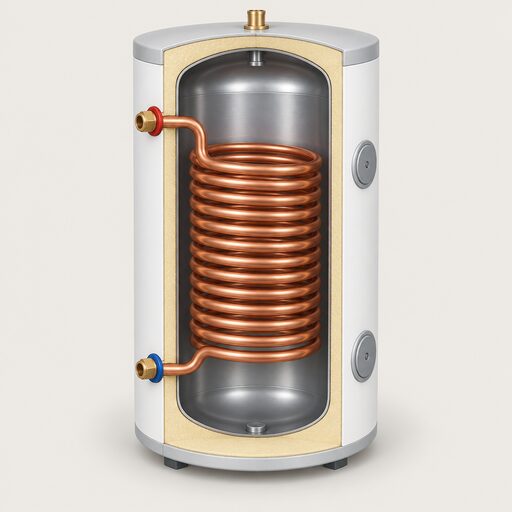
A Mixergy cylinder is an unvented hot water store with a control system that changes how the water inside is heated. The maker states that Mixergy cylinders use thermal stratification when connected with direct electric, solar PV and gas boilers, heating a small amount of water at the top first and expanding the heated volume downward7. That is the opposite of a conventional cylinder, which heats its whole contents to one temperature whether or not the household needs that much water.
The independent description matches. The Energy Systems Catapult toolkit describes a smart hot water storage tank that allows consumers to heat only the water they need, in contrast to conventional hot water tanks which heat all or nothing8. The maker's own figure for the saving is that top-down heating heats only the water a household needs and uses up to 40 per cent less energy9. That figure is the maker's, and it applies to the heating method rather than to a whole-house energy bill.
The tank is listed in the SAP Appendix Q product database, including the integrated solar PV diverter, and the maker states it is found under Appendix Q as a Smart Hot Water tank10. SAP listing matters because it feeds the standard assessment used for Energy Performance Certificates, so a listed product can be recognised in the modelling that underpins a home's rating.
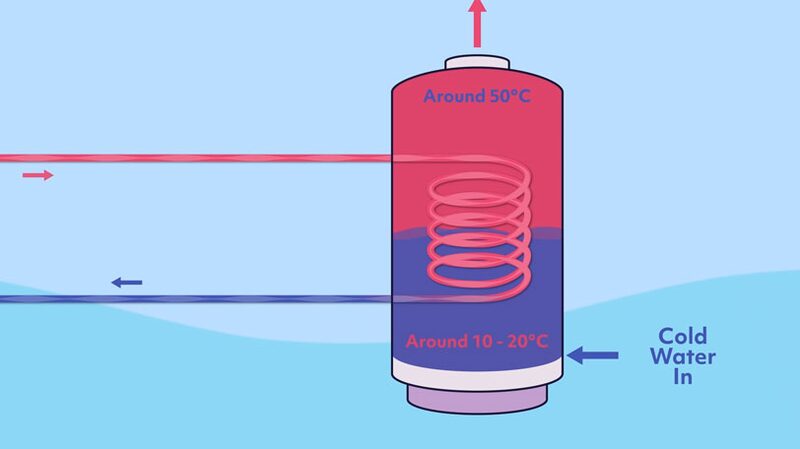
How the boiler and tank work together in a heating system
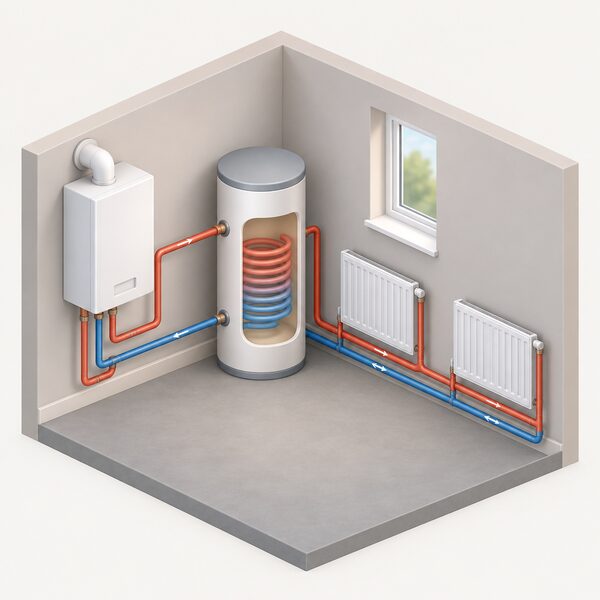
In a boiler-charged installation the cylinder is a zone on the heating system, heated by the boiler through a coil or heat exchanger in the same way as any unvented cylinder. The maker's own case study describes the starting point plainly: the old heating system comprised a gas fired condensing system boiler which heated a vented hot water cylinder and wet radiators, with old radiators on a single pipe arrangement11. Replacing the cylinder with a Mixergy unit leaves that arrangement intact.
What changes is when and how much the boiler runs for hot water. Because the tank heats from the top down, a short boiler run can produce a usable draw of hot water rather than requiring the full cylinder to reach temperature. The maker states that the cylinder reaches a useful temperature up to ten times faster than a conventional tank10. That is a maker figure for the cylinder, and it describes the tank rather than the boiler.
The boiler itself is unchanged, and so is its dependence on fuel. A household on gas remains on gas; a household on oil remains on oil, with the delivery, storage and tank replacement that implies. Independent guidance notes that renewable liquid gases can be used with existing infrastructure, such as tanks, boilers, fires, cylinders, hobs and ovens, in fact any LPG appliance12. That is a route for off-gas-grid homes, not a route to independence from delivered fuel.
Where the tank fits: hot water cylinder or central heating thermal store
A Mixergy tank is a hot water cylinder, not a thermal store for the radiators. The distinction is worth stating because the two are often confused. Independent guidance describes a thermal store as one where heated water is usually stored in a large, well-insulated cylinder often called a buffer or accumulator tank13. A buffer vessel serves the heating circuit; a hot water cylinder serves the taps.
The maker is working on combining the two. In its account of the MESH project, the plan highlights the consolidation of the heating buffer vessel and hot water cylinder into a single smart tank, reducing system complexity, with potential component cost savings14. That is a development project, not a product a household can specify today, and it is described as a plan rather than a delivered system.
For households replacing a combi boiler, the cylinder question is unavoidable. Independent guidance states that if you are replacing a combi boiler with a heat pump, you will probably need to install a hot-water tank or cylinder15. A combi provides heat and hot water direct from the boiler itself, with no external water tank16. Moving to a cylinder, whether charged by a boiler now or a heat pump later, is the step that creates the storage a heat pump needs.
Cylinders are a mature category, and Mixergy is not the only maker. One manufacturer describes hot water storage tanks as perfectly compatible with boilers, heat pumps and solar thermal systems17, and another states that its hot water cylinders work with gas (or oil) boilers to provide hot water for your home18. The compatibility question is therefore not unique to Mixergy; what differs is the control method and the upgrade modules.
Size and space: how a Mixergy compares to a conventional cylinder
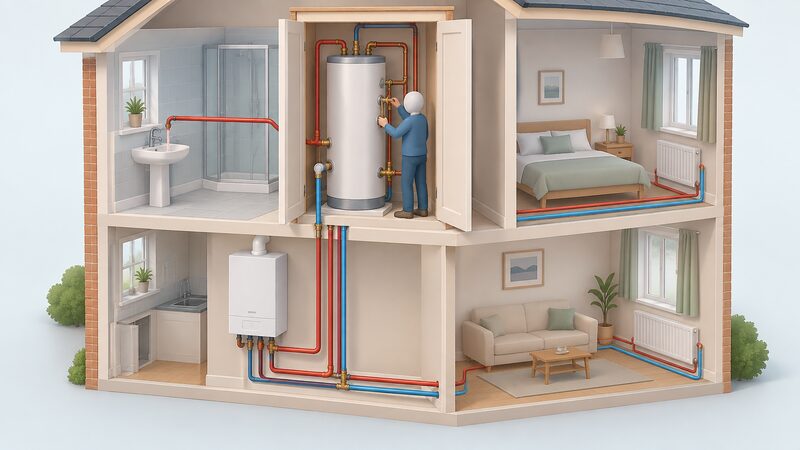
The maker states that Mixergy cylinders provide up to a third more usable hot water than traditional cylinders4. The practical consequence is that a smaller nominal cylinder can meet the same demand, which matters in airing cupboards and converted lofts where space is fixed. Cylinder diameters start at 495mm and run to 582mm, and the maker notes that the units will have additional clearance requirements4.
Documented installations show the effect. In one case study the household was able to choose a smaller cylinder size compared to their old one, 180 litres19. In the maker's research bungalow, a small, 120 litre Mixergy tank can sustain multiple shower heads and a full bath11. Those are maker case studies of specific homes, not a general sizing rule, and cylinder sizing remains an installer's calculation based on occupancy and draw-off.
For comparison, storage combi hot-water tanks are typically sized between 40 and 200 litres20, and a second source puts combi storage at typically between 40 and 200 litres16. Those are small buffers built into a combi rather than full cylinders, so the comparison is about the space a household gives up, not like-for-like capacity.
The commercial end of the range is much larger. The maker's range is available in 500, 800, 1125 and 2000 litre sizes, and separately described as available from 400L to 2,000L9. Those sizes are for larger buildings and are not domestic installations.
| Specification | Figure | Source type |
|---|---|---|
| Usable hot water versus traditional cylinder | Up to a third more | Maker4 |
| Cylinder diameter range | 495mm to 582mm, plus clearance | Maker4 |
| Documented domestic cylinder | 180 litres | Maker case study19 |
| Research bungalow tank | 120 litres | Maker case study11 |
| Commercial range | 500, 800, 1125 and 2000 litres | Maker9 |
| Combi storage tank, for comparison | 40 to 200 litres | Independent20 |
Cost, VAT and grant eligibility: what a heat battery household pays today

Prices for Mixergy cylinders are installer-quoted, and no published retail price appears in the material available here. What can be stated is the grant and tax position, which is unsettled and differs by scheme.
The Boiler Upgrade Scheme provides grants to assist with installation costs, and ground source heat pumps are named among the eligible technologies21. The scheme's headline figure for heat pumps is £7,500 towards the cost of installing a heat pump for property owners, including landlords, and independent guidance states that after receiving the grant amount of £7,500, a typical household will have paid just under £6,000 for the installation23. Those figures relate to heat pumps, not to a cylinder charged by a boiler.
For heat batteries specifically, official guidance states that a £2,500 grant for heat batteries will also be available once the legislation and appropriate product standards are in place5. Independent guidance puts it more directly: if you're eligible, you can get £2,500 off the cost of installing a heat battery to work with your central heating system, and separately that households in England or Wales can get £2,500 off the cost of a heat battery installation25. The condition attached to the official wording is the one to watch: the grant depends on legislation and product standards that were not yet in place at the date given.
On VAT, the reduced rate applies to a list of energy-saving materials that has been extended. The legislation adds water source heat pumps, certain electrical batteries, and certain smart diverters to the list of energy-saving materials that can qualify for the reduced rate of VAT26. Official guidance also lists micro combined heat and power units as qualifying for a lower rate of VAT27. A hot water cylinder charged by a gas or oil boiler is not named on that list, so the reduced rate should not be assumed for the cylinder itself.
Where a boiler-charged Mixergy falls short
The tank does not reduce dependence on the boiler, the fuel or the grid. A household on gas remains connected to the gas network and exposed to its prices; a household on oil or LPG remains dependent on deliveries and on-site storage. The maker's own framing of the transition is that the cylinder can be upgraded with a heat pump module, effectively repurposing the unit for its new life as a heat pump cylinder3. That is a future step, and until it is taken the heat still comes from combustion.
The integrated alternative shows what full independence from a boiler looks like, and it is a different product. The Mixergy iHP X is described as having no need to connect to a boiler, external heat pump, or central system, and the 180L model is stated to achieve a hot water temperature of 59°C via its heat pump28. Independent guidance puts heat batteries generally at 55 to 60°C, connecting to an existing wet central heating system via a heat exchanger6. Those temperatures suit a well-insulated cylinder and a wet system, and they are lower than a boiler's hot water setpoint.
Installation is not a DIY job. The maker states that to install a Mixergy cylinder you'll need a fully qualified and competent plumber or heating installer with experience in unvented systems4. Unvented cylinders are a controlled installation, and the competence requirement is part of what a household is buying.
The remaining dependence is worth naming precisely. A boiler-charged Mixergy tank leaves the household reliant on a fuel supplier, a boiler manufacturer for spares and service, and the installer for the cylinder's commissioning. It adds a control system and, in the solar variant, an app and diverter. What it removes is the all-or-nothing heating of a conventional cylinder, and what it preserves is the option to convert the same tank to a heat pump or solar input later without starting again.
Sources28 cited
- Mixergy SAP listing, Mixergy, 2026
- Mixergy X, Mixergy, 2026
- Making the transition to a gas free home, Mixergy, 2023
- Mixergy homeowner guide, Mixergy, 2025
- Carbon Budget and Growth Delivery Plan: heat and buildings factsheet, GOV.UK, 2026
- Electric heating advice, Centre for Sustainable Energy, 2026
- How Mixergy saves your customers money and energy, Mixergy, 2025
- Our Homes Net Zero Toolkit, Energy Systems Catapult
- Mixergy news, Mixergy, 2026
- Smarter hot water, lower tenant bills, Mixergy, 2026
- The R&D bungalow, Mixergy, 2026
- Biomass strategy, Liquid Gas UK, 2026
- Thermal energy stores, Energy Saving Trust, 2025
- Warm Homes Plan signals a shift to system-led home decarbonisation, Mixergy, 2026
- An introduction to heat pumps, Which?, 2025
- Different boiler types, Uswitch, 2025
- Hot water storage tanks, Ferroli, 2026
- Ideal cylinder, Ideal Heating, 2026
- Tim and Kat's electric dreams, Mixergy, 2024
- What are the different types of boiler, Which?, 2025
- Boiler Upgrade Scheme: installers, Ofgem, 2026
- Boiler Upgrade Scheme research briefing, UK Parliament, 2026
- Energy Performance Certificates, Uswitch, 2026
- Air source heat pump costs and savings, Which?, 2026
- Storing energy, Energy Saving Trust, 2026
- VAT relief for energy-saving materials, legislation.gov.uk, 2026
- Tax on shopping: energy-saving products, GOV.UK, 2026
- Mixergy iHP X, Mixergy, 2026
 Hybrid Heat PumpsHow hybrid systems pair a heat pump with a gas, oil or LPG boiler, what decides which appliance runs, what they cost, how much gas they displace, and why the Boiler Upgrade Scheme will not fund them.
 Replacing a Gas or Oil BoilerSwapping a gas, oil or LPG boiler for a heat pump changes how your home is heated and how much it costs.
 LPG Boilers and HeatingWhat LPG is, how LPG boilers differ from natural gas appliances, and how bulk tanks and cylinder supply work for off-grid homes.
 System Boilers ExplainedA system boiler heats your radiators and stores hot water in a separate cylinder, so several taps and showers can run at once.
 Combi BoilersWhat a combination boiler is, how it produces heating and instantaneous hot water from one unit, and the flow rate and mains pressure it depends on.
 Hot Water CylindersA heat pump needs a cylinder to store hot water, so swapping a combi means getting one.