
In this answer
Short answer
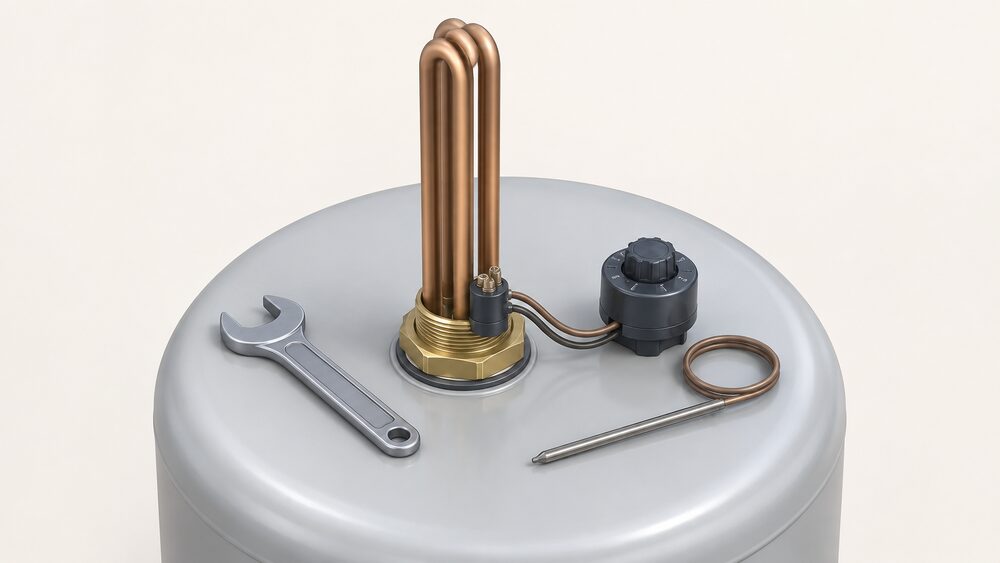
A Mixergy smart hot water cylinder is fitted with a 3 kW immersion heater. That is the same rating as a typical immersion heater in any UK cylinder: Which? states that immersion heaters are typically 3 kW1. Mixergy's own product pages list a 3 kW immersion heater, 1.3/4 inch BSP, supplied fitted to its 210 litre direct unvented smart cylinder2. The maker has also stated that every Mixergy cylinder variant carries a 3 kW immersion3.
So the answer to the sizing question is short: 3 kW, across the range. What makes a Mixergy tank different is not the element's power but the control around it. The tank measures its own state of charge and heats from the top down, so the immersion can be run for a short, targeted period rather than for a full-cylinder reheat.
What the immersion heater does in a smart hot water tank
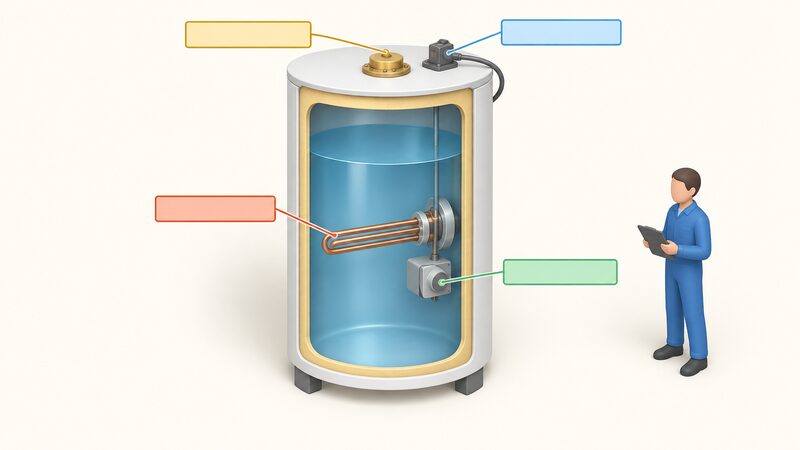
In a conventional cylinder the immersion is a blunt instrument: it sits in the tank and, when switched on, heats the whole body of water towards its thermostat setting. Mixergy's design changes the relationship between the element and the water. The Catapult energy systems centre describes the company as having designed a smart hot water storage tank that allows consumers to heat only the water they need, in contrast to conventional tanks which heat all or nothing8.
That is achieved through what Mixergy calls patented stratified heating technology, which it states delivers up to 40% hot water energy savings9. The company's own figures put the saving at up to 40% less energy than a conventional tank, and up to 40% off hot water bills5. These are maker claims rather than independently verified results, and they depend on the household actually using the partial-heating behaviour rather than filling the tank every time.
The practical effect for a household is that the immersion becomes a controllable heat source rather than a fallback. Mixergy states that because the tank measures its state of charge, it can skip a reheat entirely when there is enough stored hot water for the next day4. A tank that knows how much hot water it holds can also tell a household how much it has left, which is the basis for the tariff and solar behaviour described below.
Charging when electricity is cheap vs heating water on demand
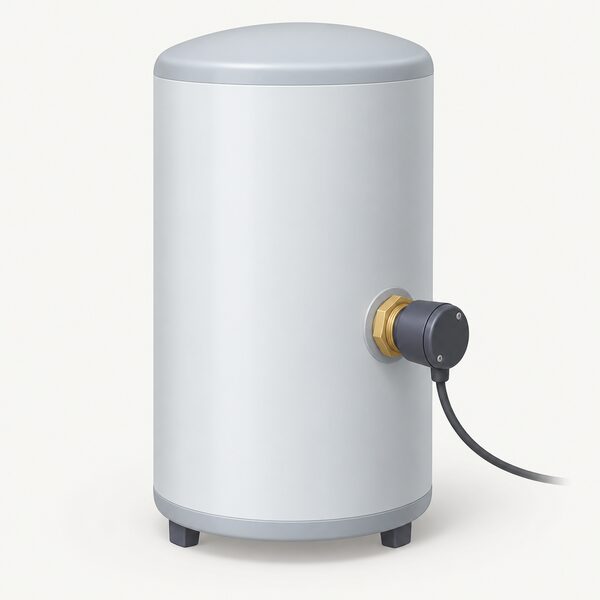
The 3 kW rating matters most when it is matched to a time-of-use tariff. Mixergy states its tanks can use dynamic time-of-use tariffs to provide cheap hot water in off-peak periods2. Independent guidance makes the same point for conventional cylinders: an Economy 7 supply means a household can heat water using overnight cheap electricity10.
The cost of running the element is the constraint. The Centre for Sustainable Energy gives a figure of 78p per hour of use for a 3,000 W immersion heater, as of July 20266. Which? bases its own immersion cost illustration on heating a 180 litre tank from 10°C to 60°C twice a day, taking around three hours each time1. Those two figures together show why the control layer matters: three hours of element time is a substantial draw, and shifting it into an off-peak window is where the saving comes from.
This is the difference between charging and heating on demand. A tank that heats on demand draws power whenever hot water is wanted. A tank that charges ahead of time draws power when it is cheapest, stores the heat, and then delivers it later. Mixergy's state-of-charge sensing is what allows the second pattern without the risk of running cold, because the tank can decide whether a reheat is needed at all4.
Using the tank with a heat pump, boiler or your own renewables
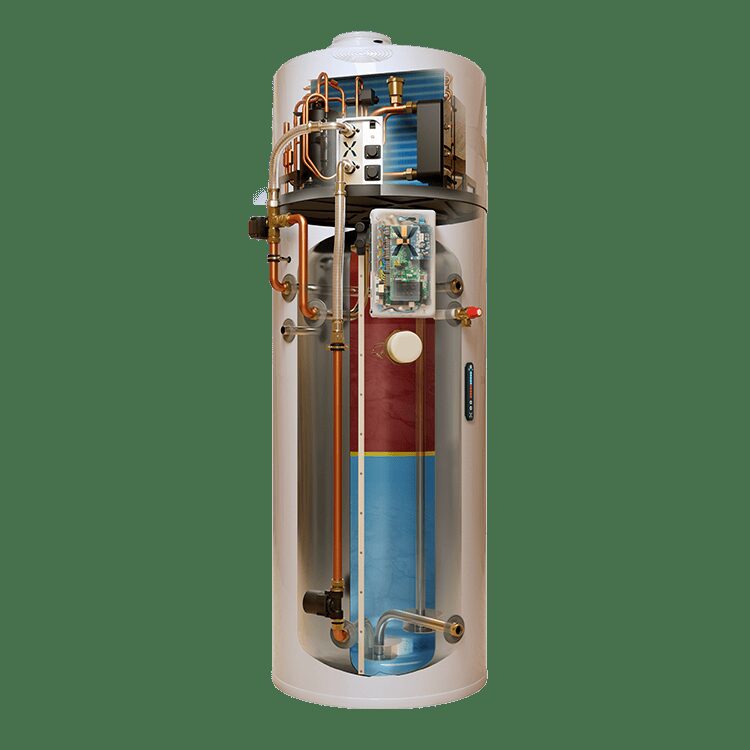
The immersion is one of several ways to put heat into a Mixergy cylinder, not the only one. Mixergy states a cylinder can take four different heat sources: a gas or oil boiler, direct electric, solar PV and a heat pump via the Mixergy heat pump module7. The company also describes the tank as able to connect to any energy source, including heat pump, solar PV or gas and oil boiler11.
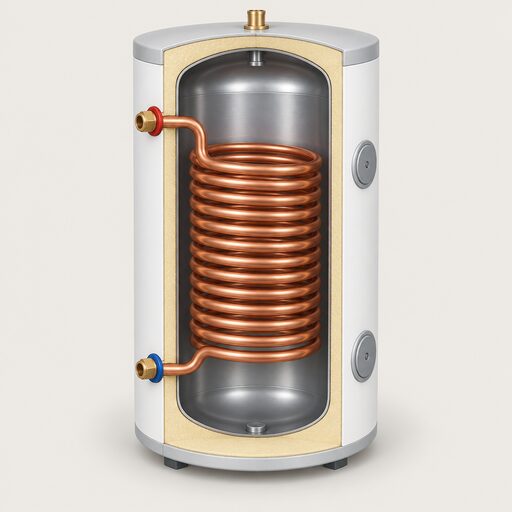
With the heat pump module fitted, Mixergy states that a plate heat exchanger and pump assembly circulate the full contents of the tank to heat it to a single temperature12. That is a different heating pattern from the top-down stratification used with the immersion, and it reflects the way heat pumps prefer to work across a whole body of water rather than a small layer of it.
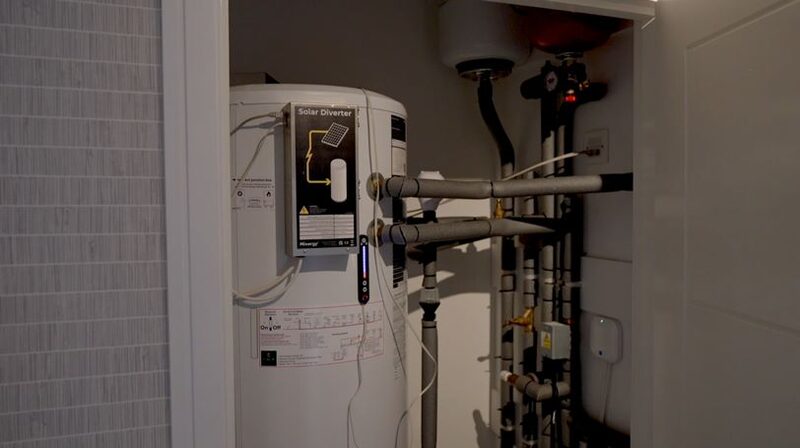
On the renewables side, Which? notes that some immersion heaters can use electricity from solar panels, and that a solar diverter switch can power the immersion heater in a hot water tank for free, storing hot water for later use1. Hammersmith and Fulham council gives the same description of a diverter's function13. Mixergy states its tank can connect to solar water heating panels, which can then use a boiler or immersion to top up the tank in winter months14. In a case study at Cala Homes East, residents could heat between 10% and 100% of the volume in their tank15.
Combi, system or regular: where a Mixergy cylinder fits
A Mixergy cylinder is a stored hot water product, so it occupies the same territory as a system or regular boiler installation rather than a combi. It needs a cylinder, a feed and expansion arrangement appropriate to its type, and a heat source. The maker positions its range from 120 litres up to 250 litres, which covers the cylinder sizes found in most UK homes4.
The company has also developed products for tighter spaces. The Mixergy Cube X is described by the maker as a smart, energy-saving, discreetly sized way to provide heating and hot water, especially when space is at a premium16. Separately, Mixergy's MESH work, profiled as a Heat Pump Ready innovation, looks at consolidating the heating buffer vessel and hot water cylinder into a single smart tank, reducing system complexity with potential component cost savings17.
For a household weighing up a replacement, the relevant point is that the cylinder is a direct functional substitute for an existing hot water cylinder, and the immersion within it is a standard 3 kW element. The Mixergy Care Plan Plus does not cover replacement installation work for the Mixergy hot water cylinder, so the cost of the swap itself sits outside that plan18.
Where the 3 kW figure comes from, and what it does not tell you
The 3 kW rating is consistent across the sources that describe Mixergy hardware. The maker's product listing for the 210 litre direct unvented smart cylinder includes a 3 kW immersion heater, 1.3/4 inch BSP, fitted2. A distributor listing for the same cylinder repeats the same specification19. Mixergy's own statement that every cylinder variant can be used for grid flexibility, whether indirect with a gas boiler, heat pump or solar PV, sits alongside the 3 kW immersion figure3.
The rating does not change with capacity. A 120 litre tank and a 250 litre tank both carry a 3 kW element4. What changes is the time taken to heat a given volume of water, and how much of that volume the tank chooses to heat. Mixergy states its top-down heating heats usable hot water up to 10x faster than a conventional system, which is a claim about usable hot water rather than about the element's power11.
The company also reports 30% more usable hot water from its smart cylinders20. Both figures are maker claims. They describe the outcome of stratification and control, not a larger element.
What this means for a household's energy independence
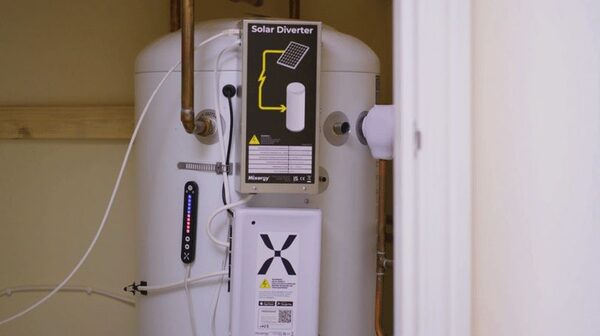
A 3 kW immersion heater is a grid-dependent device: it converts electricity into heat, and the electricity comes from somewhere. What a Mixergy tank adds is the ability to choose when that conversion happens, and to combine it with other heat sources. Mixergy states its tanks can connect to any energy source, including heat pump, solar PV or gas and oil boiler11, and that a cylinder can take four heat sources7.
That flexibility is the independence argument. A household with solar PV and a diverter can put surplus generation into the cylinder instead of exporting it1. A household on a time-of-use tariff can charge the tank in the cheap window2. A household with a heat pump can use the module to heat the full tank contents12. The dependence that remains is on the electricity supply, the tariff, and the manufacturer's controls and app, which is where the scheduling logic lives.
The immersion itself is the simplest and most robust of these paths, because it needs nothing beyond a mains supply and a working element. It is also the most expensive per unit of heat when run at peak rates, which is why the timing controls carry so much of the value. For a household assessing the technology, the honest summary is that the element is ordinary and the control layer is the product.
Sources20 cited
- Immersion heaters, Which?, 2026-06-01
- Mixergy 210 Litre Direct Unvented Smart Cylinder, Kiasa, 2026-09-20
- Revolutionising energy management: Mixergy and grid flexibility, Mixergy, 2023-11-10
- Specifying smart hot water for low heat demand homes, Mixergy, 2026-07-16
- We're paying households up to £250 a year for their hot water, Mixergy, 2026-09-15
- How much electricity am I using?, Centre for Sustainable Energy, 2026-07
- What about decarbonisation of water, Mixergy, 2021-08-12
- Our Homes Net Zero Toolkit, Energy Systems Catapult, 2025-07-31
- Hot water solutions, Mixergy, 2026-06-23
- Hot water, Uswitch, 2025-01-31
- Mixergy secures £9.2 million investment, Mixergy, 2023-03-27
- Using your Mixergy tank with a heat pump, Mixergy, 2023-05-18
- Solar panels, London Borough of Hammersmith and Fulham, 2026-09-17
- How heating better, faster and cheaper helps social housing providers, Mixergy, 2022-11-08
- Helping homeowners at Cala Homes East save carbon, Mixergy, 2023-05-03
- Introducing the Mixergy Cube X, Mixergy, 2023-11-22
- Warm Homes Plan signals a shift to system-led home decarbonisation, Mixergy, 2026-01-21
- Care Plan Plus, Mixergy, 2026-06-02
- Mixergy 250 Litre Direct Unvented Standard Smart Cylinder, Kiasa, 2026-09-20
- Smarter hot water, happier tenants: Mixergy at ASCP 2025, Mixergy, 2025-05-19
 Hot Water CylindersA heat pump needs a cylinder to store hot water, so swapping a combi means getting one.
 Hot Water Cylinder ControlsWhat temperature should a hot water cylinder thermostat be set to, and does it need its own timer apart from the heating?
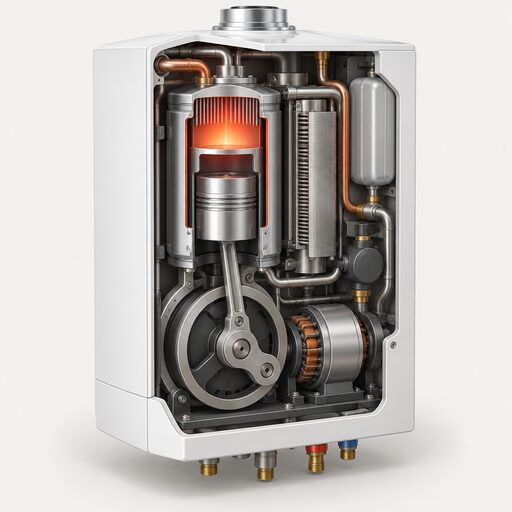 Micro-CHP TypesWhich type of micro-CHP actually gets fitted in UK homes, and how much electricity does one make while it heats your house?
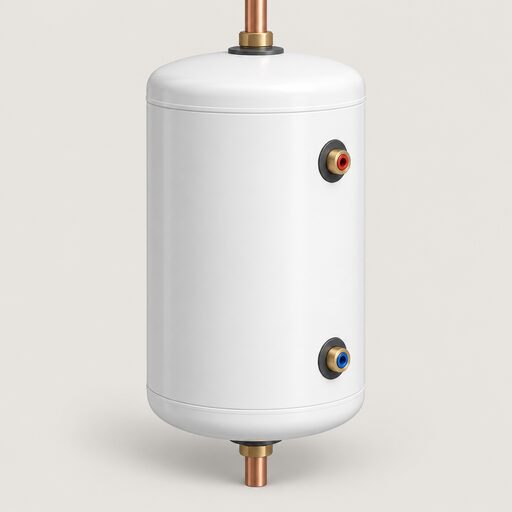 Buffer Tanks and VolumisersA buffer tank adds water volume to a heat pump system, but plenty of homes do not need one.
 Which Homes Suit a Heat PumpMost UK homes can have a heat pump fitted, so the real question is whether yours makes it easy or expensive.
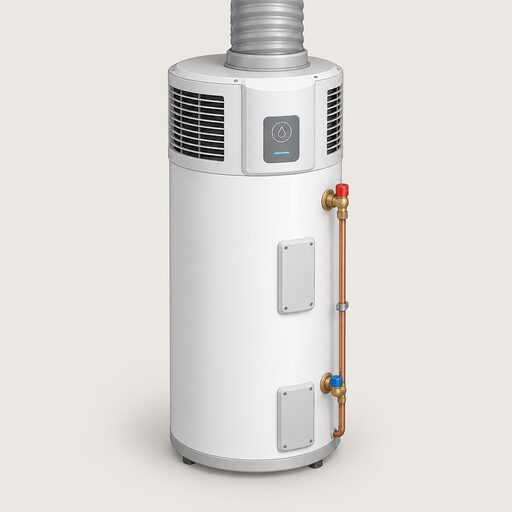 Hot Water Heat PumpsA hot water heat pump heats only the water in your cylinder, using air instead of a boiler flame.