
In this answer
Short answer
Most UK households asking about home backup generator size are trying to keep a handful of things alive: the fridge, the freezer, the boiler, the lights, the router and a few sockets. For that list, the band quoted across maker guidance is 3,000 to 5,000W, with 5,000W and above described as the point where multiple appliances or partial home backup becomes realistic1.
The number that decides the size is not the steady total. It is the surge. Motors in fridges, freezers, pumps and power tools draw far more at the instant they start than they do while running, so a generator has to cover the highest simultaneous surge rather than the sum of the running watts. Makers advise leaving 10 to 20% more than the calculated load, and one puts the headroom at 15 to 20%4.
Above that, the question changes shape. A 5,000W generator can power a house, but it cannot run the entire house and all major appliances at once: it is described as an excellent size for bare essentials such as a refrigerator, lights, a furnace blower and electronics, but short of central air conditioning or several high-wattage devices together3. Whole-house backup is a different design, not a larger version of the same thing.
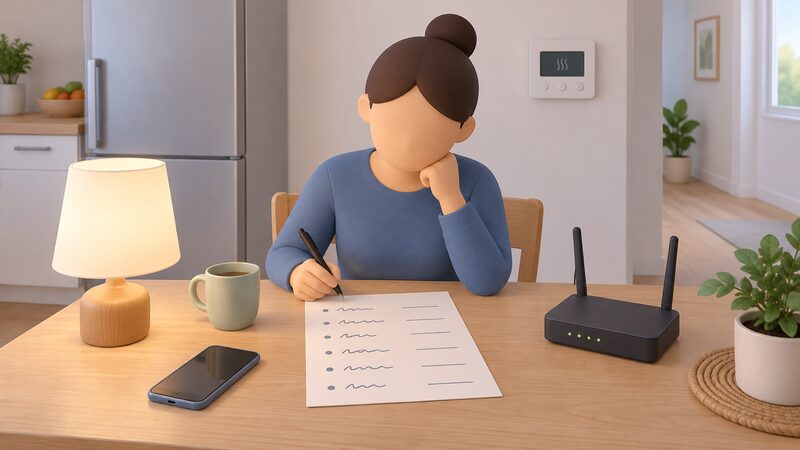
What a backup generator has to run: the essential-items list
The starting point is a list, not a number. Decide which circuits must stay live, then size to that list. The recurring essentials in UK guidance are refrigeration, lighting, communications and a small number of outlets, with heating controls and pumps close behind in winter2.
That list is deliberately short because the alternative is unaffordable in practice. Network operators warn that in a wide event there will not be enough generators to keep everyone powered, as more than one million homes, at least 5% of households in Great Britain, will be without power at once8. Backup is a personal resilience measure, not a substitute for the network.
A backup-capable setup is not only a generator. Guidance describes it as battery storage, a compatible hybrid inverter, control functions for safe off-grid switching, and a design that prioritises critical loads9. For essential home backup, the battery side is put at 5 to 10 kWh usable, with an inverter of 2 to 3 kW as a typical emergency power supply limit7.
Two practical checks belong on the list. The first is that any existing backup generator meets the power needs and connections required in an emergency10. The second is that the loads chosen are genuinely the ones the household needs, because every extra appliance widens the generator and the fuel store.
Sizing: 3,000 to 5,000W is usually enough for essentials
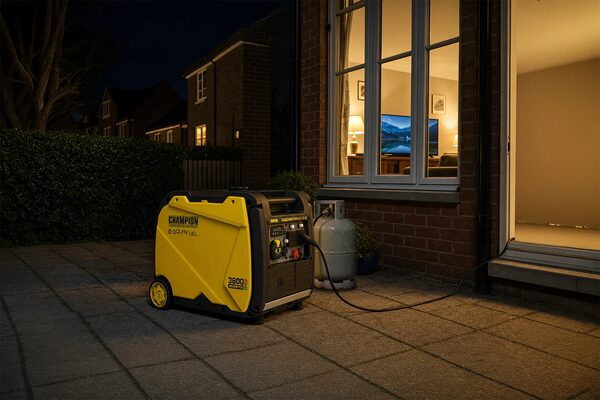
The convergence across maker guidance is striking. For essential items such as lights, fridge, Wi-Fi and a few outlets, a 3,000 to 5,000W generator is usually enough2. Medium generators of 3,000 to 5,000 watts are described as covering large appliances such as refrigerators, freezers, space heaters and sump pumps, for emergency power at home or in a small business4. Off-grid guidance uses the same band, with a 3,000 to 5,000-watt generator generally sufficient to run basic off-grid appliances11.
Above that, the categories step up. Large generators of 6,000 to 10,000 watts are described as covering most household appliances, power tools and large construction lights, and extra large units of 10,000 watts and up for multiple large appliances and whole home systems4. On the battery side, the equivalent figures are 1 to 2 kWh for shorter outages and essential devices, 3 to 4 kWh for overnight outages and more reserve, and expandable systems for extended outages5.
A worked example makes the arithmetic concrete. For a freezer, six light bulbs and a router, the target is a generator able to handle around 3,800 to 4,200 watts continuous plus surges6. For a typical three-bedroom home, something offering around 4 kW plus surge is described as a good baseline6. Inverter guidance for home backup puts the sweet spot at 3,000W to 5,000W, with 1,500W to 3,000W or more for lighter setups12.
| Load group | Guidance figure | Source type |
|---|---|---|
| Lights, fridge, Wi-Fi, a few outlets | 3,000 to 5,000W | Maker guidance2 |
| Lighting, fridge, communication | 5 kW to 6 kW | Maker guidance5 |
| Freezer, six bulbs, router | 3,800 to 4,200W continuous plus surges | Maker guidance6 |
| Typical 3-bed home | around 4 kW plus surge | Maker guidance6 |
| Home backup inverter | 3,000W to 5,000W | Maker guidance12 |
| Essential home backup battery | 5 to 10 kWh usable | Maker guidance7 |
Why starting loads matter when choosing between sizes
Running watts describe an appliance once it is going. Peak watts describe the instant it starts, and for anything with a motor that instant is the sizing decision. A fridge freezer is a small continuous load, but its compressor surge is what a generator has to absorb, and the same applies to freezers, sump pumps, heating pumps and power tools.
The margin advice reflects this. One maker recommends a generator typically 10 to 20% more than the calculated load4. Another puts it at 15 to 20% more capacity than the calculated total to avoid overloading5. A third states the principle plainly: leave yourself some headroom rather than selecting a generator that is only just powerful enough for your calculated load13.
There is a second reason for headroom. Loads do not start in sequence in a real outage. If the fridge, the freezer and the heating pump all restart after a brief interruption, the surges can coincide, and a generator sized exactly to the running total will trip. Sizing to the highest plausible simultaneous surge is the safer basis.
For larger installations the same logic appears in official guidance. Where a system replaces an existing one, the installed generation capacity of the new system should not be smaller than the existing system, except where a smaller system would be more appropriate or effective14. That is a rule about replacement installations such as photovoltaics, but the principle of not downsizing below demonstrated need carries across.
Petrol, diesel or battery: how the power source affects sizing
The fuel or storage choice changes what the same headline number can actually deliver. A fuel generator's output is limited by its engine and alternator, and it must run to produce anything. A battery system's output is limited by its inverter, and its duration by usable capacity, which is why sizing guidance for batteries separates the two: 1 to 2 kWh for shorter outages and essential devices, 3 to 4 kWh for overnight outages and more reserve5.
For battery planning, one maker suggests multiplying battery energy by about 0.85 to 0.9, then dividing by average load5. That derating reflects the gap between nameplate capacity and what a household can draw in practice. Home standby generators, by contrast, are typically powered by natural gas, diesel fuel or liquid propane, and diesel is described as suited to larger homes with higher power requirements, extended outages, regular use and higher-power backup systems13.
The source also shapes the household's dependence. A petrol or diesel generator depends on fuel supply, storage and rotation, and on the household being able to run and maintain an engine. A battery system depends on the grid or solar to recharge, and on the manufacturer's software and support. A domestic battery paired with solar can store as much electricity as a household typically uses in a day, enabling a PV system to meet up to 70% of annual electricity demand16. Whether that is worthwhile depends on wanting backup power, not having full-retail export rates, or being able to access cheap overnight charging tariffs17.
Backup design itself depends on the inverter, transfer equipment, battery capacity, household loads and system configuration, so the same battery can behave differently in two homes18. A full backup option can carry both smaller single-phase loads and larger loads such as electric cookers or heat pumps19.
Where a bigger generator is worth it: whole-house backup
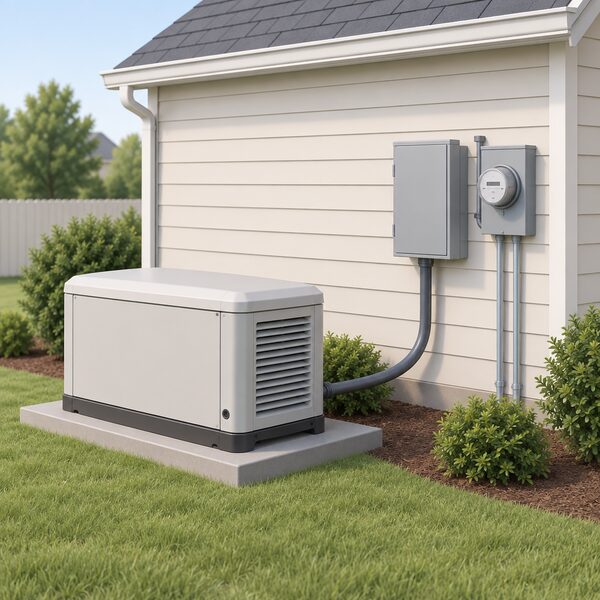
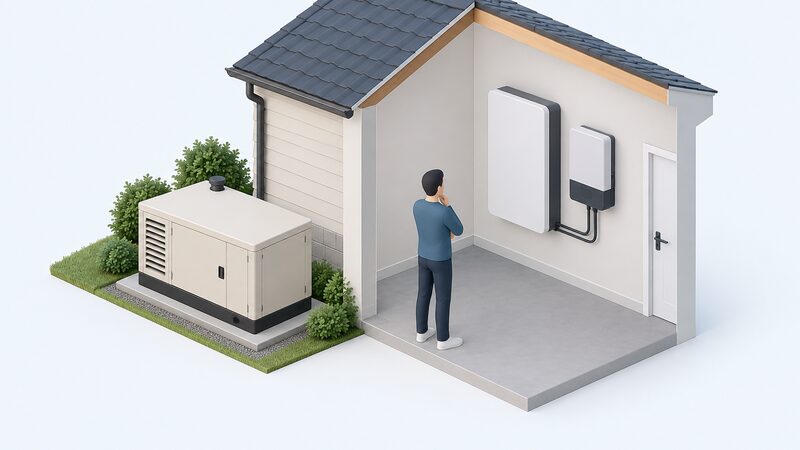
Whole-house backup is a design decision, not a size upgrade. The maker figures for it are an inverter of 8 kW or higher and a battery of 20 kWh or more7. That is a different order of cost and installation from a portable unit, and it usually involves a transfer arrangement so the house can run on the backup supply without back-feeding the network.
The case for going larger rests on what the household cannot do without. A 5,000W generator can power a house but cannot run the entire house and all major appliances at once, and lacks capacity for central air or multiple high-wattage devices3. Households with electric cooking, electric heating or a heat pump are therefore in a different category from those with gas heating and a few essentials.
Heating is the clearest dividing line. Ground and water source heat pumps are offered in 5kW, 8kW and 12kW systems, which should cover the demands of any household20. Gas boiler sizing runs separately: a 24 to 30kW boiler suits any home with up to three bedrooms, while larger houses require 35kW or more21. Those are heat output figures, not electrical draw, but they indicate the scale of the plant a whole-house backup would need to keep running. Households that may need backup are advised to discuss backup boilers and heating options with installers during planning, including a backup generator or heating alternative for blackouts in remote areas22.
There is also a network dimension. Generators of 50kW or less generally face no network capacity constraints or reinforcement costs in most areas, while installations of 50kW or greater warrant checking the thermal network view map for constraints23. Large scale generation is generally classed as greater than 2MW24. For a domestic installation these thresholds are far above the likely size, but they mark where a project stops being a household matter.
Connecting a generator to the house supply
A generator cannot simply be plugged into a wall socket to feed the house wiring. Domestic distributed generation is connected to the home's main wiring through proper arrangements, not through a socket25. Small plug-in microgeneration is defined in legislation as intended for connection to a low voltage consumer's installation by means of a standard plug and socket, which is a separate category from a generator feeding a consumer unit26.
The practical route is a changeover or transfer arrangement installed by a competent electrician, so that the generator and the grid cannot be connected to the same circuits at once. That protects the household, the network and anyone working on the lines. The connection rules and notification requirements are covered in more detail in connecting a generator to a house and whether you need to tell the network operator.
Sizing and connection are separate decisions, and getting the size right does not make the connection safe. Households planning a fixed installation should also look at essential loads and backup circuits and generator safety, and at the wider picture in backup power for UK homes.
Sources26 cited
- How to buy the best generator, Which?, 2026-01-20
- Best home backup generator, EcoFlow, 2025-06-24
- Guide to emergency generator, Jackery UK, 2026-06-03
- Emergency backup generator, EcoFlow, 2025-10-28
- Best generator for home backup power UK, BLUETTI UK, 2026-08-31
- Best home emergency generator, EcoFlow, 2025-10-29
- Emergency backup power guide: solar PV and batteries, Jackery UK, 2026-06-24
- Emergency power cuts, Electricity North West, 2026-09-19
- Solar power modes explained, Astronergy
- Care and assisted living providers, Energy Networks Association, 2026-09-17
- Solar generator 1000 v2, Jackery, 2026-09-19
- What size inverter do I need?, SolaX Power, 2026-05-13
- Home backup guide, Champion Power Equipment UK, 2026-09-20
- Building Regulations Part L and F review, stage 2a, Welsh Government, 2020-11
- Home generator cost, Jackery UK, 2026-04-29
- Making the most of your solar PV panels, Centre for Sustainable Energy, 2026-08
- Is a home battery worth it?, Independent Association of Accountants, 2026-09-20
- Add battery to existing solar system, Tigo Energy, 2026-09-02
- Backup power function, Fronius, 2026-09-17
- Ground and water source heat pump, MCS Certified, 2026-06-09
- Boiler statistics, Uswitch, 2024-01-04
- Living with a heat pump, Home Energy Scotland, 2024-02
- Generation connections, SSEN, 2026-09-19
- Generation connections FAQs, NIE Networks, 2026-09-19
- What is domestic distributed generation?, UK Power Networks, 2026-09-17
- The Electricity and Gas (Energy Company Obligation) Regulations 2026, legislation.gov.uk, 2026-07-16
 What Size Battery?How much electricity does your home use in a day, and how much of that falls in the hours when power is cheap or your solar panels are generating?
 Sizing a Self-Sufficient HomeHow many solar panels and how much battery storage does a home need to stop relying on the grid?
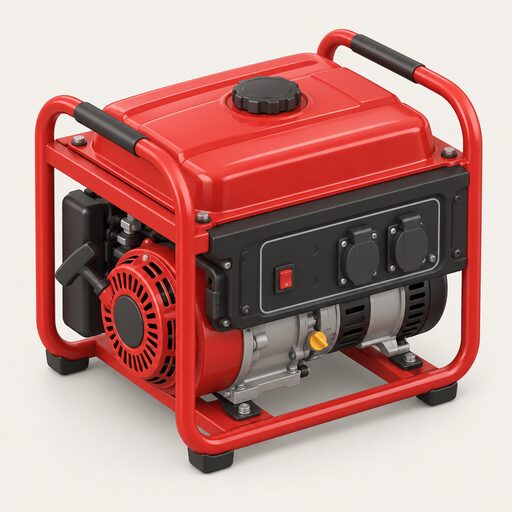 The Full Backup Power GuideHow long do UK power cuts usually last, and what can keep your fridge, heating or phone going until the power comes back?
 Maintaining Backup PowerWill your generator actually start when the power goes off?
 Home Battery CostA home battery usually costs between one and a half and ten thousand pounds fitted, depending on size.
 Home Battery ManufacturersWho makes the home batteries sold in the UK, and what does a battery bought direct from a UK brand actually cost and cover?