
In this answer
Short answer
A home battery pays for itself over a period that independent guidance puts in the region of 8 to 12 years, which is similar to the reported lifespan of the equipment1. That is the headline answer, and it is a range rather than a promise. A maker's own figure for a domestic battery gives a wider realistic range of around 8 to 15 years, depending on energy prices, battery cost, tariff choice and usage2.
The reason payback is a range is that the saving is not a property of the battery. It is the product of how the battery is charged, what it displaces, what it cost to install and how long it keeps working. A battery charged on a cheap overnight rate and discharged into an expensive evening is doing something quite different from one charged from rooftop solar and discharged into the same evening, even though the box on the wall is identical.
This page sets out what payback means, what drives it, where the money actually comes from, and where the saving stops. It does not recommend a product, a tariff or an installer, and it does not give a figure the evidence cannot support.
What payback actually means for a home battery
Payback is the point at which the money a battery has saved equals the money it cost to buy and install. It is not the same as profit, and it is not the same as the battery's lifespan. A battery that pays back in nine years and lasts twelve has three years of net benefit; one that pays back in twelve and lasts ten never gets there.
The saving itself comes from a simple function. A battery stores unused energy for use later, for example to power a home during the night7. In a solar household, that means generation that would otherwise have been exported at a low rate is used on site instead. In a household without solar, it means electricity bought in a cheap period is used in an expensive one.
Two things follow. First, payback is measured against a counterfactual: what the household would have paid without the battery. Second, the counterfactual changes as tariffs change, so a payback figure is only ever true for the prices and tariff in force when it was calculated. Independent guidance describes the mechanism plainly: a battery stores cheap electricity when prices are low for use later, even during peak times, which can significantly increase savings8.
It is worth separating payback from the other things a battery does. Backup during a power cut is a benefit, but not all batteries can deliver electricity during a power cut, so it cannot be assumed into the sums1. Reduced reliance on grid electricity is a benefit, but it is not a cash flow. Payback is a financial measure, and only the financial flows belong in it.
Payback depends on how you charge and discharge the battery

The charge and discharge pattern is the single biggest variable in the sums, because it determines how many kilowatt hours are moved from a cheap period to an expensive one, and how often.
With a battery and no solar panels, charging stops when the battery is full and the battery discharges when the next cheap tariff period ends, automatically3. That is a daily cycle tied to the tariff clock. The saving is the price difference between the cheap window and the period the stored electricity displaces, multiplied by the energy moved, multiplied by the number of cycles in a year.
With solar, the pattern is different. Without a battery, a household might only use 30 to 50 per cent of what it generates9. A battery raises that self-consumption share, which is why independent case-study guidance notes that a battery will increase the cost but will allow more of what is generated to be used10. The saving here is the retail price of the electricity not bought, rather than the spread between two tariff periods.
There is a floor on discharge as well. When the battery gets down to a set level, maybe 20 per cent of total storage capacity, the system stops taking electricity out3. That reserve is not lost energy, but it is capacity that cannot be cycled, and it trims the annual throughput the sums assume.
Independent monitoring of homes with batteries alongside solar found that homes with batteries consistently show lower total daily grid consumption across three seasons, with winter consumption seeing an increase attributed to a suspected arbitrage pattern11. In plain terms, the batteries were doing their job for most of the year, and the winter behaviour looked like deliberate charging and discharging against price rather than self-consumption.
Cost: what you pay upfront shapes the sums
Payback is a fraction: annual saving on top, upfront cost underneath. Both move, and the upfront cost is the one the household controls least.
The up-front cost of installing a battery can be up to £2,544 more than the alternative13. That figure is the additional cost of adding storage, not the total installed price, and it is the number that has to be recovered before payback begins. Prices for specific systems are installer-quoted, and no published range applies across the market.
Cost is also why batteries are not yet standard in new homes. Batteries are not standard in the Future Homes Standard, because housebuilders pushed back on the extra upfront cost and the government left them optional14. That is a useful signal about how the industry itself reads the economics: the saving is real, but the capital outlay is large enough that it has not been made mandatory.
There is a financing dimension. Green Homes Wales offers a 6-month upfront repayment holiday while new energy efficiency measures begin delivering results15. That structure exists precisely because the saving arrives after the cost, and a repayment holiday bridges the gap. It applies in Wales; equivalent support differs across the four nations.
VAT sits on top of the capital cost and changes the arithmetic. Battery storage installed with solar PV is listed at 0 per cent VAT5. The zero rate on energy saving materials is scheduled to end on 31 March 2027, after which the rate reverts to the reduced 5 per cent5. Home charging generally sits at 5 per cent VAT, the lower level charged for domestic energy16. A household buying storage alongside solar before that date faces a different capital figure from one buying after it.
| Cost element | Figure | Source basis |
|---|---|---|
| Additional upfront cost of installing a battery | up to £2,544 more | Independent guidance13 |
| VAT on battery storage installed with solar PV | 0 per cent | Independent guidance5 |
| VAT rate after 31 March 2027 | 5 per cent reduced rate | Independent guidance5 |
| VAT on home charging | 5 per cent | Official guidance and independent statistics16 |
| Green Homes Wales repayment holiday | 6 months | Welsh scheme rules15 |
Tariffs and smart charging: where most of the saving comes from

If payback has a single lever, it is the tariff. A battery on a flat rate tariff has almost nothing to arbitrage; a battery on a well-chosen time-of-use tariff has a daily price spread to work with.
Home battery storage is usually used in combination with solar panels or a smart time of use tariff, or both3. That is not a marketing preference, it is where the value is. Independent guidance is direct about the pairing: an EV, heat pump or home battery makes smart tariffs much more valuable8. The technologies and the tariff reinforce each other.
The scale of the effect is documented. Households can save up to 64 per cent on their energy bills through installing packages of measures such as a battery, a heat pump and rooftop solar with a time-of-use tariff6. Separately, some households could reduce annual energy bills by around £800 by combining clean technologies such as heat pumps, solar panels and battery storage with the right smart tariff18. Both figures are for packages, not for a battery alone, and both depend on the tariff being the right one.
Take-up shows the direction of travel. The proportion of home EV charge points that use an EV tariff is 62 per cent19. Households that already have a cheap overnight window for a car are well placed to use the same window for a battery, because the cheap overnight electricity on a two-rate tariff can also be used for other appliances20.
The future home is expected to run on this structure. Independent guidance describes the energy efficient house of the future using a smart time-of-use tariff and an export tariff21. A battery is the device that lets a household buy at the low point of that tariff and sell or avoid buying at the high point.
Sizing the battery to the household
Sizing decides whether the capital cost is matched to the saving. Too small and the battery fills before the cheap window ends; too large and part of the capacity never cycles enough to earn its keep.
A maker's guidance suggests adding around 15 to 20 per cent headroom for inverter losses, standby consumption and real-world variation22. A separate maker's note puts the same headroom at roughly 10 to 20 per cent when sizing for essential loads22. The two figures are not reconciled, and both are maker guidance rather than an independent standard, so the honest position is that headroom is expected and its exact size is a matter of judgement.
Backup reserve is a second deduction. Most homeowners reserve around 10 per cent of total capacity for power-cut backup23. That capacity is held back rather than cycled, so it does not contribute to the saving, though it does contribute to resilience. A home battery is described by the same maker as a 10 to 15 year investment23, which is the horizon the sizing decision has to fit.
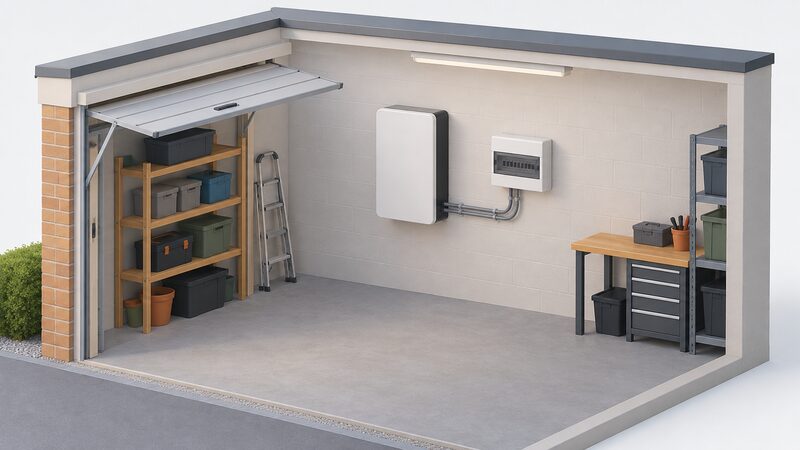
Physical size is a practical constraint that feeds back into cost. A typical battery storage system is around 100cm x 60cm x 25cm3. Where that unit can go, and whether it needs to be indoors or outdoors, affects installation work and therefore the upfront figure.
The sizing question is developed in more detail on what size home battery you need, and the difference between nameplate and usable capacity is set out on battery capacity and usable capacity. Both matter to payback because only usable, cycled capacity earns anything.
Degradation and warranty: how long the saving lasts
Payback and lifespan are on the same clock, which is why degradation is a payback question and not just a maintenance one.
Independent guidance puts the typical lifespan of a battery at about 10 to 12 years3. Official guidance gives domestic battery storage a shorter lifetime of around 10 to 15 years when compared with solar panels4. The two ranges overlap and neither is precise, but both sit close to the 8 to 12 year payback range1. A battery that pays back at the top of that range and degrades at the bottom of the lifespan range has little margin.
The mechanism of degradation is charge and discharge. A battery's lifespan depends on its type and how often it is charged and discharged fully12. That is why the discharge floor matters: a system that stops at around 20 per cent of total storage capacity is not cycling that portion, which reduces wear but also reduces throughput3.
Warranty terms are the manufacturer's promise about retained capacity over time, and they are the household's protection if degradation runs faster than expected. The detail of retained capacity, throughput limits and conditions is covered on home battery warranties, and the underlying chemistry on home battery cycle life and degradation. Both are worth reading before accepting a payback figure, because a payback calculation that ignores the warranty is assuming performance the maker has not promised.
There is a safety dimension to charging that sits outside the financial sums but inside the household's risk. Official fire service guidance is to charge items away from escape routes, never in a corridor or a room that provides the only way out of the home, and to disconnect the charger once charging is complete25. It also states that the correct battery and charger for the device should always be used, charged as per the manufacturer's instructions25. For a home battery, that means an installed system charged as its maker specifies, not a workaround.
Where the saving stops
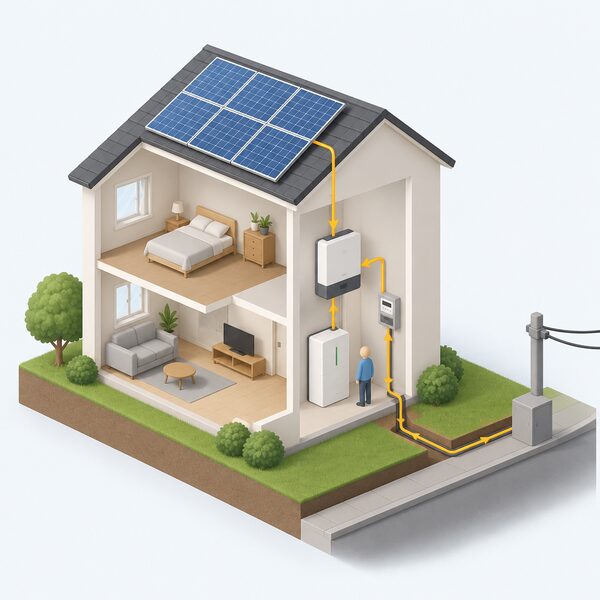
A battery does not make a household independent of the grid, and it does not remove the need for a supplier. It shifts when electricity is bought, and from whom the value is captured, but the connection remains.
Export is the other half of the picture. Surplus solar electricity can be sold back to an energy supplier through a Smart Export Guarantee tariff when the battery is full3. Homeowners can sell power produced and stored in a battery back to the grid automatically26, and domestic and business customers can sell surplus electricity they do not need back to the grid27. Solar PV systems can sell any surplus energy not used back to the grid28, and the Smart Export Guarantee is the route by which surplus solar electricity is sold back29.
What remains is dependence on the tariff structure that creates the saving. If the price spread between cheap and expensive periods narrows, the saving narrows with it. If the household changes tariff, the calculation changes. The battery is a fixed asset earning a variable return, and the variable is set by the market, not by the household.
The wider context is that household energy independence is a spectrum. A battery moves a household along it by increasing self-consumption and by capturing price differences, and the home battery storage guide covers the full picture. What it does not do is sever the connection, and any payback figure that implies otherwise is overstating the case.
Sources29 cited
- Battery storage advice, Centre for Sustainable Energy, 2025-10
- 10kW solar battery price UK, Jackery UK, 2026-06-04
- Battery storage, Energy Saving Trust, 2026-08-19
- Domestic battery storage, Parliamentary Office of Science and Technology, 2026-06-25
- Zero carbon zero VAT, MCS Foundation, 2026-09-20
- Clean heat: supporting low-income households, Energy UK, 2026-06-11
- Solar panels, Oxfordshire County Council, 2026-09-17
- Should I switch to a time of use tariff, Energy Saving Trust, 2026-01-23
- Solar panels, Uswitch, 2026-09-16
- Installing solar panels to help reduce your carbon footprint, Energy Saving Trust, 2025-09-24
- Grid impacts of heat pumps, EVs and solar revealed, Energy Systems Catapult, 2025-08-18
- Battery storage, MCS Certified, 2026-09-17
- Solar panel installation, maintenance and repair, NICEIC, 2026-09-17
- Future Homes Standard for your home's future, Low Carbon Hub, 2026-09-01
- Green Homes Wales, Development Bank of Wales, 2026-09-17
- EVs: the facts, Society of Motor Manufacturers and Traders, 2025-09-22
- EV charging VAT, Zapmap, 2026-08-24
- Clean tech combo could help households beat rising energy bills, Energy Saving Trust, 2026-07-15
- Smart meter Guaranteed Standards of Performance draft impact assessment, Ofgem, 2025-08
- Time of use tariffs explained, Which?, 2026-04-23
- House of the future, Energy Saving Trust, 2026-07-15
- Best battery for solar panel, BLUETTI UK, 2026-08-31
- How much battery storage should you get, Spirit Energy, 2026-08-07
- Battery storage, Energy Saving Trust, 2026-08-19
- Lithium-ion batteries, North Wales Fire and Rescue Service, 2026
- Batteries in the home, Solar Energy UK, 2026-09-17
- Renewable energy, Electricity North West, 2026-09-19
- Solar panels, London Borough of Hammersmith and Fulham, 2026-09-17
- Solar power facts, Energy Saving Trust, 2026-08-13
 Payback and SavingsHow long until a home battery pays for itself, and why do quoted payback times vary so much?
 Cycle Life and DegradationHow long will a home battery actually last, and what decides that?
 Home Battery CostA home battery usually costs between one and a half and ten thousand pounds fitted, depending on size.
 Home Battery WarrantiesHow long does a home battery warranty really last, and what does it actually promise?
 The Full Home Batteries GuideA home battery stores cheap or solar power for later, but will it really cut your bills enough to be worth it?
 Batteries and IndependenceHow far home battery storage moves a UK household away from the grid and supplier pricing, covering self-sufficiency, winter limits, cost, lifespan, backup, export payments and flexibility earnings.