

In this answer
Short answer
Green Homes Wales is a Welsh Government initiative, managed by the Development Bank of Wales, that helps homeowners in Wales improve their homes with energy efficiency upgrades1. It is not a grant scheme in the usual sense. The core offer is an interest free loan of £1,000 to £25,000 with repayment terms up to 10 years, and for larger projects terms may be extended1. Grant funding sits alongside the loan for specific measures rather than replacing it.
The scheme is not means tested1. Applicants do have to pass credit checks and affordability assessments, and the property must be owned by them and be their primary residence1. Funding is offered on a first come, first served basis subject to funding availability, and submitting an application does not guarantee funding1. The Welsh Government had invested almost £12 million into the scheme as of March 20262.
For a household, the value is the funded assessment and the coordination that comes with it. Green Homes Wales funds the initial assessment up to a value of £600 and provides fully funded access to a Retrofit Coordinator, who produces a detailed home assessment with energy efficiency and decarbonisation recommendations3. What remains is a loan obligation: repayments are personally liable, and the scheme is a finance product administered on behalf of Welsh Ministers, not a gift1.
What the scheme actually offers
The headline is a loan, and the terms matter more than the rate. Interest free borrowing of £1,000 to £25,000 over up to 10 years is unusual in the home improvement market, and the six-month upfront repayment holiday is designed to run while new measures begin delivering results1. Loans are unsecured, but homeowners are personally liable to make the agreed repayments1.
Alongside the loan, the scheme provides grant funding for specific energy efficiency measures, which reduces out-of-pocket expenses1. The grant cannot be accessed in isolation: Green Homes Wales offers a finance package which provides grant funding in certain circumstances1. There is also project cost top up funding available alongside a grant from the Boiler Upgrade Scheme, which can support the costs of heat pump technology, supply and fitting or labour, and associated pipework and radiator costs1.
The funded assessment is the part that costs the household nothing. Green Homes Wales funds the initial assessment up to a value of £600, and provides fully funded access to a Retrofit Coordinator to create a detailed home assessment3. Homeowners begin with an initial assessment and a detailed whole home review to identify suitable improvements2. Fully funded expert advice is part of the package2.
The scheme was announced as a pilot in October 2024, intended to decarbonise homes across all tenures and to support the market to develop and strengthen local supply chains5. It works in conjunction with collective purchasing schemes being organised by a number of local authorities in Wales2. Solar Energy UK has called for Green Homes Wales and Warm Homes to be aligned with the Warm Homes Plan6.
Who can apply

Eligibility turns on the property and the applicant's finances, not on benefits. The scheme is for homeowners in Wales, subject to affordability and credit checks7. The home must be owned by the applicant, be their primary residence, and be located in Wales1. It must not be a new build property, meaning homes built in the last six months that have not previously been occupied1.
Private landlords cannot currently apply, and are directed to Climate Action Wales for further information1. Listed buildings are not currently supported by the scheme1. Citizens Advice guidance for Wales adds that the home should not be in a conservation area, that the applicant lives in the home, and that the home was built over six months ago8.
The scheme supports the installation, in domestic properties located in Wales, of certain types of energy efficiency improvement measures and low carbon heating systems4. It is administered on behalf of Welsh Ministers by DBW Investments (11) Limited, trading as the Development Bank of Wales4.
| Requirement | Detail |
|---|---|
| Location | Property must be in Wales1 |
| Ownership | Home must be owned by the applicant1 |
| Occupancy | Must be the primary residence1 |
| Property age | Not a new build, meaning built in the last 6 months and not previously occupied1 |
| Means testing | Not means tested1 |
| Financial checks | Credit checks and affordability assessments required1 |
| Landlords | Private landlords cannot currently apply1 |
| Listed buildings | Not currently supported1 |
Conditions, exclusions and what is not covered
The funding can be used to cover the costs of the supply and installation of the eligible measures1. It will not cover any remediation work required, or any project management or design costs, except where agreed specifically by the scheme1. Ventilation systems are eligible for loan funding support where insulation is being installed, or where additionally recommended by the Retrofit Coordinator1.
Installers must either be registered with TrustMark as an approved PAS 2030 installer, or registered with TrustMark and certified with the Microgeneration Certification Scheme where the installation involves a low carbon technology such as a heat pump or solar panels1. The installer cannot be a member of the applicant's household or immediate family1.
For quality assurance, Green Homes Wales embeds the requirement for PAS 2035 compliance across its structure and the conditions of third parties engaged with it, including Retrofit Coordinators and installers1. The Retrofit Coordinator develops a tailored improvement plan, ensures recommendations are sound, cost effective and in line with standards, and helps plan the work in the right order3. The coordinator needs to be involved throughout the installation and work on the home, ready to advise at any point, and needs a good working knowledge of the Green Homes Wales scheme and its criteria3.
The loan agreement is governed by and construed in accordance with the laws of England and Wales, with the exclusive jurisdiction of the courts of England and Wales4. Confirmation comes in the form of a funding offer letter once the application is fully processed and the required documents and supporting information are submitted alongside it1. If a first loan has been fully repaid, a household can apply for further funding to undertake new energy efficiency measures1.
How the process runs
The route is assessment first, then decision, then work. Homeowners begin with an initial assessment and a detailed whole home review to identify suitable improvements, whether that is installing a heat pump, upgrading insulation, or modernising the heating system2. The Retrofit Coordinator then develops a tailored improvement plan based on what the home needs and what the household wants3.
The end decision on whether or not to go ahead with any work always lies with the homeowner3. That matters because the assessment is funded whether or not the work proceeds, and because the loan is a personal liability rather than a charge on the property1.
Supported measures span fabric, heating and generation. The list includes air source heat pumps, ground or water source heat pumps, high heat retention storage heaters, biomass boilers or stoves, solar thermal, solar PV, solar PV with a solar diverter or solar PVT, solar PV with battery storage, solid wall insulation, flat roof or room in roof insulation, loft insulation including top-ups, cavity wall insulation, high performance glazing, draught proofing, floor insulation, and heating controls and smart home energy management systems1.

For general advice on current support options, the scheme directs households to Nest on 0808 808 2244, which provides free and impartial general advice1. Households comparing routes across the UK can start with the home energy grants pillar or the Wales-specific page on home energy grants in Wales, and those weighing a loan against other finance should read interest-free loans for home energy work.
What it means for energy independence
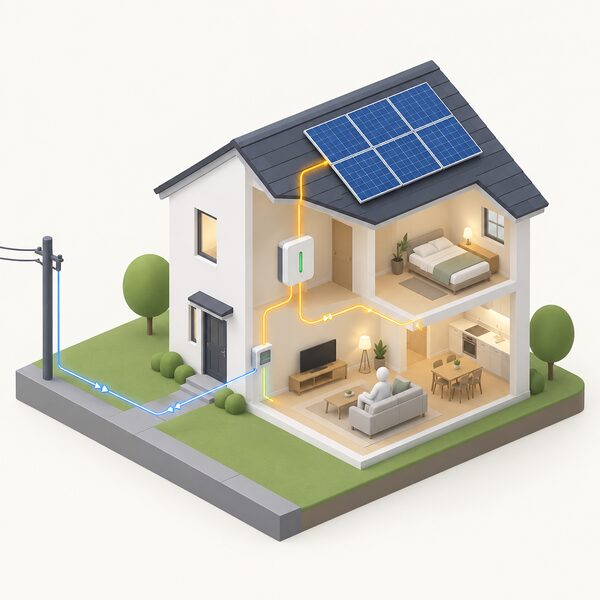
Green Homes Wales buys a household a plan and a loan, not autonomy. The measures it supports, particularly solar PV with battery storage and heat pumps, reduce the amount of energy a home draws from the grid and from gas, and the funded assessment is what makes the ordering of that work coherent rather than piecemeal1. That is a real shift in how much of a home's energy it supplies or controls itself.
The dependence that remains is financial and structural. The household owes the loan, personally, whether or not the measures perform as modelled1. The scheme itself can be suspended or closed, and grant amounts and eligibility requirements can change before an offer letter is issued4. The installer must be TrustMark registered and, for low carbon technology, MCS certified, so the choice of who does the work is constrained by scheme rules rather than open1. And the scheme is a Welsh Government initiative administered by the Development Bank of Wales, so its continuation depends on Welsh Government funding decisions rather than on the household's own arrangements1.
"The end decision on whether or not you go ahead with any work will always lie with you, as the homeowner."
Sources8 cited
- Green Homes Wales, Development Bank of Wales, 2026-09-17
- £5 million to help Welsh households invest in greener homes, Welsh Government, 2026-03-05
- Choosing a retrofit coordinator: what you need to know, Development Bank of Wales, 2025-09-30
- Loan standard terms and conditions: Green Homes Wales, Development Bank of Wales, 2026-09-17
- Written statement: Green Homes Wales scheme, Welsh Government, 2024-10-17
- Solar Energy UK manifesto for Wales, Solar Energy UK, 2026-02
- Financial support for home energy, Energy Saving Trust, 2026-09-14
- Get help with the cost of energy efficiency, Citizens Advice, 2023-03-17
 Energy Policy in WalesWhat help can you get in Wales to make your home warmer and cheaper to run?
 Home Energy Planning WalesSolar panels and heat pumps often need no planning permission in Wales, but the rules differ from England.
 Housing Stock Data for WalesHow energy efficient are Welsh homes, and how many have a rating?
 Community Energy in WalesWales wants more of its energy owned by local people, not big companies.
 The Full Grants and Schemes GuideWhich grants can you actually get right now, and how do you apply for them?
 Smart Meters in WalesCan you get a smart meter fitted free in Wales, and will it work if you live in a rural area or an older home?