
In this guide
Wales has 1.4 million homes, and those homes are responsible for about 25% of the country's carbon emissions annually1. Housing produces 21% of Welsh carbon emissions on the Welsh Government's own accounting, and the same stock accounts for 27% of all energy consumed in Wales2. That combination, a large, old, relatively inefficient housing stock sitting on top of a legally binding decarbonisation commitment, is what the Welsh housing stock data exists to measure.
The main instrument is the Energy Performance Certificate. EPCs cover around 55% of the Welsh housing stock, based on Census 2021 analysis by the ONS, against around 60% in England4. A separate ONS analysis puts coverage at 67% of residential dwellings in Wales having had at least one EPC registration since records began in 2007, as of March 20255. The two figures measure different things and both are published.
What the data shows is a stock split sharply by age. New dwellings in Wales are overwhelmingly efficient: in the quarter January to March 2026, 92% of new domestic properties received an energy efficiency rating of A or B6. Existing dwellings are not: they were more likely to receive a C (47%) or D (31%) rating6. Heat pumps appear in 1.5% of Welsh properties with an EPC, and in 1.0% of existing dwellings5.
What the Welsh housing stock data shows: 1.4 million homes, about a quarter of carbon emissions
The headline figures come from two directions. The Welsh Government's impact assessment for the Welsh Housing Quality Standard 2023 states that the 1.4 million homes in Wales are responsible for about 25% of carbon emissions annually1. The decarbonisation strategy for Welsh housing puts housing at 21% of Welsh carbon emissions, citing BEIS 2018 data, and notes that embodied carbon is typically 10 to 15% of lifetime carbon2. A Welsh Government case study on resident engagement gives a third framing: these homes are responsible for 27% of all energy consumed and 15% of all demand-side greenhouse gas emissions3. A fourth, from the Warm Homes Programme impact assessment, records that in 2021 Welsh homes accounted for approximately 10% of all greenhouse gas emissions in Wales, noting that emissions driven by electricity consumption are counted separately8.
These are not competing measurements of the same quantity. They are different boundaries: carbon emissions, energy consumed, demand-side emissions, and emissions excluding those attributed to electricity generation. A reader comparing them should treat the range as a definitional spread rather than a disagreement.
The direction of travel is set by the decarbonisation programme, which requires Welsh homes to have reduced carbon demand by 80% by 20503. The Welsh Housing Quality Standard 2023 underpins the commitment to decarbonise housing in Wales to meet legally binding climate targets in 2050, and sets standards relating to decarbonisation to support carbon reduction from the Welsh housing stock1. It is a legally binding standard, and local authorities must comply with it under section 111 of the Housing (Wales) Act 20141. Significant costs are anticipated to bring the current social housing stock up to it1.
For a household, the practical reading is that the Welsh stock is being measured against a 2050 target, not a 2030 one, and that the measurement is patchy. Fuel poverty affected 14% of Welsh households in 2021, a figure the Welsh Government links directly to less energy efficient houses9. The data that describes the problem is also the data that determines who qualifies for help.

EPCs: what they record and how the rating works
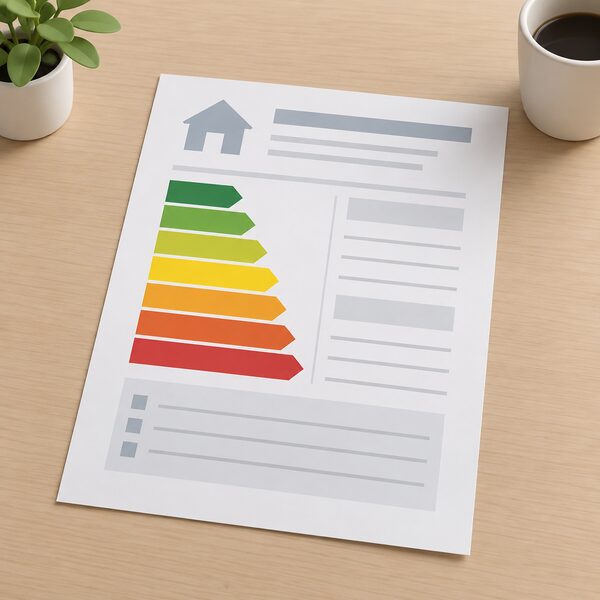
An Energy Performance Certificate provides information about the energy efficiency and emissions of a building10. It contains information on potential energy costs and carbon dioxide emissions, with a coloured chart showing how energy efficient the building is or could be, plus information on measures which could be made to improve the energy efficiency of the building and an indicative cost for each improvement11.
Both the energy efficiency rating and the environmental impact rating are scored on a scale of 1 to 100 and split into bands from A to G, with A being the most efficient12. For non-domestic properties an A+ band also exists6. The certificate is produced by an assessor using the Standard Assessment Procedure, or SAP, for the energy rating of dwellings; Reduced SAP, known as RdSAP, is used for existing homes where information may not be available12.
SAP is versioned, and the version matters for new build compliance. The government's approved methodology for the energy rating of new dwellings in England moved from version 10.2 to version 10.3 on 24 March 202614. The Standard Assessment Procedure is planned to be replaced by the Home Energy Model6.
The certificate data is publicly available, and some of the underlying data may be shared for monitoring and compliance of the energy performance of buildings regulations, with government also able to use some data for research or statistical purposes11. That is the mechanism by which an individual certificate becomes a national statistic.
"Each EPC is valid for 10 years and can be used multiple times during that period."
How much of Wales's housing stock has an EPC: around 55% coverage
Coverage is the single most important caveat on Welsh EPC data, and the published figures differ by method.
The ONS analysis based on Census 2021 puts EPC coverage at around 55% of the housing stock in Wales, against around 60% in England4. The same 55% figure appears in the quarterly EPC statistical release for July to September 2023, attributed to the same Census 2021 analysis16. A later release, covering January to March 2026, states that EPCs cover around 67% of the housing stock in Wales, again based on Census 2021 analysis, against around 71% in England6.
The ONS's own energy efficiency article resolves the apparent conflict by measuring something slightly different: just over 71% of all residential dwellings in England, and 67% in Wales, had at least one EPC registration since records began in 2007, as of March 20255. On that basis, roughly two thirds of Welsh dwellings have been assessed at some point in the last eighteen years, while a smaller share carries a current certificate.
Coverage is not evenly distributed, and the age split is stark. A much smaller proportion of dwellings built before 1930 were covered by an EPC (58%), compared with dwellings built since 2012 (90%)5. The homes least likely to appear in the data are the older, harder-to-treat ones that the decarbonisation programme most needs to reach.
The register itself is not a complete picture of the housing stock. The Energy Performance Dashboard shows the number of properties with each EPC rating from A to G across Wales, but it does not include properties on the Rent Smart Wales database where the address data is insufficient to match with an EPC17. That exclusion matters for any reading of private rented sector compliance.
| Measure | Wales | England | Basis |
|---|---|---|---|
| EPC coverage of housing stock | around 55% | around 60% | Census 2021 analysis4 |
| EPC coverage of housing stock | around 67% | around 71% | Census 2021 analysis6 |
| Dwellings with at least one EPC since 2007 | 67% | just over 71% | as of March 20255 |
| Pre-1930 dwellings covered | 58% | not given | as of March 20255 |
| Post-2012 dwellings covered | 90% | not given | as of March 20255 |
EPC lodgements in Wales: the latest quarterly and annual figures

Lodgement counts show how much assessment activity is happening, and they move sharply quarter to quarter.
In the quarter January to March 2026, 22,000 domestic EPCs were lodged in Wales, an 8% decrease on the same quarter a year earlier. Of those, 20,000 were for existing dwellings, an 11% decrease, and 2,000 were for new dwellings, a 43% increase6. Over the 12 months to March 2026, 90,000 domestic EPCs were lodged in Wales, a 10% increase on the previous 12 months, of which 8,000 were for new dwellings, a 19% increase6.
The preceding year ran higher in the second quarter. In April to June 2025, 25,000 domestic EPCs were lodged in Wales, a 32% increase compared with the same quarter in 2024. Of those, 24,000 were for existing dwellings, a 36% increase, and 2,000 were for new dwellings, a 5% decrease4. Over the 12 months to June 2025, 87,000 domestic EPCs were lodged in Wales, a 14% increase on the previous 12 months, of which 81,000 were for existing dwellings, a 16% increase4.
For context, the England and Wales total in the quarter January to March 2026 was 460,000 EPCs lodged across domestic and non-domestic properties, a 2% decrease compared with the same quarter in 20256. In April to June 2025 the equivalent total was 544,0004.
Non-domestic lodgements in Wales have been falling. In the quarter January to March 2026, 1,000 EPCs were lodged for non-domestic properties, a 20% decrease, and over the 12 months to March 2026, 4,000 were lodged, a 17% decrease6. In the year ending March 2023, by contrast, 5,000 non-domestic EPCs were lodged, a 12% increase18.
Local authority variation is extreme. In the quarter January to March 2026, the Welsh local authority with the largest increase in EPCs lodged for new dwellings compared with the same quarter in 2025 was Cardiff, at 541%, while the largest decrease was in the Vale of Glamorgan, at -75%6. An earlier quarter showed the same volatility in the other direction: in July to September 2023 the largest increase in new dwelling EPCs was in Merthyr Tydfil (467%) and the largest decrease in Caerphilly (-63%)16.
Ratings in Wales: new dwellings at 92% A or B, existing homes mostly C and D
The rating distribution is where the Welsh stock's two-speed character is clearest.
In the quarter January to March 2026, 92% of new domestic properties in Wales received an energy efficiency rating of A or B, and the majority of new dwellings were given an A EER (55%)6. Existing dwellings were more likely to receive a C (47%) or D (31%) rating6.
The pattern is stable across releases, though the exact split moves. In April to June 2025, 90% of new domestic properties in Wales received an A or B rating, with 9% rated C or D; the majority of new dwellings were given a B EER (44%), and existing dwellings were more likely to receive a C (47%) or D (33%) rating4. In July to September 2023, 87% of new domestic properties received an A or B rating, while only 13% received a rating of C or D16. In January to March 2023, 84% of new domestic properties received an A or B rating18.
The ONS adds a longer view: in Wales, median EPC scores for new dwellings increased from 81 to 84 over the five-year period to March 20255. The same analysis records that 1.4% of properties in England and 1.5% in Wales have heat pumps, and that while 1.5% of properties with an EPC in Wales have one, only 1.0% of existing dwellings do5.
| Rating outcome | Wales, Q1 2026 | Wales, Q2 2025 | Wales, Q3 2023 |
|---|---|---|---|
| New dwellings rated A or B | 92% | 90% | 87% |
| New dwellings rated C or D | not given | 9% | 13% |
| Existing dwellings rated C | 47% | 47% | not given |
| Existing dwellings rated D | 31% | 33% | not given |
Non-domestic ratings in Wales sit lower: in the quarter January to March 2026, an A+, A or B rating was given to 37% of non-domestic properties in Wales, against 43% in England6.
The independence reading is straightforward. A new Welsh home is built to a standard that leaves little for the occupier to fix. An existing Welsh home, most likely rated C or D, is a property where the household's energy independence depends on measures the certificate itself recommends, and where the data shows heat pumps remain rare.
How the Welsh Housing Conditions Survey fills the gaps
The EPC register only covers homes that have been assessed. The Welsh Housing Conditions Survey exists to describe the rest.
The survey's purpose was to provide an estimate of the condition and energy efficiency and performance of the housing stock in Wales19. It ran from April 2017 to March 2018 and was the first national housing conditions survey in Wales since the Living in Wales Property Survey 200819. Non-invasive inspections were carried out by qualified surveyors in 2,549 properties across Wales between August 2017 and April 2018, and a total of 2,552 full surveys were completed9. Vacant properties were not included19.
The survey data was validated, processed and run through data models by BRE before being sent to the Welsh Government in August 2018 for analysis and reporting19. The WHCS is one aspect of the Welsh Government's Housing Conditions Evidence Programme19. It is cited as a reference in the Welsh housing decarbonisation strategy, and all data in that strategy is drawn from the Welsh Housing Conditions Survey 2017-20182.
The gap between the survey and the present is the central limitation. A new Housing Survey is currently planned for 2027-28, which will provide more up-to-date raw data to underpin future fuel poverty estimates9. Until then, the physical-condition evidence base for Welsh housing rests on fieldwork carried out in 2017 and 2018, while the EPC register continues to accumulate certificates for the subset of homes that are sold, let or built.
For a household, this means two different kinds of evidence exist about Welsh homes. The EPC record describes an individual property at a point in time and is available to the occupier. The survey describes the stock as a whole, is sample-based, and is now several years old. Neither is a substitute for the other, and the Welsh Government's own fuel poverty modelling depends on the survey being refreshed.
Wales's renewable electricity position: 55% of consumption, 1.5 GW locally owned target
The housing data sits inside a wider energy picture, and the Welsh targets are among the most ambitious in the UK.
The Welsh Government's target is to meet the equivalent of 100% of Wales's annual electricity consumption from renewable sources by 2035, and to continue to keep pace with consumption thereafter7. The same 100% by 2035 target appears in the energy generation statistics for Wales, in the renewable energy deep dive, and in the 2026 written statement that raised the local ownership target20. An earlier milestone sits underneath it: a target of 70% of electricity consumption to be met by renewable sources by 203023.
On local ownership, the target is at least 1.5 GW of renewable energy capacity to be locally owned by 2035, excluding heat pumps21. The same 1.5 GW by 2035 figure appears in the energy use report, in the consultation response on renewable energy targets, and in the UK Solar Roadmap20. A separate target covers 5.5 GW of renewable energy capacity to be provided by heat pumps by 203521.
Progress against the earlier local ownership goal is well advanced. Wales has already achieved 97% of its target for at least 1 GW of renewable electricity and heat capacity to be locally owned by 2030, and local ownership of renewable energy stood at 0.99 GW at the end of 202423.
The share of consumption currently met by renewables is published on two bases that do not agree: approximately 55% on one official statistics basis, against 56% in 2020 falling to 55% in 2021 on another. Both figures are published and neither has been ruled correct.
| Target | Figure | Date |
|---|---|---|
| Renewable electricity, share of annual consumption | 100% | 20357 |
| Renewable electricity, interim share | 70% | 203023 |
| Locally owned renewable capacity | at least 1.5 GW | 203521 |
| Locally owned renewable electricity and heat capacity | 1 GW | 203023 |
| Renewable capacity provided by heat pumps | 5.5 GW | 203521 |
| Local ownership achieved | 0.99 GW | end of 202422 |
The independence implication is that Wales is targeting a position where its annual electricity consumption is matched by renewable generation and a meaningful share of that capacity is locally owned. That is a national target, not a household one. A Welsh home's own independence still depends on the measures installed at the property, and the data shows those measures are concentrated in new build.
EPC reform and what it means for Welsh homes
EPC reform is being developed across the UK nations, and the Welsh position is shaped by both devolved and reserved decisions.
The reform programme covers introducing new ratings, redesigning the certificates, and improvements to the operational infrastructure25. The Scottish Government has consulted on reducing the validity period of EPCs from 10 to five years to ensure consumers have more up-to-date information13. The current validity period is ten years13. The 10-year term is also stated in the England and Wales statistical release6.
On social housing, the Climate Change Committee recommended evaluating the cost effectiveness of retrofitting social housing to reach an EPC A rating, and reviewing the proposed target1. The Welsh Housing Quality Standard 2023 is the instrument that carries the decarbonisation standards for social homes, and it is legally binding1.
For private housing, the Welsh Government offers free energy upgrades through the Warm Homes Nest Scheme for houses with a poor EPC rating12. The scheme operates in Wales12.
The independence reading of reform is that the certificate is becoming a more frequently refreshed document, and in Scotland potentially a five-yearly one. A household's EPC is the record that determines access to schemes such as Nest and, for landlords, the compliance position. Reform changes the certificate, not the building.
Where to find and check an EPC record
Domestic EPCs for England and Wales are lodged on the Landmark Register and can be accessed at epcregister.com26. Certificates issued in Scotland are lodged on the Energy Saving Trust Scotland register26.
Northern Ireland uses separate registers: epbniregister.com for dwellings and ebpniregisternd.com for all other properties, both of which also allow users to find assessors15.
An EPC is needed whenever a property is built or marketed for sale or rent15. It must be provided when a building is advertised for sale or for let to a new tenant, and it is also required upon completion of construction of a new building25. Certain large non-domestic buildings must display one25.
The Energy Performance Dashboard published by Rent Smart Wales shows the number of properties with each EPC rating from A to G across Wales, and is the route to the aggregate picture rather than a single address17. For the wider statistical context, the UK home energy statistics pillar covers deployment, prices and fuel poverty data across the four nations, and the EPC statistics page explains what the certificate data shows in more detail. Comparable nation-level pages are available for England, Scotland and Northern Ireland.

Sources26 cited
- Welsh Housing Quality Standard 2023: integrated impact assessment, Welsh Government, 2024
- Homes of Today for Tomorrow: decarbonising Welsh housing between 2020 and 2050, Welsh Government, 2024
- Active Building Centre resident engagement case study, Welsh Government, 2024
- Energy Performance of Buildings Certificates: April to June 2025, England and Wales, Ministry of Housing, Communities and Local Government, 2025
- Energy efficiency of housing in England and Wales, Office for National Statistics, 2025
- Energy Performance of Buildings Certificates: January to March 2026, England and Wales, Ministry of Housing, Communities and Local Government, 2026
- Summary of responses to the consultation on Wales renewable energy targets, Welsh Government
- New Warm Homes Programme: integrated impact assessment, Welsh Government
- Fuel poverty modelled estimates for Wales, October 2024, Welsh Government, 2024
- Energy Performance Certificates: a guide, Scottish Government
- Sale and rent: energy performance of buildings leaflet, Building Control Northern Ireland, 2013
- Energy performance certificates, House of Commons Library
- Reforming energy performance certificates, Scottish Government, 2026
- Notice of approval of the methodologies for the energy performance of new buildings, Ministry of Housing, Communities and Local Government, 2026
- Energy Performance Certificates, Northern Ireland Direct
- Energy Performance of Buildings Certificates: July to September 2023, England and Wales, Ministry of Housing, Communities and Local Government, 2023
- Energy Performance Dashboard, Rent Smart Wales, 2026
- Energy Performance of Buildings Certificates: January to March 2023, England and Wales, Ministry of Housing, Communities and Local Government, 2023
- Welsh Housing Conditions Survey April 2017 to March 2018: technical report summary, Welsh Government, 2021
- Energy use in Wales report, third edition, Welsh Government
- Renewable energy deep dive: biannual recommendations update, Welsh Government
- Energy generation and energy use in Wales: first combined edition report, Welsh Government, 2026
- Energy generation in Wales 2021, Welsh Government
- UK Solar Roadmap, Department for Energy Security and Net Zero
- Energy Performance of Buildings Scotland amendment regulations 2026: business and regulatory impact assessment, Scottish Government, 2026
- Feed-in Tariffs: guidance for licensed electricity suppliers, Ofgem, 2021
 Housing Stock and EPCsWelsh homes are among the oldest and least energy efficient in the UK, so what does that mean for yours?
 Housing Stock Data for EnglandHow energy efficient are English homes, and how many have insulation or low carbon heating?
 Welsh Housing Quality StandardWhat does the Welsh Housing Quality Standard mean for your home if you rent from a council or housing association in Wales?
 Housing Stock Data for ScotlandScotland's housing is measured differently from England's, so the numbers you see may not compare directly.
 Energy Policy in WalesWhat help can you get in Wales to make your home warmer and cheaper to run?
 Housing Stock Data for NIMost homes in Northern Ireland heat with oil, so why are the grants and help different from the rest of the UK?