
In this guide
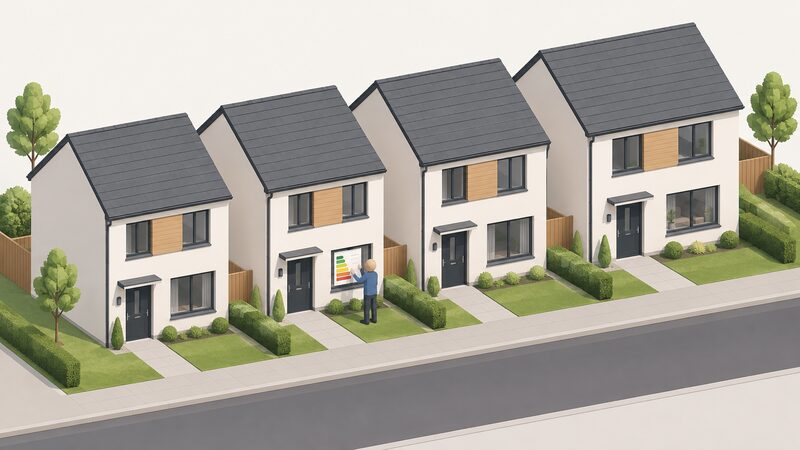
New build homes in England and Wales are overwhelmingly rated in the top two EPC bands. In the quarter January to March 2026, 87% of new dwellings in England were given an A or B rating, up from 86% in the same quarter a year earlier, and in Wales 92% of new domestic properties received an A rating or above1. The median EPC rating for new builds across urban areas, larger rural areas and smaller rural areas in both nations was 84 as of March 20252.
Those ratings sit against a much weaker picture for the existing stock. In England over the same quarter, 88% of existing dwellings were given a C or D energy efficiency rating, compared with 12% of new dwellings1. The gap is the single most useful fact in the dataset: it shows what current building standards deliver, and how far the standing housing stock sits from them.
The figures come from Energy Performance Certificates lodged on the Energy Performance of Buildings Register, not from a separate survey of construction3. An EPC is required when a building is constructed, sold or let, so the lodgement counts track activity in the market as well as the physical completion of homes4. This page sets out the headline numbers, what drives them, how the four UK nations differ, the rules behind the certificates, and what the data does and does not say about a household's energy independence.
What the new build EPC statistics show
The headline measure is the share of newly completed dwellings landing in the top bands. In England, 67% of new dwellings in the January to March 2026 quarter were given a B energy efficiency rating, and the A or B share overall was 87%1. In Wales the distribution sits higher still: 55% of new dwellings were given an A rating, and 92% of new domestic properties received an A or above1.
The volume figures matter as much as the ratings, because they show how much of the stock is being renewed. In England, 48,000 EPCs were lodged for new dwellings in the first quarter of 2026, a 6% increase on the same quarter in 2025, and 204,000 over the 12 months to March 2026, a 2% increase on the previous year1. In Wales, 2,000 new dwelling EPCs were lodged in the quarter, a 43% increase, and 8,000 over 12 months, a 19% increase1.
For context, the same release recorded 460,000 EPCs lodged across England and Wales in the quarter for domestic and non-domestic buildings together, a 2% decrease on the same quarter in 2025, of which 416,000 were domestic EPCs in England, a 1% decrease1. New dwellings are therefore a minority of all lodgements: 48,000 out of 416,000 domestic certificates in England, with existing dwellings accounting for 368,0001.
A separate official dataset, the energy efficiency characteristics of new dwellings, draws on the same register and is published as Official Statistics in Development, meaning its methods are still being refined3. The main Energy Performance of Buildings Certificates release, by contrast, was changed from Official Statistics in development to Official Statistics from October 20241. That distinction matters when a figure is used for anything load-bearing: the quarterly release carries the stronger designation.
What drives the ratings
The ratings are high because the certificate measures the building, not the household. The EPC assessment reflects the energy performance of the building itself, not the way it is used by its occupants5. Assessors use the standard assessment procedure (SAP) to determine the energy efficiency rating of a home, and reduced SAP (RdSAP) for existing homes where information may not be available6. New builds are assessed under the full SAP method, which is one reason the two sets of figures are not directly comparable.
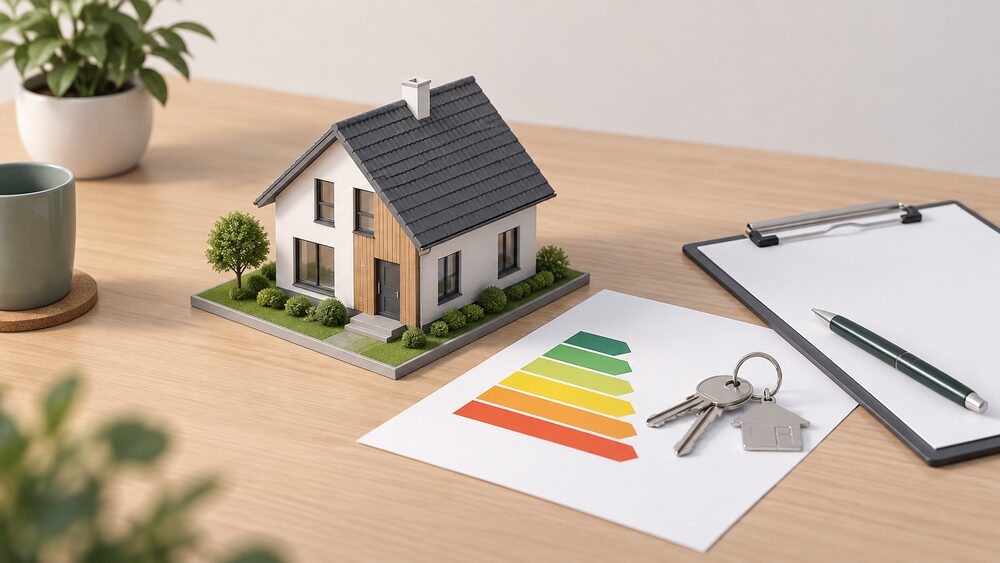
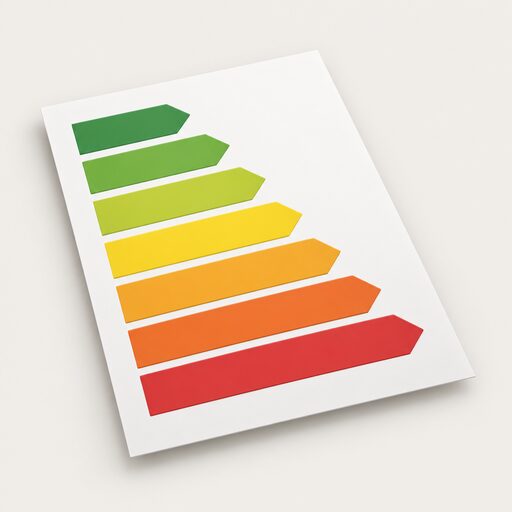
The certificate is also a standardised document. EPCs are produced using standard information about buildings, allowing buyers and tenants to compare energy efficiency and likely heating and lighting costs before entering a contract7. Each certificate carries information on potential energy costs and carbon dioxide emissions, with a coloured chart showing how energy efficient the building is or could be, plus a report setting out cost effective measures to improve the rating, such as low energy bulbs or upgrading insulation7.
The scale itself runs from 1 to 100, split into bands A to G, with A the most efficient6. For non-domestic buildings the certificate shows an asset rating alongside an indication of energy performance based on primary energy use, and the bands run to A+5. Domestic certificates do not use the A+ band.
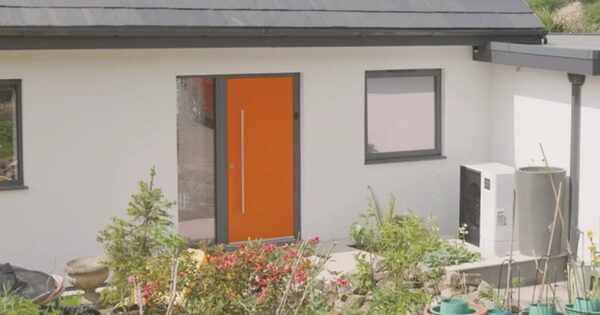
Two structural drivers sit behind the new build figures. The first is the building regulations regime, which sets the fabric and services standard a new dwelling must meet before it can be signed off. The second is the direction of travel in heating: the government has stated that under the Future Homes Standard heat pumps will become "the primary heating technology"6. The Future Homes Standard was consulted on again at detailed specification stage from November 2023 to March 2024, and one option considered would have required solar PV panels covering the equivalent of 40% of a new home's ground floor area, with an exemption for blocks of flats over 15 storeys6.
"heat pumps will become 'the primary heating technology'"
How the figures differ across England, Scotland, Wales and Northern Ireland
The published quarterly series covers England and Wales only, and the two nations do not move together. In the first quarter of 2026, England recorded 48,000 new dwelling EPCs, a 6% increase, while Wales recorded 2,000, a 43% increase1. Over 12 months, England's 204,000 new dwelling lodgements represented a 2% increase, against Wales's 8,000 and 19% increase1.
Regional variation within England is wider than the national change. In the first quarter of 2026 the largest regional increase in new dwelling EPCs was in London, at 43%, and the largest decrease was in the North West, at 9%1. Within Wales, the local authority picture is more volatile still: Cardiff recorded a 541% increase in new dwelling EPCs against the same quarter in 2025, while the Vale of Glamorgan recorded a 75% decrease1.
The pattern is not stable from quarter to quarter. In the second quarter of 2025, England recorded 52,000 new dwelling EPCs, a 2% decrease, with London down 16% and the East of England up 13%8. In the first quarter of 2023, England recorded 53,000 new dwelling EPCs, a 10% decrease, with the North East down 20% and Yorkshire and The Humber up 19%9. In the third quarter of 2023, England recorded 59,000 new dwelling EPCs, a 6% decrease, with Yorkshire and The Humber up 15% and London down 18%10. Annual totals have moved in both directions: 247,000 in the 12 months to March 2023, a 3% increase, and 237,000 in the 12 months to September 2023, a 4% decrease9.
Scotland and Northern Ireland publish their own arrangements rather than appearing in the England and Wales quarterly series. Scotland's EPC requirements are set out in the Energy Performance of Buildings (Scotland) Regulations, and a new build heat standard consultation confirmed that for new buildings an EPC will be required upon completion as is the case now11. Northern Ireland's building regulations were amended in 2008 to replace the energy rating notice requirement for new dwellings with a requirement to give a copy of the EPC not more than five days after completion12. Northern Ireland's own consultation on the energy performance of buildings regime records a local new-build rate of 163,778 m2 per year for non-domestic buildings, which is a floor area measure rather than a dwelling count13.
| Measure | England | Wales |
|---|---|---|
| New dwelling EPCs, Q1 2026 | 48,000, up 6%1 | 2,000, up 43%1 |
| New dwelling EPCs, 12 months to March 2026 | 204,000, up 2%1 | 8,000, up 19%1 |
| New dwellings rated A or B, Q1 2026 | 87%, up from 86%1 | 92% at A or above1 |
| Most common new dwelling rating, Q1 2026 | B, 67%1 | A, 55%1 |
| Existing dwellings rated C or D, Q1 2026 | 88%1 | C 47%, D 31%1 |
The rules that require an EPC on a new dwelling
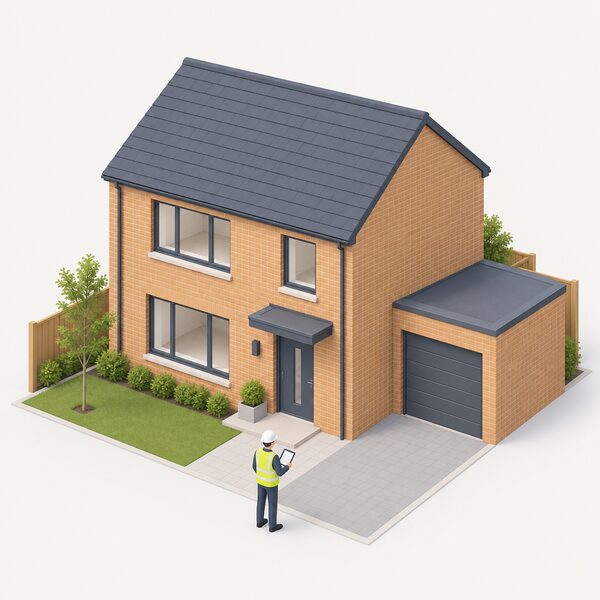
It is a legal requirement for all new build domestic dwellings in England and Wales to have an EPC when completed4. The duty is set out in the Energy Performance of Buildings (England and Wales) Regulations 2012: a relevant person must, no later than five days after construction work has been completed on a building, give to the owner an energy performance certificate for the building14. Regulations 18 to 21 of the Building Regulations amendment made in 2012 set out the requirements for energy performance certificates in relation to the construction of a building15.
The obligation is not new. The EPC requirement on construction of new buildings commenced on 30 September 200812. In Northern Ireland, the Building Regulations (Northern Ireland) 2000 were amended so that a copy of the energy performance certificate for any completed new building must be given not more than five days after completion12.
Across the UK, the trigger points are consistent. EPCs must be provided when a building is advertised for sale or for let to a new tenant, and they are also required upon completion of construction of a new building16. Public buildings are required to display their EPC rating, and certain large non-domestic buildings must display theirs18. In Scotland, dwelling owners are legally required under the Energy Performance of Buildings (Scotland) Regulations 2008 to provide an EPC on construction, sale or rental of a building to a new tenant19. Where a building is let in Scotland, the EPC must be provided to a new tenant free of charge20.
The certificate has a defined life and a defined producer. Each EPC is valid for 10 years and can be used multiple times during that period7. An EPC can only be produced by an accredited energy assessor who will visit the property to carry out an assessment, and a copy is lodged on a national register accessible through the EPC Register search facility7. The owner or landlord must have an EPC, make it available to potential buyers or tenants, and give a copy to the new owner when selling; the certificate should be made available to buyers or prospective tenants at no cost7.
There are exemptions. EPCs are not required for protected buildings, places of worship, temporary buildings of two years or less, low energy demand industrial and agricultural buildings, seasonal residential buildings, stand-alone buildings under 50 m2, and buildings suitable for demolition21. A new dwelling that falls into one of those categories would not generate a lodgement in the statistics.
What the statistics mean for a household's energy independence
A new build's EPC rating is a statement about the fabric and fixed services of the home, and that is where its contribution to energy independence lies. A dwelling rated A or B needs less energy to hold a comfortable temperature, so a greater share of what it does use can be met from a household's own generation or from a supply the household controls. The certificate also records the emissions, efficiency and running costs of the heating system, and the cost of energy to run the home to standardised conditions, which is the part that speaks most directly to running costs22.
The limits are as important as the benefits. The EPC assessment reflects the energy performance of the building itself, not the way it is used by its occupants5. A high rating is not a measurement of consumption, and it does not tell a household what its bills will be. The certificate is also an asset rating produced at a point in time: it is valid for 10 years, and nothing in the regime requires it to be updated when a heating system is replaced or a household adds solar panels7.
Dependence remains in three places. The first is the grid: a new dwelling connected to mains electricity and gas still draws its heat and power from outside the boundary, and the EPC says nothing about the carbon intensity of that supply. The second is the heating system itself, which under current standards is typically a gas boiler, though the government has stated that heat pumps will become the primary heating technology under the Future Homes Standard6. The third is the certificate's own infrastructure: EPCs are lodged on a national register and can only be produced by an accredited assessor, so the data a household relies on to judge a home sits with a register and an assessor rather than with the household7.
The statistics are also used well beyond the buyer. EPCs are the basis of many energy efficiency policies in the domestic built environment, which is why the accuracy of the underlying assessment matters23. The government has said it will reform EPCs by introducing new ratings, redesigning the certificates, and improving the operational infrastructure, and in Scotland a new EPC rating system for domestic buildings is planned to give clearer information on the fabric energy efficiency of a property, the emissions, efficiency and running costs of its heating system, and the cost of energy to run the home to standardised conditions17. The Standard Assessment Procedure itself is planned to be replaced by the Home Energy Model1.
For a household reading the numbers, the practical position is this: a new build is very likely to sit in the top two bands, and the existing stock is very unlikely to. That gap is the measure of what the building regulations have achieved, and of how much of the country's housing still depends on the grid and on gas for its comfort.
Sources23 cited
- Energy Performance of Buildings Certificates, January to March 2026, GOV.UK, 2026
- Energy efficiency of housing in England and Wales, Office for National Statistics, 2025
- Energy efficiency characteristics of new dwellings, GOV.UK, 2026
- Energy Performance of Buildings Certificates change note, GOV.UK, 2025
- Energy Performance Certificates guide, Scottish Government, 2026
- Future Homes Standard, House of Commons Library, 2026
- Energy Performance Certificates, nidirect, 2026
- Energy Performance of Buildings Certificates, April to June 2025, GOV.UK, 2025
- Energy Performance of Buildings Certificates, January to March 2023, GOV.UK, 2023
- Energy Performance of Buildings Certificates, July to September 2023, GOV.UK, 2023
- New Build Heat Standard consultation, part II, Scottish Government, 2022
- Energy Performance of Buildings Regulations (Northern Ireland), Building Control Northern Ireland, 2008
- Draft Regulatory Impact Assessment, Part F, Northern Ireland Department of Finance, 2021
- The Energy Performance of Buildings (England and Wales) Regulations 2012, regulation 34, legislation.gov.uk, 2012
- The Building Regulations &c. (Amendment) Regulations 2012, legislation.gov.uk, 2012
- Energy Performance of Buildings (Scotland) Regulations 2025: update, Scottish Government, 2025
- Energy Performance of Buildings (Scotland) Regulations 2025: government response, Scottish Government, 2025
- Energy performance of buildings regime, House of Commons Library, 2026
- Domestic EPC reform consultation, Scottish Government, 2021
- Energy Performance Certificates guide: buildings for let, Scottish Government, 2023
- Trading Standards guidance on EPC exemptions, Isle of Anglesey County Council, 2025
- Reforming Energy Performance Certificates, Scottish Government, 2025
- Energy Performance Certificate accuracy research, GOV.UK, 2026
 EPC StatisticsHow energy efficient are UK homes, and is it getting better?
 Efficiency of UK HomesMost UK homes now score better on energy than they did a decade ago, but older houses still lag well behind new builds.
 Housing Stock and EPCsHow energy efficient are Scottish homes, and how many reach a good rating?
 Housing Stock and EPCsWelsh homes are among the oldest and least energy efficient in the UK, so what does that mean for yours?
 Housing Stock and EPCsNorthern Ireland's homes score best in the UK for energy efficiency, yet most run on heating oil.
 Housing Stock Data for ScotlandScotland's housing is measured differently from England's, so the numbers you see may not compare directly.