

In this guide
Household energy numbers in the UK come from a small set of organisations, each with a defined remit. The Department for Energy Security and Net Zero (DESNZ) publishes the accredited official statistics, including Energy consumption in the UK 2025, which covers overall energy consumption with detail on the industry, transport, domestic and services sectors1. Ofgem publishes the scheme data, including Boiler Upgrade Scheme statistics sourced from Ofgem and the Microgeneration Certification Scheme (MCS) Installation Database2. MCS itself supplies the installation database that sits behind much of the renewables uptake data3.
The practical consequence for a household is that no single body answers every question. Consumption figures, scheme uptake, installer certification, fuel poverty and supplier service ratings each sit with a different publisher, and the frequency and status of the data vary just as much. Some of it is accredited official statistics, some is official statistics in development, and some is published by charities and trade associations rather than government at all.
This page maps those publishers: what each one produces, how often, whether it is free, and which questions each is equipped to answer. It also sets out where the data stops being a neutral public good and starts being a company's own account of its products.
Who publishes UK home energy data: the landscape at a glance
The landscape divides into four layers, and knowing which layer a figure comes from tells you how much weight it carries.
The first layer is central government statistics. UK energy in brief 2026 is a summary of some of the key annual statistics in the UK energy system10, and Energy consumption in the UK 2025 carries accredited official statistics status1. The Office for National Statistics (ONS) hosts the Explore local statistics service, which carries 109 local indicators including fuel poverty for England7. DESNZ supplies the domestic electricity consumption indicator for both Great Britain and Northern Ireland, with Great Britain estimates covering the months February to January4.
The second layer is the regulator. Ofgem publishes Boiler Upgrade Scheme statistics, sourced from Ofgem and the MCS Installation Database2, and the scheme's installer and property owner guidance11. Ofgem also publishes consumer-facing advice on getting help with energy bills14.
The third layer is certification and advice bodies. MCS is an independent certification scheme for microgeneration installation companies and products15, and its Installation Database is the source for heat pump deployment statistics3 and domestic battery installation statistics16. The Energy Saving Trust gives free impartial advice on energy and renewables in England and Wales8 and administers Scottish Government grant and loan schemes18.
The fourth layer is charities, trade associations and trackers. Citizens Advice, National Energy Action, the Heat Pump Association, the European Heat Pump Association (EHPA) and Solar Heat Europe all publish numbers that government statistics do not cover, from supplier service ratings to European market sales.

DESNZ: the official source for Great Britain's domestic electricity consumption
DESNZ is the anchor publisher. Its Energy consumption in the UK 2025 release is badged as accredited official statistics and covers overall energy consumption in the UK with details of the industry, transport, domestic and services sectors1. That accreditation matters: accredited official statistics meet the standards set by the Office for Statistics Regulation, which is a stronger status than the "official statistics in development" label applied to some scheme data.
The domestic electricity consumption indicator is published by DESNZ for Great Britain and by DESNZ for Northern Ireland, and the Great Britain estimates cover the months February to January4. That unusual reporting window is worth knowing before comparing a calendar year with a statistical year.
The department's output is not limited to consumption. UK energy in brief 2026 summarises key annual statistics across the UK energy system10, and the department publishes the methodology and background note for the Warm Homes: Local Grant and Warm Homes: Social Housing Fund statistics, with questions directed to energyefficiency.stats@energysecurity.gov.uk19. It also publishes research into how households seek energy advice, exploring which sources are trusted, what advice is perceived as most important, perceived gaps in provision, the customer journey in searching for advice, and how advice could be tailored to encourage homeowners to decarbonise their homes20.
For a household's energy independence, DESNZ data is the baseline against which everything else is measured. It tells you what a typical home consumes and how that has changed, but it does not tell you what any individual home should do, and it does not cover the performance of a specific installation.
MCS: the go-to source for data on renewables uptake
MCS describes itself as an independent certification scheme for microgeneration installation companies and products15. Its roles include setting and maintaining technical standards for installations and products, certifying installers and products against those standards, issuing MCS certificates for completed eligible installations, and assisting certification bodies to review and address cases and consumer issues relating to installers or products15.
The MCS Installation Database is the source behind a large share of UK renewables uptake data. Heat pump deployment quarterly statistics for the United Kingdom cite the Microgeneration Certification Scheme Installation Database as their source3. Domestic battery installation statistics are sourced from the MCS database16, and the earlier release of MCS certified domestic battery installation statistics takes its data from the MCS Installation Database17. The battery statistics cover retrofitting electric batteries into domestic properties in the United Kingdom16.
What MCS certification does not do is guarantee performance. MCS requires installers to provide a design-stage prediction of system efficiency, not verify actual performance, and it does not require remediation of systems that are underperforming relative to their design21. Weather compensation is not mandatory under current requirements of the scheme, and third party non-modulating controls are not prohibited21.
"MCS requires installers to provide a design-stage prediction of system efficiency, not verify actual performance."
That distinction is central to reading MCS data correctly. The database records what was installed and certified, not how well it subsequently performed. For a household, certification is evidence that an installer and product met the scheme's standards at the point of installation; it is not a performance warranty, and the scheme's own rules say so.

Energy Saving Trust: advice body, scheme administrator and FCA-regulated organisation
The Energy Saving Trust occupies an unusual position: it is simultaneously an advice body, a scheme administrator and a regulated financial services firm. It is authorised and regulated by the Financial Conduct Authority under reference number 7161959.
Its advice role covers England and Wales, where it gives free impartial advice on energy and renewables8. Its scheme administration role is Scottish. The Scottish Government awarded the Energy Saving Trust a contract as part of a competitive tender exercise to administer and manage Scottish Government Heat and Energy Efficiency live and closed grant and loan schemes, with the contract starting on 1 December 2023 and an initial term running until November 202618. The amount paid to the Energy Saving Trust for administration of the HES Grant and Loan schemes from December 2023 onwards was withheld under Regulation 10(5)(e) of the Environmental Information Regulations, covering the confidentiality of commercial or industrial information18.
That combination has a practical implication. When the Energy Saving Trust publishes a savings figure or a scheme detail, it may be speaking as an adviser, as a scheme administrator, or as a regulated firm, and the three roles carry different accountability. Its FCA authorisation is the clearest accountability route, because it brings the firm within the Financial Ombudsman Service and the regulator's rules.
For household energy independence, the Energy Saving Trust is a route into grant funding rather than a source of raw data. It tells households what support exists and administers the schemes that deliver it, which makes it a first stop for Scottish households in particular.
Citizens Advice: supplier service ratings and consumer data for England and Wales

Citizens Advice publishes the supplier service ratings that many households use to judge an energy company, alongside consumer information. Its remit is England and Wales22. It offers information and support on struggling to pay bills, problems with your energy supplier or supply, saving energy at home and getting a better energy deal14.
The contact routes are specific. Citizens Advice can be reached on 0808 223 1133, with a Welsh language line on 0808 223 1144, open Monday to Friday, 9am to 5pm22. In England, there is also a line on 0808 144 884414.
Citizens Advice also sits within a wider consumer protection framework. Consumer protection rights in the UK are set out in official guidance22, and the Energy Ombudsman handles complaints that cannot be resolved with a supplier. Facilitated Complaints Resolution covers disputes against a participating energy supplier, energy broker or heat network, for residential or business customers23. The Energy Ombudsman also publishes advice for consumers worried about their energy bills24.
The distinction between these routes matters. Citizens Advice gives advice and publishes service ratings; the Energy Ombudsman resolves disputes. A household with a billing problem and a household wanting to compare suppliers are using different parts of the same consumer infrastructure.
National Energy Action: fuel poverty data and the charity behind the numbers
Fuel poverty data has two distinct publishers, and they should not be confused. The fuel poverty indicator for England is sourced from the Department for Energy Security and Net Zero, and the figures are modelled estimates for England based on data from the English Housing Survey7. Household and fuel poverty numbers at region level come from the national fuel poverty statistics, 20247. Fuel poverty for England is one of 109 local indicators on the ONS Explore local statistics service7.
National Energy Action is the charity that works with those numbers. It offers advice and support to help people across England, Wales and Northern Ireland stay warm and manage energy costs25, and it provides free advice about energy bills and keeping warm and safe in your home, along with benefits advice and income maximisation26. Its phone number is 0800 304 715925, and a British Sign Language interpreter can be requested26.
In Northern Ireland, the advice landscape is separate. NI Energy Advice offers free independent and impartial energy advice to domestic householders in Northern Ireland, including referrals to energy grants and other sources of help27. The Consumer Council NI and Northern Ireland Energy Advice give free, independent and impartial energy advice to all domestic householders in Northern Ireland28. Northern Ireland also publishes its own energy efficiency tips27, low carbon heating guidance28 and energy saving grants information29.
Trade associations and trackers: Heat Pump Association, EHPA and Solar Heat Europe
Beyond government and charities, trade associations publish market data that official statistics do not cover, usually for their members and usually free to read.
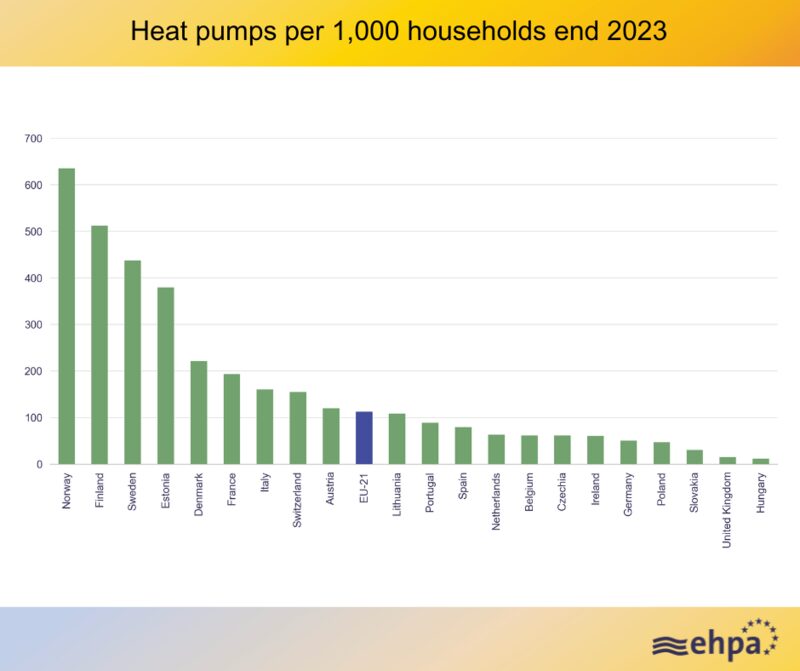
The Heat Pump Association publishes resources including a blog on the potential of heat pumps in commercial and industrial settings, published on 17 September 202630. The European Heat Pump Association published market data on 20 August 2026 showing that over half of households in Norway, Finland and Sweden own heat pumps, that around 2.9 million domestic heat pumps were sold across 21 European countries in 2025, and that sales grew in 14 of 18 countries analysed30. Solar Heat Europe published its Solar Thermal Market Outlook in September 2026 and made it available free on its website30.
The ONS also publishes its own dataset on heat pumps used in central heating of dwellings in England and Wales, maintained by the Housing Analysis team29. That sits alongside the MCS-derived deployment statistics rather than replacing them, and the two answer different questions: one describes the housing stock, the other describes certified installations.
Trade association data carries a different weight from official statistics. It is usually the most current view of a market, because associations survey their members faster than government releases statistics, but it is also published by bodies representing the industries concerned. Where an official figure exists on the same point, the official figure is the one to use.
Scheme and policy data to watch: Boiler Upgrade Scheme, SAP replacement and sector growth plans

The Boiler Upgrade Scheme is the most closely tracked household scheme, and its data has a clear publisher chain. The statistics are a statistical release on capital grant uptake to support the installations of low carbon technologies in domestic and non-domestic buildings5, sourced from Ofgem and the MCS Installation Database2. The dataset was updated on 27 August 20266, and the scheme's territorial extent is England and Wales6.
The scheme's budget history is published in the installer guidance. The 2022 to 2023 financial year budget is given as £150m11.
Policy questions about the scheme, including eligibility criteria, go to DESNZ at boilerupgradescheme@energysecurity.gov.uk11. Ofgem publishes separate guidance for property owners13 and a dedicated Boiler Upgrade Scheme page15.
Two other developments are worth watching. The Standard Assessment Procedure is planned to be replaced by the Home Energy Model in 202730. And the Electricity Networks Sector Growth Plan, led by BEAMA and the Energy Networks Association, was due for publication on 8 September 202630. BEAMA's own market data recorded Heating and Ventilation members' optimism falling to a -50% balance in the first quarter of 2026 as strong autumn and winter 2025 sales flattened out30.
Choosing the right source for your question
The right publisher depends on the question, and matching them saves time.
For consumption and sector totals, use DESNZ. Energy consumption in the UK 2025 is accredited official statistics covering the industry, transport, domestic and services sectors1, and UK energy in brief 2026 summarises the key annual statistics10. For local electricity consumption, the DESNZ indicator covers Great Britain on a February to January basis4.
For renewables uptake, use MCS-derived data. Heat pump deployment statistics cite the MCS Installation Database3, and battery installation statistics are sourced from the MCS database16. For scheme uptake, use the Boiler Upgrade Scheme statistics, sourced from Ofgem and the MCS Installation Database2.
For fuel poverty, use the DESNZ-sourced England indicator, which is modelled from the English Housing Survey7. For supplier service ratings and consumer advice in England and Wales, use Citizens Advice22. For Northern Ireland advice, use NI Energy Advice and the Consumer Council NI27.
For installer and certificate problems, MCS is the contact for issues with the installation process, the installer, or the MCS certificate or product8. Its general telephone number is 0333 103 8130, and routine post-installation verification on behalf of Ofgem is handled on 0333 103 819813. Property owners contacted for MCS checks should aim to respond within seven days12. For MCS certified installations, a complaint must be made no more than two years after the date that the system was commissioned8.
For disputes with a supplier rather than an installer, Facilitated Complaints Resolution covers disputes against a participating energy supplier, energy broker or heat network23.
Sources30 cited
- Energy consumption in the UK 2025, GOV.UK, 2025-09-25
- Boiler Upgrade Scheme BUS Statistics July 2026, GOV.UK, 2026-08-27
- Heat pump deployment quarterly statistics United Kingdom 2026 Q1, GOV.UK, 2026-06-11
- Domestic electricity consumption indicator, ONS, 2025-12-18
- Boiler Upgrade Scheme statistics July 2026, GOV.UK, 2026-08-27
- Boiler Upgrade Scheme statistics dataset, data.gov.uk, 2026-08-27
- Fuel poverty indicator, ONS, 2026-09-20
- Who to contact, Ofgem, 2026-09-17
- Home Renewables Scotland, Energy Saving Trust, 2026-02-19
- UK energy in brief 2026, GOV.UK, 2026-07-30
- Boiler Upgrade Scheme guidance for installers V5, Ofgem, 2026-04-28
- Boiler Upgrade Scheme guidance for installers v5.1, Ofgem, 2026-07-02
- Boiler Upgrade Scheme guidance for property owners, Ofgem, 2026-03-25
- Getting help if you can't afford your energy bills, Ofgem, 2026-09-17
- Boiler Upgrade Scheme, Ofgem, 2026-09-17
- MCS domestic retrofit battery installations 2025 2026, GOV.UK, 2026-05-28
- MCS certified domestic battery installation statistics, GOV.UK, 2025-05-29
- FOI 202500462873, Scottish Government, 2025-07-22
- Warm Homes statistics methodology and background note, GOV.UK, 2026-08-27
- Home energy information, advice and guidance, GOV.UK, 2026-03-11
- CFP report on the heat pump transition, GOV.UK, 2026-05
- Consumer protection rights, GOV.UK, 2026-09-17
- Facilitated Complaints Resolution, Energy Ombudsman, 2026-09-20
- Worried about your energy bills, Energy Ombudsman, 2026-03-24
- Getting help with your energy bills, Birmingham City Council, 2026-06-24
- Energy efficiency tips, nidirect, 2026-09-17
- Low carbon heating, nidirect, 2026-09-17
- Energy saving grants in your area, nidirect, 2026-09-17
- Heat pumps used in central heating, England and Wales, ONS, 2025-10-28
- UK homes unfit for the challenges of climate change, Climate Change Committee, 2019-02-21
 The Full Statistics GuideHow many homes in the UK have solar panels, heat pumps or batteries?
 Official Energy StatisticsWhere can you find the government's official figures on UK energy prices and how much gas and electricity the country uses?
 Who Owns Which Energy SupplierWho is actually behind the company that sends your energy bill?
 Energy Debt and ArrearsHow much do households in the UK owe their energy supplier, and how many people are behind on their bills?
 The Full Energy Suppliers GuideWho the UK's domestic gas and electricity suppliers are, how the market is structured across Great Britain and Northern Ireland, what a supplier is licensed and obliged to do, how the price cap limits bills, what happens when a supplier fails, and who regulates it all.
 Paid and Restricted Energy DataWhere can you actually read the numbers behind a news story about heat pumps or solar?