
In this guide
As of 1 July 2026 there were 97,266 public charging devices and 121,171 public EV chargers in the United Kingdom, according to the government's quarterly statistics1. The gap between those two numbers is the single most important thing to understand about EV charging data: a device is the physical unit bolted to the ground, while a charger is an individual connector on it. A rapid unit with two cables is one device and two chargers. Government statistics count devices; independent trackers tend to count chargers, which is why the headline totals differ so much between publishers.
Independent statistics put the network at 123,677 EV chargers at the end of August 2026, across 47,810 charging locations2. Of those, 20,730 are rapid or ultra-rapid chargers rated 50kW and above, spread across 7,104 locations3. The network added 13,281 EV chargers during 20252.
For a household, the public network is the fallback, not the foundation. Home charging sits entirely outside these counts, and the data on domestic access is the more telling figure for energy independence: in 2023 there were 1.8 million dwellings in England with access to an EV charge point, of which around 930,000 had one for exclusive use4.
What counts as a device, and why the totals disagree
The definitional split runs through every published figure. Government statistics report devices: 97,266 public charging devices in the UK as of 1 July 20261. Independent trackers report chargers: 121,171 on the same date1, and 123,677 by the end of August 20262. Neither is wrong. They are counting different objects.
The same pattern appears in the mid-2025 data. At 30 June 2025 the network encompassed 82,369 devices, 110,486 EVSEs and 40,479 locations6. EVSE stands for electric vehicle supply equipment, the technical term for a single charging point, so the 110,486 figure sits between the device count and the charger count depending on how multi-cable units are treated.
Government statistics draw their data from Zapmap, the electric vehicle and charging point platform, and the figures are correct as at the publication date5. That means the official quarterly release and the independent tracker share a common underlying dataset, which is why their device-level figures align even when their headline numbers do not.
The power rating bandings used in the official statistics are 3kW up to 8kW, 8kW to 49kW, 50kW to 149kW and 150kW and above5. These bands matter more than the total for anyone judging what the network can actually do. As of 1 July 2025, 44,231 devices sat in the lowest band, 3kW up to 8kW, representing 54 per cent of all charging devices, while 16,677 devices were rated 50kW and above, representing 20 per cent5. The network is overwhelmingly slow charging, and the rapid share is the minority that makes long journeys possible.
The figures: growth, speed and location
The official quarterly series gives the cleanest picture of growth. Between 1 July 2024 and 1 July 2025 the UK added 17,370 public charging devices, an increase of 27 per cent, and between 1 April 2025 and 1 July 2025 it added 5,495 devices, an increase of 7 per cent5. Those rates describe a network expanding steadily rather than explosively.
The speed mix as of 1 July 2025 was heavily weighted to slow charging. Devices rated 8kW to 49kW represented 26 per cent of charging devices, those rated 50kW to 149kW represented 10 per cent, and the highest band, 150kW and above, accounted for 11 per cent5. Adding the two rapid bands gives roughly a fifth of the network at 50kW or above, consistent with the 20 per cent share recorded for that threshold.
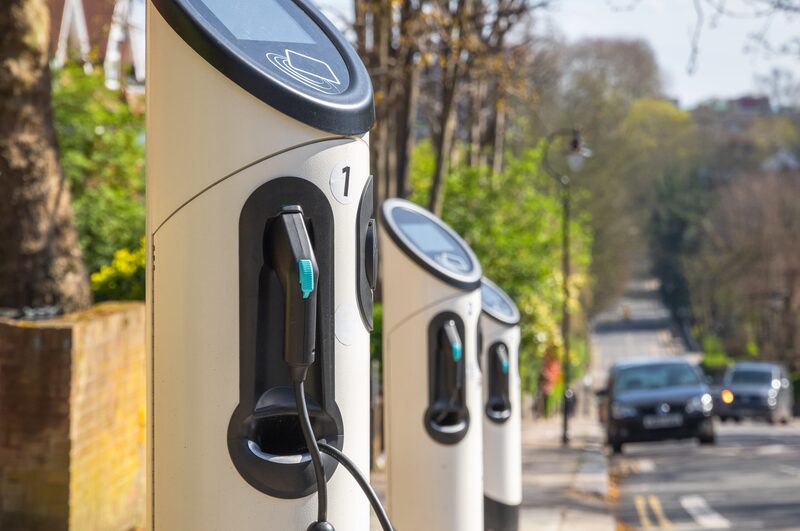
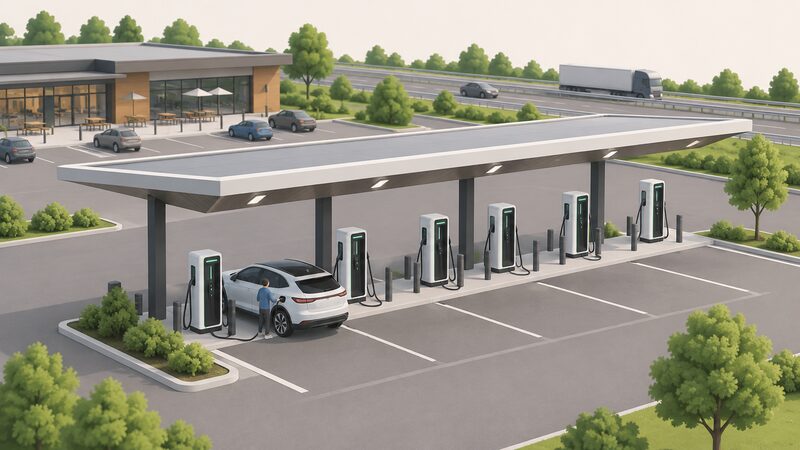
By location type, 40,109 devices were designated as destination chargers, 49 per cent of the total, 30,169 were on-street, 37 per cent, 7,803 were en route and 3,921 fell into the other category5. The official definitions are precise: on-street devices are located on residential streets only; en route devices sit in motorway service areas, service stations, electric forecourts and ferry terminals, plus 50kW and above devices at hotels and restaurants; destination devices sit in retail car parks, car parks, leisure, education and transport locations, plus devices rated 49kW and below at hotels and restaurants; and other devices are semi-public with access restrictions, such as workplace car parks and dealership forecourts5.
| Location type | Devices, 1 July 2025 | Share |
|---|---|---|
| Destination | 40,109 | 49% |
| On street | 30,169 | 37% |
| En route | 7,803 | not given |
| Other | 3,921 | not given |
The independent tracker divides the network differently, into en-route, destination and on-street charging, and records 41,054 EV chargers in the on-street category as of August 20262. It also counts 1,069 charging hubs across the UK open to all EVs3. Hubs matter because they concentrate multiple high-power units at one site, which changes the experience of a journey stop even when the national device total barely moves.
What drives the numbers
Three forces shape the totals: the size of the electric vehicle fleet, the investment committed by charge point operators, and the planning rules that require charge points in new buildings.
The fleet is the demand side. ChargeUK, the industry body, reported in July 2024 that over 930,000 public, home and work chargers were supporting 1.1 million fully electric vehicles, and that the network could deliver nearly seven gigawatts of power every day7. The same release noted that ChargeUK members were providing infrastructure that more than a million EV drivers relied on7. The ratio of chargers to cars is the measure that matters for congestion at peak times.
The supply side is concentrated. ChargeUK members operate around 70,000 charge points, or more than two thirds of the UK's public EV charging infrastructure, and have committed to invest over £6 billion in private capital into EV charging by 20308. The association has doubled its membership in the last 12 months and now represents 40 companies involved in installing, operating and supporting charge point infrastructure9. That concentration means a handful of operators' investment decisions move the national figures.
"The ZEV mandate has underpinned the rollout of 120,000 public chargers to date"
Planning rules add supply independently of the market. The requirement for EV charge points in new buildings was expected to add up to 145,000 extra charge points each year across England following implementation11. That measure applies in England only, which is one reason the nations diverge.
Cost pressure is the counterweight. ChargeUK reported that the charging sector's energy bills increased by up to 79 per cent since 2021, with parts of operators' bills rising fourfold in just four years12. Its three-point plan calls for action on operators' high energy costs, the addition of EV charging to the Renewable Transport Fuel Obligation, and a reduction of VAT on public charging to 5 per cent12. Those costs feed directly into the price a household pays at a public device, which is covered in more detail in the public EV charging price data.
How the network differs across the UK nations
The regional split is stark, and it is measured per head of population rather than in raw totals, which is the only fair comparison given how unevenly population and vehicle ownership are distributed.
As of 1 July 2025, London had 275.4 public charging devices per 100,000 population, Scotland 130.8, the UK as a whole 121.3, Wales 112.4 and Northern Ireland 35.85. On higher-power devices rated 50kW and above, Scotland led with 37.5 per 100,000 population, against a UK figure of 24.7, Wales at 24.0, London at 16.1 and Northern Ireland at 9.85. Scotland's advantage in rapid charging is long standing: Ofgem noted in 2021 that the public charging experience was significantly different in Scotland to the rest of Britain, with a greater variety of charge point operators and processes in Great Britain outside Scotland13.
| Nation or region | Devices per 100,000 | 50kW and above per 100,000 |
|---|---|---|
| London | 275.4 | 16.1 |
| Scotland | 130.8 | 37.5 |
| United Kingdom | 121.3 | 24.7 |
| Wales | 112.4 | 24.0 |
| Northern Ireland | 35.8 | 9.8 |
Quarterly change varies too. Between 1 April and 1 July 2025, Yorkshire and the Humber had the greatest percentage increase in total devices at 12.8 per cent, London had the greatest increase in absolute number at 1,135 devices, and Northern Ireland had the smallest increase at 1.8 per cent5. On devices rated 50kW and above, the North West had the largest percentage increase at 12.2 per cent, an increase of 199 devices, while Northern Ireland recorded a decrease of 1.1 per cent5.
Within England, charging is overwhelmingly urban. As of 1 July 2025, 84.4 per cent of public charging devices in England were in an urban setting, with urban major conurbation accounting for 47.6 per cent of all devices and rural village and dispersed accounting for 7.8 per cent5. That distribution is the opposite of where off-street parking is most plentiful, and it explains why on-street charging dominates the policy debate.
The rapid build-out has shifted decisively away from the capital. In the 24 months to the end of April 2026, 7,598 rapid and ultra-rapid EV charge points were added to the public network, with 7,044 of them, or 93 per cent, in areas outside London14. Including standard charge points, 32,471 charge points or charging devices were added over the same period, of which 23,639 were outside London14. At the end of April 2026 there were 92,141 charge points in total and 120,388 EV chargers14.
The rules that shape the count
Several regulatory threads determine what gets built and what gets counted.
The charge point requirement for new buildings applies in England and was expected to add up to 145,000 extra charge points each year following implementation11. The measure does not extend to Scotland, Wales or Northern Ireland, so the new-build contribution to the national total is an England-only effect.
Consumer connectable product security regulations, which came into force in 2024, explicitly exclude charge points for electric vehicles15. The security requirements that apply to smart speakers, cameras and similar connected devices therefore do not cover EV charging equipment under that regime, a gap that matters as more charge points connect to home networks.
Public funding has supported on-street provision. The On-Street Residential Chargepoint Scheme installed 5,676 public charging devices across local authorities in the 12 months to 1 July 202616. That scheme targets exactly the households the private market struggles to serve: those without off-street parking.
The government's market study set out the scale of the task in 2021, estimating that an additional 280,000 to 480,000 public EV chargepoints would need to be installed by 2030 to meet anticipated demand17. The EV Infrastructure Strategy that followed forecast that the UK would require between 280,000 and 720,000 chargepoints by 203018. A separate SMMT account of the same strategy gives the range as between 300,000 and 720,00019.
What the network means for household energy independence
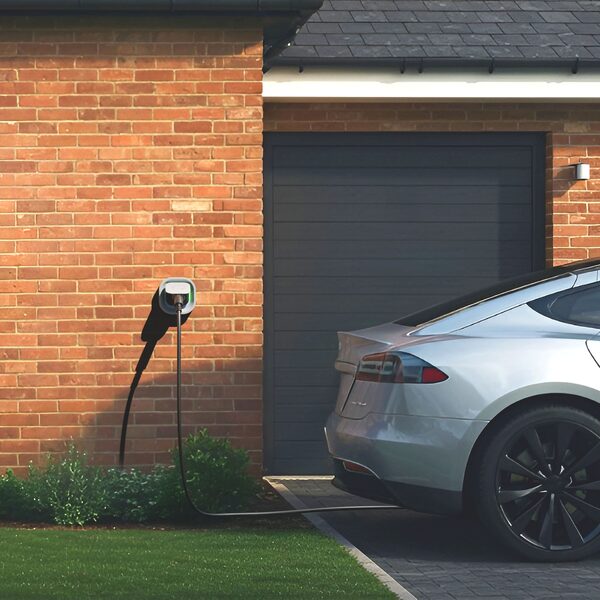
The public charging network is shared infrastructure, and a household that relies on it depends on an operator, a payment system and a grid connection it does not control. Home charging is the opposite: it puts the energy transaction inside the home, on the household's own supply, and it is the reason domestic charge point access is the more consequential statistic.
The English Housing Survey found that in 2023 there were 1.8 million dwellings in England with access to an EV charge point, of which around 930,000 had access to one for exclusive use4. Exclusive use is the figure that matters for independence: a shared or communal charge point still leaves the household queuing and paying someone else.
The gap between the two numbers, 1.8 million with access against 930,000 with exclusive use, is a plain difference of the two published figures, and it describes households whose charging depends on a landlord, a management company or a local authority rather than on their own supply.
SMMT modelling suggests there could be 5.85 million home chargers in the UK by 203020. The same modelling sets out three scenarios for the public network, and the range is enormous. Under a scenario where on-street residential charging dominates, 2,333,837 public chargers would be required by 2030, including 1,945,671 on-street chargers, at a cost of £17,603,794,430 for the public chargers alone20. Under a forecourt and hub dominated scenario, 688,877 public chargers would be required, including 315,001 on-street, at a cost of £13,647,803,51920. Under a workplace and destination dominated scenario, 937,532 public chargers would be required, including 105,468 on-street, at a cost of £13,647,803,519 for the public element20.
| Scenario | Public chargers required by 2030 | On-street chargers | Cost of public chargers |
|---|---|---|---|
| On-street residential dominant | 2,333,837 | 1,945,671 | £17,603,794,430 |
| Forecourt and hub dominant | 688,877 | 315,001 | £13,647,803,519 |
| Workplace and destination dominant | 937,532 | 105,468 | £13,647,803,519 |
The scenario choice is not academic for a household. The on-street dominant scenario implies a dwellings-to-on-street-charger ratio of 7:1; the forecourt scenario implies 43:1; the workplace scenario implies 129:120. A household without a driveway is betting on which of those futures arrives.
Other estimates of the 2030 requirement span an even wider range. SMMT's own modelling puts the requirement at between 689,000 and 2.33 million public chargepoints20. The Climate Change Committee estimate is 280,000, the International Council on Clean Transportation estimate is 430,000, Transport and Environment puts it at 480,000, and a study backed by the Renewable Energy Association reaches up to three million20. The EV Energy Taskforce's early findings suggested up to 700,000 non-home chargepoints could be needed20. These are modelled projections, not commitments, and the spread reflects genuinely different assumptions about how people will charge.
The dependence that remains is structural. A household charging at home still depends on a supplier, a distribution network and, for most, a gas-fired grid at peak. A household charging publicly depends on all of that plus an operator's pricing, which ChargeUK has argued is distorted by energy costs and the VAT treatment of public charging12. The network's growth is real and measurable; the independence it delivers to any individual household depends on whether the charge point is on their own wall.
Sources20 cited
- Public electric vehicle charging infrastructure statistics, 1 July 2026, GOV.UK, 2026
- EV charging statistics, Zapmap, 2026
- EV charging statistics, Zapmap, 2026
- English Housing Survey 2023 to 2024: low carbon technologies in English homes fact sheet, GOV.UK, 2024
- Electric vehicle public charging infrastructure statistics, July 2025, GOV.UK, 2025
- Zapmap statistics for H1 2025, Zapmap, 2025
- EV charging network can deliver half a billion miles of motoring every day, ChargeUK, 2024
- ChargeUK responds to EU changes to automotive emissions targets, ChargeUK, 2025
- ChargeUK launches Our Electric Future manifesto, ChargeUK, 2026
- ChargeUK responds to review of the ZEV mandate, ChargeUK, 2026
- REA welcomes EV charger requirement for new buildings from 2022, REA, 2021
- Action on high energy costs needed to keep EV transition on track, ChargeUK, 2025
- EV public charging: phase 1 publication, Ofgem, 2021
- Over nine in 10 rapid EV charge points built outside London in last two years, ChargeUK, 2026
- Regulations: consumer connectable product security, GOV.UK, 2024
- Grant schemes for electric vehicle charging infrastructure statistics, 1 July 2026, GOV.UK, 2026
- Electric vehicle charging market study: final report, GOV.UK, 2021
- A full scale recovery requires a fully charged future, SMMT, 2023
- Chip crisis subdues new car market but EVs now second only to petrol, SMMT, 2023
- SMMT EV infrastructure position paper, SMMT, 2024
 Public EV Charging PricesCovers the published price series for public charging, how per-kWh rates differ by network and speed, and how they have moved over the past year.
 Electric Vehicle RegistrationsNew car registration data showing the share of UK sales that are battery electric and plug-in, how that share has changed by year, and what the monthly reporting cycle means for home charging demand.
 EV Charging Speeds and TimesHow long an electric car takes to charge depends on the charger and the car together, so a faster charge point will not always speed things up.
 Electric Vehicle TariffsCharging an electric car at home can cost far less overnight, but only on special electricity plans.
 Charging With a Home BatteryHow a home battery and an EV charger share one supply, whether a battery can usefully charge a car, and how combined systems are controlled so the battery is not discharged into the vehicle at a loss.
 V2G and V2H ChargingCan your electric car earn money by sending power back to your home or the grid?