
In this answer
Short answer
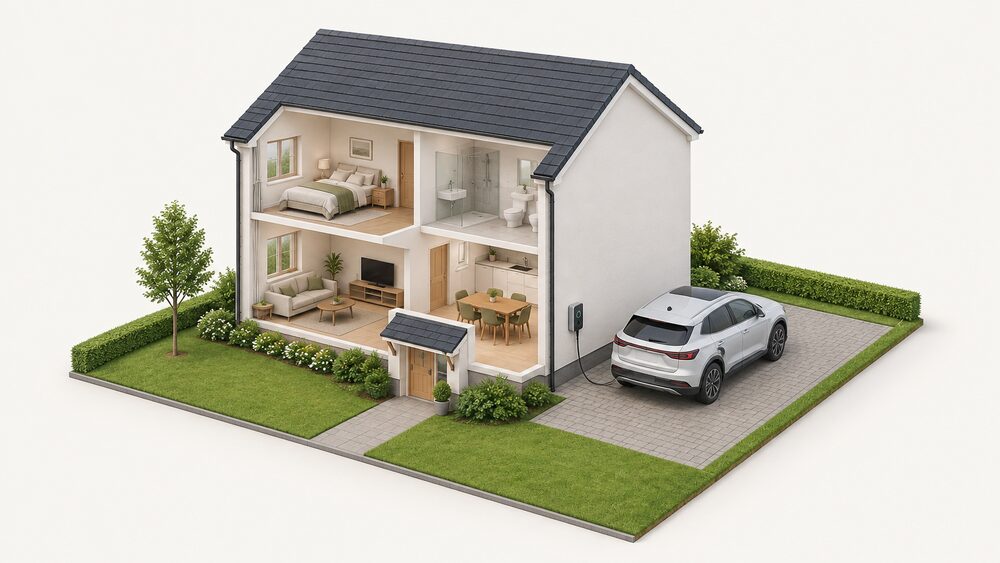
Yes, in principle: a car battery can supply a house, and the technology that does it is called vehicle-to-home, or V2H. In practice it is not yet a mainstream UK option. Independent guidance states that bidirectional charging, which lets an EV either draw or supply power to your home or the grid, is currently being trialled in some places but is not widely available1.
The distinction matters because the question usually means one of two things. Vehicle-to-grid (V2G) allows an electric vehicle charger to not only charge a vehicle, but also take energy from the vehicle, and V2G sends that electricity back to the grid when needed, generating cash for the EV owner3. V2H uses the same two-way hardware but keeps the energy at home, powering the house rather than delivering it back to the network4.
What a household gets from V2H is a second battery, already parked on the drive. What it does not get is independence from the grid, a supplier or a manufacturer's software. The car has to be bidirectional compatible, the charger has to be bidirectional compatible, and the installation has to be able to take the extra load5.
What vehicle-to-house actually means, and which cars can do it
Vehicle-to-house is one branch of a family of technologies usually grouped as V2X. Official guidance defines V2X as allowing electric vehicles to operate bidirectionally, charging from the electricity grid but also discharging to the grid, building or home as needed10. Within that, V2H is the domestic case: the energy powers a home rather than being delivered back to the grid4.
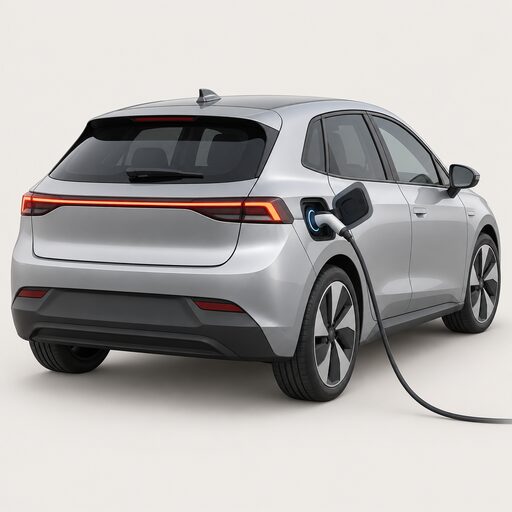
The car side of the equation is the constraint. Bidirectional capability is a property of the vehicle's onboard equipment, and it is not universal. Independent guidance is explicit that your EV and EV charger will need to be bidirectional charging compatible, which means a household cannot assume that any electric car will do it5. The same guidance describes bidirectional charging as allowing EVs to power your home or export energy to the grid, and notes it provides backup power during outages11.
For a household trying to work out whether their car qualifies, the practical answer is that the maker's specification for the exact model is the only reliable source, and that UK availability of the matching home hardware is still limited. The technology is real and demonstrated; the retail route to it is not yet settled.
There is a second, smaller version of the idea that is more widely fitted. A vehicle-to-load socket, sometimes a three-pin outlet in the car, can run a laptop or a power tool. It is not a house supply, and it is not wired into the home's circuits.
Bidirectional charging: how power flows from car to house

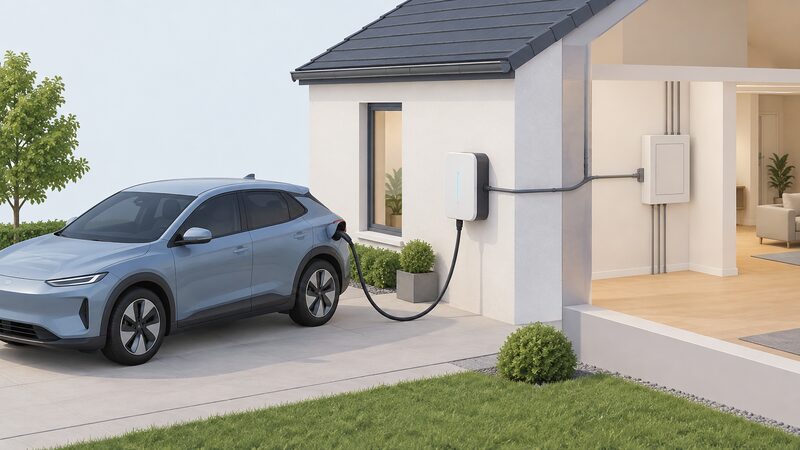
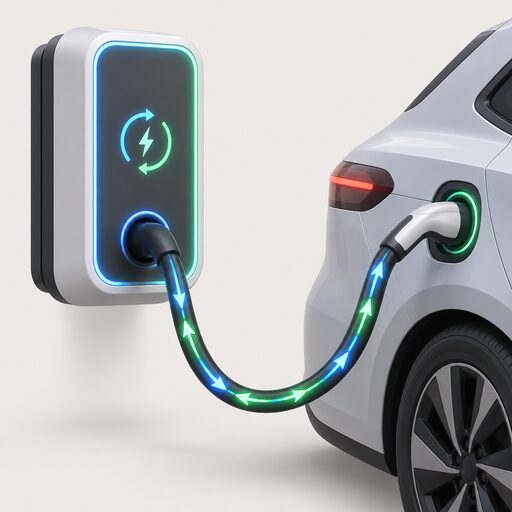
A conventional home charger is a one-way device. Power comes from the grid, through the charger, into the battery. A bidirectional charger adds the reverse path: it can take energy out of the vehicle and put it into the house or the network3.
The Energy Saving Trust describes the potential in terms of a two-way movement of energy, with energy stored in the car battery used in the home or sold back to the grid at times of peak demand12. That is the commercial logic as well as the technical one. A car sits idle for most of the day, and a stationary battery that can be called on at peak times has value to the network as well as to the household.
The flow is not uncontrolled. A V2H system has to decide when the car charges, when it discharges, and how much it is allowed to give up. That decision-making sits in the charger and its software, which is why the charger, not just the car, has to be bidirectional compatible5.
"Vehicle-to-grid technology (V2G) allows an electric vehicle (EV) charger to not only charge a vehicle, but also take energy from the vehicle"
For a household, the independence question is straightforward. V2H reduces reliance on the grid at particular moments, and it can cover an outage. It does not remove the grid connection, the electricity supplier or the need for a charger that a manufacturer supports with firmware and an app.
How much of a house a car battery can run, and for how long
No household consumption figure is given here, so no run-time can be calculated. What is given is the size of the resource in driving terms, which is the way most owners think about it.
Most battery electric cars have a real-world range of about 220 miles on a full charge6. A battery-only vehicle can be expected to deliver about 100 to 200 miles of driving from a single charge, and a plug-in hybrid's battery fuels the car for up to 70 miles7. Those figures describe the battery's capacity in motion, not in the home.
Two things follow. First, the car battery is large relative to a typical home's evening demand, which is why the technology attracts interest. Second, every kilowatt-hour the house takes is a mile the car does not travel. A household using V2H for backup or peak shifting is trading range for resilience, and the trade is deliberate.
The battery itself is durable by design. Most electric car batteries are guaranteed by manufacturers to last for eight years or around 100,000 miles7. Even when a battery is no longer suitable for use in a car, it can be repurposed as a home energy storage system to store cheaper off-peak electricity or solar energy13. That second-life path is a separate proposition from V2H, but it shows the same pack being treated as a domestic asset.
What you need besides the car: charger, hardware and grid connection
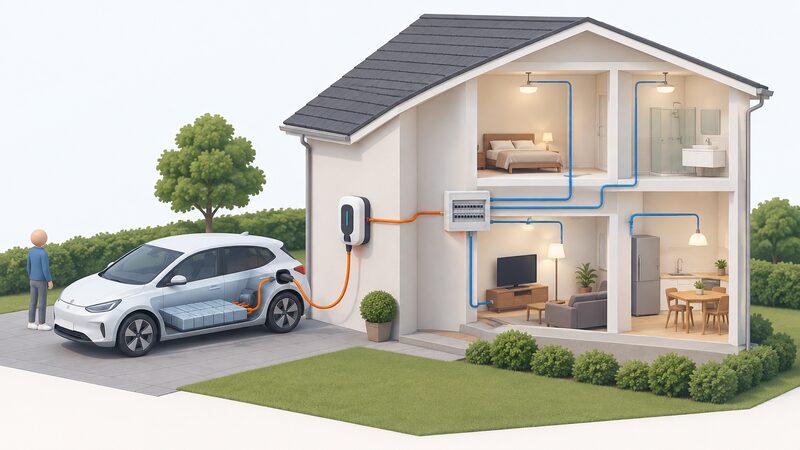
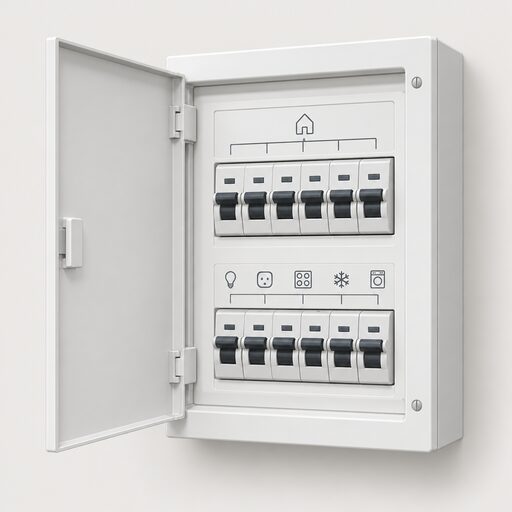
The car is the smallest part of the problem. A working V2H setup needs a bidirectional charger, an installation that can carry the load, and a network connection that can accept it.
Start with the electrical capacity. EV chargers and other low-carbon technologies can push a home's electricity demand above the available supply, which may require an upgrade14. Where that happens, the distribution network operator runs an adding-more-power process. Installing low carbon technology such as an electric vehicle charger or heat pump is one of the stated reasons for applying15. The same principle applies in Northern Ireland, where a supply that cannot cope with new equipment is a recognised connection issue16.
Then there is the charger itself. Almost all electric cars come from the manufacturer with a cable with a charger-side Type 2 connector, so the vehicle end of the connection is standard17. The house end is where the variation sits, and a bidirectional unit is a different product from a standard wallbox.
Planning is usually the least of it. If your home has off-street parking it is likely the installation of a domestic electric vehicle charger will fall under permitted development, with no application required, provided it meets the criteria18. Installing a home charger is classified as development, so it is up to the householder to ensure the correct permissions are in place19.
V2H and solar: charging and discharging around the sun
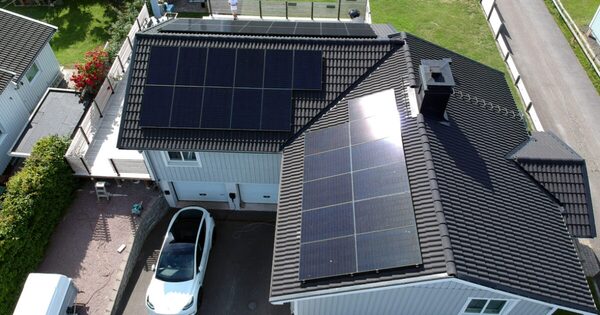
Pairing a car battery with solar is the combination that makes V2H most interesting to a household, because it turns the car into storage for generation the home cannot use at the moment it is produced.
Solar can charge an electric car, though solar power alone is unlikely to be relied on year-round in the UK, especially in winter21. Home generation can be used to power electrical appliances, or even your electric vehicle22. The car becomes a destination for surplus midday output that would otherwise be exported.
The carbon case has been modelled. Storing generation from a 4 kWp domestic solar PV system with an EV battery over a weekend with 6 hours of sun per day can save over 600 kgCO₂e per year23. That figure is a modelled estimate for a specific scenario, not a guarantee, and it depends on the system size and the weather.
The economics of two-way operation have also been modelled. A 7kW V2G charger could be capable of achieving annual revenues of around £436 above smart charging, in a high plug-in rate scenario where the car is connected 75% of the time24. That is a modelled revenue potential for V2G, not a V2H saving, and it depends on tariff and behaviour.
For energy independence, the solar-plus-V2H combination is the strongest version of the idea: generation on the roof, storage on the drive, and less bought from a supplier. The dependence that remains is the grid for winter and for the days the car is away.
Grants, VAT and the cost of setting up V2H in the UK
There is no grant specific to V2H. What exists is grant funding for home chargepoints, which is the hardware a V2H setup would build on.
The UK Government grant offers up to £350 per socket for residential landlords, people living in flats and people who rent25. Landlords and flat tenants are eligible for a government grant of up to £350 for home EV chargers, which can reduce the installation cost to as low as £6509. If you live in rental accommodation or own a flat in the UK, the government's EV charge point grant provides grant funding26.
| Scheme | Who it is for | Value | Condition |
|---|---|---|---|
| EV chargepoint grant for renters and flat owners | Renters and flat owners | Up to £350 per socket25 | Vehicle must be on the OZEV-approved list27 |
| EV chargepoint grant for residential landlords | Landlords | Up to £350 per socket25 | Cannot apply if you live in the property28 |
| Households with on-street parking | Homes without off-street parking | Grant towards a chargepoint | Must install a cross-pavement solution alongside29 |
The landlord scheme has firm exclusions. You cannot apply if you live in the property, if the property is not a residential property, if a chargepoint was already installed before OZEV confirms eligibility, if the property is only used for holiday accommodation, if you have no company registration number or VAT registration number, or if you are installing because of a mandatory requirement28. Each parking space must be off-street, private and clearly defined, accessible to your tenant, and owned by you or one you have the legal right to use28.
The on-street scheme has its own conditions: the applicant must not have already installed the chargepoint, must own or rent the home they live in, must install a non-temporary cross-pavement charging solution alongside the chargepoint, must not have private and exclusive access to off-street parking, must have adequate on-street parking, must have permission from the local highways authority, and must own or be responsible for an eligible vehicle29. Northern Ireland runs its own chargepoint and infrastructure grant arrangements30.
On tax, home charging carries just 5% VAT8. Public charging has generally been treated differently, though a First-tier Tribunal ruling in February 2026 held that public EV charging can qualify for the reduced 5% rate where supply at a single location to an individual customer does not exceed 1,000kWh per month. That case concerns public networks rather than domestic V2H.
On payment, at least one charger maker has enabled paying for an EV charger in instalments through PayPal, announced in May 2026. Prices for bidirectional hardware are installer-quoted, and no published UK figure for a V2H charger appears in the material behind this page.
Where V2H falls short
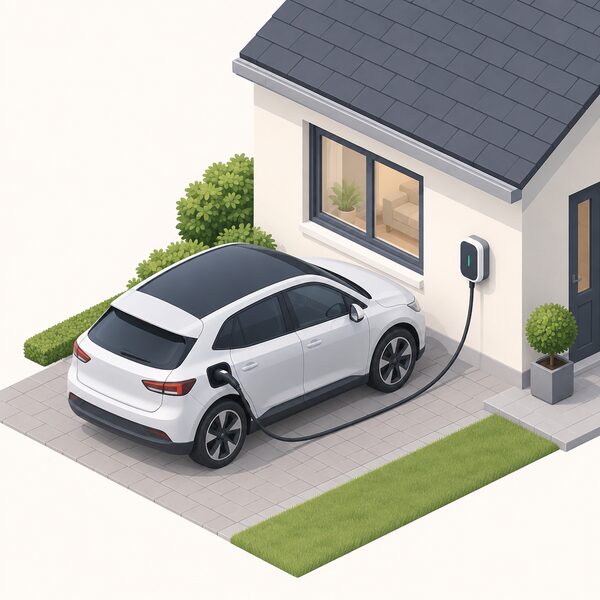
The limits are worth stating as plainly as the benefits. Bidirectional charging is being trialled in some places but is not widely available, so a household cannot currently buy a settled, supported V2H package in the way it can buy a standard home charger1. The car and the charger both have to be compatible, which narrows the field twice over5.
The car has to be at home to help. A V2H system cannot supply the house while the vehicle is at work, and the reserve kept back for driving reduces what is available to the home. The battery is also the household's transport, so leaning on it for backup means accepting that the two uses compete.
Finally, the independence on offer is partial. V2H can cover an outage and shift when power is drawn, and official guidance notes that further innovation in home battery technology, V2X and solar can provide households with additional backup options during power outages10. It does not remove the grid connection, the supplier relationship, or the manufacturer's control of the charger's software.
Sources30 cited
- Battery storage, Energy Saving Trust, 2026-08-19
- Battery storage (England), Energy Saving Trust, 2026-08-19
- Vehicle-to-grid best practice guide, Energy Saving Trust, 2026-05-05
- LCT strategy, Energy Networks Association, 2026-09-17
- Battery storage, Centre for Sustainable Energy, 2025-10
- Debunking myths, Energy Saving Trust, 2025-09-22
- Electric cars and energy bills, Uswitch, 2026-04-27
- EVs: the facts, SMMT, 2025-09-22
- EV charging statistics, Uswitch, 2025-12-15
- Well-adapted energy system, Climate Change Committee, 2026-09-19
- Integrating solar panels with EV charging, Uswitch, 2025-07-02
- Smart homes, Energy Saving Trust, 2026-01-21
- Electric car battery guide, Power NI, 2026-04-10
- If your electricity supply can't cope, NIE Networks, 2026-09-19
- Adding more power, UK Power Networks, 2026-09-17
- EV chargepoint and infrastructure grants, Department for Infrastructure Northern Ireland
- Tethered vs untethered, Zapmap, 2026-02-23
- Planning permission, Planning Portal, 2026
- Planning permission for EV charging, Planning Portal, 2026
- Agile streets, Energy Saving Trust, 2025-10-03
- Can solar panels charge electric cars?, The CPA, 2026-04-15
- Generating renewable electricity, Energy Saving Trust, 2025-12-11
- More than money, Cenex, 2026-09-17
- V2GB, Cenex, 2026-09-17
- Charging electric vehicles, Energy Saving Trust, 2026-04-23
- EV for home charging, Electricity North West, 2026-09-19
- EV chargepoint grant eligibility, GOV.UK, 2026-09-17
- Grant for landlords, Find a Grant, 2026-09-18
- Grant for households with on-street parking, Find a Grant, 2026-09-18
- EV chargepoint grant, GOV.UK, 2026-09-17
 Electric Vehicle TariffsCharging an electric car at home can cost far less overnight, but only on special electricity plans.
 Charging and Energy IndependenceCharging an electric car at home can cut your fuel costs, but how much does it really free you from the grid?
 Vehicle-to-Home and LoadCan an electric car really power your house, and which cars can do it?
 V2G and V2H ChargingCan your electric car earn money by sending power back to your home or the grid?
 The Full EV Charging GuideCharging an electric car at home usually means a wallbox, but do you need one, and what will it cost to fit and run?
 The Full New Technology GuideWhich new home energy ideas can you actually buy in the UK right now, and which are still stuck in trials?