In this guide
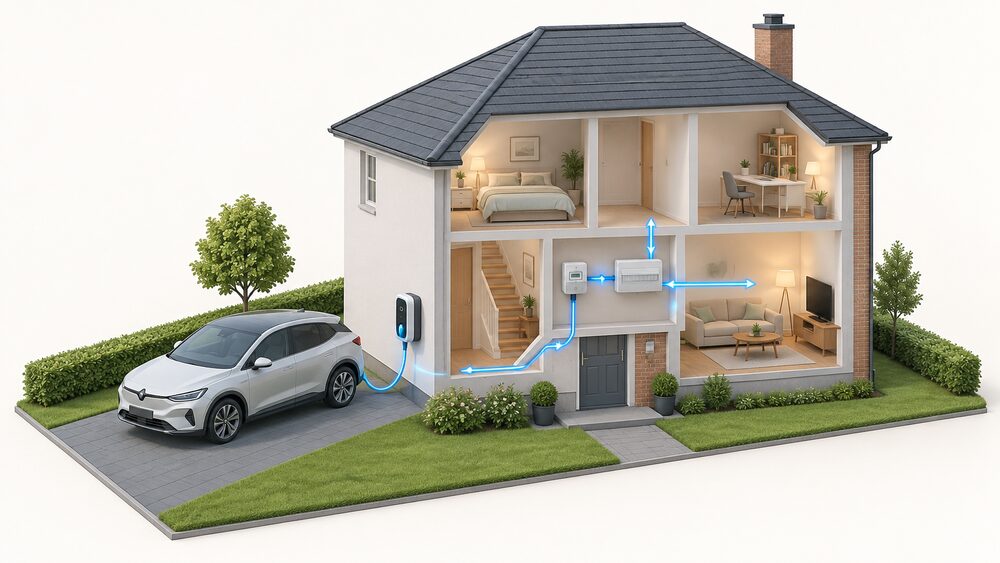
Vehicle-to-home (V2H) uses the battery in an electric car to supply the house it is parked at, behind the meter, through a bidirectional charger. Vehicle-to-load (V2L) is simpler: a socket on or in the vehicle that runs an appliance or a tool directly, with no wiring work at the property. Both sit inside the wider family known as V2X, which "allows for electric vehicles to operate bidirectionally, charging from the electricity grid but also discharging to the grid, building or home as needed"1. Vehicle-to-grid (V2G) is the third member, sending energy back into the public network rather than into the house.
For a UK household the practical position in 2026 is that the idea is proven and the products are not yet ordinary. Bidirectional charging, which lets an electric vehicle either draw or supply power to a home or the grid, is "currently being trialled in some places but isn't widely available"2. V2G remains restricted by eligibility: a smart meter, a compatible V2G charger and a car that supports the technology3. One assessment of commercial readiness put mass rollout in the UK between 2030 and 20354. What is already large is the resource sitting on driveways: around 19 million UK households could benefit from home charging if they had a charge point5, and 90% of electric car charging is already done at home, on a 2025 government survey6.
The energy-independence case is real but bounded. A 40 kWh Nissan Leaf holds more usable energy than most fitted home batteries, and V2H "can provide backup power from your EV to your home during power outages and support off-grid setups"3. The dependencies that remain are substantial: the car must be at home and charged, the charger must be compatible, the smart meter and supplier arrangements sit with a commercial party, and the discharge rate is capped by the hardware, not by the battery's size.
What vehicle-to-home and vehicle-to-load actually mean
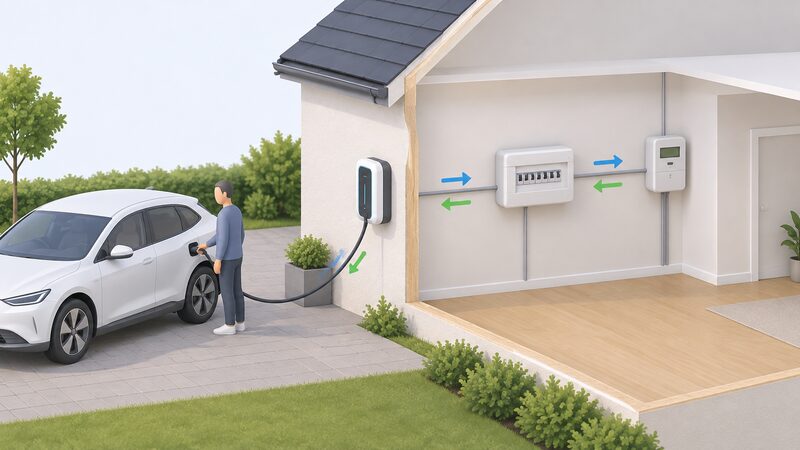
V2H reverses the normal flow at the charge point. The charger "allows an electric vehicle (EV) charger to not only charge a vehicle, but also take energy from the vehicle"12, and that energy is then used inside the property rather than sold. In a domestic installation, a car can "power a house with energy flowing both to and from the vehicle", turning the vehicle into a store for the building13. Early demonstrations framed the same hardware both ways: vehicles "plug into this unit to provide both charging for the vehicle and enable it to act as a battery store, either to provide electricity directly to a building or to the National Grid"14.
V2L is a different animal and does not need a bidirectional wallbox at all. The power comes out of the vehicle through its own socket, so the house wiring is untouched and there is no interaction with the meter or the network operator. Nissan's 2026 Ariya update introduces an 11kW bi-directional onboard charger alongside Vehicle-to-Load functionality, which indicates the direction mainstream models are taking. V2L is best understood as portable power for appliances and tools rather than as a way to run a house.
The distinction matters for what each can do. V2H is a whole-property proposition and therefore involves the consumer unit, isolation arrangements and, where export is possible, the distribution network operator. V2L is a plug. Where the household aim is to keep a fridge, a router and some lighting alive in a cut, V2L may suffice. Where the aim is to shift the house onto stored energy at peak times or through a longer outage, that is V2H, and it brings the installation and compatibility burden with it. The related comparison of vehicle-to-grid and vehicle-to-home sets out where the two diverge on value.
V2X: the family of technologies, from V2G to V2L
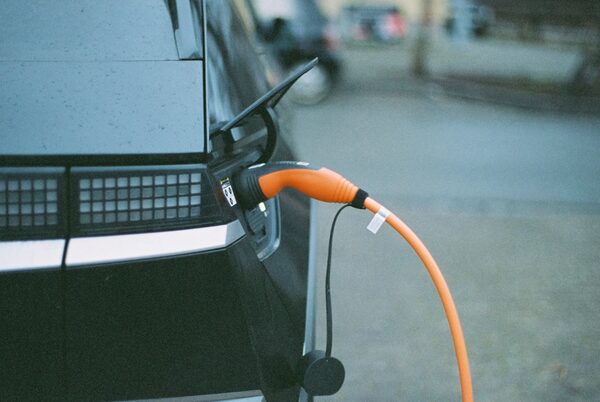
V2X is the umbrella. Within it, V2G "enables energy stored in EVs to be fed back into the electricity network"15, and in doing so "helps reduce peak demand on the electricity network"15. Framed commercially, V2G "allows electric vehicles to not only draw power from the grid to charge their batteries but also to send electricity back to the grid when needed generating cash for the EV owner"16. Official guidance in Wales describes it as "the use of vehicle batteries as storage to help balance supply and demand on the electricity network", applying at scales "from individual batteries up to aggregation of multiple batteries across one or multiple carparks"17.
The boundary between V2G and V2H is often set by the charger's firmware and the supplier contract rather than by the car. One description covers both at once: using the EV battery "to release power back through the charger either for use in the building it's connected to or back into the grid in general"18.
| Term | Where the energy goes | What it typically needs |
|---|---|---|
| V2G | Public electricity network | Smart meter, compatible V2G charger, compatible car3 |
| V2H | The building behind the meter | Bidirectional-compatible EV and charger19 |
| V2L | An appliance plugged into the vehicle | Vehicle with a V2L socket |
"V2X allows for electric vehicles to operate bidirectionally, charging from the electricity grid but also discharging to the grid, building or home as needed"
What you need: a bi-directional charger and a compatible car
Both ends must support the function: "your EV and EV charger will need to be bi directional charging compatible"19. One account sets out three conditions: an electric car, suitable charging infrastructure in the form of public chargers and wallboxes that support bidirectional charging, and a uniform software language between them20. That third condition is the one householders underestimate, because a car and a charger can be individually bidirectional and still not talk to each other.
Connector standards decide a good deal. Of the common connections, "only CHAdeMO currently has a valid protocol for V2G charging in order to feed electricity into the public grid"20, which is why the Leaf has dominated UK V2G work. Ordinary AC charging is a different world: almost all electric cars are supplied with a cable carrying a charger-side Type 2 connector21, and home chargers come either with a tethered Type 1 or Type 2 cable or with a Type 2 socket for use with the vehicle's own cable22. A Type 2 to Type 2 cable is needed for Tesla home and public AC chargers, while Tesla Superchargers use tethered cables23. The minimum needed to charge a car at all is a Mode 2 cable into an ordinary socket, which is very slow24. None of these ordinary arrangements delivers V2H by themselves.
There are physical preconditions too. A home charge point needs a driveway or garage25. Charge points are tested and certified for home and commercial use as separate categories26. For the equipment itself and what it currently costs, see bidirectional chargers; the protocol picture is set out under bidirectional charging standards.
The Nissan Leaf, the car that carried UK V2G
Nissan is the pioneer of this technology, and the Leaf "has been able to charge bidirectionally" for several years20. Common V2G-ready vehicles are listed as the Nissan Leaf and the VW ID Buzz3. The Leaf's rapid charging uses a CHAdeMO connector tethered to the charging unit, with the inlets behind a flap in the centre of what would normally be a car's grille27.
| Nissan Leaf specification | Figure |
|---|---|
| First generation battery | 24 kWh27 |
| First generation update | 30 kWh27 |
| Leaf MkII battery | 40 kWh27 |
| On-board AC charger | 6.6 kW, Type 227 |
| Maximum DC rate | 46 kW28 |
| Rapid DC capability | 50 kW27 |
| Official WLTP range | 168 miles27 |
| Real-world range | 151 miles27 |
| 0 to 100% on a 7 kW home charger | approximately seven hours29 |
| 20 to 80% on a 50 kW DC charger | approximately 43 minutes29 |
Charging speed and range depend on the specific variant, since different models have different battery capacities28. Figures for the 40 kWh Leaf also vary: a real-world range of 160 miles is reported in one account30, against the 151 miles given above, so both are stated here.
The fleet is what makes the Leaf strategically interesting. Nissan sold around 28,000 zero-emission Leafs in the UK between 2010 and 2018, equivalent to about 825 MWh of battery storage capacity8. Earlier official analysis noted that more than 20,000 Nissan EVs in the UK could represent 300 MW of virtual power plant31. Public-sector deployment followed: Leeds City Council, with the biggest electric fleet of any local authority in England, installed five V2G chargers32. A fuller account sits at the Nissan LEAF and vehicle-to-grid.
How much power a car can supply to a home
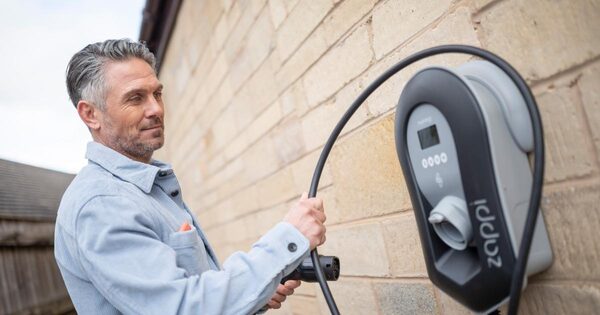
The size of the battery is not the constraint in a domestic setting; the charger and the on-board electronics are. A typical car has a maximum AC charging rate of 7kW to 11kW, or less for plug-in hybrids7, and that is broadly the scale at which power comes back out too. The Leaf's on-board AC charger is 6.6 kW27. Nissan's 2026 Ariya update is described with an 11kW bi-directional onboard charger. Much of the modelling of V2G economics is built around a 7kW V2G charger8.
What that means in a house is worth stating plainly. Seven kilowatts is enough to run lighting, a fridge, a router, a television and a kettle, though not comfortably all at once alongside an electric shower or a hob. It is comparable to the continuous output of a fitted home battery rather than to the output of a mains supply. Higher figures belong to public rapid charging in the other direction: on a 350 kW DC charger, charging times from 20% are quoted as 3 minutes for a 25 kWh battery, 7 minutes for 50 kWh, 11 minutes for 75 kWh and 15 minutes for 100 kWh25. Those rates have no bearing on what a house can draw back.
Stored energy is the other half of the sum. A battery-only vehicle gives about 100 to 200 miles of driving from a single charge6, on batteries commonly in the 24 to 40 kWh range for a Leaf27. Electric vehicle batteries "in principle offer a very large potential to contribute to home energy storage and electricity system balancing"33, and that potential is precisely what V2G aggregation is built on: if 50% of the UK's electric vehicles were V2G enabled, that would open up 22 TWh of flexible EV discharging capacity a year10.
Costs and savings: what bidirectional charging is worth
There is no settled UK retail price for a bidirectional charger, and where a household is quoted one it will be installer-quoted rather than listed. The comparison point is a conventional unit: for most, 7kW chargers are a good choice and cost around £900 to buy and install, as of February 20267. On top of that sits a premium. The V2G Britain work projects the premium over an equivalent smart charger falling to between £656 and £1,164 by 203034, with the underlying projections converging on around £650 to £1,150 in 20308; a separate Cenex forecast predicts V2G charger cost falling to £1,000 by 20309. All of those are projections, not prices a buyer can pay today.
Against the cost sit two revenue streams. The first is avoided fuel cost from home charging at all, which does not need bidirectional kit: drivers who can charge at home could save up to £750 a year compared with a petrol car35, and home charging is likely to be cheaper than at a public station36. Residents accessing cheaper rates have been cited charging for as little as 2p per mile37. VAT reinforces the gap: home-charged electricity is at 5% while charging away from home is at 20%11. A full Leaf charge at home has been calculated at just over £15 at an electricity rate of 24.5p/kWh6.
The second stream is export and flexibility. Reported earnings run from 5p to 15p per kWh, depending on supplier and demand, and this is not a fixed amount3. Average UK revenue generation from V2G has been estimated at £150 to £200 a year9. Modelled against a high plug-in archetype, plugged in 75% of the time, a 7kW V2G charger could capture around £436 a year above smart charging revenues, four times that achieved at the average plug-in rate8. The spread between £150 and £436 is largely behavioural: how often the car is plugged in decides the return. Tariff detail is covered under V2G earnings and the tariffs behind them.
System-level value is larger than household value. V2G could defer network upgrades of £5bn, or £180 per household9, and reduced renewable curtailment could amount to a saving of 6 MtCO₂e a year9. Chargepoints able to export or allow in-home demand flexibility "can save households significant amounts of money while reducing the strain on the grid at peak times"39.
What a car battery can do in a power cut
This is where V2H differs most sharply from V2G. A battery system arranged for backup "will let you run your home on batteries during a power cut"40, and V2H specifically "can provide backup power from your EV to your home during power outages and support off-grid setups"3. Energy Systems Catapult has identified enabling Priority Services Register households to use V2H to provide back-up power for their dwelling during a power cut as a use case for vulnerable customers41.
The limits are firm ones. V2H is limited to certain EV models and compatible chargers3. The car has to be at home and holding charge, which is exactly what may not be true during a storm. Distribution operators have built the opposite assumption into their tools: SSEN's Power Track lets customers find the nearest EV charge point if they have an electric vehicle that needs charging during a power cut42, which is a reminder that the car is normally a load to be served rather than a generator to be relied on.
Against that, the energy available is meaningful. A 40 kWh Leaf battery holds more than most domestic battery installations, and household chargers are designed to fully charge a car in a matter of hours, usually overnight on a time-of-use tariff43. A household using stored car energy in an outage is trading driving range for lighting and refrigeration, and should expect that trade to be explicit. How this compares with a fixed installation is examined at vehicle-to-grid or a home battery.

Battery health: does exporting power wear the battery out?
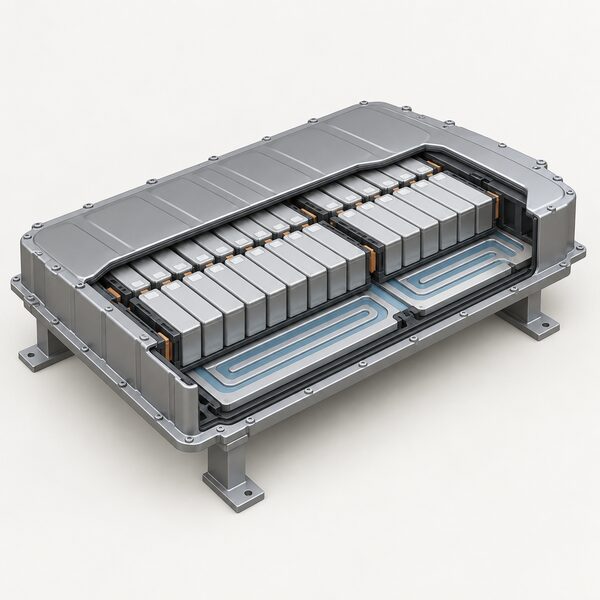
The honest answer is that there are concerns, and that the measured impact is reported as smaller than the concern. Frequent charging and discharging could shorten EV battery life, but "the impact should be relatively minimal" when operated within recommended guidelines3. Cenex goes further, suggesting managed V2G "could extend useable battery life by 10%"9 and that capacity fade can be reduced by 9.1% over a year through battery management9. The mechanism is that a V2G system holding a battery away from extremes of state of charge may treat it more gently than an owner who habitually charges to full.
That is consistent with general battery guidance, which links longer life to only using rapid charging when needed, not fully charging the battery and not letting it get too low44. Charging to 100% can overheat the battery and cause cell degradation, meaning lithium cells lose their ability to charge at their original rate45. Battery condition is itself a determinant of range44.
The practical constraint for a household is usually contractual rather than electrochemical: what the vehicle manufacturer's warranty permits. That is the subject of V2G, battery degradation and vehicle warranties. Figures on life extension come from a V2G advocate's own analysis and should be read as modelled, not as independent field measurement.
Where V2G stands in the UK today
V2G is "still not widely available, with eligibility requirements such as having a compatible car, charger and smart meter"3. As at 2021, four V2G charger models were available in the UK through different suppliers, with new suppliers entering the market regularly46. One major project recorded 330 V2G devices installed across the UK since its start10. The UK and France have been identified as the lead markets for V2G34. Commercial readiness and mass rollout in the UK have been put between 2030 and 20354.
The analytical groundwork is unusually thorough for a technology at this stage. The V2G Britain feasibility study, part of the Vehicle-to-Grid competition, identified 24 potential value streams for V2G8 and 18 commercial archetypes representative of current and future customers48. Where V2G's value sits relative to ordinary smart charging is contested within that work: one statement has smart charging capturing 40% of the total value of V2G for low plug-in scenarios and merely 10% for high plug-in cases, while another version of the same analysis gives 80% and 24%. The direction is consistent either way: the harder the car is worked, the more of the value is specific to bidirectional operation.
Network operators are moving on connection processes, with a UK-first approach announced to fast-track vehicle-to-grid technology49. Local network conditions can bite: when neighbouring homes all export solar simultaneously, local network voltage rises, and some EV chargers respond by shutting down50. Manufacturers are also signalling intent, with Toyota Motor Europe planning V2G integration as a more advanced solution as it expands its energy collaborations to further countries51. Trials remain the usual route in, typically involving online registration, eligibility verification and coordination with installers and energy suppliers, often requiring specific EV models and compatible chargers and sometimes a selection process3. Separately, landlords applying for the chargepoint grant contact an OZEV-authorised installer for a quote, then create an account and apply with property and vehicle details52. Availability of trials and schemes is not uniform across England, Scotland, Wales and Northern Ireland, and the nation pages track the differences.
What this means for household energy independence

A car used as a house battery increases independence in one specific way: it lets a household consume energy bought cheaply, or generated on site, at a time it chooses. Stored solar that would otherwise be exported at a relatively low rate can instead be held for later use including overnight EV charging53, and installing storage lowers the amount exported, reducing export payments, while overall savings are greater than relying on export payments alone54.
The dependencies that remain should be stated as firmly. V2G needs a smart meter and therefore a supplier relationship3. Export arrangements need the distribution network operator. The charger needs a compatible vehicle and a shared software language20. The equipment is trialled rather than widely sold2. And the asset is a car, which spends a significant part of its life away from the property. V2L asks none of this and delivers correspondingly less. The broader framing sits on the emerging home energy technology pillar and at emerging technology and household energy independence.
Sources54 cited
- Well-adapted energy system monitoring framework, Climate Change Committee, 2026-09-19
- Battery storage advice (England), Energy Saving Trust, 2026-08-19
- Vehicle-to-grid charging guide, Uswitch, 2025-07-02
- V2G and mitigating future winter blackouts, Cenex, 2022-12-14
- Home and community charging statistics, Zapmap, 2026
- Electric cars and energy bills, Uswitch, 2026-04-27
- Electric car charging at home, Which?, 2026-02-25
- V2GB: Vehicle to Grid Britain, Cenex, 2026-09-17
- More than money: finding the true power of V2G, Cenex, 2026-09-17
- Case study: UK electric vehicle to grid (V2G) charging, Ofgem, 2021-07-06
- Government urged to rethink pay-per-mile scheme for electric vehicles, NAPIT, 2026-02-24
- Vehicle-to-grid best practice guide, Energy Saving Trust, 2026-05-05
- V2G domestic installation, Cenex, 2017-03-09
- Cenex launches EBBS and Flows energy systems project, Cenex, 2015-03-06
- Storage and vehicle to grid, Electricity North West, 2026-09-19
- Low carbon technologies strategy, Energy Networks Association, 2026-09-17
- Electric vehicle infrastructure national standards, Welsh Government, 2023-06
- EV glossary, Uswitch, 2024-11-26
- Battery storage advice, Centre for Sustainable Energy, 2025-10
- What is bidirectional charging, Carwow, 2025-05-30
- Tethered vs untethered chargers, Zapmap, 2026-02-23
- Home charging guide, Zapmap, 2025-06-19
- EV connector types, Zapmap, 2026-05-20
- Electric vehicle charging, SMMT, 2025-06-25
- Charging electric vehicles, Energy Saving Trust, 2026-04-23
- Kitemark certification for EV charging, BSI, 2026-09-17
- Nissan Leaf model charging guide, Zapmap, 2026
- How long does it take to charge an electric car, Zapmap, 2026-04-15
- Electric car charging times, Zapmap, 2026-04-15
- Top tips for driving an electric car, Zapmap, 2024-12-06
- Upgrading our energy system: smart systems and flexibility plan, Ofgem, 2017-07
- Energy stored in electric car batteries could be used to power homes, Cenex, 2021-11-10
- Demand flexibility, CREDS, 2026
- An introduction to vehicle-to-grid charging, Cenex, 2019
- EVs: the facts, SMMT, 2025-09-22
- EV charger installation and maintenance, NICEIC, 2025-08
- Four more EV models qualify for £3,750 discount under the Electric Car Grant, GOV.UK, 2025-12-03
- New car market powers up as industry calls for VAT cut on EV public charging, SMMT, 2023-07
- Response to the Treasury consultation on VAT relief for energy saving materials, Energy Saving Trust, 2025-10-08
- Tim's story: solar panels and a heat pump, Energy Saving Trust, 2025-04-03
- Unequal EV: technology viability and future services for vulnerable customers, Energy Systems Catapult, 2023-02-28
- SSEN moves to Yellow Alert status in the north of Scotland, SSEN, 2024-12-20
- How to charge an electric car, Uswitch, 2022-02-02
- Electric vehicle battery basics, Energy Saving Trust, 2025-09-16
- Tips for electric cars in hot weather, Zapmap, 2025-07-08
- Commercial viability of V2G, Cenex, 2021-01
- Case study: UK hydrogen heated homes of the future, Ofgem, 2021-07-29
- V2G Britain case study, Cenex, 2022-11-11
- UK-first approach to fast-track vehicle-to-grid technology, UK Power Networks, 2026-03-12
- Making home energy management work for consumers, Energy Systems Catapult, 2026-02-12
- Toyota to expand EV charging ecosystem across the UK, SMMT, 2025-12-04
- Electric vehicle chargepoint and infrastructure grants for landlords, Find Government Grants, 2026-09-18
- Can solar panels charge electric cars, CPA, 2026-04-15
- Battery storage, Home Energy Scotland, 2026-09-20
 Charging and Energy IndependenceCharging an electric car at home can cut your fuel costs, but how much does it really free you from the grid?
 Charging With a Home BatteryHow a home battery and an EV charger share one supply, whether a battery can usefully charge a car, and how combined systems are controlled so the battery is not discharged into the vehicle at a loss.
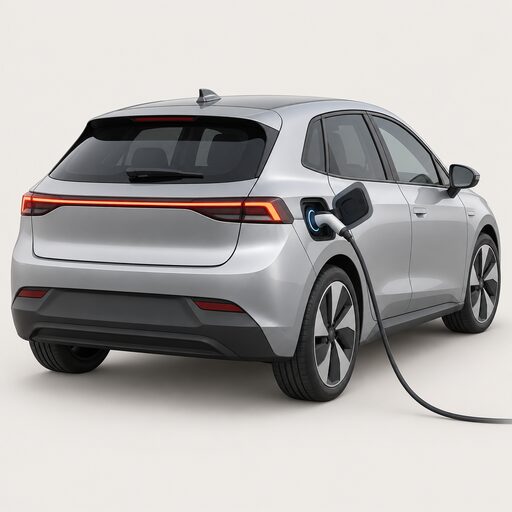 V2G and V2H ChargingCan your electric car earn money by sending power back to your home or the grid?
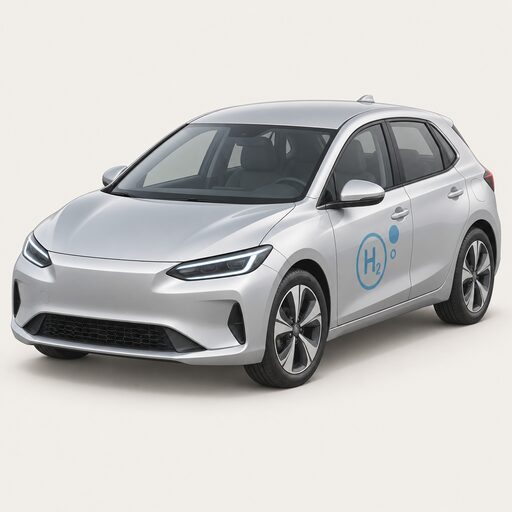 Fuel Cell Cars as Home PowerCan you really run your home from a hydrogen car?
 Inverters and Inverter-ChargersIf the power goes off, what actually keeps your fridge and boiler running?
 Whole-Home Energy DesignHeating and hot water use more energy than anything else at home, so that choice shapes everything.