
In this guide
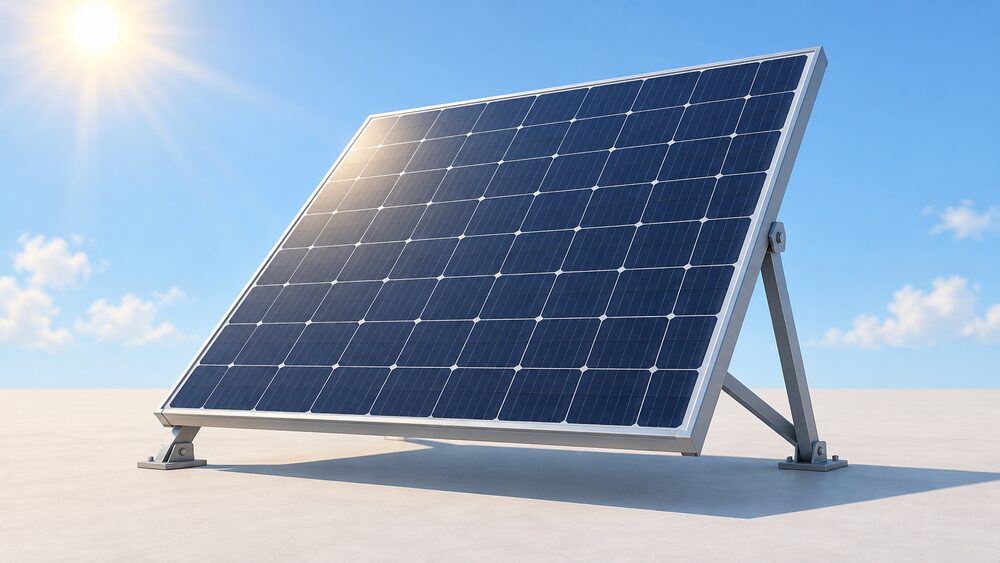
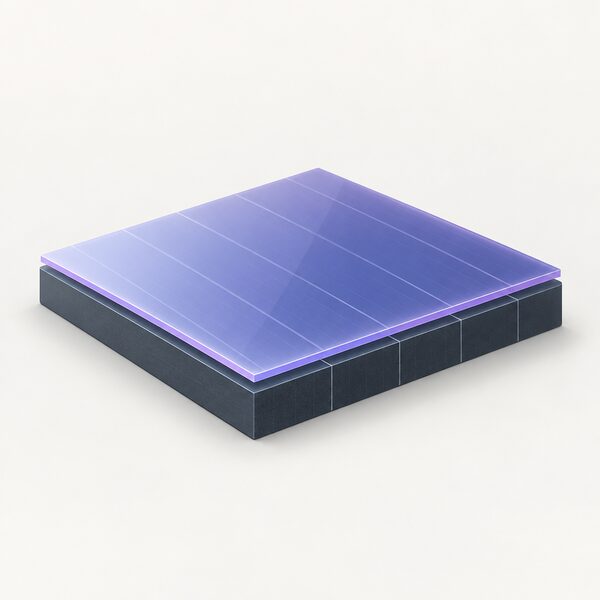
A tandem perovskite-silicon panel stacks a thin perovskite absorber layer on top of a conventional silicon cell so that the two materials capture different parts of the light spectrum. The point of the design is efficiency. The best silicon panels on sale today are around 25% efficient and are approaching their theoretical performance limit, while current industrial-size silicon-perovskite tandem modules reach 31.1%, and tandems have recorded commercial efficiencies above the levels possible with current silicon panels1.
The laboratory numbers run higher again. Perovskite-silicon tandem cells have reached 35% in the lab, with 31% the record at module size and in industry. Perovskite on its own, without a silicon partner, records 27% in the lab and 21% at module size1. Those four figures, taken together, explain why the industry treats the tandem as the serious route to market: perovskite alone does not beat good silicon, but perovskite on silicon does.
For a UK household the practical answer today is simple. Perovskite panels are not yet commercially available and have yet to be proven in real-world environments2. No tandem module can be specified for a domestic roof through the normal UK installer market, and because tandem cells generally involve at least one thin film technology they currently carry similar instability issues and short lifetimes to thin film1. The efficiency case is settled in the data; the durability case is not.
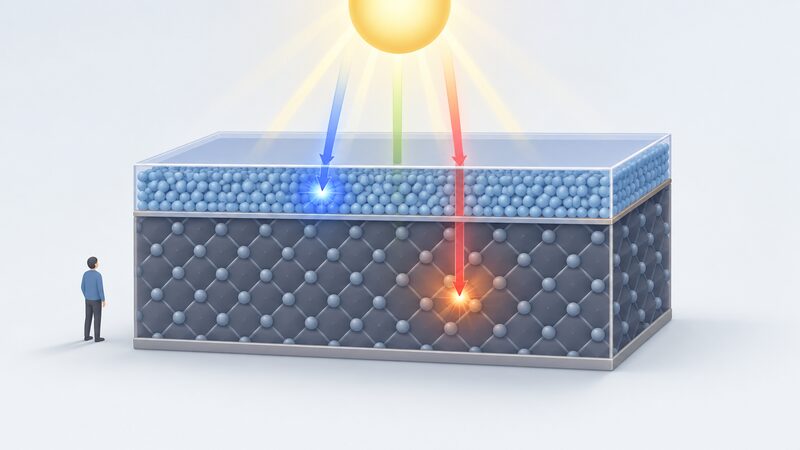
Two absorber layers instead of one
A conventional panel converts sunlight into electricity using one or two layers of semi-conducting material, packaged into panels or other modular forms4. In almost all domestic panels that semiconductor is silicon6. A single absorber can only use part of the solar spectrum efficiently: photons with less energy than the material's bandgap pass through unused, and photons with much more energy waste the surplus as heat. That loss mechanism is what caps silicon at around 25% in the best production cells1.
A tandem sidesteps the cap by putting two absorbers in the optical path. The upper layer, a perovskite, has a wider bandgap and takes the high-energy blue and green light. The silicon underneath takes the red and near-infrared that passes through. Each layer works closer to its own optimum, and the two outputs combine.
Silicon/perovskite is the most common tandem type, but it is not the only pairing. Others include perovskite/organic, perovskite/perovskite and chalcogenide/silicon, and triple-junction cells add a third material layer1. Perovskites are commonly lead halide compounds1.
The reason perovskite pairs so readily with silicon is that it can be deposited as a thin film on top of an existing cell, rather than being grown as a separate wafer. That is also the source of the difficulty. Thin film materials such as amorphous silicon, cadmium telluride and copper indium gallium selenide are established but less efficient than monocrystalline or polycrystalline panels, with thin film modules reaching up to 13%6. Tandems inherit the thin film family's weakness: because at least one layer is a thin film, tandem cells currently show the same instability and short lifetimes1.
Efficiency: 31.1% in industrial modules against about 25% for silicon
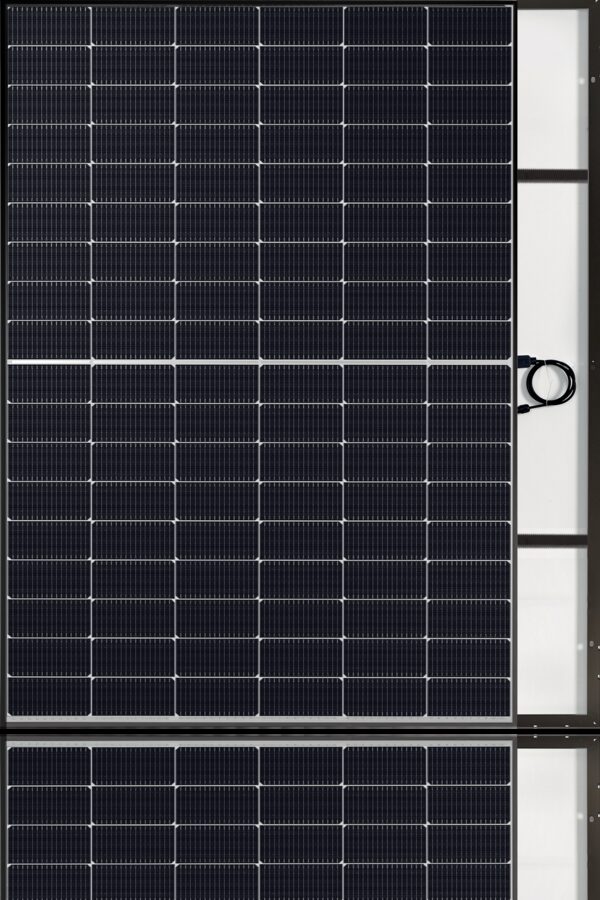
The headline comparison is between two module-level numbers, not between a laboratory cell and a product. Industrial-size silicon-perovskite tandem modules currently reach 31.1% efficiency, and the record at module and industry scale is 31%. The best performing silicon panels now available are about 25% efficient1.
| Technology | Record lab cell | Record module or industry | Source type |
|---|---|---|---|
| Perovskite/silicon tandem | 35% | 31% (31.1% current industrial modules) | Official1 |
| Perovskite alone (commonly lead halide) | 27% | 21% | Official1 |
| Best current silicon panels | around 25% | (approaching theoretical limit) | Official1 |
| Thin film modules | up to 13% | Independent2 | |
| Polycrystalline silicon modules | around 14 to 15% average | Official7 |
The gap matters most where roof area is fixed. A household with a small or awkward roof cannot simply add more panels; raising the efficiency of each square metre is the only route to more generation from the same array. That is the case tandem makers put forward, and it is the case that is genuinely supported by the efficiency figures.
Two cautions belong beside the numbers. First, 31.1% is what industrial-size modules achieve, not what a warranted, weather-aged rooftop product delivers over twenty years; no such product is on the UK market to measure2. Second, the testing regime is unsettled. Existing International Electrotechnical Commission standards for silicon photovoltaic cells are not well suited to next generation solar technologies such as silicon-perovskite tandem cells3. Until test methods catch up, efficiency and degradation claims for tandems are harder to compare like for like than they are for silicon. How to read claims at this stage is covered in technology readiness and energy product claims.
Records and the direction of travel
The laboratory record for perovskite-silicon tandem cells stands at 35%, against 31% at module size1. That six-point gap between cell and module is normal in photovoltaics: a record cell is a small, carefully made device measured under controlled conditions, while a module has interconnection losses, inactive border area, glass and encapsulation. A household reading a record announcement should expect the shippable module figure to trail it.
Perovskite also performs unusually well in low and artificial light. Dye-sensitised, perovskite and organic indoor photovoltaics have all demonstrated indoor efficiencies above 35%1, higher than their outdoor cell records, because indoor spectra suit wide-bandgap absorbers. That points to a separate product category for sensors and small devices rather than to rooftop generation, but it is part of why perovskite attracts research money.
What manufacturers are targeting beyond the published records is not something this page can state as fact, because efficiency roadmaps are company statements rather than measured results. The documented position is that tandems have recorded commercial efficiencies above the levels possible with current silicon panels1, and that silicon itself has little headroom left1. Further detail on the material sits on perovskite solar cells and the direct comparison on perovskite vs silicon solar panels.
Oxford PV and the race to commercial manufacture
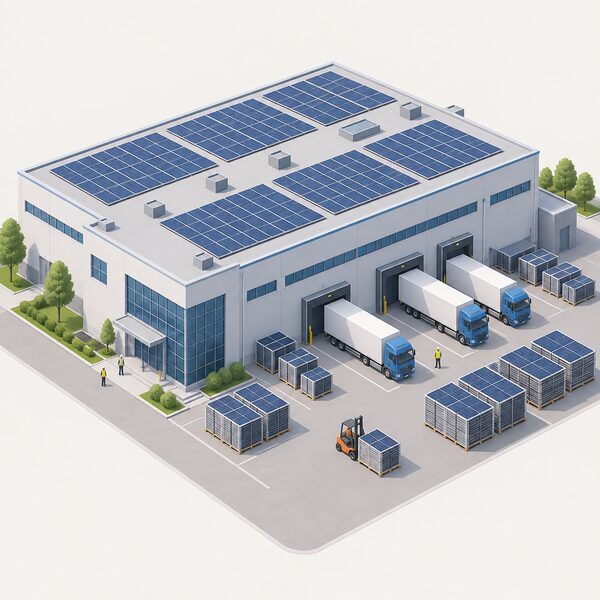
Oxford PV is the UK-based company working in perovskite-tandem photovoltaics, and Power Roll is a UK-based company working in flexible photovoltaics1. Oxford PV has manufacturing facilities in the United States and Germany, building perovskite and tandem photovoltaics on a commercial scale1.
That is a meaningful distinction from most emerging energy technology. The company is not at demonstrator stage: it is operating factories. But those factories are in the United States and Germany, not the United Kingdom, and commercial-scale manufacture is not the same thing as retail availability through UK installers. A British household benefits from a British company's intellectual property only when modules reach a UK distribution channel, with a UK-recognised certification and a warranty that a UK buyer can enforce.
The broader supply picture underlines the point. Around 80% of the panels available in the UK are made in China8. A tandem product entering that market has to compete on cost per watt installed against very large, very mature silicon production, not only on efficiency. Company-specific detail is on Oxford PV, and the wider pattern of early companies and what happens when they fail is covered in energy technology company failures.
Not yet on the UK market
Perovskite panels are not yet commercially available and remain unproven in real-world environments2. There is no published UK price for a tandem module, no mainstream installer offer, and no domestic certification pathway that a homeowner can point to.
Anyone waiting should also be clear that there is no purchase support on the way. There are no dedicated government grants for solar panels in the UK at the moment, though this might change as details of the Warm Homes Plan emerge9. A tandem panel, when it arrives, would be bought at whatever the unsubsidised installed price turns out to be.
The silicon market meanwhile keeps moving. Polycrystalline panels are being phased out in the UK and few installers still offer them2, and one Welsh social landlord's specification states plainly:
"These panels must NOT BE INSTALLED in any Barcud properties unless otherwise approved"
Tandem modules would enter a market that has already standardised on high-efficiency monocrystalline silicon, not one waiting to be rescued. Timing expectations are discussed further on when will perovskite panels be available.
How tandems compare with the panel types on sale today
| Type | What it is | Efficiency | Status in the UK |
|---|---|---|---|
| Monocrystalline silicon | Single larger silicon fragment per cell, dark blue or black with no visible crystals10 | Best panels around 25%1 | The mainstream domestic product |
| Polycrystalline silicon | Small silicon crystals melted together, visible crystals in shades of blue6 | Around 14 to 15% average at module level7; slightly less efficient than monocrystalline10 | Being phased out, few installers offer them2 |
| Thin film | Amorphous silicon, cadmium telluride, copper indium gallium selenide6 | Up to 13%2 | Niche |
| Perovskite alone | Commonly lead halide1 | 27% lab cell, 21% module1 | Not commercially available2 |
| Perovskite-silicon tandem | Perovskite layer on a silicon cell1 | 35% lab, 31% module, 31.1% industrial modules1 | Not commercially available2 |
Polycrystalline panels have a lower cost per watt case against them: they are less efficient than monocrystalline and considered aesthetically less pleasing, though they have been described as environmentally better in manufacture and often the cheapest option11. Their manufacturing method also results in lower energy efficiency and a shorter lifespan6. Perovskite has been described in local authority guidance as offering higher efficiency than any other panels11, but that is a statement about the material's potential rather than about a product a household can buy.
Lifetime is the unresolved question
Silicon's durability is well documented. Panels are commonly described as lasting 25 years or more12, 30 years or more13, over 25 years14, and 25 or more years with very little maintenance15; one independent source puts most at 25 to 30 years16 and another estimates monocrystalline and polycrystalline life at around 50 years17. Panels usually come with a 25-year performance warranty and a five to 10-year product warranty18, and inverters are not expected to last as long as the panels themselves19.
Against that, tandem cells currently have instability issues and short lifetimes, because they generally involve at least one thin film technology1. This is the single largest barrier between a 31.1% module efficiency and a rooftop product. A panel that starts high and degrades quickly can generate less over a 25 year life than a silicon panel that starts lower and holds its output. Nothing in the available evidence yet resolves how tandem modules age in a temperate maritime climate.
Roof and weather questions, if tandems do arrive
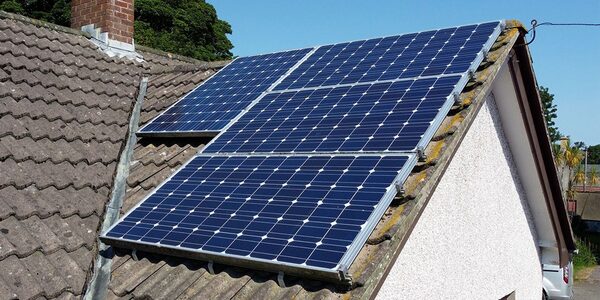
A tandem module of conventional construction would be installed like any other panel, and the existing rules would apply. Building regulations normally apply to a roof-mounted solar installation20, the roof must be strong enough to take the weight, especially if panels sit on top of existing tiles21, and panels can go on pitched or flat roofs12, with flat installations tilted and spaced to avoid shading12. Flat roofs give more flexibility over angle but are more complex, may need additional mounting systems and can cost more than a pitched roof9. On pitched roofs, planning guidance asks that panels match the colour of the existing roof covering as closely as possible23. Outbuildings are possible where the roof is strong enough24, and park homes only where the roof is strong enough, with a direct connection to the electricity network and their own meter25. Where a roof is renovated, existing panels can be refitted to it26.
On weather, photovoltaic panels use light rather than heat, so they work during daylight even when cloudy or overcast27, and even on overcast days the UK has enough sunlight for panels to work28. They generate in winter, but less than in summer29. Cool and windy conditions can be beneficial, cooling the modules and raising efficiency27. In the UK, rain cleans panels tilted at 15 degrees or more24. Perovskite's strong low-light behaviour, seen in indoor efficiencies above 35%1, suggests a technology suited to diffuse northern light, but that remains an inference from indoor measurements rather than UK field data.
What tandems would mean for household energy independence
Solar photovoltaics reduce the share of a home's electricity bought from a supplier: domestic systems can help reduce energy bills30 and reduce reliance on the grid, with an Energy Performance Certificate improved as a result4. In one documented Scottish case, panels generated 6,580kW over a year, equal to around half the home's total energy consumption31.
A higher-efficiency module raises that share where roof area is the binding constraint, and only there. It does not change the timing problem: generation peaks at midday and in summer, demand peaks in the evening and in winter, and without storage the surplus goes to the grid. A tandem panel is a better collector, not a different system.
The dependencies also stay where they are. The household remains connected to the distribution network, remains a supplier's customer for imported units and for any export payment, and takes on a new dependence on the manufacturer of a young technology whose lifetimes are currently short and whose test standards are not yet fitted to it1. Silicon's 25-year performance warranties18 exist because silicon has 25 years of field evidence behind them; an equivalent promise on a tandem module would rest on a much thinner record. The wider question of how emerging technology changes a household's position is taken up on emerging technology and household energy independence and across the emerging home energy technology guide.
When tandems might reach UK homes

No date can be given from the evidence here. What can be said is the sequence that has to complete. Commercial-scale tandem manufacture already exists, at facilities in the United States and Germany1. The efficiency case is already made, at 31.1% for industrial modules against about 25% for the best silicon1. What remains outstanding is durability, where tandems currently show short lifetimes1, and testing, where the existing IEC standards for silicon cells are not well suited to silicon-perovskite tandems3. Until an accepted test regime exists, the certification and warranty structures that UK installers and lenders rely on cannot be built around the product.
For now, perovskite is not commercially available and is unproven in real-world environments2. A household choosing solar in 2026 is choosing between silicon technologies, with polycrystalline already being phased out2 and monocrystalline the mainstream. How standards for new categories get established is set out on standards and certification for emerging energy products.
Sources31 cited
- Next generation solar technologies, UK Parliament POST, 2026-06-25
- Are solar panels worth it?, Which?, 2026-05-15
- UK Solar Roadmap, DESNZ, 2025-06
- How do solar panels work, Smart Energy GB, 2026-03-16
- Generating your own energy: solar electricity, Welsh Government
- Solar panel installation, maintenance and repair, NICEIC, 2026-09-17
- Solar PV specification notice, Sell2Wales, 2026-06-15
- Aiko solar panels review, Which?, 2026-08-12
- Solar panel installation, Energy Saving Trust, 2026-09-07
- Solar photovoltaic information, Centre for Alternative Technology, 2026-03-10
- Clifton local listed building consent order guidance, Bristol City Council, 2025-02
- Solar panels, Hammersmith and Fulham Council, 2026-09-17
- Solar panels, Home Energy Scotland, 2026-09-20
- Solar photovoltaic PV, MCS, 2026-07-30
- Solar PV panels, AgilityEco, 2026-09-20
- Solar mythbusting and frequently asked questions, Low Carbon Hub, 2025-12-10
- Buying advice for solar panels, Which?, 2026-08-12
- Buying a house with solar panels, Energy Saving Trust, 2026-08-13
- Make the most of your solar panels, Which?, 2026-08-12
- Solar panels guidance, Islington Council, 2026-09-17
- Solar thermal water heating and home energy generation, Planning Portal, 2026-09-17
- Solar energy, Solar Energy UK, 2026-09-17
- Solar panels planning permission checklist, Islington Council, 2026-09-17
- Solar panels advice, Energy Saving Trust, 2026-08-27
- Park homes energy advice, Centre for Sustainable Energy, 2026-07
- Solar roof tiles, Energy Saving Trust, 2026-08-13
- Solar panel myths debunked, Which?, 2026-06-09
- How much of your electricity can solar panels produce, Which?, 2024-06-27
- Solar power facts, Energy Saving Trust, 2026-08-13
- Solar PV advice, National Energy Action, 2026-04-23
- Tim's story: solar panels and heat pump, Energy Saving Trust, 2024
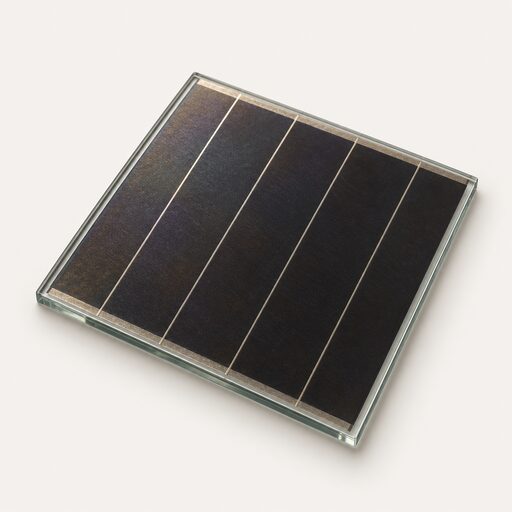 Perovskite Solar CellsPerovskite solar panels are a newer kind of panel that could be cheaper and more efficient than the ones sold today.
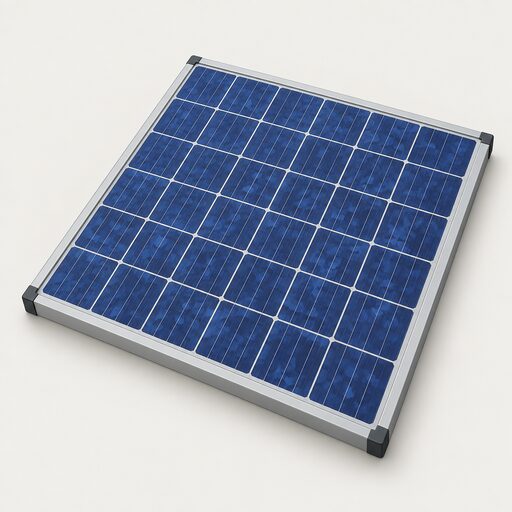 Panel TypesWhich solar panels are best for a UK home, and how much do they cost?
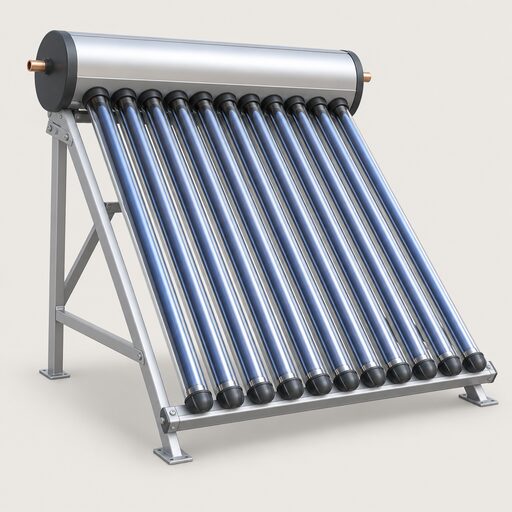 Solar Thermal Water HeatingSolar thermal panels heat your water using the sun, working alongside your boiler rather than replacing it.
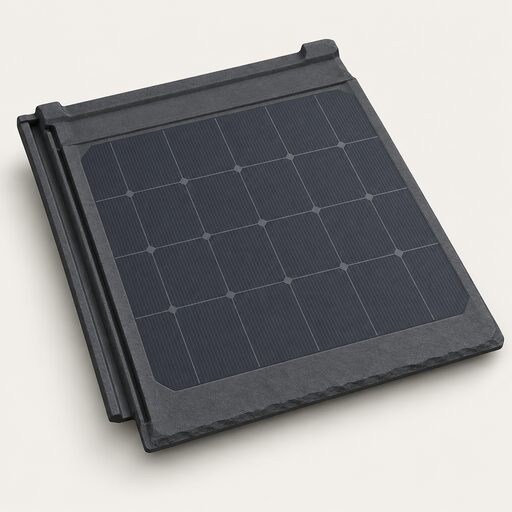 Roof-Integrated SolarSolar tiles replace your roof covering instead of sitting on top of it, so the finished roof looks like a roof.
 Plug-In Solar KitsCan you really plug solar panels into a normal wall socket in the UK, and is it legal now?
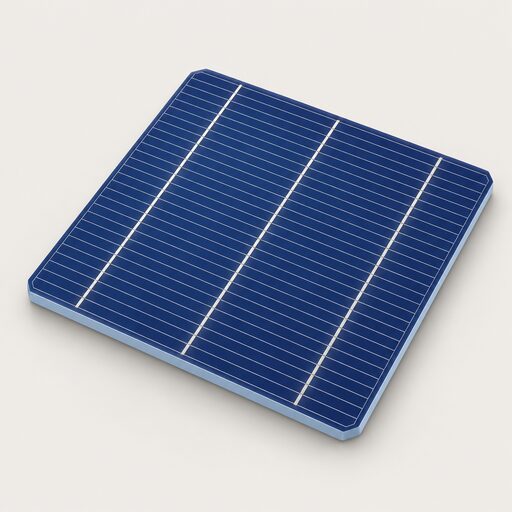 Solar Cell TechnologyBuying solar panels means choosing between cell types that work in different ways.