
In this guide
Oxford PV is a UK-founded company working on perovskite-tandem solar technology, and it is the name most often attached to the perovskite question in Britain. Parliamentary research published in June 2026 names it, alongside Power Roll, as one of two examples of UK-based companies working in perovskite-tandem and flexible PV respectively1. The same briefing records that Oxford PV has demonstrated 26.9% efficiency for a large module, and that the most common tandem type, silicon with perovskite, has reached 31.1% in current industrial size modules1.
The catch for a household is where the panels are made and when they arrive. Oxford PV's manufacturing facilities are in the United States and Germany, building perovskite and tandem PV on a commercial scale1. The company states that it expects the first tandem solar modules manufactured at volume from 2027, with a roadmap target of 27% module efficiency that year and 30% by 20301. There is no UK residential sales route today.
This page sets out what the technology is, what the efficiency figures actually mean, where the manufacturing sits, and what remains unresolved on durability. It also places Oxford PV against conventional silicon, which still holds an estimated 98% of the PV market1, and against the wider question of what a higher-efficiency module does for a household's energy independence.
What Oxford PV makes: perovskite-tandem solar technology
A tandem solar cell stacks two light-absorbing materials so that each captures a different part of the solar spectrum. The most common pairing is silicon with perovskite, and it is the combination Oxford PV works on1. Perovskite is a family of materials, commonly lead halide, that can be tuned to absorb light that silicon passes over, which is why the stacked cell converts more of the incoming energy than either layer alone.
The efficiency ladder in the parliamentary briefing shows the gap clearly. Perovskite on its own has a 27% laboratory record and a 21% record at module size. Organic PV sits at 19% in the laboratory and 15% at module size. The perovskite-silicon tandem reaches 35% in the laboratory and 31% at module size1. That is the technical case for tandem: it is not a marginal improvement on perovskite alone, it is a different order of performance.
For a household, the practical translation is area. A more efficient module produces more electricity from the same roof, which matters most where roof space is limited, shaded in part, or awkwardly oriented. The same briefing notes that silicon PV materials need to be thicker for sufficient light absorption, which makes silicon a poor choice for flexible panels1. Perovskite's potential to be made thin and flexible is one reason it attracts attention beyond rooftop arrays, including building-integrated applications.
What Oxford PV is not, at this stage, is a panel brand a UK householder can specify. It is a technology developer with a research base in Britain and production elsewhere. The distinction between where a technology is invented and where it is manufactured runs through the rest of this page, and it is the single most important thing to understand before treating the name as a purchasing option. The wider technology family is covered in perovskite solar cells and tandem perovskite-silicon panels.
Record efficiency: 26.9% module efficiency in practice
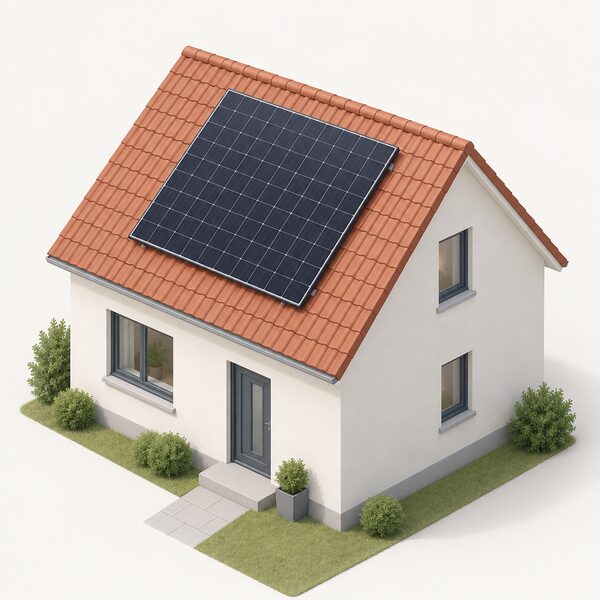
The headline figure attached to Oxford PV is 26.9% for a large module, recorded in the June 2026 parliamentary briefing1. It sits between the 21% module record for perovskite alone and the 31.1% achieved by industrial size silicon/perovskite tandem modules generally1. In other words, Oxford PV's demonstrated module is a strong result for a developer, but it is not the ceiling of what tandem modules have reached.
The company's own roadmap is more ambitious than its demonstrated figure. It targets 27% module efficiency in 2027 and 30% by 20301. Those are targets, not measurements, and the gap between a 26.9% demonstration and a 27% production target is smaller than the gap to 30%. A household reading these numbers should treat the 2027 figure as close to what has already been shown in a large module, and the 2030 figure as a forward claim.
Context matters here. A conventional silicon module sold in the UK today sits well below these numbers. One independent product listing records a SolarEdge module at 440W and 22.53% efficiency2. That is a real, purchasable panel, and it is roughly four percentage points below Oxford PV's demonstrated large module and eight below the industrial tandem figure. The comparison is not like for like, because one is a shipping product and the other is a demonstration, but it shows the size of the efficiency prize.
"Oxford PV has demonstrated 26.9% for a large module"
The efficiency gain does not translate one for one into household savings. Output depends on roof area, orientation, shading, inverter sizing and how much of the generated electricity is used on site rather than exported. A higher-efficiency module changes the ceiling on a constrained roof; it does not change the weather. The efficiency question in isolation is covered in how efficient are perovskite solar panels.
Manufacturing in the US and Germany, not the UK
Oxford PV is a UK-based company, but its production is not in the UK. The parliamentary briefing states plainly that there are manufacturing facilities in the United States and Germany, building Oxford PV's perovskite and tandem PV on a commercial scale1. The research and development identity is British; the factory footprint is not.
This is not unusual in the sector, but it has a specific consequence for the UK. The same briefing notes that the overwhelming majority of panels installed in the UK are imported3. A British-founded perovskite developer with overseas plants therefore reinforces an existing pattern rather than breaking it. For a household thinking about energy independence, the origin of the panel is a supply chain question rather than an operational one: once installed, a panel generates regardless of where it was made, but the replacement part, the warranty claim and the company relationship all sit with an overseas manufacturer.
The UK does have manufacturing in adjacent energy technologies. Micro-CHP is described in one consultation as primarily manufactured in the UK, unlike many other products supported by the Feed-in Tariff4. Electric heating has UK production too, with the neos radiator made in Britain in Leeds and inspired by German electric heating technology5. Off-site construction follows the same pattern, with ZEDpods constructed off-site in the UK6. Solar panel manufacturing, by contrast, is not a domestic strength, and Oxford PV's current facilities do not change that.
For a household, the practical point is that buying British is not an available option in perovskite tandems, and will not be while production sits abroad. The supply chain question is explored further in technology readiness and energy product claims.
When UK households can expect tandem panels
Oxford PV states that it expects the first tandem solar modules manufactured at volume from 20271. That is the company's own expectation, and it is described elsewhere as not a hard commitment. The roadmap targets that accompany it, 27% module efficiency in 2027 and 30% by 2030, give a sense of the intended trajectory1.
Volume manufacturing is not the same as UK residential availability. The company began selling commercial perovskite-silicon panels in the United States in 2024, at 24.5% efficiency, and its 26.9% residential panel was not available to customers1. The pattern so far is commercial deployment first, residential later, and the United States before the UK. Nothing in the record sets a date for a UK household to order a tandem panel.
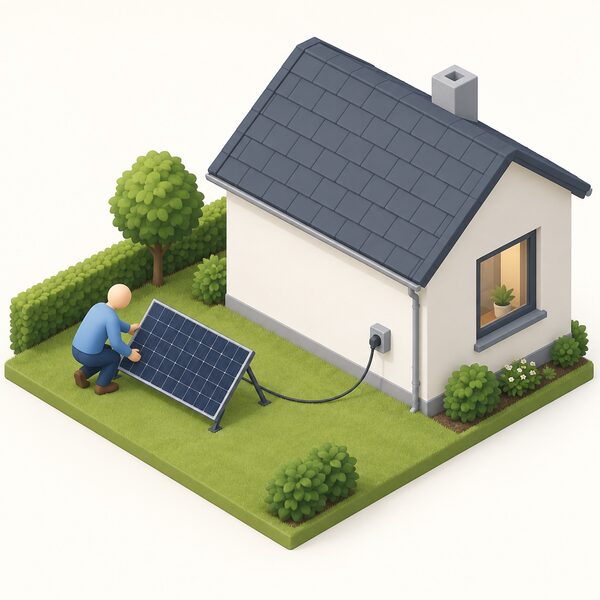
What is changing in the UK is the route to solar generally, not the panel technology. Plug-in solar panels became legal to buy and use across Great Britain from 27 August 2026, with the government announcing that the easy-to-install panels can be plugged into homes across the country7. The Energy Saving Trust confirms that for residents of England, Scotland and Wales, plug-in solar panels became available from 27 August 2026 for the first time8. One in eight households, 13%, planned to get plug-in solar panels within the next five years, according to a May 2026 survey9.
New build rules move on a separate track. From 24 March 2027, every new home built in England has to have a heat pump, solar panels and much better insulation10. From 24 March 2028, all new build homes in England must be fitted with a system for renewable energy generation, such as solar panels11. Those requirements will be met with whatever panels are on the market, which in the near term means silicon.
| Date | Development | Applies to |
|---|---|---|
| 2024 | Oxford PV begins selling commercial perovskite-silicon panels in the US at 24.5%1 | United States |
| 27 August 2026 | Plug-in solar panels legal to buy and use7 | Great Britain |
| 24 March 2027 | New homes in England must have a heat pump, solar panels and better insulation10 | England |
| 2027 | Oxford PV expects first tandem modules manufactured at volume1 | Company expectation |
| 24 March 2028 | All new build homes in England must have renewable generation such as solar11 | England |
The timeline question is covered in more detail in when will perovskite panels be available.
What a 27% module means for household energy independence
A more efficient module changes how much of a household's electricity can come from its own roof, and that is the core of energy independence. The gain is real but bounded. Moving from a 22.53% module to a 26.9% module is roughly a fifth more output from the same area, before any system losses1. On a roof that is already fully covered, that is a meaningful increase. On a roof with spare space, the cheaper route to the same output is usually more lower-efficiency panels.
Independence from the grid is not the same as independence from a supplier. A rooftop array reduces the electricity drawn from the network, but the household remains connected, and the connection is what provides power at night and in winter. The same is true of every solar installation, whatever the cell technology. What tandem efficiency offers is a higher self-generation ceiling, not a route off the grid.
There is a second dependence that a household should weigh: the manufacturer. A panel with a 20-year-plus expected life will outlast many of the companies that made it, and a warranty is only as good as the firm behind it. Oxford PV is a privately held developer with investment from Equinor Ventures and Legal and General, who first invested in 20161. That is a different ownership profile from the large UK energy suppliers, where Octopus Group is the majority owner of Octopus Energy12 and OVO Group is the majority owner of OVO Energy, with Mitsubishi Corporation holding a 20% stake12. A developer backed by energy and financial investors is not the same as a utility-owned manufacturer, and the warranty question sits with the company.
The broader independence picture is set out in emerging technology and household energy independence.
Durability and lifespan: the 20-year question

Perovskite's weakness is not efficiency, it is durability. The manufacturer is reportedly attempting to create panels with a 20-year lifespan by 20271. That is a target, and it is reported rather than demonstrated in the field. Against it, independent guidance puts monocrystalline panel life expectancy at around 50 years, and polycrystalline panels at the same figure, described as lasting the same length of time as monocrystalline panels13. A plug-in solar system is described as keeping generating for 20-plus years14.
The gap between a 20-year target and a 50-year expectation for silicon is the central commercial risk in perovskite tandems. Silicon has decades of installed base behind its figures; perovskite does not. A household weighing a future tandem purchase is therefore weighing a higher-efficiency panel with a shorter and less proven service life against a lower-efficiency panel with a long track record.
There is a standards dimension too. Existing International Electrotechnical Commission standards for silicon photovoltaic cells are not well suited to next generation solar technologies such as silicon-perovskite tandem cells15. That matters because certification is how a panel demonstrates it meets a recognised benchmark. Where the standards do not fit the technology, the assurance a household can rely on is thinner, and the testing regime has to catch up before tandem panels carry the same confidence as silicon.
The durability question is covered further in perovskite solar cells and in standards and certification for emerging energy products.
How Oxford PV compares with conventional silicon panels
Crystalline silicon is the incumbent by a wide margin. First generation crystalline silicon is the most common PV material, with an estimated 98% market share1. That dominance is not an accident: silicon is well understood, widely certified, manufactured at enormous scale and backed by field data stretching back decades. Any new cell technology is measured against that baseline.
On efficiency, tandem wins. The perovskite-silicon tandem holds a 35% laboratory record and 31% at module size, against a perovskite-only record of 27% in the laboratory and 21% at module size1. A shipping silicon module sits lower still, with one independent listing recording 22.53%2. On flexibility, silicon is the weaker option, because silicon PV materials need to be thicker for sufficient light absorption, which makes silicon a poor choice for flexible panels1. Perovskite's thin-film potential is a genuine differentiator for curved surfaces and building-integrated work.
On durability and assurance, silicon wins. The 50-year life expectancy figures for monocrystalline and polycrystalline panels13 are not matched by any published perovskite figure, and the standards gap for tandem cells15 means the certification framework is still being adapted.
| Attribute | Perovskite-silicon tandem | Crystalline silicon |
|---|---|---|
| Laboratory record | 35%1 | Lower than tandem1 |
| Module-size record | 31.1% industrial, 26.9% Oxford PV large module1 | 22.53% on one shipping module2 |
| Market share | Emerging | Estimated 98%1 |
| Life expectancy | 20-year target reported for 20271 | Around 50 years13 |
| Standards fit | Existing IEC silicon standards not well suited15 | Established |
| Flexibility | Thin-film potential1 | Needs thicker material, poor for flexible panels1 |
The comparison is not a straightforward win for either. Tandem offers more power per square metre and the prospect of flexible formats; silicon offers certainty, certification and a long service life. A household choosing today is choosing silicon, because that is what is available and certified. The head-to-head is set out in perovskite vs silicon solar panels.
Where the UK route stands for a household
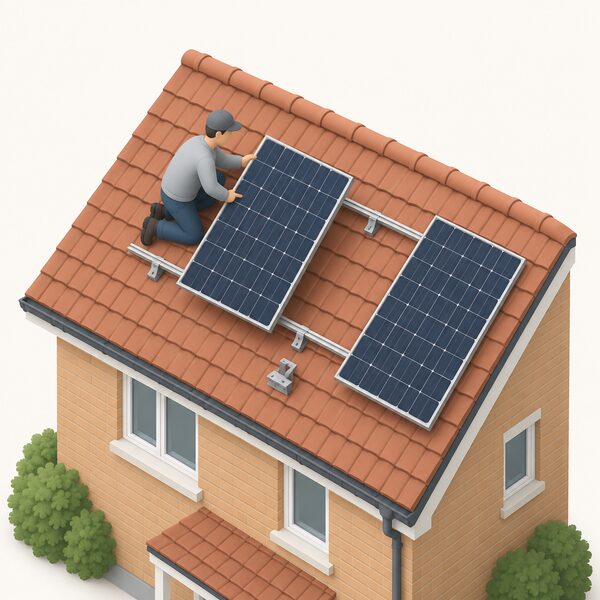
The practical position for a UK householder is that Oxford PV is not a purchasing option. There is no UK residential sales channel, no published UK price, and no installer network for tandem panels. Prices for solar installation are installer-quoted, and no published figure exists for a tandem system. Where a household wants solar now, the available routes are conventional silicon panels and, since 27 August 2026, plug-in solar in Great Britain7.
The support framework around solar is worth noting because it applies to whatever panel is fitted. A temporary VAT zero rate applies to the installation of energy saving materials in residential accommodation in Great Britain, under Group 23 of Schedule 8 to the Value Added Tax Act 199416. Grant funding has moved through programmes such as the Home Upgrade Grant Phase 2, which allocated £630 million for delivery between September 2023 and March 202517. Those are general facts about the UK market, not Oxford PV facts, and they apply to silicon installations today.
Certification is the other practical gate. Product certification bodies list solar PV among the technologies they assess18, and local authority guidance treats solar equipment on residential buildings as a planning matter in some cases19. A household installing any panel, tandem or silicon, meets the same certification and planning framework.
For households tracking the technology rather than buying it, the useful markers are the 2027 volume manufacturing expectation and the 27% and 30% roadmap targets1. Until a UK sales channel exists, the name is a research story rather than a product. The wider emerging technology landscape is covered in emerging home energy technology.
Sources19 cited
- POSTnote 771: Solar Photovoltaics, UK Parliament, 2026-06-25
- SolarEdge solar panels, Which?, 2026-08-12
- Solar carparks and EV charging call for evidence, Department for Energy Security and Net Zero, 2025-05
- HHIC response document, Heating and Hot Water Industry Council, 2026-09-17
- Trust Electric Heating Ltd, Which? Trusted Traders, 2026-09-17
- ZEDpods, BRE Group, 2026-09-17
- Households can save as plug-in solar panels come to market, GOV.UK, 2026-08-27
- Plug-in solar panels, Energy Saving Trust, 2026-09-17
- Plug and play: 7 million want plug-in balcony solar, Uswitch, 2026-08
- Future Homes Standard for your home's future, Low Carbon Hub, 2026-09-01
- What the Future Homes Standard means for homeowners, NICEIC, 2028-03-24
- Which energy suppliers are British?, Uswitch, 2026-06-26
- Buying advice for solar panels, Which?, 2026-08-12
- Plug-in solar explained, Low Carbon Hub, 2026-07-09
- UK Solar Roadmap, Department for Energy Security and Net Zero, 2025-06
- Extension of VAT energy saving materials relief, GOV.UK, 2024-01-11
- Green Homes Grant LAD and Home Upgrade Grant statistics, GOV.UK, 2025-11
- Certifying your product, MCS Certified, 2026-05-18
- Solar equipment on residential buildings, Hart District Council, 2025-01