In this guide
A solar module datasheet is a short document with a lot of load-bearing numbers, and most of them are laboratory figures rather than promises about a British roof. The rated wattage is measured under Standard Test Conditions: artificial light at 1,000 watts per square metre, the equivalent of noon sunshine, with the cell at 25 degrees Celsius, applied indoors. Module efficiency sits between 15 and 23 percent on most modern panels, with premium models quoted higher. Power tolerance, often written as 0 to plus 3 percent, says how far the individual module may deviate from its nameplate rating when it is flash-tested at the factory.
The datasheet is not optional reading, and it is not something a buyer has to hunt for. Under the MCS installation standard for solar PV, the manufacturer's datasheet for the proposed solar modules, the inverter, any module-level power electronics and any electrical energy storage system must be supplied to the customer before the contract is awarded, along with a proposed module layout drawing. The same standard requires the results of system performance and self-consumption estimates to be communicated before the point that the contract is awarded.
For a household, the practical use of these figures is comparison. Two quotes with the same headline system size can carry modules of different efficiency, different temperature behaviour and different warranted degradation, and only the datasheets show it. What none of the figures change is the underlying dependence: the panels produce direct current that an inverter converts to alternating current, the system is registered with the local network operator, and without storage the household still draws from the grid outside daylight hours.
What a datasheet tells you before you buy
The datasheet is the only document in a solar quotation that states what the hardware itself will do, independently of the installer's yield model. It carries the rated power, the module efficiency, the power tolerance, the temperature coefficients, the certifications held and the dimensions from which efficiency per square metre is derived. Manufacturer guidance on certification is blunt about the sequence a buyer follows: verify the datasheet, request the certificates, and match certifications to the region in which the modules will be used7.
MCS requires that the module datasheet, the inverter datasheet and, where fitted, the datasheets for module-level power electronics and storage are handed over before contract award, together with a module layout drawing and, where the shading factor falls below 1.0 and the MCS methodology is used, a sunpath diagram8. That gives a household the specification and the site assumptions at the same moment, before anything is signed.
Datasheets also matter after installation. Where output is being questioned, the expected degradation of the panels is found on their datasheet, which can be located online by make and model, and the make and model are searchable on the MCS certificate for the installation9.
For anything sold on a free or assigned-benefit basis, the consumer code requires members offering free systems in return for assigning Feed-in Tariff benefits to give the consumer full information in writing about the value and conditions of the arrangement before the consumer signs a contract. Where a household is considering a plug-in system rather than a roof installation, Electrical Safety First recommends that households have their electrical installation assessed by a competent electrician registered with a competent persons scheme before purchasing or using a plug-in solar system, particularly in older properties or where the condition of the installation is unknown10.
Efficiency: 15 to 23% for modern panels, and what the number actually means
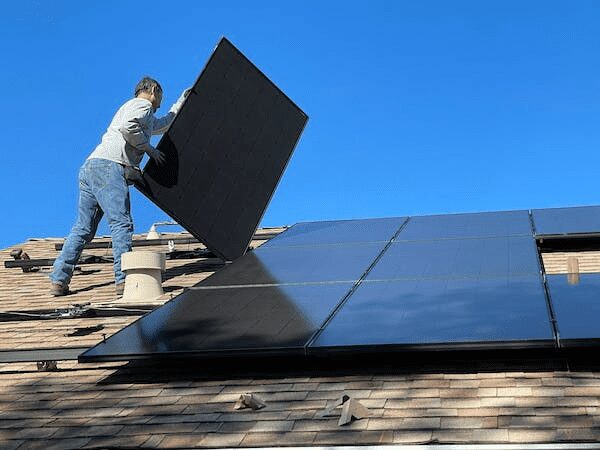
Module efficiency is the share of the sunlight falling on the panel that leaves it as electrical power. The formula is straightforward: electrical power output divided by solar power received, multiplied by 1003. A module described as 25 percent efficient converts a quarter of the sunlight striking its surface into electrical power, which at Standard Test Conditions works out at about 250 watts of peak power for every square metre of roof area11.
Most modern panels convert between 15 and 23 percent of incident sunlight, with premium options higher1. An independent review of retrofit technologies for the UK housing stock put the range of panels then on the market at 14 to 22 percent12. The gap between those two ranges is largely time: the review dates from 2021, and the top of the commercial range has moved since.
The definition of area matters more than it looks. For the purposes of Requirement L3 in England, official guidance states that the efficiency of a panel should be calculated by dividing the output in kWp by the area of the whole of the panel, including the frame but excluding flashings13. Approved Document L works on an assumed panel efficiency of 0.22 kWp per square metre for roof-mounted arrays on dwellinghouses14.
What efficiency does not tell a household is how much electricity the system will make. That depends on geographical location, the season and hours of daylight, the roof's compass direction and slope, any shading that blocks the panels at certain times of day, and the efficiency of the system as a whole. Efficiency governs how much power a given area of roof can carry, not how much sun falls on it.
Looking further ahead, tandem solar cells have recorded commercial efficiencies above the levels possible to achieve with current silicon panels, according to a parliamentary research briefing15. That is a laboratory and early-commercial position, not something on domestic datasheets today. More detail on the underlying cell architectures sits in solar cell technology.
Standard Test Conditions: the 25°C lab benchmark behind the rated wattage
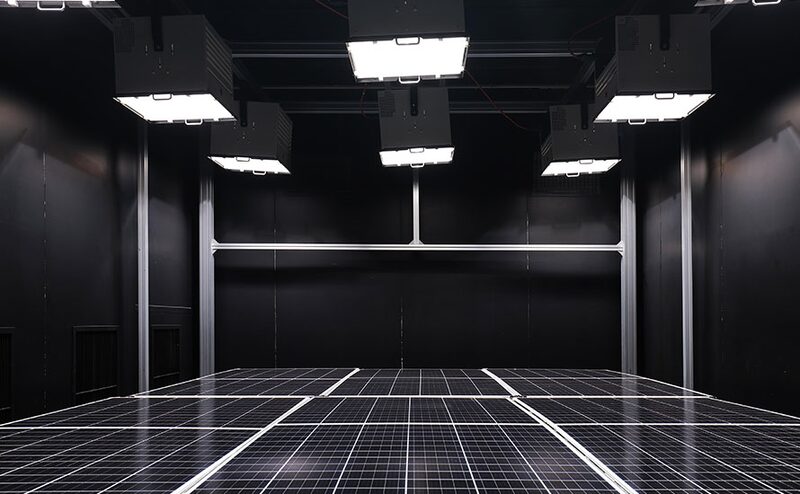
Every nameplate wattage on a domestic module is an STC figure. The conditions are artificial sunlight shining directly on the photovoltaic cells at 1,000 watts per square metre, the equivalent of noon sunshine, at 25 degrees Celsius, applied at an indoor lab2. A second maker describes the same benchmark as 1,000 W/m² irradiance with controlled cell temperature16.
The consequence is that a 400W panel is rated to produce 400W of direct current only under those conditions17. On a British roof the module is rarely at 25 degrees when the irradiance is high, and rarely at 1,000 W/m² when it is cool. Rated power for domestic modules typically runs between 100W and 400W per panel2, though a glossary from an independent community energy organisation puts a typical residential panel at around 250 to 400 watts under ideal conditions, with more efficient panels reaching up to 450 watts18.
Independent test programmes go well beyond a single STC flash. The Which? solar panel testing regime includes power stabilisation with solar radiation exposure of 25 kWh/m², determination of maximum overall production performance, nominal efficiency, performance decline after sun exposure, power output, power exposure with an external solar radiation exposure of 60 kWh/m², determination of maximum power generation, electroluminescence, and current leakage due to humidity19. That list is a useful reminder of what a single STC number leaves out.
Datasheet wattage also has a regulatory edge for plug-in systems. Consumer guidance from Electrical Safety First sets a professional assessment threshold where the total maximum DC power generated by the panels is above 960W, that is two panels each rated at 480W or above feeding into the micro-inverter10. Further detail is in plug-in solar kits.
Power tolerance: why a stated wattage is a band, not a point
Power tolerance is the permitted difference between the label and the measured output of the individual module. Modern high-volume modules generally carry a positive-only tolerance. The Jinko EAGLE 570-590 Watt module is specified with a positive power tolerance of 0 to plus 3 percent, and the EAGLE 580-600 Watt module carries the same 0 to plus 3 percent4. A positive-only band means the flash-tested module will measure at its rating or above, never below, which removes one source of disappointment in a string where modules are wired in series.
What tolerance is not is a prediction of roof output. Under real conditions a 400W panel commonly delivers 300W to 350W, depending on conditions17. Over a year, estimates of what a single 400W module produces in the UK cluster fairly closely but do not agree: 340 to 380 kWh a year under UK weather and sunlight conditions17; roughly 320 to 400 kWh annually before unusual shade or system losses, on an assumption of 800 to 1,000 kWh per kWp per year16; and 350 to 600 kWh a year depending on roof pitch, shade and environment21.
| Figure for a 400W module | Value | Basis |
|---|---|---|
| Rated output | 400W DC | STC, 25°C cell temperature17 |
| Typical real output | 300W to 350W | Actual conditions17 |
| Annual generation | 340 to 380 kWh | UK weather and sunlight17 |
| Annual generation | 320 to 400 kWh | At 800 to 1,000 kWh/kWp/year16 |
| Annual generation | 350 to 600 kWh | Varies with pitch, shade, environment21 |
Temperature losses: about 0.35% for each degree above 25°C
A photovoltaic panel performs optimally at 25 degrees Celsius, and beyond that efficiency typically decreases by about 0.35 percent per additional degree22. On a 35 degree day, that means a panel loses roughly 3 percent of its efficiency22. A second maker gives the temperature sensitivity as about 0.3 to 0.5 percent of output for every 1 degree rise above 25, and puts the resulting hot-weather loss at 10 to 15 percent23. Solar Energy UK, the trade body, describes performance falling by 0.34 percentage points per degree Celsius compared with standard conditions at 25 degrees24.
Those three figures are close enough to treat as one effect. The datasheet expresses it as the temperature coefficient of maximum power, and a smaller magnitude is a module that holds its output better on a hot, still day. The practical size of the effect in Britain is modest: the temperature coefficient is a summer afternoon matter, and the far larger seasonal swing comes from daylight, not heat. Panels can be 25 to 50 percent less effective in winter than in summer, because of winter's shorter days and increased cloud cover25.
Two related points from official guidance are worth setting beside the coefficient. Solar PV requires only daylight and not direct sunlight to generate electricity, so power can be generated even on a cloudy day26. And the modules themselves consist of one or two layers of semi-conducting material, normally packaged together into panels or other modular forms26. The temperature coefficient describes a property of that semiconductor, not of the installation.
Monocrystalline, polycrystalline and thin film: how cell type shapes efficiency
Official Welsh guidance groups domestic PV into crystalline cells, thin-film and hybrid types26. Within crystalline, the split is between single-crystal and multi-crystal silicon.
Monocrystalline modules take their efficiency from the single-crystal silicon that makes up the photovoltaic cells, and are described by an independent certification body as the most efficient panels currently available for domestic properties27. A Welsh public-sector scheme specification puts them at typically around 21 percent28, and official guidance from a local authority calls them the most efficient option in terms of commercially available solar panels29. Maker figures run higher: 20 to 23 percent typical residential rates, with some premium models up to 26 percent1, and one manufacturer claims a minimum efficiency of 23 percent for current monocrystalline3. Official and independent figures are the safer anchor here; the maker numbers describe the top of their own ranges.
Polycrystalline modules are slightly less efficient than monocrystalline, which are dark blue or black with no visible crystals30. Typical polycrystalline ratings are given as 15 to 17 percent1, though the consumer test body Which? lists polycrystalline up to 21 percent31. The two documents disagree, and the difference is probably one of typical versus best available. Official guidance adds that polycrystalline is less efficient than monocrystalline because it has a higher cost per watt of power, and is aesthetically less pleasing29.
Thin film panels are less efficient than either monocrystalline or polycrystalline27, listed at up to 13 percent31.
| Cell type | Efficiency | Source type |
|---|---|---|
| Monocrystalline | Typically around 21%28 | Official scheme specification |
| Monocrystalline | 20 to 23%, premium up to 26%1 | Maker guidance |
| Polycrystalline | 15 to 17% typical1 | Maker guidance |
| Polycrystalline | Up to 21%31 | Independent test body |
| Thin film | Up to 13%31 | Independent test body |
The same local authority guidance attributes to monocrystalline a cut in the typical electricity bill of 65 percent29. That is a single official claim about a whole system, not about a module, and it depends entirely on the household's consumption pattern. A fuller comparison sits in types of solar panel sold in the UK.
Certifications on the datasheet: IEC 61215 and IEC 61730
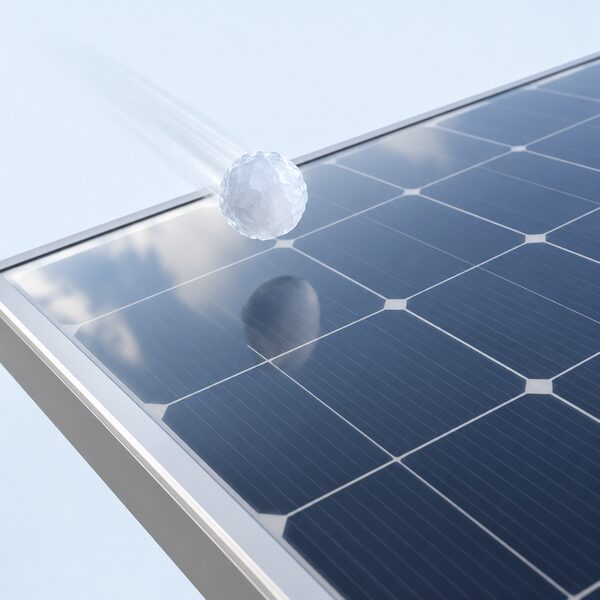
Two standards appear on almost every domestic module datasheet. IEC 61215 is the performance and durability standard; IEC 61730 covers module safety. The Jinko EAGLE 570-590 Watt module lists IEC 61215, IEC 61730 and UL 61730 certified products, and the EAGLE 580-600 Watt module lists IEC 61215 and IEC 617304.
The hail sequence within IEC 61215 is the part householders ask about most. It requires a hail test performed with a 25mm ice ball fired at 23 metres per second at eleven specified locations in the module glass, and the power loss cannot be more than 5 percent from the original measurement6.
"requires a hail test performed with a 25mm ice ball"
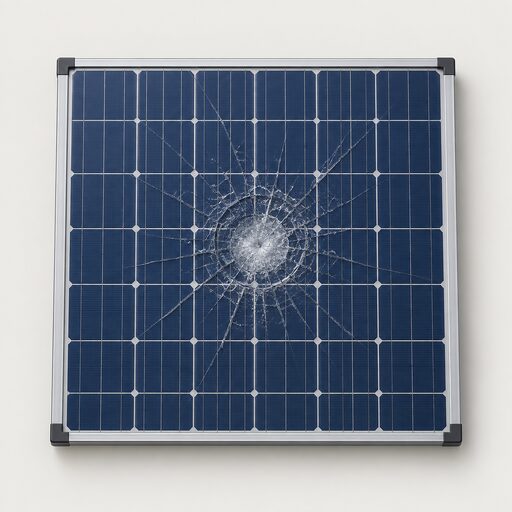
Glass construction sits behind that result. Panels from MCS-registered brands are made with tempered glass, so they will shatter rather than crack, like a car windscreen9.
A datasheet listing a certification is a claim, not proof of a current certificate. Manufacturer guidance on the subject sets out the check a buyer makes: verify the datasheet, request the certificates, and match certifications to the region7. The full picture of what each standard tests is covered in solar panel standards and testing.
From datasheet to real output: orientation, shading and degradation over 25 years
Rated power is what a module can do; orientation and shading decide what it does. Official guidance states that a system facing east or west tends to get around 15 to 20 percent less energy than one facing directly south33. An independent test body gives 15 percent less for an east or west roof and around 30 percent less for north-facing34. The Centre for Alternative Technology puts the east or west penalty at about 20 percent and says panels perform well facing anywhere between south-east and south-west at an angle of 20 to 50 degrees30. These are the same effect measured on slightly different assumptions. Where a roof is heavily shaded, official guidance is that solar panels may not be the most suitable option29. This is developed in roof orientation, pitch and shading.
Degradation is the other bridge between datasheet and lifetime output. Most panels lose between 0.2 and 0.5 percent of their efficiency each year5. An independent installer guide and two makers all settle on roughly 0.5 percent a year as the working figure5. A broader independent estimate gives a range of 0.5 to 3 percent per year depending on the type of panel, which would mean total degradation after 25 years of anything between 12.5 and 75 percent, with a good quality, well-maintained panel at a 0.5 percent rate still operating at 87.5 percent of full capacity35.
Worked through on a module starting at 22 percent efficiency, a 0.5 percent annual loss gives 20.9 percent at ten years, 18.9 percent at twenty and 17.9 percent at twenty-five; at 0.2 percent a year the same module is around 17 percent at twenty-five years5.
| Years in service | Efficiency at 0.5%/year loss, from 22% start5 |
|---|---|
| 10 | 20.9% |
| 20 | 18.9% |
| 25 | 17.9% |
Panels are expected to remain operational for 25 years or more33, and most come with a 25-year performance guarantee36. Some guarantees run longer, offering a minimum performance level such as 88 percent of initial capacity after 30 years37. The inverter is the shorter-lived component: official guidance is that inverters usually need replacing after around 12 years33. Warranties and degradation covers the terms in detail.
What efficiency means for cost, roof space and payback
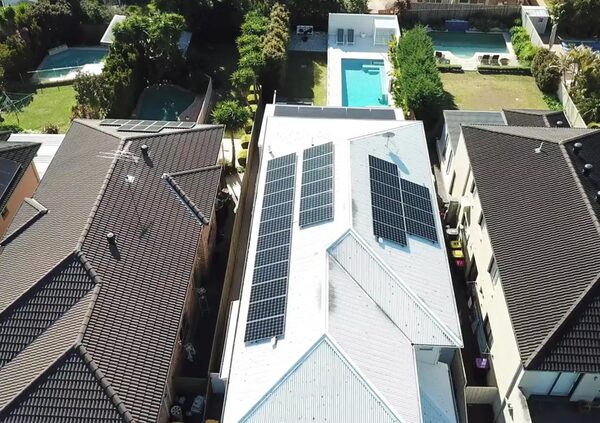
Efficiency is a roof-area question before it is a money question. Approved Document L assumes 0.22 kWp per square metre for roof-mounted arrays on dwellinghouses14. An average domestic system is around 3.5 kWp, typically covering between 10 and 20 square metres of roof using between six and twelve panels33. A higher-efficiency module fits more kilowatts peak onto a constrained roof; on a roof with spare area, the constraint moves to cost per installed kilowatt peak instead. Sizing is covered in what size solar system does a home need.
On cost and return, official guidance puts a typical installation at around £6,100 as of October 2025, saving between £530 and £650 a year on electricity bills for a typical home without electrical heating or an electric vehicle, and paying for itself in 10 to 12 years33. Within that, the saving is £650 a year if someone is home all day and £530 a year if everyone is out until 6pm33. An independent comparison of rooftop against plug-in systems gives a rooftop payback of 10.9 to 12.2 years38, which sits squarely alongside the official range. A trade association article states that solar panels pay for themselves within about five years33; that is a considerably shorter figure than the official and independent estimates, and the two claims cannot both hold. Which? calculations assume 25.8p/kWh electricity and estimated annual consumption of 2,500 kWh a year, as of 1 June 202531.
The direction of travel is favourable on both axes: panel prices are now less than half their 2010 price, and efficiency has almost doubled22.
What the datasheet does not settle: the independence question
An efficient module reduces the roof area needed for a given kilowatt peak. It does not, on its own, reduce a household's dependence on outside parties. The array produces direct current which a solar inverter converts to alternating current33, so an inverter manufacturer and its replacement cycle of around 12 years sit permanently in the chain33. The installation must be registered with the local distribution network operator, usually by the installer33. For export payments under the Smart Export Guarantee, the installation must be certified under MCS or equivalent and the property must have a smart meter capable of half-hourly readings, which brings a supplier into the arrangement31.
Regulatory and property conditions also sit outside the datasheet. Solar panels often do not need planning permission because they are considered permitted development, with exceptions for listed buildings and homes in conservation areas33. Installation may require approval under the Building Regulations because of the additional loading on the roof structure and the associated electrical works, and a household should also check for conditions attached to the original planning permission, an Article 4 Direction, or restrictions listed in the property's deeds29. The roof must be in good condition, have sufficient space and receive ample sunlight through the day29. In Northern Ireland, official guidance is that homeowners should seek independent advice on solar panels, heat pumps and other energy efficiency measures from organisations offering it.
Ratings persist beyond the household too: where a property with an existing array changes hands, an independent body's checklist asks whether the system is properly registered with MCS and any export tariffs, and the make and model on that MCS record is what leads back to the datasheet. The relationship between generation and genuine autonomy is set out in solar panels and household energy independence, and the wider picture in the solar PV guide.
Sources38 cited
- Solar panel efficiency explained, Fuse Energy, 2026-04-14
- What does rated power mean on solar panels, EcoFlow, 2025-06-16
- How solar panel efficiency impacts your savings, SunPower, 2026-07-28
- EAGLE 570-590 Watt module datasheet, JinkoSolar, 2024
- How long do solar panels last, So Energy, 2025-11
- pH levels when washing panels, Canadian Solar, 2026-09-17
- Guide to solar panel certifications: IEC, UL and TUV, Astronergy, 2026-09-17
- MCS 032 solar PV installation standard, MCS, 2025-01-01
- Solar panel problems and how to solve them, Which?, 2026-03-26
- Plug-in solar consumer guide, Electrical Safety First, 2026-08
- Solar modules with 25% efficiency: what it really means, LONGi, 2026-09-17
- Existing and future technologies for retrofitting the UK housing stock, CREDS, 2021-06-08
- Approved Document L frequently asked questions, GOV.UK, 2026-09-08
- Approved Document L Volume 1: Dwellings, GOV.UK, 2026
- Solar photovoltaics research briefing, UK Parliament POST, 2026-06-25
- Solar panel output explained, Bluetti, 2026-08-31
- Solar panel kit with battery and inverter in the UK, Jackery, 2026-06-04
- Energy glossary, Low Carbon Hub, 2026-08-05
- How we test solar panels, Which?, 2026-08-12
- EAGLE 580-600 Watt module datasheet, JinkoSolar, 2024
- How much electricity does solar power produce, Jackery, 2026-07-10
- Solar panel efficiency and energy savings, SunPower, 2026-07-28
- How many solar panels to power a refrigerator, EcoFlow, 2025-06-05
- Fact check: solar power works best in the summer, Solar Energy UK, 2023-06-13
- Do solar panels work in winter, Uswitch, 2026-09-15
- Generating your own energy: solar electricity, Welsh Government, 2026-09-17
- Solar panel installation, maintenance and repair, NICEIC, 2026-09-17
- Barcud solar panel installation scheme specification, Sell2Wales, 2026-06-15
- Clifton local listed building consent order guidance, Bristol City Council, 2025-02
- Solar photovoltaic information service, Centre for Alternative Technology, 2026-03-10
- Are solar panels worth it, Which?, 2026-05-15
- Light reflection from a solar system, Canadian Solar, 2026-09-17
- Solar panels: energy improvement options, Hammersmith and Fulham Council, 2025-10
- Buying advice for solar panels, Which?, 2026-08-12
- How long do solar panels last, Uswitch, 2026-07-13
- Solar panels guide, Uswitch, 2026-09-16
- Could solar panels save you £500 a year, Which?, 2026-06-17
- Plug-in solar panels vs rooftop systems, Which?, 2026-04-27
 How Energy Products Are TestedWhy does a solar panel's datasheet power rating look better than what you actually get on a UK roof?
 Standards and TestingWhat do the certificates on a solar panel datasheet actually prove, and which ones should you look for in the UK?
 Solar and Energy IndependenceHow far domestic solar cuts dependence on suppliers and the grid, what self-consumption really looks like across the year, what a battery, diverter or EV adds, and the grid-outage limit of ordinary inverters.
 Where Energy Products Are MadeWhere are solar panels and heat pumps actually made, and does it matter where yours comes from?
 Warranties and DegradationHow long do solar panels actually last, and what do the warranties really cover?
 MGD 003 Self-ConsumptionBuying a battery with solar panels means asking how much of your own solar you will actually use instead of sending it to the grid.