
In this guide
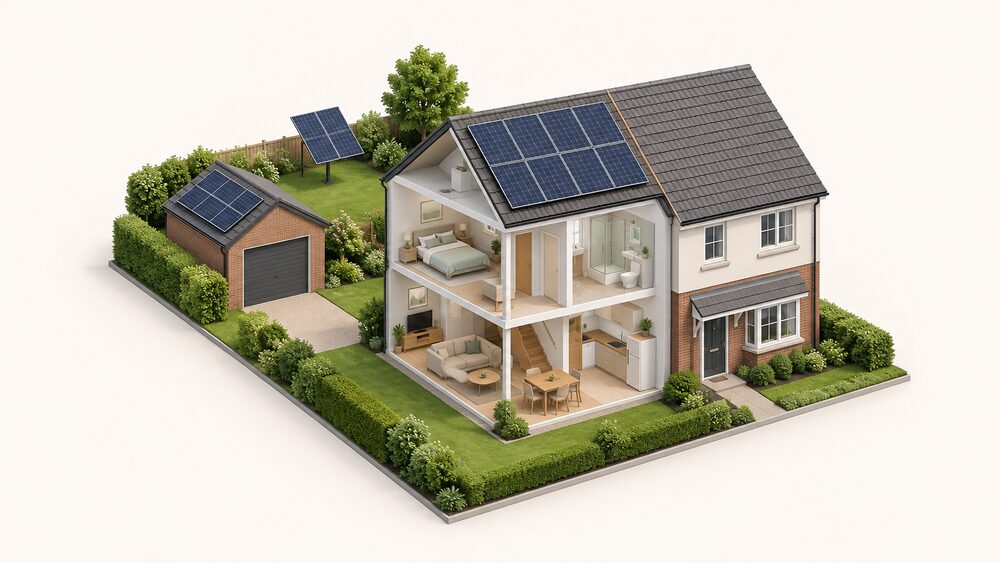
Most houses in the UK can have solar panels. Roof-mounted panels on a house or block of flats, and on a building within the grounds, are in most cases permitted development, whether the property sits in a conservation area or not1. The exceptions are narrow and specific: listed buildings, walls that front a highway inside a conservation area, and streets covered by an Article 4 direction that has removed the right2.
What varies between homes is not whether panels are allowed but how much roof is usable and what consent the building needs. A south-facing semi with a clear pitched roof is the straightforward case. A mid-terrace with a small roof, a flat with no roof at all, a listed cottage and a leasehold block each need a different answer, and for some of them a plug-in kit is the only realistic route.
The financial backdrop is time-limited. Installing qualifying energy-saving materials, solar panels included, carries 0% VAT until 31 March 20274. Parliamentary research confirms residential solar receives the zero rate until that date5. After it ends, the reduced rate is expected to apply, so the VAT position on a quotation depends on when the work is completed.
Roof and building suitability: what a house needs
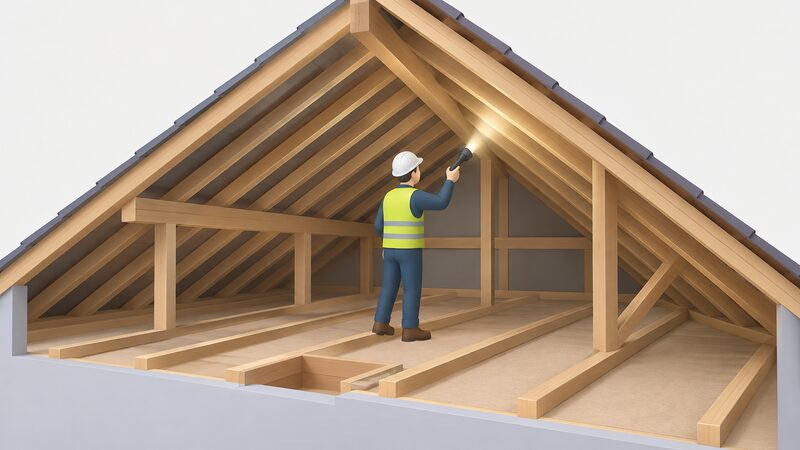
The physical requirements are the same whatever the house type. Panels can be installed on both pitched and flat roofs; on a flat roof they need to be tilted and spaced to avoid shading, which changes the mounting rather than ruling the roof out9. Flat roof work is possible with more flexibility over panel angle, but it is more complex because panels may need additional mounting systems and the roof must support the extra weight, so it can cost more than a pitched roof installation10.
The number of panels a roof can take is limited by the roof shape, skylights, shading from nearby buildings or trees, local planning or conservation area requirements, local grid capacity and export limits10. That list matters more than house type on its own. A large bungalow roof with a dormer and two mature trees may yield less than a compact terrace with a clean south slope.
Building Regulations approval is likely to be needed to add a solar panel to the roof of a home6. The adequacy of the existing roof to carry the load from the panel will need to be checked and proven6, and the check covers the additional wind, snow and static load imposed by the panels and compliance with Part A: Structure12. The regulations also cover the electrical installation13. This is a structural question, not a paperwork formality, and it is the point at which an older roof may need strengthening before anything is fitted.
Planning permission: when panels are permitted development
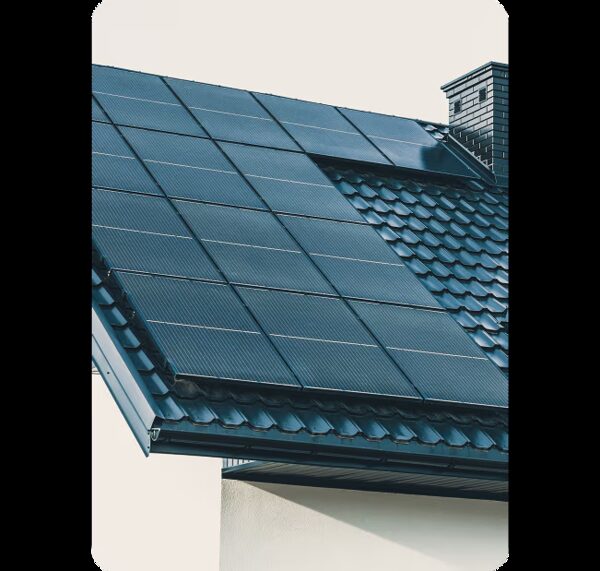
Placing solar panels on the roof of a house or flat, or on a building within the grounds, is considered in most cases permitted development under the Town and Country Planning (General Permitted Development) (England) Order 2015, Schedule 2, Part 14, Class J14. Homes can often have panels without requiring planning permission from the council, so long as certain conditions apply13. Solar panels and equipment installed on domestic buildings and land are usually considered permitted development, with a few exceptions15.
The conditions are what decide the marginal cases. Panels must be no higher than the roof, excluding any chimney1. On pitched roofs they must not exceed the highest part of the roof, again excluding chimneys16. Equipment must not stick out more than 20 centimetres from the wall or roof slope17. Where the conditions cannot be met, planning permission is needed18.
Scotland has its own householder permitted development rules, set out in Circular 1 of 202419. Development is not permitted on a listed building or within the curtilage of a listed building, and is not permitted within a World Heritage Site19. Wales publishes separate guidance on planning permission for solar panels2, and Northern Ireland has its own consent route. Where a household sits near a national boundary, the nation matters more than the house type.
Listed buildings and conservation areas: where permission is needed
A listed building is the clearest case. Solar panels on listed buildings need planning permission and listed building consent13. Listed building consent will be required to place panels on a listed building, including buildings within the curtilage which pre-date July 194820. If the property is listed, planning permission and listed building consent are always needed16. The same applies where the house or flat is, or sits within the garden or grounds of, a listed building17.
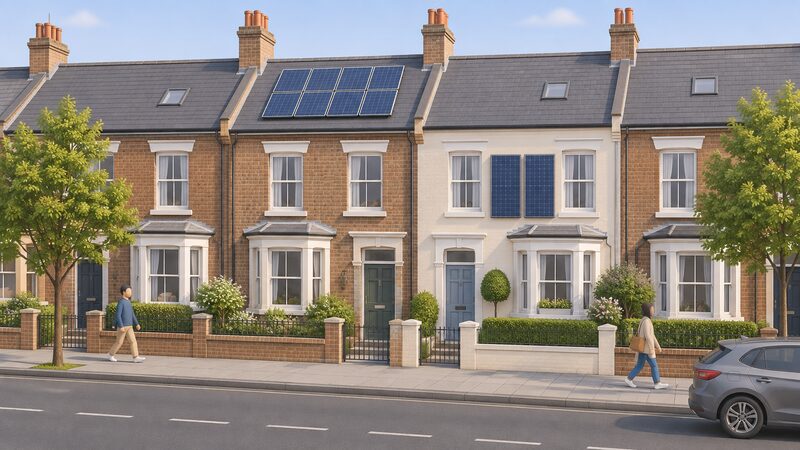
Conservation areas are more permissive than their reputation suggests. Planning permission is not usually required to install solar panels on the roof of a house or block of flats in a conservation area, even if the roof faces a highway1. Panels fitted to roofs in conservation areas do not require planning permission provided they meet the general rules16. Where the property is in a conservation area or a World Heritage Site, consent is required when panels are fitted on the principal or side elevation walls and are visible from the highway2.
The wall rule is the one that catches people out. Planning permission is required when installing panels or other equipment on a wall fronting a highway within a conservation area1. A highway includes roads, paths and public rights of way3. Planning permission is required if panels are fitted to a wall facing a public road, defined in planning terms as a highway, which includes adopted roads but not footpaths16.
Article 4 directions change the picture street by street. They remove permitted development rights for solar panel installations, so planning permission must be applied for3. Where an Article 4 direction covers a conservation area and removes rights for roof alterations, planning permission may be required20. Where there is no Article 4 direction, permitted development rights apply and no permission is needed20. Checking with the planning department first, through the duty planning officer service, is the standard step before ordering18.
One local variation shows how far consent can be relaxed. A local listed building consent order in the Clifton Conservation Area covers the installation of solar panels to listed residential properties, removing the need for consent for those works subject to the conditions of the order21. Under that order, a panel will not be permitted on a roof slope that faces the main street, because it would be clearly visible from any distance and cause harm to the asset21.
Outbuildings and garages: panels away from the main roof
Solar panels include roof-mounted panels as well as ground-mounted panels within the curtilage of residential accommodation1. A building within the grounds of a house is treated in the same way as the house itself for permitted development purposes1. That makes a garage, a workshop or a garden office a legitimate mounting location, and it can be the better one where the main roof is shaded, small or awkward.
The conditions still apply. Panels mounted on outbuildings within the curtilage of a dwelling must not protrude more than 500 millimetres from the outer surface of an external wall, roof plane, roof ridge or chimney19. Standalone solar panels on domestic premises must not exceed 4 metres in height3. On a flat roof, panels cannot be sited within 1 metre of the external edge of the roof2.
Where a standalone installation triggers any of the conditions, full planning permission is needed for flats and householder planning permission for houses14. The distinction between a roof-mounted array on an outbuilding and a ground-mounted array in the garden matters here, because the ground-mounted case is the one that most often needs an application.
Plug-in and balcony solar: the low-power alternative for flats and renters
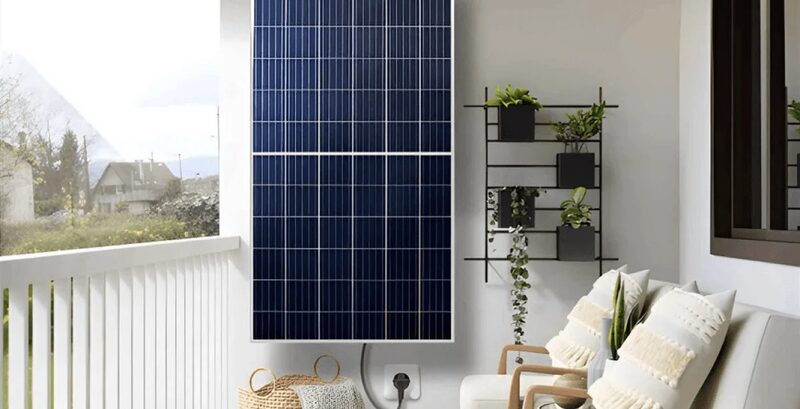
For flats and rented homes, a plug-in kit is often the only route that does not depend on a landlord's consent to structural work. The low-cost panels can be put in any outdoor space or on some balconies22. Renters and flat owners need permission from their landlord or freeholder before installing7. Plug-in solar panels are considered permitted development for flats, subject to restrictions, and landlord or freeholder permission is needed to fix panels to the outside of the building23.
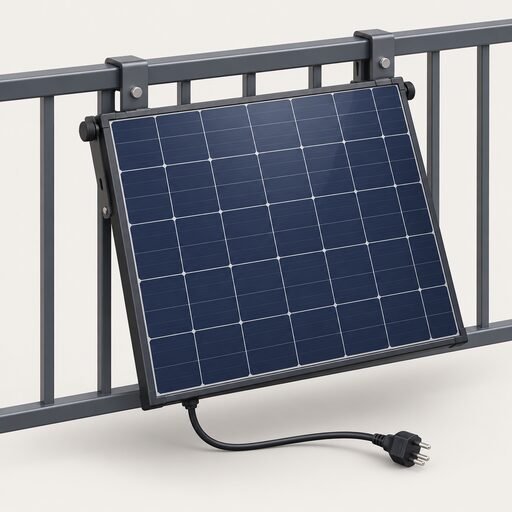
A kit typically includes one or two solar panels, a microinverter that converts direct current to usable alternating current, and a lead fitted with a standard three-pin plug, along with mounting brackets and an app for monitoring23. The interim product specification requires at least one PV module, a grid-following inverter, a connection lead fitted with a plug complying with BS 1363, and a mounting system for the panel24.
The output ceiling is the defining limit. UK-compliant plug-in solar devices are limited to a maximum output of around 800W, which is enough for everyday appliances but leaves higher-use appliances drawing from the grid7. Only one plug-in solar kit is allowed per home, so a second unit cannot be added on a different socket23.
| System | Typical annual generation | Source |
|---|---|---|
| Plug-in or balcony kit | Up to 720kWh (estimated) | 23 |
| Rooftop array | 3,800kWh to 4,350kWh | 23 |
The gap between those two rows is the honest measure of what a plug-in kit does for independence. It covers a share of base load and reduces what is drawn from the grid, but it does not make a flat self-sufficient, and it does not remove the supplier. For the wider picture, see plug-in solar kits and balcony solar systems.
New-build homes: the Future Homes Standard and solar by default
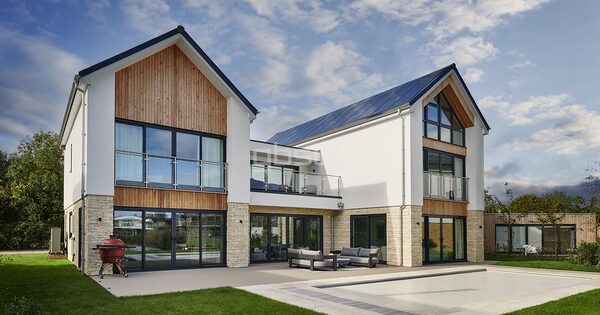
New rules will mean every new home comes with solar panels by default8. That is the direction of travel, but the detail is not settled. A final decision on the amount of solar panels that new homes will typically be expected to include is yet to be made, and solar panels are not currently mandated25.
The consultation history shows the range under consideration. The government consulted again on a detailed specification from November 2023 to March 202425. One option would have required solar PV panels covering the equivalent of 40% of a new home's ground floor area, and under that option solar PV panels would not have been required for blocks of flats over 15 storeys25.
The bill impact is significant. The Microgeneration Certification Scheme and Solar Energy UK say the Future Homes Standard would save the average household around £1,000 a year5. That figure is a modelled saving for new homes built to the standard, not a saving available to an existing dwelling.
For an existing home, the standard changes nothing directly. It does change the market: a buyer comparing a new build with solar fitted against an older house without it is comparing two different running costs. The practical question for an existing householder is whether the roof can take an array, which is answered by the suitability and consent rules above rather than by the standard.
VAT: the 0% rate and when it ends
Installing energy-saving materials, including insulation and solar panels, carries 0% VAT until 31 March 20274. Parliamentary research confirms residential solar receives the zero rate of VAT until 31 March 20275. The relief is a deadline, not a permanent feature of the market.
The date matters for quotations. A quote issued now and a quote issued after the deadline are not comparable, because the VAT treatment differs. The reduced rate is expected to apply once the zero rate ends, so the difference is a real sum on a typical installation rather than a rounding error.
What solar means for household energy independence
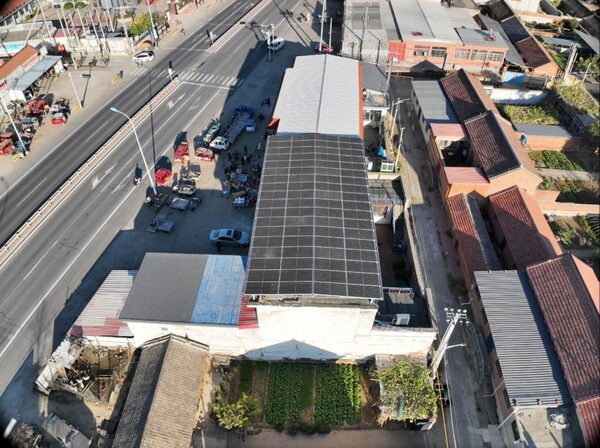
Photovoltaic panels could power a home, reduce bills and may earn money26. That is the benefit side, and it is real: a rooftop array of the size the published comparison covers generates 3,800 to 4,350kWh a year23, which is a substantial share of a typical household's consumption.
The dependence that remains is worth stating as plainly as the benefit. A grid-connected array still draws from the grid at night and in winter, still relies on a supplier for import and export, and still depends on the distribution network's capacity to accept what it exports. Local grid capacity and export limits are among the factors that constrain how many panels a roof can carry in the first place10. A plug-in kit is more dependent still: capped at around 800W, one per home, and unable to cover higher-use appliances7.
Tenure adds a second layer. A homeowner with a suitable roof controls the decision. A renter or flat owner needs a landlord's or freeholder's permission before installing7, and a listed building owner needs planning permission and listed building consent before anything is fitted13. For those households, the realistic ceiling on independence is lower, and the plug-in route is the one that fits within it.
For the fuller picture of what an array does and does not deliver, see solar panels and household energy independence and the full guide to solar PV.
Sources26 cited
- Solar panels guidance, City of York Council, 2026-09-17
- Planning permission: solar panels, Welsh Government, 2026-09-17
- Renewable energy: solar panels and heat pumps, Rother District Council, 2026-09-17
- Energy Performance Certificates guide, Uswitch, 2027-03-31
- Future Homes Standard and residential solar, Parliamentary Office of Science and Technology, 2026-06-25
- Building regulations: energy efficiency, Welsh Government, 2026-09-17
- Plug-in solar panels, Energy Saving Trust, 2026-09-17
- Families to save in biggest home upgrade plan in British history, GOV.UK, 2026-01-20
- Solar panels, London Borough of Hammersmith & Fulham, 2026-09-17
- Solar panel installation, Energy Saving Trust, 2026-09-07
- Building regulations energy efficiency, Planning Portal, 2026
- Solar panels, East Hertfordshire District Council, 2026-09-17
- Solar panels and planning permission, Cornwall Council, 2026-09-17
- Solar panels, Wirral Council, 2026-09-17
- Installing solar panels at your home, Brighton & Hove City Council, 2026-09-17
- Planning and solar, Frome Town Council, 2025-09-02
- Solar panels, Bristol City Council, 2026-09-17
- Solar panels guidance, London Borough of Islington, 2026-09-17
- Householder permitted development rights, Scottish Government, 2024-05-28
- Solar photovoltaics and planning in conservation areas, West Suffolk Council, 2026-09-17
- Clifton local listed building consent order guidance, Bristol City Council, 2025-02
- Households can save as plug-in solar panels come to market, GOV.UK, 2026-08-26
- Plug-in solar panels, Which?, 2026-09-15
- Plug-in solar interim product specification, Department for Energy Security and Net Zero, 2026-07
- The Future Homes Standard, House of Commons Library, 2024-10-24
- Solar photovoltaic panels, London Borough of Bromley, 2026-09-17
 Solar Mounting SystemsWill your roof take the extra weight of solar panels, and will it still keep the rain out afterwards?
 Balcony Solar SystemsCan you really plug solar panels into a normal socket, and what will it save you?
 Planning Permission EnglandMost homes in England can have solar panels fitted without planning permission, but does yours count as one of the exceptions?
 Roof Orientation and ShadingWhich way should your roof face for solar panels, and does it really matter if it is not south?
 Cooling with Solar PanelsCan solar panels run an air conditioner, and will they cover the whole bill?
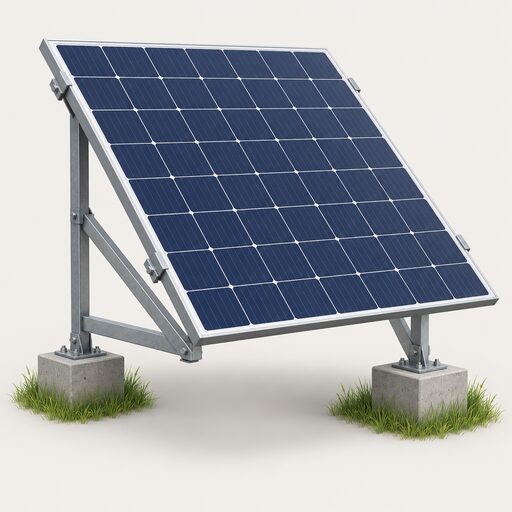 Ground-Mounted SolarGround-mounted solar panels sit on a frame in your garden instead of on your roof, which helps if your roof is shaded, small or facing the wrong way.