
In this guide
Selling solar electricity back to the grid now runs through two entirely separate mechanisms, and which one applies to a household depends on when its panels were accredited. The Feed-in Tariff (FIT) is closed to new applications, but installations already accredited continue to receive payments for their eligibility period, typically 20 years and 25 years for solar accredited before 1 August 20121. New solar households are paid for export through the Smart Export Guarantee (SEG), under which larger suppliers must offer a price per kWh for exported electricity3.
The two schemes do not overlap on the same electricity. A household cannot receive both SEG payments and FIT export payments for the same generation capacity, though it can receive SEG payments for one installation while receiving FIT export payments for a completely separate one with distinct import and export meters and different import and export MPANs2. FIT generation payments and SEG export payments can be held at the same time5.
What a household is paid is not a single national figure. FIT export payments are a fixed rate set when the installation was accredited, adjusted annually with inflation1. SEG rates are set by each supplier, and the scheme rules require only that larger suppliers offer a price per kWh4. The metering and evidence requirements differ too, and they are where most disputes and delays arise.
The Feed-in Tariff is closed, but existing payments continue
The FIT scheme was introduced on 1 April 2010 by the Department for Energy and Climate Change, and it required participating licensed electricity suppliers to make payments on electricity generated and exported by accredited installations1. It closed to new applications on 1 April 2019, and all pathways for accreditation are now closed3. Installations already accredited under the scheme continue to receive payments2.
That distinction matters for anyone buying a property with panels already on the roof. The scheme still operates for existing arrangements, and the payments are made by FIT licensees, the licensed electricity suppliers that administer the scheme day to day2. Much of that administration, including making FIT payments, taking and verifying meter readings, handling complaints and updating generator details, sits with the licensees rather than with Ofgem1.
The scheme's territorial extent is England, Wales and Scotland3. Northern Ireland has its own arrangements, and the FIT scheme as described here does not extend to it.
For a household, the practical consequence is that FIT income is a legacy asset attached to a specific accredited installation, not a scheme a new buyer can join. It is also a payment stream that depends on the installation remaining registered, metered and evidenced, which is why the record-keeping obligations below carry real weight.
How the FIT worked: generation and export payments
The FIT paid on two separate bases, and understanding the split explains almost everything about how the scheme is administered today.
| Payment | Basis | What it rewards |
|---|---|---|
| FIT Generation Payment | Fixed payment per kWh generated by the eligible installation9 | Output, whether used on site or exported |
| FIT Export Payment | Fixed payment per kWh exported to the National Grid9 | Only what leaves the property |
Payments are based on meter readings that FIT generators submit to their FIT licensee, and they are made at least quarterly1. Ofgem's own description of the scheme confirms payments are usually quarterly for the electricity accredited installations generate and export12.
The scale of the scheme is substantial. A total of £470,575,744.17 in FIT export and generation payments was made in the quarter to 30 June 20247. In Scheme Year 13, export payments to FIT generators totalled £80,733,2818. Approximately 1.3 TWh of renewable electricity was exported to the grid under the FIT scheme in Scheme Year 141.
The scheme was designed by government to promote the uptake of renewable and low-carbon electricity generation, and later to promote the uptake of small-scale renewable and low-carbon generation specifically11. That purpose shaped the tariff structure: generation payments reward output regardless of self-consumption, which is why a FIT household's economics differ from a SEG household's.
What FIT pays today: rates, indexation and the term
FIT support is payable for the installation's eligibility period, typically 20 years, and tariffs are adjusted annually6. The eligibility period is not uniform: FIT generators receive support for between 10 and 25 years depending on technology type, capacity, when their installation was commissioned, and whether it was previously accredited under the Renewables Obligation scheme13. Solar installations accredited before 1 August 2012 have a maximum eligibility period of 25 years1.
The tariff rate assigned to an accredited installation depends on several factors:
- technology type
- total installed capacity
- position in deployment caps
- for solar, whether it is classed as a multi-site generator
- for solar, whether it meets the Energy Efficiency Requirement5
Generation and export tariffs are adjusted by the percentage increase or decrease in inflation, based on the 12-month period ending on 31 December of the previous year2.
Deployment caps place limits on the total capacity that can receive a particular tariff rate in a particular tariff period14. Tariff periods for solar PV, wind, hydro and anaerobic digestion installations are quarterly; for micro CHP they are six monthly14. These caps are historical now, since the scheme is closed, but they explain why two neighbouring installations accredited weeks apart can sit on different rates.
Where an installation is extended, payment can be split. In the worked example Ofgem gives, a 40kW installation extended by 10kW, where the extension is accredited and there is no separate meter, entitles the generator to payment for 80% of the electricity at the tariff rate of the original installation and 20% at the extension tariff rates9.
The Smart Export Guarantee: how new solar households get paid
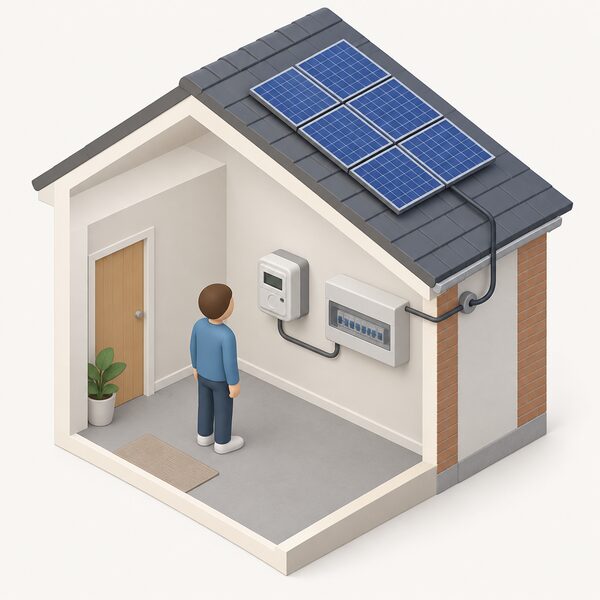
The Smart Export Guarantee is the route by which a household installing solar now is paid for what it exports. Solar panels capture the sun's energy and convert it into electricity that can be used in the home or sent back to the electricity grid in return for a payment known as the Smart Export Guarantee15. The government's announcement of the scheme confirmed that households and businesses installing new solar panels would be guaranteed payment for power provided back to the grid16.
The obligation falls on larger suppliers. Suppliers with more than 250,000 domestic electricity supply customers must offer small-scale generators a price per kWh for the electricity they export to the grid4. SEG generators are paid by their chosen SEG Licensee for the electricity they export back to the National Grid10.
Two conditions shape what a household can actually claim:
- Exported power must be metered, with a meter capable of reporting exports on a half hourly basis9.
- Generators must have a smart meter to monitor exports17.
Both are metering requirements rather than paperwork, and they are the reason a SEG claim depends on hardware being in place before the first payment.
The scheme does not set a rate. Each SEG licensee sets its own price per kWh, and the rules require only that an offer is made. That is the structural difference from the FIT: a FIT generator's export rate was fixed at accreditation and indexed, while a SEG generator's rate is a commercial offer that can be compared and changed.
For a household, SEG income is therefore a live commercial relationship rather than a legacy entitlement. It depends on the supplier, on the meter, and on the export being measured rather than deemed.
SEG versus FIT export: the one-way switch
A legacy FIT generator with export capability faces a choice, and it is not reversible in the way a tariff switch usually is.
| FIT export tariff | SEG export rate | |
|---|---|---|
| Who sets it | Fixed at accreditation, indexed annually1 | Each SEG licensee sets its own4 |
| Basis of payment | Fixed rate per kWh exported9 | Price per kWh offered by the chosen licensee4 |
| Can it be held with the other? | No, not for the same generation capacity5 | No, not for the same generation capacity5 |
| Reversible? | Cannot be reclaimed once given up1 | Commercial offer, can be compared and changed |
Generators with the ability to export have to make an initial choice whether to receive the guaranteed export payment or sell exported electricity on the open market1. Generators intending to claim SEG payments must not be in receipt of an FIT export tariff for the same generation capacity5. The restriction is stated plainly: you cannot receive both SEG payments and FIT export payments for the same electricity18.
The generation side is treated differently. Generators do not have to opt out of FIT generation payments to receive SEG export payments5. So a FIT household can keep its generation payments and add SEG export payments, provided it gives up the FIT export tariff on that same capacity.
There is also a route for a second, separate installation. A household can receive SEG payments for an installation when it already receives FIT export payments for a different installation, as long as the installations are completely separate with distinct import and export meters and different import and export MPANs2.
The comparison a household is making is between a fixed, inflation-adjusted export rate set years ago and a current commercial rate that may rise or fall. The scheme rules do not express a preference, and no source in the evidence base recommends one route over the other.
Metering: smart meters, generation meters and deemed export
Metering is where the two schemes diverge most sharply, and where a household's claim either stands or falls.
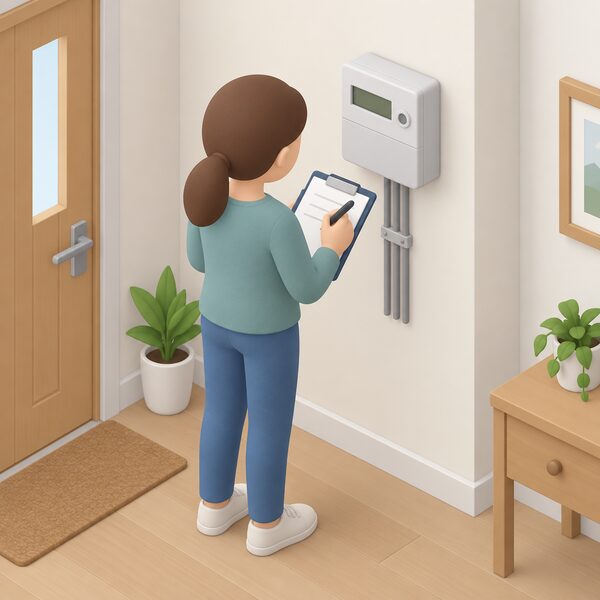
Under the FIT, a generation meter must be able to calculate the electricity generated by the installation separate from any other energy source, unless pro-rating is available2. A FIT household must be able to measure the electricity generated, and exported if applicable, separately from all other sources to receive generation payments and, if metered, export payments18. A generation meter cannot be used to claim FIT export payments, though the generation reading could be used to claim deemed export payments if eligible2.
Deemed export is the mechanism that made FIT export payments possible without an export meter. The deemed percentage is set annually by government: for Scheme Year 13 it was 75% for hydro and 50% for all other technologies, applied to generation meter readings8. That 50% figure is the one most solar households recognise.
Under the SEG, the approach is different. Exported power must be metered, with a meter capable of reporting exports on a half hourly basis9, and generators must have a smart meter to monitor exports17. A smart meter automatically sends electricity and gas meter readings to the supplier, and readings are sent via the DCC's secure network20. Smart meters are supplied free by energy suppliers10.
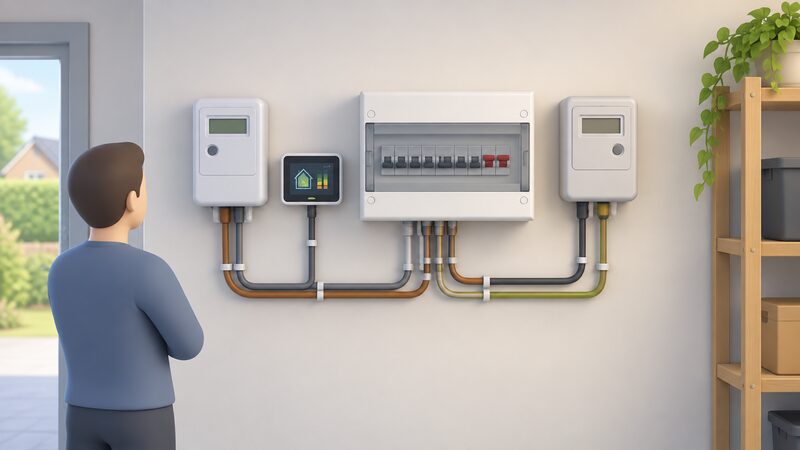
The smart metering system can support up to four smart electricity meters per household, and smart electricity meters can be used as generation meters22. That matters for a household running both a FIT installation and a separate SEG installation, since the metering has to keep the two streams distinct.
Your obligations as a FIT generator
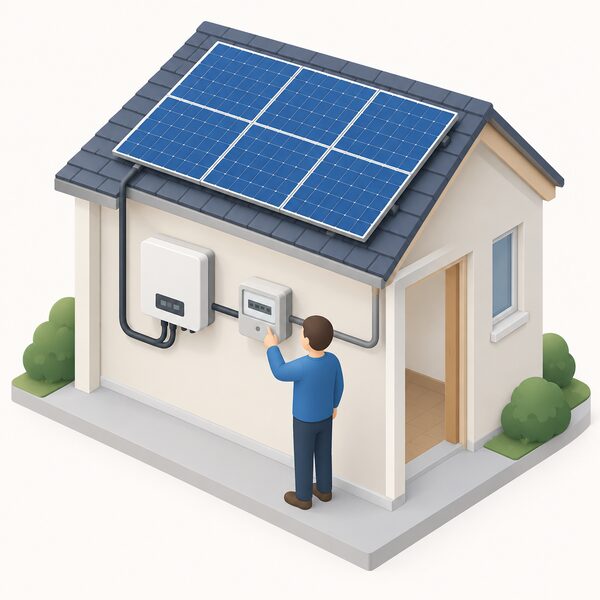
FIT generators are responsible for registering with a FIT licensee, from whom they receive payments, and for providing meter readings and any other information that might be required about their installation18. The generator is the owner of the accredited installation1.
Several notifications are mandatory:
- Inform the Mandatory FIT Licensee as soon as possible of a change in ownership of an accredited FIT installation9.
- Notify Ofgem and the FIT licensee when extending or reducing total installed capacity23.
- A generator of a ROO-FIT installation must inform Ofgem, in addition to the FIT licensee, of any changes to the installation or its ownership by updating the Renewable Electricity Register18.
- Tell the FIT Licensee if they become the owner, nominated recipient or a connected person of 25 or more FIT installations2.
- For solar PV, a new generator taking over an installation will need to make a new multi-installation declaration2.
Storage and electric vehicle charging attached to a FIT installation must be reported. Co-locating storage with the FIT installation should be reported to the FIT Licensee, and additionally to Ofgem if ROO-FIT accredited, with an updated single line or schematic diagram, details of the meter readings used to claim FIT payments, and details of the storage facility installed including confirmation of the date installed and commissioned with supporting evidence2.
Evidence retention is a continuing duty. It is the generator's responsibility to retain and provide evidence upon request regardless of when they assumed responsibility for an installation, including where an installation has been acquired post commissioning24.
The Central FIT Register and proving ownership
The Central FIT Register is the register kept and maintained by Ofgem in which all FIT accredited installations are recorded, and it is described as a database of all FIT accredited installations25. The Renewables and CHP Register is the register maintained by Ofgem through which FIT generators with ROO-FIT installations apply for accreditation and record any changes to it25.
Ownership is not assumed. FIT companies are responsible for establishing that a FIT applicant is the owner of the eligible installation and must obtain documented evidence of the relationship between owner and installation26. When registering an eligible installation, a FIT licensee was required to ensure that the identity of the FIT generator was verified, and a FIT licensee must have requested domestic installation owners to provide proof of address, which may have taken the form of utility bills, bank statements, council tax bills or equivalent documents5. Applicants are also required to provide proof of ownership of the installation19.
Accepted evidence includes:
- a receipt or other documentation stating ownership or the transfer of ownership from the previously stated owner, with invoices acceptable if values are redacted
- a sale and purchase agreement as part of a property sale or equivalent showing the installation is paid in full
- a death certificate where required26
For a buyer, that means the paperwork trail is the asset. A property with panels but no ownership evidence, no meter readings history and no register entry is a property whose FIT income cannot be relied on.
Where a dispute arises, only the owner of the installation or those who have been assigned FIT payment rights as nominated recipients may complain or raise a dispute, although non-owners may still make certain information requests27.
What happens when a FIT supplier fails or a household switches
FIT payments do not transfer automatically when a supplier fails. If a household receives FIT payments from a FIT licensee that has failed, the payments will not transfer automatically18.
Switching between FIT licensees is a different process and is supported by the rules. All FIT licensees have a duty to facilitate the switching of a FIT generator from one FIT licensee to another5. The new FIT Licensee is obliged to pay all FIT payments from the switch date, and the old FIT licensee is obliged to pay all FIT payments due up to the switch date2. The previous FIT licensee shall be obliged to pay all FIT payments due to the FIT generator up to the switch date5.
The generator has steps to take. A household needs to agree a new statement of FIT terms with the new licensee and provide up-to-date meter readings before payments start18. FIT licensees are responsible for making FIT payments to generators and nominated recipients in a timely manner5.
The Continuity of FIT Payments Direction provides assurance that electricity generated between the date of the last meter reading where FIT payments were made and the date the installation moves to a new FIT licensee will be paid9. That closes the gap that would otherwise open during a switch.
For a household, the practical point is that FIT income is portable between licensees but not automatic. It follows the installation and the paperwork, not the energy account.
What the scheme has delivered
The FIT scheme's own statistics run from 1 April 2010 to 31 March 2026, covering the total number of installations and total capacity by technology alongside installation types, with a further breakdown by region28. Quarterly activity data covers 2010 to 2026, per quarter by technology and capacity28.
The most recent quarterly report covers the third quarter of FIT Year 16, from 1 October to 31 December 20256. Ofgem also publishes a levelisation report detailing the total FIT payments made by FIT licensees for the quarter from April to June 202629.
The government's own framing of the scheme's reach, at the point the SEG was announced, was that there were over 830,000 solar installations producing enough power for two million homes16. That figure is from January 2019 and describes the installed base at the point the FIT closed.
One Ofgem annual report gives 8.3 TWh of electricity generated, while another states that over 82 TWh has been generated throughout the scheme's lifetime. One gives £1.76 billion in generation payments, another nearly £16.2 billion of FIT payments made to generators over the scheme lifetime. The figures are not reconciled in the documents, and the difference appears to be between a single scheme year and the scheme lifetime.
Where the money comes from and what dependence remains
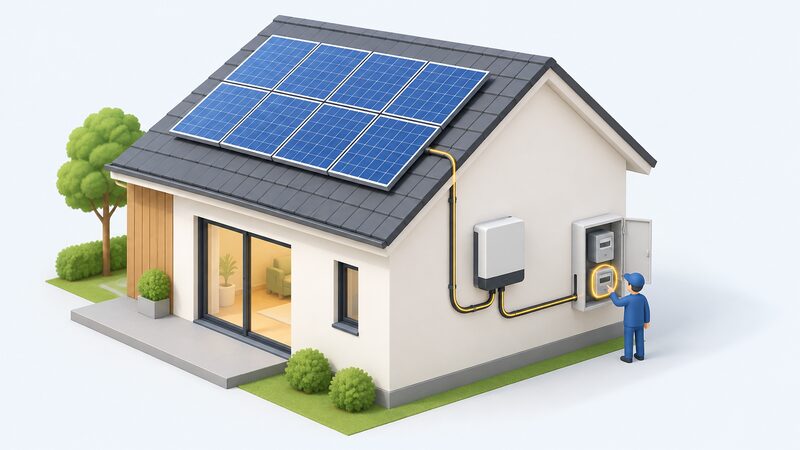
Both schemes pay for export to the grid, which means both depend on the grid being there to accept the electricity. A FIT or SEG household is not independent of the network; it is a small generator connected to it, paid by a licensee for what it sends out.
The dependence has several layers. The household depends on a FIT licensee or a SEG licensee to make the payment, on a meter to measure the flow, and on the register or the supplier's records to establish entitlement. Under the FIT, the payment stream is tied to an accreditation that cannot be recreated. Under the SEG, it is tied to a commercial offer that a supplier sets and can change.
What the household controls is its own consumption. Electricity used on site is not exported and not paid for at an export rate; it displaces imported electricity instead. The Oxfordshire guidance describes the model plainly: solar panels let a household sell any surplus energy it does not use back to the grid30. The word surplus carries the whole economics of export payments.
For energy independence, the export payment is the least independent part of a solar installation. It converts a physical output into a financial claim on a supplier. The self-consumed portion is the part that reduces reliance on imports, and it is not paid for by anyone.
Sources30 cited
- Feed-in Tariffs (FIT), Ofgem
- Guidance for FIT Generators V18, Ofgem, 2024
- FIT scheme closure, Ofgem
- The future for small-scale low-carbon generation: SEG, BEIS, 2019
- FIT Guidance for Licensed Electricity Suppliers V17.1, Ofgem, 2024
- Feed-in Tariffs Quarterly Report Issue 64, Ofgem, 2026
- Feed-in Tariffs Quarterly Report Issue 57, Ofgem, 2024
- Feed-in Tariffs Annual Report Scheme Year 13, Ofgem, 2023
- Feed-in Tariffs Guidance for renewable installations V16, Ofgem, 2021
- Smart Export Guarantee (SEG), Ofgem
- FIT annual report SY14, Ofgem, 2024
- Energy customers who produce renewable energy get £800,000 compensation, Ofgem, 2022
- Feed-in Tariffs Quarterly Report Issue 63, Ofgem, 2026
- Feed-in Tariffs deployment caps reports, Ofgem
- Solar panels, Oxfordshire County Council
- Proposals to protect consumers whilst guaranteeing payments for households with solar, BEIS, 2019
- POST note 771: Smart meters, Parliamentary Office of Science and Technology
- Feed-in Tariffs (FIT) generators, Ofgem
- Feed-in Tariffs Guidance for Licensed Electricity Suppliers V15.0, Ofgem, 2021
- Getting a smart meter, Ofgem
- How do smart meters save energy?, Smart DCC
- Written evidence on smart meters, Science and Technology Committee
- Consultation on the treatment of replacement generating equipment: decision, Ofgem, 2021
- Feed Tariffs guide: commissioning, Ofgem
- Key terms explained: Feed-in Tariffs, Ofgem
- Feed-in Tariffs, Energy Ombudsman
- Dispute resolution, Ofgem
- Feed-in Tariffs quarterly statistics, Ofgem
- Feed Tariff levelisation report April to June 2026, Ofgem, 2026
- Solar Note Under 50KW April 2014, Maidstone Borough Council, 2014
 The Full Solar Panels GuideHow much do solar panels cost, and what could they save you each year?
 Solar and Battery Import TariffsWhat does a special import tariff actually get you when you have solar panels or a home battery?
 Savings and PaybackExplains how bill savings from solar are made up of avoided import and export income, and what drives the payback period.
 Export Rates Per kWhHow much will your supplier pay you for the solar power you send to the grid, and why do rates vary so much from one company to another?
 Charging an EV from Solar PanelsCharging your car from solar panels means using the power your roof makes instead of sending it to the grid.
 The Full Tariffs GuideWhich energy tariff suits how you live, and will switching really save you money?