
In this guide
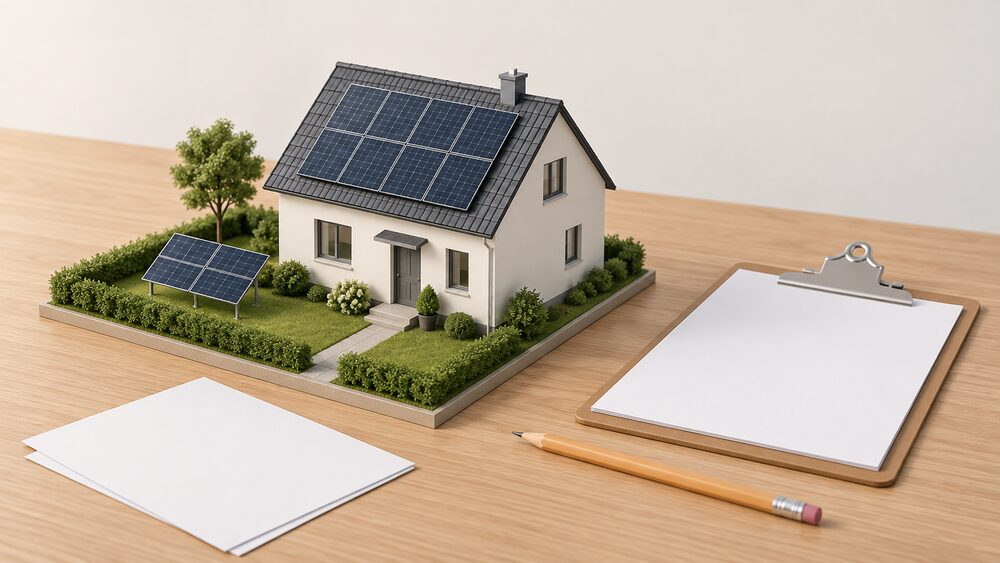
Solar panels on a house in Northern Ireland are, in most cases, permitted development. The Planning (General Permitted Development) Order (Northern Ireland) 2015 grants planning permission for the classes of development described as permitted development in its Schedule, subject to any relevant exception, limitation or condition1. Roof-mounted solar PV or solar thermal equipment on a dwellinghouse sits in Part 2, Class A, and stand alone solar within the curtilage of a dwellinghouse sits in Part 2, Class C2. A householder who stays inside those classes does not apply to the council for planning permission.
The Order is Northern Ireland legislation, made under sections 32 and 247(6) of the Planning Act (Northern Ireland) 2011, and it applies to all land in Northern Ireland1. It came into operation on 1 April 2015 and was published on 10 March 2015 as S.R. 2015 No. 703. It has been amended since, including by the Planning (General Permitted Development) (Amendment) Order (Northern Ireland) 2020, which came into operation on 21 December 2020 and changed the Article 7 period to 28 days5.
The practical answer is therefore short, but it is conditional. Permitted development is not a blanket exemption: it is a grant of permission that carries exceptions, limitations and conditions, and it does not displace building regulations, listed building consent or the planning authority's power to withdraw rights through an Article 4 Direction. The sections below set out what the classes cover, what the conditions require, and where a household's independence still depends on decisions made elsewhere.
What the Northern Ireland permitted development order actually grants
The Order does not simply say that solar panels are allowed. It grants planning permission for the classes of development described as permitted development in the Schedule, and any permission granted is subject to any relevant exception, limitation or condition specified in the Schedule1. That structure matters, because it means the permission exists from the moment the Order applies, but only for development that fits the class and satisfies the conditions attached to it.
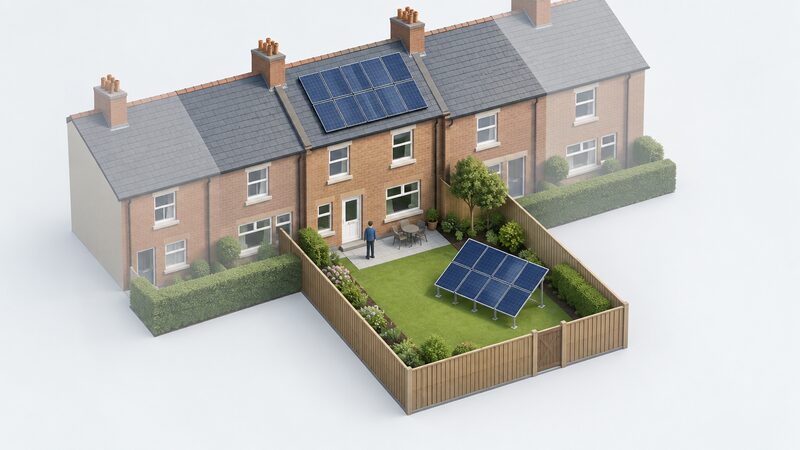
Class A covers the installation, alteration or replacement of solar PV or solar thermal equipment on the roof of a dwellinghouse, or on the roof of any building within the curtilage of a dwellinghouse2. Class C covers the installation, alteration or replacement of stand alone solar within the curtilage of a dwellinghouse2. Between them, the two classes cover the two arrangements most households consider: panels on the house or an outbuilding, and panels on a frame or mounting at ground level within the garden.
The Order was made on 25 February 2015 and came into operation on 1 April 20153. It was made under sections 32 and 247(6) of the Planning Act (Northern Ireland) 2011 and was subject to the negative resolution procedure1. Planning powers transferred to district councils, which are the authorities that deal with applications and enforcement in Northern Ireland1.
The 2020 amendment is the change most likely to be encountered in practice. It substituted "28" for "21" in Article 7(1), extending the period in that article to 28 days, and came into operation on 21 December 20205. The Order has also been amended in relation to microgeneration equipment, through the Planning (General Permitted Development) (Amendment) Order (Northern Ireland) 2023, which amends the 2015 Order6.
What drives whether permission is needed
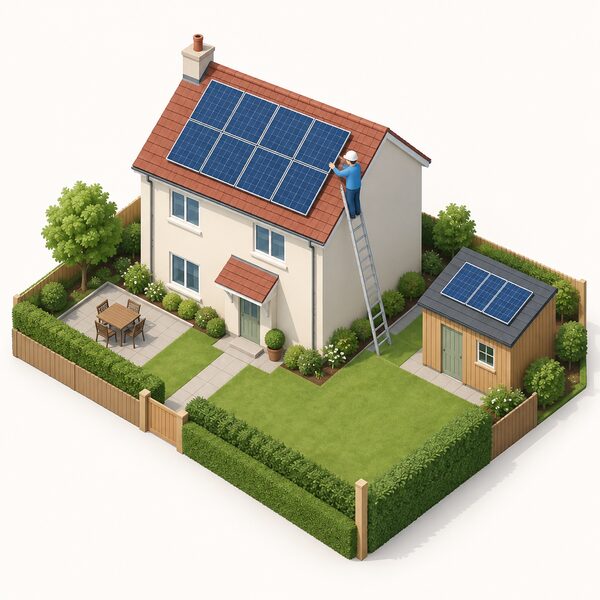
Three things decide the answer: where the equipment is mounted, what the building is, and whether the local authority has withdrawn the right.
The first is the mounting position. Roof-mounted equipment on a dwellinghouse or a curtilage building falls in Class A; stand alone equipment within the curtilage falls in Class C2. An array that is neither on a roof nor stand alone within the curtilage does not obviously fit either class, and the householder's position then depends on whether some other class applies.
The second is the status of the building. Guidance for listed buildings states that solar panels on listed buildings will need planning permission and listed building consent7. The same guidance records that for both residential and non-residential listed buildings, the installation of solar panels on buildings within the listed building's curtilage will require planning permission8. That is a wider restriction than many householders expect, because it reaches outbuildings and structures around a listed building, not just the listed structure itself.
The third is local withdrawal of the right. Article 4 Directions remove permitted development rights in named areas, and where they apply planning permission is required to install solar panels9. Directions of this kind are made area by area, so two streets in the same town can sit under different rules.
Conditions that come with the permission
The conditions attached to permitted development for solar equipment are set out in guidance that describes the rules as they stood before 27 August 2026, and they are worth reading as a statement of what a compliant installation looks like.
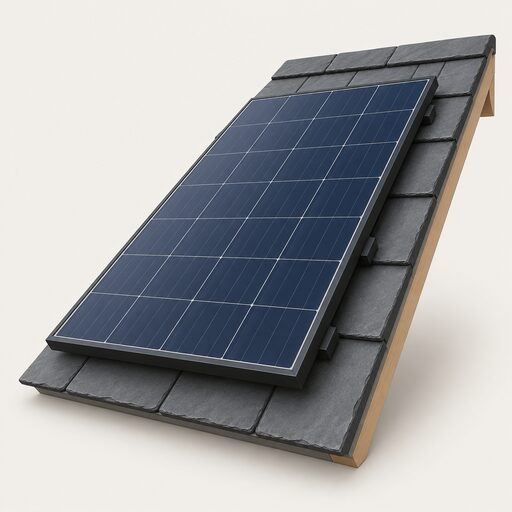
Equipment on a building should be sited, so far as is practicable, to minimise the effect on the external appearance of the building and the amenity of the area10. When no longer needed, equipment should be removed as soon as reasonably practicable10. On a pitched roof, panels should not be installed above the highest part of the roof, excluding the chimney, and should not project more than 200mm from the roof slope or wall surface10. On a flat roof, the highest part of the solar PV equipment cannot be more than 600mm higher than the highest part of the roof, excluding the chimney10.
Two further conditions bite in sensitive locations. The panels must not be installed on a building that is within the grounds of a listed building or on a site designated as a scheduled monument10. If the property is in a conservation area or in a World Heritage Site, panels must not be fitted to a wall which fronts a highway10. Guidance for conservation areas elsewhere in the UK puts the same point directly: planning permission is required when installing solar panels or other equipment on a wall fronting a highway within a conservation area11.
Where solar equipment is to be installed on a flat roof on Article 2(3) land, the developer must apply to the local planning authority for prior approval10. Prior approval is a lighter process than a full application, but it is still an application to the council and it has to be made before the work is done.
"Equipment on a building should be sited, so far as is practicable, to minimise the effect on the external appearance of the building and the amenity of the area."
Where a planning application is required
An application to the district council is required where the installation falls outside the classes, fails a condition, or sits on a building whose status removes the right.
Listed buildings are the clearest case. Solar panels on listed buildings need planning permission and listed building consent, and the curtilage restriction extends the requirement to buildings within the grounds of a listed building7. For non-residential listed buildings, planning permission will still be required12.
Conservation areas are more nuanced. Guidance records that homes can often have solar panels without requiring planning permission from the council, covered by permitted development so long as certain conditions apply, and that in some cases, such as in conservation areas and on listed buildings, planning permission may be required7. Guidance for one conservation area without an Article 4 Direction states the position plainly: no planning permission required, permitted development rights apply14. Where an Article 4 Direction is in force, the position reverses and planning permission is required to install solar panels9.
Flat roofs are a further trigger. Guidance states that planning permission is required for panels on flat roofs in conservation areas15. More generally, if an installation does not meet government requirements, an application for planning permission is needed16.
Where an application is made, the fee is set by the council. The published figures available relate to non-domestic solar panels in Scotland, where applications are £202 for each 0.1 hectare of the site area, subject to a maximum of £2,01617. No equivalent domestic fee figure for Northern Ireland appears in the available guidance, so the fee should be confirmed with the district council.
How the rules differ across the UK nations
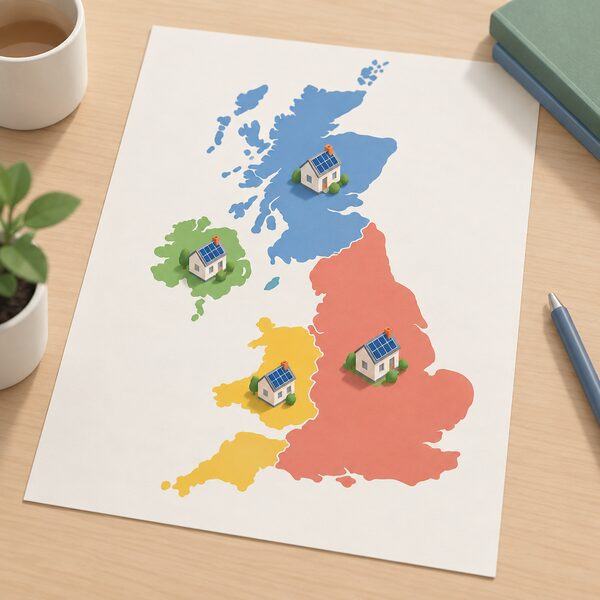
The four nations run separate permitted development regimes, and the differences are not cosmetic.
In England, permitted development for solar panels sits in Part 14 (Renewable Energy) of the Town and Country Planning (General Permitted Development) (England) Order 201520. Guidance states that planning permission is not normally needed for solar panels on domestic roofs, with some exceptions, because they are covered by permitted development rights21. The Planning Portal notes that its guidance relates to the planning regime for England and that the policy in Wales may differ10.
In Scotland, permitted development rights exist for non-domestic solar panels up to 45kW electricity or 50kW thermal18. A 2015 consultation proposed amending some existing rights to allow solar panels to be installed on more non-domestic buildings without the need for a planning application to be approved17. The published fee for non-domestic applications is £202 for each 0.1 hectare of the site area, subject to a maximum of £2,01617.
In Northern Ireland, the position is the 2015 Order and its amendments, with Class A and Class C covering domestic roof-mounted and stand alone solar1. The plug-in solar product specification notes that its application to Northern Ireland is subject to further consideration and may require amendment, which is a reminder that some newer product categories have not been settled across all four nations22.
| Nation | Domestic solar permitted development | Key limit or condition |
|---|---|---|
| Northern Ireland | Class A roof-mounted, Class C stand alone, under S.R. 2015 No. 702 | Subject to exceptions, limitations and conditions in the Schedule1 |
| England | Part 14 (Renewable Energy), Class J20 | Not normally needed on domestic roofs, with exceptions21 |
| Scotland | Existing rights for non-domestic solar up to 45kW electricity or 50kW thermal18 | Non-domestic application fee £202 per 0.1 hectare, maximum £2,01617 |
| Wales | Separate regime; Planning Portal guidance notes Welsh policy may differ10 | Confirm with the local planning authority |
What it means for household energy independence
Permitted development is the single biggest procedural advantage a Northern Ireland household has when adding solar. It removes the cost, delay and uncertainty of a planning application for a roof-mounted system on a dwellinghouse, and it does the same for a stand alone array within the curtilage2. That makes the decision largely a matter of roof suitability, budget and electrical design rather than a planning process.
What it does not do is make the household independent of the grid. A grid connection offer can only be considered once the generator has received planning permission, where appropriate, so for any installation that does need permission, the planning step comes first and the connection follows23. For a domestic system operating under the smaller connection arrangements, the household remains connected, and the array reduces imported units rather than removing the connection.
The dependence that remains is layered. There is the distribution network and the supplier, which set what happens when the panels are not generating. There is the building itself: permitted development does not override building regulations, and installing solar panels may require approval under the Building Regulations, with the associated electrical works and the additional loading on the roof structure among the reasons11. There is the manufacturer, whose warranty and continued trading sit behind the equipment. And there is the planning authority, which can withdraw the right through an Article 4 Direction in a defined area9.
For a household that wants the permitted development position recorded, a Lawful Development Certificate proves that an existing or proposed solar panel does not require planning permission and complies with the permitted development limitations and conditions20. It is not a substitute for the permission itself, but it puts the position on the record.
Sources23 cited
- The Planning (General Permitted Development) Order (Northern Ireland) 2015, legislation.gov.uk, 2015
- Schedule to the Planning (General Permitted Development) Order (Northern Ireland) 2015, legislation.gov.uk, 2015
- Planning (General Permitted Development) Order (Northern Ireland) 2015, explanatory memorandum, legislation.gov.uk, 2015
- Planning (General Permitted Development) Order (Northern Ireland) 2015 (S.R. 2015 No. 70), Department for Infrastructure, 2015
- The Planning (General Permitted Development) (Amendment) Order (Northern Ireland) 2020, legislation.gov.uk, 2020
- Changes to permitted development rights for domestic heat pumps, Department for Infrastructure, 2023
- Solar panels and planning permission, Cornwall Council, 2026
- Clifton local listed building consent order guidance, Bristol City Council, 2025
- Solar Together, Swindon Borough Council, 2026
- Planning permission: solar equipment mounted on a house or a block of flats, Planning Portal, 2026
- Solar panels guidance, York Council, 2026
- Draft LLBC order for the Clifton conservation area, Bristol City Council, 2025
- Solar Together Norfolk, South Norfolk and Broadland Council, 2026
- Solar Together domestic planning guidance, Southampton City Council, 2026
- Planning and solar, Frome Town Council, 2025
- Planning permission for solar panels, Bristol City Council, 2026
- Permitted development rights for non-domestic solar panels and domestic air source heat pumps, Scottish Government, 2015
- Permitted development rights for non-domestic solar panels and domestic air source heat pumps: page 4, Scottish Government, 2015
- Impact assessments: permitted development rights, Scottish Government, 2015
- Solar panels and permitted development, Richmond Council, 2026
- Planning for solar panels on domestic roofs, House of Commons Library, 2024
- Plug-in solar interim product specification, Department for Energy Security and Net Zero, 2026
- UK Solar PV Strategy, Part 2, Department of Energy and Climate Change, 2014
 Home Energy Planning Rules in NIDo you need planning permission for solar panels or a heat pump in Northern Ireland?
 Wind Turbine Planning in NIDo you need planning permission for a home wind turbine in Northern Ireland?
 Planning Permission EnglandMost homes in England can have solar panels fitted without planning permission, but does yours count as one of the exceptions?
 Planning Permission in NIDo you need planning permission for a heat pump in Northern Ireland?
 Planning Permission WalesDo you need planning permission for solar panels on your house in Wales?
 Permitted Development by HomeCan you put up solar panels or a heat pump without asking the council?