

In this answer
Short answer
Solar permitted development changes in England took effect on 27 August 2026, when the Town and Country Planning (General Permitted Development) (England) (Amendment) Order 2026 rewrote the domestic solar rules in Part 14 of Schedule 21. The same date brought a new permitted development right for stand-alone solar equipment in the grounds of a house or block of flats, with a 12-month transitional period running to 27 August 20271.
The direction of travel is wider, not narrower. A written answer of 15 January 2025 stated that changes to permitted development rights "will mean more homeowners and businesses will be able to install solar panels on their roofs without going through the planning system"3. Scotland is consulting on parity with England for solar panels and air source heat pumps, to be delivered by amending the Town and Country Planning (General Permitted Development) (Scotland) Order 19924.
What follows sets out what the amended rights allow, where they stop, how the four nations differ, and what remains outside planning altogether.
What the proposed changes to solar permitted development rights are
Permitted development rights are the national grant of planning permission that removes the need to apply to a council for certain works. In Northern Ireland the legislation describes the effect plainly as "removing the need to apply for planning permission"6. For solar, the rights sit in Schedule 2, Part 14 (Renewable energy) of the Town and Country Planning (General Permitted Development) Order 2015, as amended, and they allow the installation of most solar panels subject to meeting the requirements set out in local guidance7.
The 2026 amendment order is the live change. It substitutes, omits and inserts words and paragraphs in Part 14 of Schedule 2, with the changes taking effect on 27 August 20268. Specifically, it substituted Class A paragraph A.1, omitted a word in A.1(1)(d), substituted A.1(1)(e), inserted A.1(1)(f) and A.1(2), and substituted Class B paragraph B.1 while omitting a word in B.1(1)(b)(i)9. The practical effect is a restructured set of development not permitted provisions for blocks of flats and dwellinghouses, plus new plug-in solar restrictions10.
The context matters. December 2023 brought changes to various permitted development rights, many of which focused on allowing greater freedom for installation of solar panels11. A February 2024 consultation then set out home improvement scope including larger extensions, loft extensions, additions and alterations to the roof, and further flexibilities for bin and bike stores in front gardens11. The solar changes are one strand of a wider liberalisation of householder development, not an isolated measure.
The Planning Portal confirmed it is updating its common project guidance on domestic solar panels to account for the changes2. That matters for householders because the guidance most councils and installers work from is being rewritten to match the amended rights.
Rooftop solar: what the changes would allow without planning permission
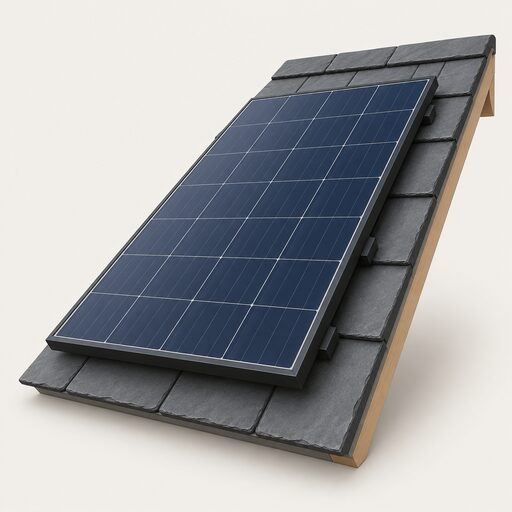
Rooftop solar falls under permitted development rights for most domestic properties12. Fixing solar panels to the roof of a single dwelling house is likely to be considered permitted development in many cases, with no need to apply for planning permission13. Installing solar panels on a roof will often fall under permitted development rights, meaning an application for planning permission is not required provided certain limits and conditions are met14.
The limits are where the detail lives. The permitted development regime for solar panels has different limits on projections and in relation to protected areas15. Planning permission is usually required for flats or maisonettes in conservation areas, National Landscapes and national parks, and listed buildings require consent12. In Wales, the roof and wall-mounted rights apply to houses, and flat residents are directed to their local planning authority for guidance13.
Scotland has already moved on the dwellinghouse side. New Class 6HA provides permitted development rights specifically for the installation, alteration or replacement of solar panels mounted on a dwelling, including dwellings within conservation areas16. The Scottish circular describes Class 6HA as covering the installation, alteration or replacement of solar photovoltaic or solar thermal equipment17.
"New Class 6HA provides PDR specifically for the installation, alteration or replacement of solar panels mounted on a dwe"
The 2026 English order also inserted a plug-in solar restriction, with paragraph A.1(1)(f) addressing plug-in solar on timber and A.1(2) addressing dwellinghouses5. Definitions of plug-in solar and standard plug and socket were inserted into the Part 14 interpretation, and the solar PV definition was amended, from 27 August 20266. Householders considering a plug-in solar kit rather than a fixed array are therefore inside the amended regime, not outside it.
Stand-alone solar equipment: the updated permitted development right
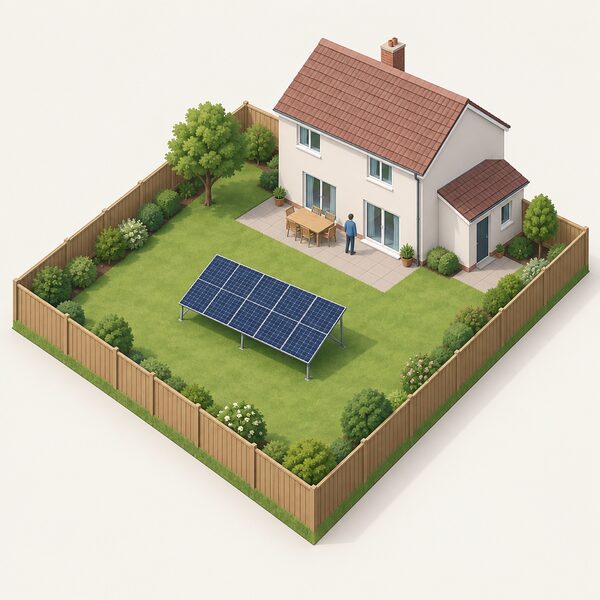
The permitted development right for stand-alone solar equipment within the grounds of a house or block of flats was updated on 27 August 20261. Standalone solar panels are permitted development provided the listed conditions are complied with13. Ground-mounted installations are classed as permitted development unless specified conditions are met18.
The central restriction is numerical. Only the first stand-alone solar installation will be permitted development, and further installations will require planning permission5. That rule applied to the position before 27 August 2026 as well, and it carries forward5. A household adding a second ground array, or replacing one with two, moves outside the right.
There is also a boundary condition. If solar equipment is to be installed on article 2(3) land within 5 metres of the boundary of the curtilage, the developer must apply to the local planning authority for prior approval1. Article 2(3) land covers the protected categories, so the practical effect is that a ground array close to a boundary in a sensitive area needs a prior approval application rather than nothing at all.
The transitional arrangement is generous but finite. Until the end of the transitional point, a household can follow the rules as they were immediately prior to 27 August, or the new rules1. The 12-month transitional period ends on 27 August 2027, until which either the old or new rules may be followed10. Projects no longer eligible under the amended rights can use the previous rules until 26 August 20272.
For a household weighing a ground-mounted array, the sequence is therefore: check whether the installation is the first stand-alone one on the property, check whether the site is article 2(3) land and how close the boundary is, and check the calendar, because the transitional window closes.
Scotland's preferred options: solar and air source heat pumps
Scottish Ministers want to ensure that there is parity in permitted development rights between Scotland and England4. The stated objective is to create parity between the permitted development rights for air source heat pumps and solar panels between England and Scotland4. The regulations would be implemented through an amendment to the Town and Country Planning (General Permitted Development) (Scotland) Order 19924.
The heat pump side carries a noise condition. The proposals include means by which the noise level of the air source heat pump is predicted, and that method includes a maximum noise level in order for air source heat pumps to be considered to be permitted development4. In England the equivalent requirement is that a unit must comply with the Microgeneration Certification Scheme Planning Standards, known as MCS 020, in order to be permitted development, because air source heat pumps can be noisy19.
The scope of the proposed Scottish right is broad. It would apply to the installation, alteration or replacement of an air source heat pump on a house or block of flats, or within the curtilage of a house or block of flats, including on a building within that curtilage20. Ground source heat pumps are typically considered permitted development already21.
Scotland is also consulting separately on permitted development rights to support the provision of new homes, with the Scottish Government considering the potential to amend existing rights or introduce new ones22. The Scottish Government has published guidance on permitted development rights for householders23.
How the changes would be implemented and reviewed
In England the vehicle is an amendment order made under the Town and Country Planning (General Permitted Development) (England) Order 2015, as amended24. The 2026 order substitutes, omits and inserts words and paragraphs in Part 14 of Schedule 28. The consultation that preceded this strand of work covered changes to support householder development, building upwards, demolition and rebuild, and the installation of electric vehicle charge points and air source heat pumps24.
Review arrangements vary by instrument. The Royal Borough of Kensington and Chelsea's local listed building consent order for solar panels is reviewed annually, quantitatively and qualitatively, and the Council will vary or revoke it if it is ineffective or gives rise to unexpected and unacceptable harm25. The same order may be extended if successful26. Southwark's proposed local listed building consent order consents the installation of microgeneration solar photovoltaics or solar thermal panels and associated works, including associated equipment necessary for the operation of the system and minor repairs and making good of the roof27.
At national level, the Solar Council tracks the solar pipeline to 2030 and beyond, progress against actions and key performance indicators, and wider economic and financial factors influencing the solar sector28.
| Instrument | Territory | What it does | Status |
|---|---|---|---|
| S.I. 2026/896 | England | Amends Part 14 Classes A and B and paragraph P | In force 27 August 20261 |
| Class 6HA | Scotland | Solar panels on a dwelling, including in conservation areas | In force16 |
| Amendment to the 1992 Order | Scotland | Proposed parity for solar and air source heat pumps | Proposed4 |
| Local listed building consent order | RBKC | Consents solar on listed buildings | Reviewed annually25 |
What the changes mean for householders
The headline for a household is that the planning route for a straightforward roof array remains open, and in some respects widens. Solar PV installations are considered a permitted development and will generally not need planning permission29. If the proposed solar panels meet the requirements, no application for planning permission is needed30. Solar panels and equipment installed on domestic buildings and land are usually considered permitted development, meaning planning permission is not required, but there are a few exceptions31.
The exceptions are the part that catches people out. Adding solar panels to a listed building or its curtilage requires listed building consent32. Changes to buildings are among the works likely to require planning permission33. In Wales, the permitted development regime for solar panels has different limits on projections and in relation to protected areas15.
For energy independence, the changes matter at the margin rather than at the core. A roof array under permitted development reduces reliance on imported gas and grid electricity without a planning application, and the amended stand-alone right keeps a single ground array in the grounds of a house or block of flats within permitted development1. What remains is dependence on the distribution network for export and import, on a supplier for billing and export payments, and on the manufacturer for the equipment itself. Planning reform does not change any of those.
Householders in England should note the transitional window: either the old or the new rules may be followed until 27 August 202710. Those in Scotland are looking at proposals rather than rights, with parity as the stated objective4. Those in Wales and Northern Ireland work from their own regimes, where the Welsh rights apply to houses and flat residents are directed to their local planning authority13, and where the Northern Ireland legislation frames permitted development as removing the need to apply for planning permission6.
For the underlying rules by nation, see solar panel planning permission in England, Scotland, Wales and Northern Ireland. For the wider picture, start with Solar PV for UK Homes.
Sources33 cited
- Stand-alone solar equipment permitted development, Planning Portal, 2026
- Changes to permitted development rules for domestic solar installations, Planning Portal, 2026-08-28
- Permitted development rights for solar: written question response, House of Commons Library, 2025-01-15
- Permitted development rights impact assessments, Scottish Government, 2026
- Solar panels guidance, Islington Council, 2026
- The Planning (General Permitted Development) Order (Northern Ireland) 2015, legislation.gov.uk, 2015
- Installing solar panels at your home, Brighton and Hove City Council, 2026
- The Town and Country Planning (General Permitted Development) (England) (Amendment) Order 2026, legislation.gov.uk, 2026
- Part 14 Class A: solar equipment on domestic premises, legislation.gov.uk, 2026
- Part 14 of Schedule 2: renewable energy, legislation.gov.uk, 2026
- More permitted development changes on the horizon, Planning Portal, 2024-02-27
- Rooftop solar and permitted development, Parliamentary Office of Science and Technology, 2026-06-25
- Planning permission: solar panels, Welsh Government, 2026
- Air conditioning and permitted development, Planning Portal, 2026
- Planning permission: roof, Welsh Government, 2026
- Householder permitted development rights circular, Scottish Government, 2024
- Circular 1/2024: householder permitted development rights, Scottish Government, 2024
- Solar panels and planning permission, Bath and North East Somerset Council, 2026
- Air source heat pump permitted development, New Forest District Council, 2026
- Air source heat pump planning permission, Planning Portal, 2026
- Air and ground source heat pumps, Croydon Council, 2026
- Permitted development rights to support the provision of new homes, Scottish Government, 2025-09
- Guidance on permitted development rights, City of Edinburgh Council, 2026
- Permitted development rights consultation: changes to support householder development, Ministry of Housing, Communities and Local Government, 2026
- Local listed building consent order for solar panels, Royal Borough of Kensington and Chelsea, 2022-05-18
- Building consent order for solar panels consultation, Royal Borough of Kensington and Chelsea, 2026
- Proposed local listed building consent order, Southwark Council, 2026
- UK Solar Roadmap, Department for Energy Security and Net Zero, 2025-06
- Switch Together Birmingham: buying solar panels and battery storage, Birmingham City Council, 2026-01-27
- Solar panels planning permission checklist, Islington Council, 2026
- Do I need planning permission, Cornwall Council, 2026
- When consent is required for a listed building, Buckinghamshire Council, 2026
- Find out if you need planning permission, Buckinghamshire Council, 2026
 Planning Permission EnglandMost homes in England can have solar panels fitted without planning permission, but does yours count as one of the exceptions?
 Planning Permission WalesDo you need planning permission for solar panels on your house in Wales?
 Building Regulations EnglandAdding a heat pump, solar panels or an extension usually needs building regulations approval, and it is separate from planning permission.
 Planning Permission ScotlandMost solar panels on Scottish homes go ahead without planning permission, but flats, conservation areas and listed buildings change that.
 Home Energy Planning WalesSolar panels and heat pumps often need no planning permission in Wales, but the rules differ from England.
 Listed Buildings and AreasYour home is listed or sits in a conservation area, so do you need permission before adding solar panels, insulation or a heat pump?