
In this answer
Short answer
Solar panels on a listed building always require listed building consent. That is the position stated by Brighton and Hove City Council, which puts it without qualification: "Solar Panels on listed buildings always require listed building consent."1 Southampton City Council answers the same question with "Yes, Listed Building Consent is required", and York City Council adds that consent is needed before work can commence.2
The consent sits alongside planning permission rather than replacing it. Cornwall Council states that solar panels on listed buildings will need planning permission and listed building consent, and the Welsh Government says installation on a listed building will require planning permission and is likely to require an application for listed building consent.4 Consent is also needed for buildings within the curtilage of a listed property, including structures that pre-date July 1948.6
The practical effect for a household is that a listed home cannot use the permitted development route that most houses rely on. Consent is applied for individually, the building's special interest is weighed, and the installation is judged on how it would affect that interest. Exeter City Council's guidance to listed building owners puts the outcome plainly: panels can sometimes be installed, "but it depends on the building and how the installation would affect its character."7
Listed building consent: always required for solar panels
The starting point is not a judgement about the merits of a particular roof. It is a rule. Frome Town Council's guidance states that listed buildings always need listed building consent for solar panels, and lists what a listed property always requires as planning permission and listed building consent.11 Rother District Council tells owners that if the house or flat is listed, listed building consent must also be applied for.12 Islington Council states that solar panels on listed buildings require planning permission and listed building consent.13
The consent covers the alteration to the listed structure itself, which is why the roof, the fixings and any associated equipment all fall inside the application. Bristol City Council notes that adding renewable energy solutions such as solar panels might be acceptable, but will require listed and or planning consent.3 East Hertfordshire District Council frames it more softly, saying a listed building owner may require listed building consent, but the direction of travel across council guidance is consistent: consent is the route, not an optional extra.14
For a household, this changes the sequence of a project. A listed home cannot order panels and book an installer on the assumption that the work is permitted. The application comes first, and the installation is designed around what the conservation officer will accept. That is the point at which roof slope, panel colour, fixing method and visibility from the street become part of the specification rather than afterthoughts.
The same rule applies to commercial listed premises. York City Council states that installing solar panels on a listed commercial premises requires a listed building consent form.3
Consent and planning permission: what you need before work starts
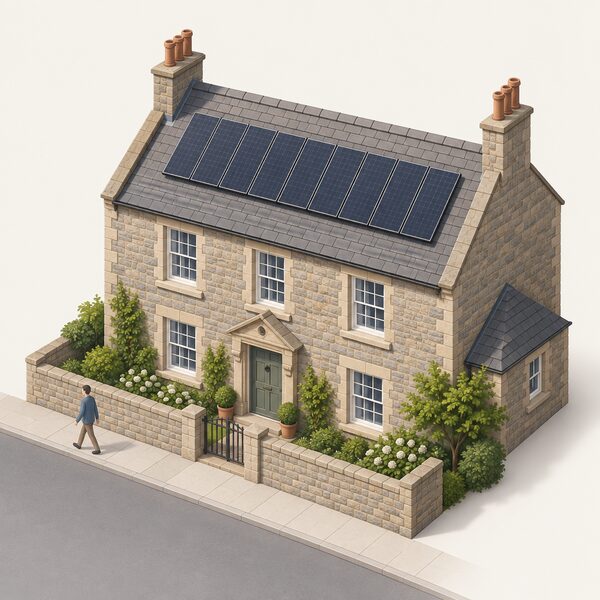
Two separate permissions are in play, and they answer different questions. Listed building consent deals with the effect of the works on the special architectural or historic interest of the listed building. Planning permission deals with the development itself. Cornwall Council and the Welsh Government both state that listed buildings need both.4
The order in which they are obtained matters less than the fact that neither can be assumed. York City Council's guidance is explicit that listed building consent is needed before commencement, and Bromley Council states that listed building consent is required before works can commence, with planning permission possibly applying in addition.3 A household that starts work first is not in a position to regularise it afterwards.
There is one route that separates the two permissions. The draft Local Listed Building Consent Order for Kensington and Chelsea notes that for non-domestic listed buildings, planning permission would still be required but listed building consent would not, while for residential buildings the installation of solar equipment is permitted development and does not require planning permission, even on listed buildings, subject to conditions reflected in the Order.16 That is a specific local arrangement, not a general rule, and it depends on the order being in force.
Where permitted development criteria are not met, planning permission is applied for in the ordinary way. The Welsh Government's guidance confirms that planning permission can be applied for if needed, and that listed buildings need planning permission and listed building consent.5
What counts as a listed building, including curtilage
The listing attaches to the building, but its reach extends into the grounds. West Suffolk Council states that listed building consent will be required to place solar panels on a listed building, including buildings within the curtilage of the listed building which pre-date July 1948.6 Buckinghamshire Council lists adding solar panels to the building or curtilage among the works that need consent.14
Curtilage is defined in the guidance rather than left to intuition. Wirral Council explains that curtilage means within the garden or grounds, and that permission is needed if the panels would be installed within the curtilage of a listed building.17 Rother District Council uses the same definition.12 Bristol City Council's planning guidance lists a house or flat that is, or is within the garden or grounds of, a listed building as a case where permission is required.18
The legislation behind permitted development carries the same restriction. In Northern Ireland, the relevant schedule states that solar PV or solar thermal equipment is not permitted development if it would be installed within the curtilage of a listed building unless listed building consent has previously been granted.19 Parallel provisions appear in the 2013 and 2009 instruments for non-domestic and domestic equipment respectively.20 The Welsh instrument for domestic equipment carries the same limit.22
The practical consequence is that a listed home's outbuildings, garden walls and boundary structures are not a loophole. A barn, garage or garden building inside the curtilage is treated as part of the listed setting, and panels on it need consent in the same way as panels on the house.
Free-standing and roof-mounted panels: where consent applies
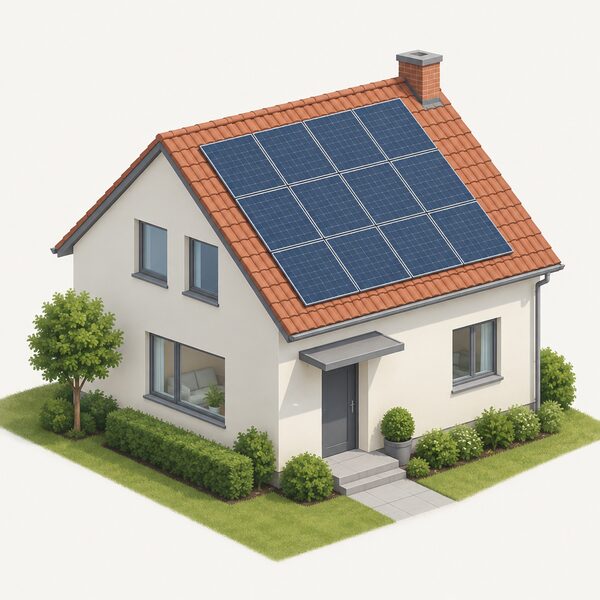
Roof-mounted panels on an unlisted house are usually permitted development. Wirral Council states that placing solar panels on the roof of a house or flat, or on a building within the grounds, is considered in most cases permitted development under the Town and Country Planning (General Permitted Development) (England) Order 2015, Schedule 2, Part 14, Class J.17 Maidstone Borough Council's note says planning permission will not normally be required for the installation of solar panels on a domestic roof, subject to all criteria being met, including panels fixed parallel to the existing roof slope and the property not being a listed building or a flat.23
Listing removes that route. West Northamptonshire Council states that planning permission is required for the erection of solar panels on roofs where they project more than 20cm from the roof plane, or on walls facing the highway, or on listed buildings or within their curtilage, including stand-alone solar panels.24 The stand-alone point matters: a ground-mounted array in the garden of a listed property is not exempt simply because it does not touch the listed structure.
The Kensington and Chelsea order shows how conditions are used to keep installations within acceptable bounds. Condition (i) requires the solar equipment to be installed on a roof structure, and condition (ii) states that the solar equipment is not to be placed on any roof slope facing a highway.25 Those two conditions together rule out ground-mounted arrays under the order and keep panels away from the most visible elevations.
"i) the solar equipment is to be installed on a roof structure"
For a household, the split is straightforward in principle. Roof-mounted panels on a listed building need consent and are judged on visibility and fixing. Free-standing panels in the grounds need consent as well, and the order route that exists in one London borough does not cover them.
Local Listed Building Consent Orders: the RBKC route for Grade II homes
A Local Listed Building Consent Order is a mechanism for granting consent to a class of works in advance, so that individual applications are not needed for each qualifying building. The Royal Borough of Kensington and Chelsea made one for solar panels on 18 May 2022.9 The Local Government Association's case study describes it as giving consent for solar panels on most Grade II and Grade II* listed buildings without the need for individual listed building consent.26 The council's own newsroom describes the draft as covering most Grade II and some Grade II* listed buildings.27
The order is made under the Planning (Local Listed Building Consent Orders) (Procedure) Regulations 2014 and sections 26D to G and 28A and Schedule 2A of the Planning (Listed Buildings and Conservation Areas) Act 1990.9 It excludes Grade I listed buildings, the six Grade II* buildings named in its Schedule 1, and ecclesiastical buildings currently in use for ecclesiastical purposes.9
Conditions attach to the consent. Details of the position, size, fixing, colour and finish, associated equipment, and any minor strengthening works to the roof must be submitted to and approved in writing by the local planning authority before works commence.9 Building regulation approval is still required notwithstanding the order.9 On planning permission, the order states that permission will not be required for solar equipment consented under it on houses and flats, provided it complies with Schedule 2, Part 14, Class A of the General Permitted Development Order 2015 as amended, and for non-residential buildings provided Class J is complied with; for both classes, installation on curtilage-listed buildings is not permitted development and planning permission will be required.9
A separate draft order covers the Sutherland Square and Liverpool Grove conservation areas. It runs for a period of no more than five years from the starting date of the order, and works started but not completed at the end date may be completed within six months of that date, while works not started will no longer benefit from the consent.10 The draft order document itself is undated, with blanks for the making date and term dates.28 The consultation on the draft lists a contact telephone number of 020 7361 3012.16
The wider point for households outside Kensington and Chelsea is that the order route exists but is local. A listed home in another authority area has no equivalent unless that authority has made its own order, and the default remains an individual listed building consent application.
What this means for a household's energy independence
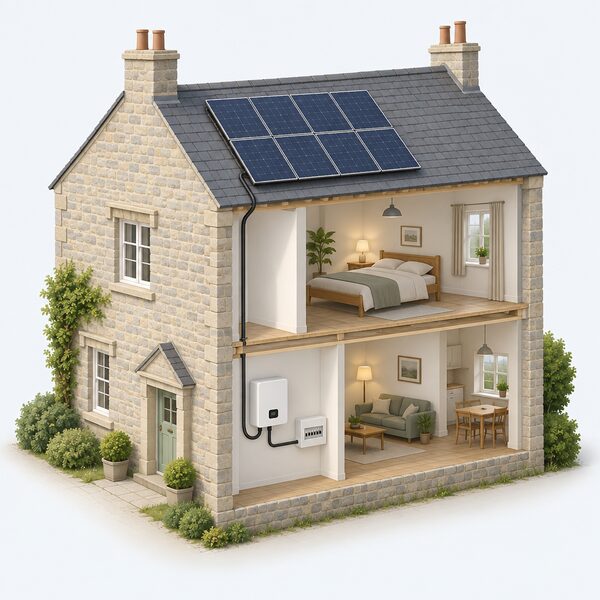
A listed home can reach the same technical destination as any other house: panels on the roof, an inverter, and a connection that reduces the electricity drawn from the grid. What differs is the permission path. Consent is individual, it is judged on the building's character, and it can attach conditions about position, colour, fixing and visibility that shape the installation before a single panel is ordered.
The dependence that remains is the same as for any grid-connected home. Panels generate when the sun is out, the grid supplies the rest, and a supplier is still needed for import and for any export payment. Listing does not change the physics; it changes the paperwork and the design freedom. A household that wants to know how the generation side works can read the guide to solar PV for UK homes, and the rules for unlisted properties are set out in solar panel planning permission in England.
Where a listed building sits in a conservation area, the two designations are separate and both can apply. The conservation area rules are covered in solar panels in a conservation area. Roof loading and structural questions, which apply whatever the listing status, are covered in building regulations and roof loading for solar panels.
Sources28 cited
- Solar panels guidance, York City Council
- Solar photovoltaic (PV) panels, Bromley Council
- Making alterations to a listed building, Bristol City Council
- Solar panels and planning permission, Cornwall Council
- Planning permission: solar panels, Welsh Government
- Solar photovoltaics and planning in conservation areas, West Suffolk Council
- FAQs for listed building owners and occupiers, Exeter City Council
- Solar equipment on residential buildings, Hart District Council, January 2025
- Local Listed Building Consent Order for the installation of solar panels, Royal Borough of Kensington and Chelsea, 18 May 2022
- Proposed Local Listed Building Consent Order, Southwark Council
- Planning and solar, Frome Town Council, 2 September 2025
- Renewable energy: solar panels and heat pumps, Rother District Council
- Solar panels guidance, Islington Council
- When consent is required, Buckinghamshire Council
- Solar panels, York City Council
- Draft Local Listed Building Consent Order for Solar Panels, Royal Borough of Kensington and Chelsea, opened 19 January 2022
- Solar panels, Wirral Council
- Planning permission for solar panels, Bristol City Council
- The Planning (General Permitted Development) Order (Northern Ireland) 2015, Schedule Part 2, legislation.gov.uk
- The Planning (General Permitted Development) Order (Northern Ireland) 2013, legislation.gov.uk, 8 April 2013
- The Town and Country Planning (General Permitted Development) (Amendment) (Wales) Order 2009, legislation.gov.uk, 9 August 2009
- The Planning (General Permitted Development) Order (Northern Ireland) 2015, Schedule Part 37, legislation.gov.uk
- Solar note under 50kW, Maidstone Borough Council, April 2014
- Planning and listed building consent requirements, West Northamptonshire Council, 14 December 2023
- Installing solar panels using the Local Listed Building Consent Order, Royal Borough of Kensington and Chelsea
- Royal Borough of Kensington and Chelsea Local Listed Building Consent Order, Local Government Association, 11 July 2022
- Making solar power an option for more homes, Royal Borough of Kensington and Chelsea, 21 January 2022
- Draft Local Listed Building Consent Order, January 2022, Royal Borough of Kensington and Chelsea, January 2022
 Listed Buildings and AreasYour home is listed or sits in a conservation area, so do you need permission before adding solar panels, insulation or a heat pump?
 Planning Permission EnglandMost homes in England can have solar panels fitted without planning permission, but does yours count as one of the exceptions?
 Planning Permission ScotlandMost solar panels on Scottish homes go ahead without planning permission, but flats, conservation areas and listed buildings change that.
 Permitted Development RightsDo you need planning permission for solar panels or a heat pump?
 Planning Permission NIDo you need planning permission for solar panels in Northern Ireland?
 Building Regulations EnglandAdding a heat pump, solar panels or an extension usually needs building regulations approval, and it is separate from planning permission.