
In this guide
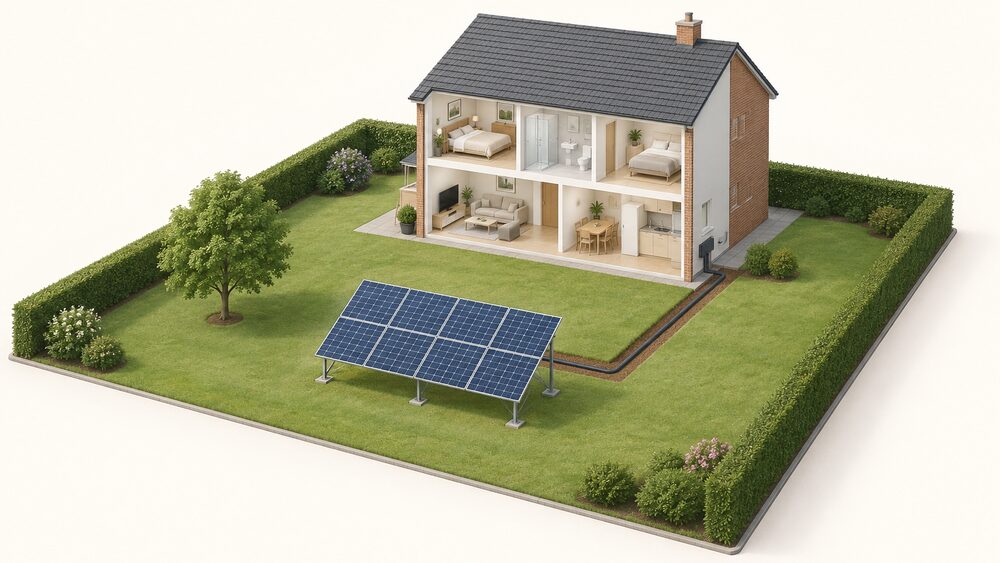
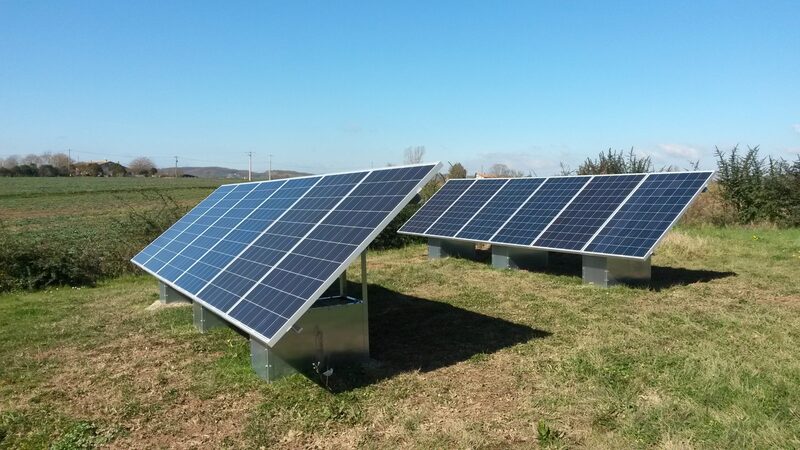
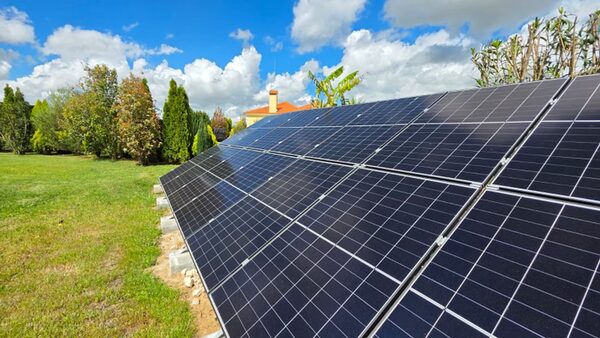
Ground-mounted solar panels are photovoltaic modules carried on a freestanding frame set in a garden, paddock or other open ground, rather than fixed to a roof. They suit homes whose roof is shaded, wrongly oriented, too small, structurally awkward or covered in a material that cannot take fixings. Energy Saving Trust states plainly that panels can be installed in the garden on a suitable frame1.
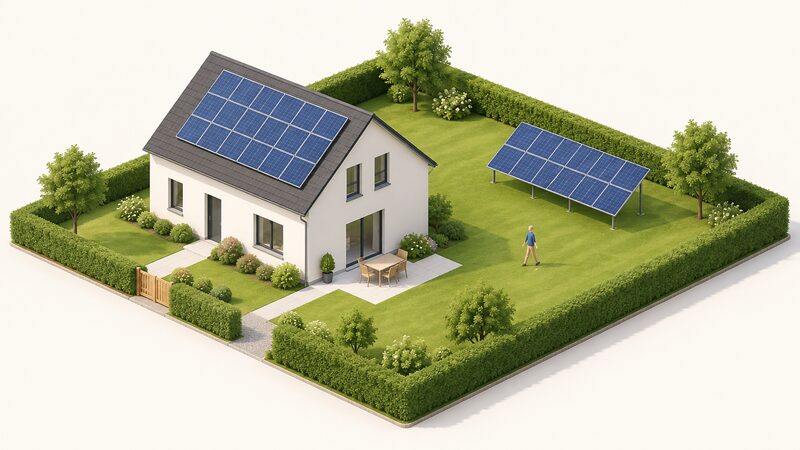
In England, a stand-alone array within the grounds of a house is usually permitted development, meaning no planning application, provided it meets a set of conditions. The array must not exceed 4 metres in height, its panel surface area must not exceed 9 square metres, no part may be more than 3 metres in length, height or depth, it must sit at least 5 metres from the property boundary, no part may be closer to the road than the closest part of the main property, and it must not be within the grounds of a listed building or a scheduled monument2. Only the first stand-alone installation qualifies4.
The permitted development right for stand-alone solar equipment was updated on 27 August 2026, and a 12-month transitional period runs to 27 August 2027 during which either the old or the new rules may be followed2. Ground mounting is therefore a genuine route to household generation where a roof cannot deliver it, but it trades roof constraints for ground constraints: land, boundary setbacks, foundations, cable runs and, in some cases, a planning application.
What ground-mounted solar panels are and when they suit a home
A ground-mounted array is a stand-alone solar installation: panels on a frame, not on a building. Planning guidance treats it separately from roof-mounted equipment, and one council technical note states directly that its residential solar document "does not apply to ground-based solar equipment"7. That separation matters, because the rules, the risks and the cost drivers are different.
The case for ground mounting is strongest where the roof cannot do the job. Solar panels can be installed on both pitched and flat roofs, but on a flat roof they need to be tilted and spaced to avoid shading, which reduces how much fits8. A roof may also be shaded by a chimney, a neighbouring building or a tree, may face the wrong way, or may be a material that cannot be drilled. Ground mounting moves the array to the best spot on the site rather than the only spot on the building.
It also suits homes with land: a large garden, a paddock, a field edge, or a plot where an outbuilding already stands. Panels on an outbuilding are a middle route, part roof mounting and part ground mounting, and are covered by their own permitted development conditions.
The trade-offs are real. A ground array needs foundations, a trench or route for the DC cable back to the house, and space that is not shaded at any point in the day. It is more visible than a roof array, and the planning conditions reflect that: equipment should be sited, so far as is practicable, to minimise the effect on the external appearance of the building and the amenity of the area9. For a household, the appeal is straightforward: generation where the roof cannot provide it, and an array that can be reached, cleaned and serviced from the ground.
Planning permission: when ground-mounted panels are permitted development
In England, stand-alone solar equipment within the grounds of a house is classed as permitted development, which does not need planning permission, unless specified conditions are breached5. The permitted development rights for solar panels sit within Part 14 (Renewable Energy) of The Town and Country Planning (General Permitted Development) (England) Order 201510. Councils across England repeat the same position: solar panels and equipment installed on domestic buildings and land are usually considered permitted development, with a few exceptions11.
The conditions are cumulative. Breach any one and planning permission is required. The table below sets out the limits as published by Bristol City Council and Bath and North East Somerset Council.
| Condition | Limit | Consequence if breached |
|---|---|---|
| Height of any part of the equipment | More than 4 metres | Planning permission required3 |
| Panel surface area | More than 9 square metres | Planning permission required3 |
| Length, height or depth of any part | More than 3 metres | Planning permission required3 |
| Distance from the property boundary | Within 5 metres | Planning permission required3 |
| Position relative to the road | Closer to the road than the closest part of the main property | Planning permission required3 |
| Existing stand-alone installation | Already one within the grounds | Planning permission required3 |
| Listed building or scheduled monument | Within the grounds or gardens | Planning permission required3 |
Only the first stand-alone solar installation will be permitted development4. That is a hard ceiling on expansion: a household that installs one garden array and later wants a second, or a larger replacement beyond the limits, moves into the planning system.
The right itself changed on 27 August 2026, when the permitted development right permitting the installation of stand-alone solar equipment within the grounds of a house was updated2. A 12-month transitional period was added, ending on 27 August 2027, during which either the old or the new rules may be followed2. For a household planning a garden array in the near term, the transitional window is the practical point: the rules that apply depend on when the work is done.
Where permitted development does not apply: listed buildings and scheduled monuments
The exclusions are firm and they catch the ground as well as the building. Panels must not be installed on a building that is within the grounds of a listed building or on a site designated as a scheduled monument2. Stand-alone solar equipment should not be installed within the boundary of a listed building or a scheduled monument2. Cotswold District Council states the stand-alone condition directly: the stand-alone solar will not be installed within the curtilage of a listed building13.
Curtilage is the operative word, and councils define it. Rother District Council explains that planning permission is required if the installation would be within the curtilage of a listed building, and that "curtilage means within the garden or grounds"9. So a garden array at a listed property is not a permitted development, however far it sits from the house and however little it is seen.
Listed building consent is a separate requirement. West Suffolk Council states that listed building consent will be required to place solar panels on a listed building, including buildings within the curtilage of the listed building which pre-date July 194814. East Hertfordshire District Council puts it more simply: if the building is a listed building, listed building consent may be required for installing solar panels15. Frome Town Council states that listed building consent is always needed for solar panels on listed properties16. Cornwall Council adds that solar panels on listed buildings will need planning permission and listed building consent17.
Scheduled monuments follow the same logic. Class J of the General Permitted Development Order excludes development where solar PV or solar thermal equipment would be installed on a site designated as a scheduled monument18. The same exclusion appears in the stand-alone solar guidance2.
The practical effect for a household in a listed building or on a scheduled monument site is that a garden array is a planning application, not a notification, and it will be assessed on its effect on the setting of the designated asset. Elsewhere, permitted development rights may also have been removed by an Article 4 Direction, in which case planning permission is required regardless of the standard conditions19. The listed building consent for solar panels page covers that route in more detail.
Land and space requirements: footprint, clear ground and garden capacity
The permitted development cap is on panel surface area, not on the land the array occupies. The surface area of the solar panels forming part of the stand-alone solar must not exceed 9 square metres13, and Bath and North East Somerset Council states that permission is needed where the surface area of the panels is more than 9m²5. Nine square metres of module is a small array, roughly four to five standard domestic panels.
The land needed is larger than the modules. An array has to be spaced so that rows do not shade each other, angled towards the sun, and set at least 5 metres from the boundary4. Access for installation and maintenance adds more. For scale, a 4.5kWp system typically covers between 20 to 30 square metres of surface area, typically using around 12 panels20. That is a roof figure, but it gives a sense of how much module area a mid-sized domestic system involves, and a ground array of that size would exceed the 9 square metre permitted development cap and need planning permission.
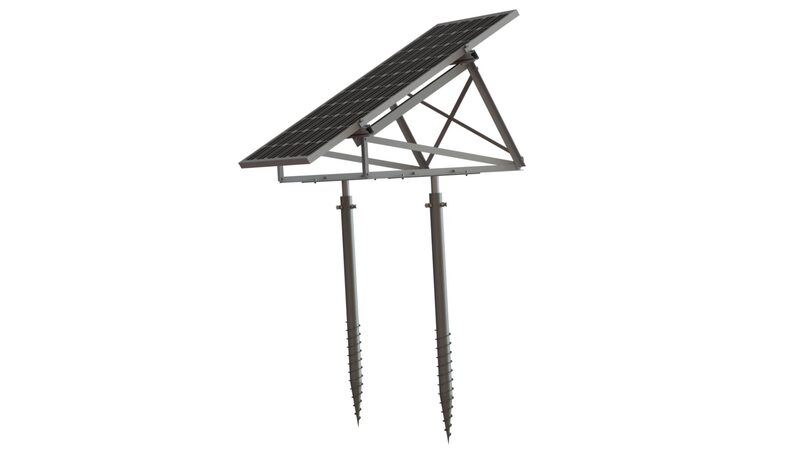
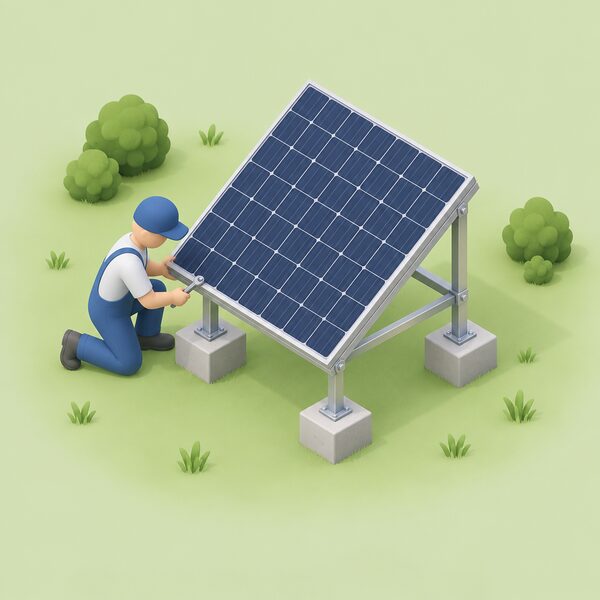
Foundations are the other land consideration. Maidstone Borough Council's guidance for medium-scale ground-mounted arrays states that solar PV arrays should be installed using pile driven or screw foundations, or pre-moulded concrete blocks known as shoes, and should be capable of easy removal21. The same document notes that a 50kW ground-mounted array may only require 25 footings, each capable of easy removal21. Domestic arrays are far smaller, but the principle holds: ground mounting should be reversible.
Land use status is worth knowing. Solar farms are a temporary use, which means that the development of a greenfield site as a solar farm will not change the status of that site from greenfield to previously developed land21. For a household with a paddock, that framing is useful: a ground array is not a permanent change of land character in planning terms.
Placement: distance from the house and avoiding shading
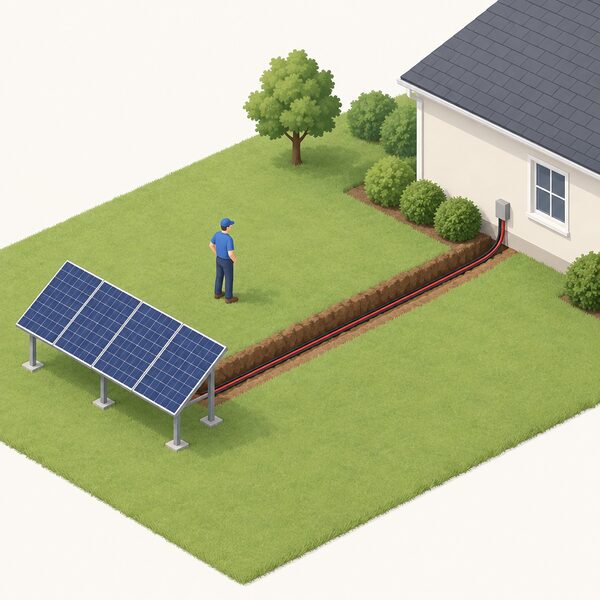
The planning rules govern distance from the boundary, not distance from the house. Stand-alone solar panels and equipment should be at least 5 metres from the boundary of the property4, and any part of the equipment within 5 metres of the boundary of the property's curtilage requires permission5. Rother District Council states the same limit: the installation would need permission if it would be located 5m within the boundary of the property9. There is also a road condition: permission is required if any part of the equipment would be closer to the road than the closest part of the main property3.
Distance from the house is a design question rather than a planning one, and it is driven by two things: shading and cable run. An array needs a position that is clear of shade across the day and the year, because shade on even part of an array reduces output. The roof orientation, pitch and shading page explains how shade behaves on an array, and the same principles apply on the ground.
The cable run back to the house is the cost and loss penalty of distance. A longer DC run needs more cable, more containment and, depending on length and routing, a larger conductor size to keep voltage drop within limits. The solar DC cabling and connectors page covers the components involved. A trench across a lawn or a gravel path is a reinstatement job, and it is the main reason a garden array costs more to install than a roof array of the same size.
Appearance conditions apply too. Equipment on a building should be sited, so far as is practicable, to minimise the effect on the external appearance of the building and the amenity of the area4, and Rother District Council states that the solar panel should be placed so far as is practicable to reduce its effect on the external appearance of the building and the amenity of the area9. For a ground array, that translates into screening, positioning away from sightlines, and avoiding a position that dominates a neighbour's outlook.
How many panels a garden can realistically hold
There are two answers, and they depend on whether the array stays inside permitted development.
Inside permitted development, the 9 square metre panel surface area cap governs13. With standard domestic modules, that is a small array of roughly four to five panels. The 4 metre height limit and the 3 metre length, height or depth limit also constrain the frame3, and only one stand-alone installation is allowed4. A garden array built to these limits is a modest generator, sized to offset part of a household's demand rather than to cover it.
Outside permitted development, the limit is the site. A larger array needs planning permission, and the constraints become shading, boundary setbacks, access and the cable run rather than a fixed area cap. For a sense of scale, a 4.5kWp system typically uses around 12 panels and covers between 20 to 30 square metres20. A ground array of that size would need permission, and would need a clear area larger than the module area once row spacing and the 5 metre boundary setback are accounted for.
Context on the wider market: there are nearly 1.7 million solar installations on homes across the UK20. Ground-mounted domestic arrays are a small part of that total, and the permitted development cap is one reason. The what size solar system does a home need page covers system sizing in general.
| Array size | Permitted development? | Governing limit |
|---|---|---|
| Up to 9m² of panel surface | Yes, if all other conditions met | Surface area cap13 |
| Above 9m² of panel surface | No | Planning permission required5 |
| Second stand-alone array | No | Only the first is permitted development4 |
| Any array over 4m tall | No | Height limit3 |
Ground-mounted versus roof-mounted: which fits which home
The choice is usually made for a household by the roof. Where the roof is suitable, roof mounting is the default: it uses existing structure, needs no separate foundations, keeps the cable run short, and is covered by its own permitted development rights. Homes can often have solar panels without requiring planning permission, covered by permitted development so long as certain conditions apply17.
Ground mounting wins in specific circumstances. A roof that is heavily shaded, north-facing, too small, or made of a material that cannot be penetrated is a candidate. So is a home with a large garden or paddock where an array can be placed in full sun. A flat roof is a partial case: panels can be installed on flat roofs, but they need to be tilted and spaced to avoid shading8, which reduces the number that fit and can make a ground array more productive per panel.
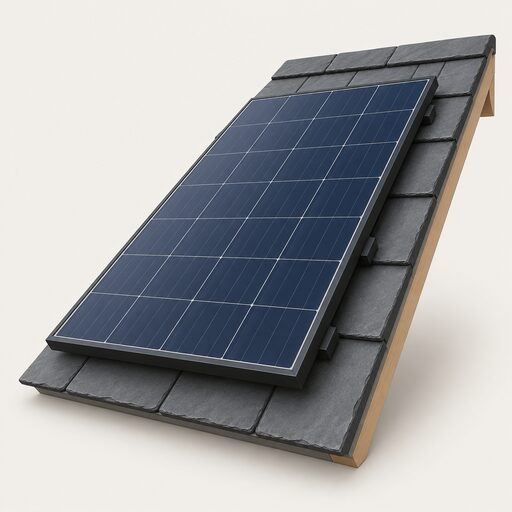
There are also planning differences between the two. Roof-mounted panels on a house are subject to conditions such as projecting no more than 200mm from the roof slope or wall surface and not being installed above the highest part of the roof, excluding the chimney23. In Wales, roof and wall-mounted panels should not be installed above the ridgeline and should project no more than 200mm from the roof or wall surface18. Ground-mounted arrays are governed instead by the height, area, boundary and road conditions set out above.
Conservation areas and National Landscapes add a further layer. Prior approval is required where solar panels are located on a flat roof in conservation areas and National Landscapes13. For stand-alone solar, the Cotswold guidance notes the permitted development right applies to dwellings excluding those that have had permitted development rights removed, or those located within the AONB or a conservation area13. A household in a designated landscape should expect the ground-mount route to be more constrained than the roof route, not less.
Costs and VAT on ground-mounted installations
Published UK cost evidence for ground-mounted solar is dominated by large projects rather than domestic garden arrays. The Department for Energy Security and Net Zero reports that the levelised cost of electricity of ground-mounted solar projects decreased from £92/MWh in 2016 to £47/MWh in 2025, based on 2020 prices6. That is a utility-scale figure and it does not translate directly to a domestic array, but it shows the direction of travel for ground-mount costs.
For a household, ground-mount prices are installer-quoted. The cost drivers are the frame and foundations, the trench and cable run back to the house, the inverter position, and any screening or reinstatement. Roof mounting avoids the foundations and the trench, which is why a ground array of the same panel count generally costs more to install. The how much do solar panels cost in the UK page covers domestic pricing in general.
Scale context from the same government roadmap: ground-mount solar PV today powers the equivalent of around 2 million Great Britain homes, rising to the equivalent of around 9 million by 20306. Floating solar is a related technology, and its costs are currently higher than those for conventional ground mount solar6.
VAT is a dated consideration. Eligible solar panel and battery installs remain zero-rated for VAT until 31 March 2027, then move to 5% from 1 April 2027. A household commissioning a ground array should check the VAT position at the point of contract, because the rate depends on when the installation is completed.
What owning a ground-mounted array means for energy independence
A ground-mounted array does the same job as a roof array: it generates electricity at the point of use, reducing the amount drawn from the grid and the amount bought from a supplier. What it changes is where the generation happens and what the household depends on to keep it running.
The independence it adds is real but partial. The array still needs an inverter, and it still connects to the grid through a G98 or G99 notification or application, covered on the connecting solar to the grid page. It still depends on a supplier for import when generation is low, and on the grid for export payments. A ground array does not change any of that. What it does change is the ceiling on how much a constrained roof can generate: where a roof cannot carry a useful array, the ground can.
The dependence it adds is land and maintenance. A ground array is exposed to wind, weather and, in some settings, livestock and machinery. It needs the ground kept clear, the frame checked, and the cable route protected. It also needs a plan for the end of its life. Maidstone Borough Council's guidance states that if electricity production from the solar array has permanently ceased for more than six months during the anticipated 25 year period, the array and any associated structures should be removed and the ground reinstated to its original condition21. That is a decommissioning obligation written into the planning framework for medium-scale ground arrays, and it is a useful expectation for any ground-mounted installation: the land returns to what it was.
There is also a roof-related benefit worth noting for households weighing the two. East Hertfordshire District Council advises that it is important to minimise any damage to the roof covering by carefully planning how the array is installed, maintained, and removed at the end of its useful life15. A ground array removes that risk entirely, because the roof is never touched.
For a household, the honest summary is this: ground mounting buys generation where the roof cannot provide it, at the cost of land, foundations, a cable run and a planning regime that caps the permitted-development array at 9 square metres of panel surface. It is a route to greater self-supply, not to independence from the grid.
Sources23 cited
- Solar panels advice, Energy Saving Trust, 2026
- Planning permission for stand-alone solar equipment, Planning Portal, 2026
- Planning permission for solar panels, Bristol City Council, 2026
- Solar panels guidance, Islington Council, 2026
- Solar panels planning permission, Bath and North East Somerset Council, 2026
- UK Solar Roadmap, Department for Energy Security and Net Zero, 2025
- Solar equipment on residential buildings, Hart District Council, 2025
- Solar photovoltaic panels, London Borough of Bromley, 2026
- Renewable energy: solar panels and heat pumps, Rother District Council, 2026
- Solar panels and permitted development, Richmond upon Thames Council, 2026
- Do I need planning permission, Cornwall Council, 2026
- Class J: installation of solar equipment on non-domestic premises, legislation.gov.uk, 2026
- Permitted development, Cotswold District Council, 2026
- Solar photovoltaics and planning in conservation areas, West Suffolk Council, 2026
- Solar panels, East Hertfordshire District Council, 2026
- Planning and solar, Frome Town Council, 2025
- Solar panels and planning permission, Cornwall Council, 2026
- Planning permission: solar panels, Welsh Government, 2026
- Planning frequently asked questions, London Borough of Hammersmith and Fulham, 2026
- Solar power facts, Energy Saving Trust, 2026
- Solar note under 50kW, Maidstone Borough Council, 2014
- Installing solar panels safely, Health and Safety Executive for Northern Ireland, 2026
- Planning permission for solar equipment on a house or block of flats, Planning Portal, 2026
 Planning Permission EnglandMost homes in England can have solar panels fitted without planning permission, but does yours count as one of the exceptions?
 Planning Permission WalesDo you need planning permission for solar panels on your house in Wales?
 Solar Mounting SystemsWill your roof take the extra weight of solar panels, and will it still keep the rain out afterwards?
 Roof Orientation and ShadingWhich way should your roof face for solar panels, and does it really matter if it is not south?
 Panels by Home TypeCan your house have solar panels, and how many will fit?
 Building-Mounted Wind TurbinesWill a wind turbine on your roof actually make enough electricity to be worth it?