
In this guide
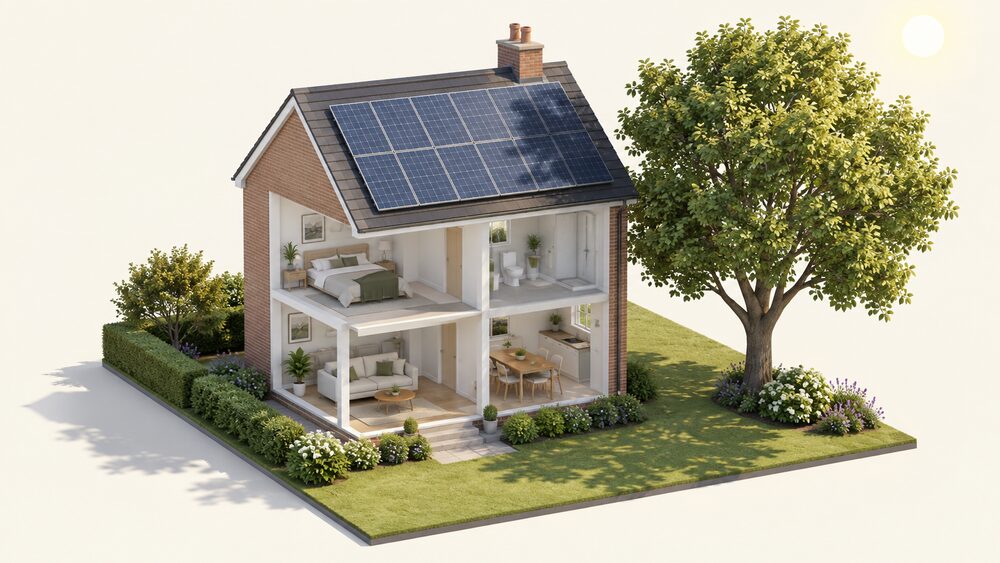
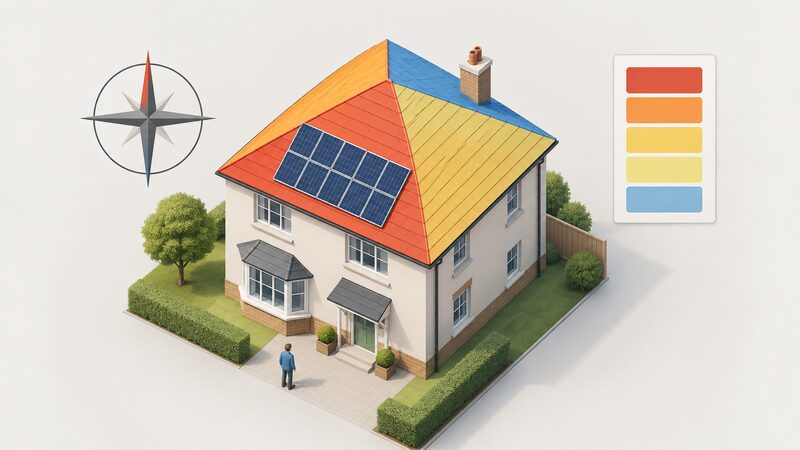
The best roof direction for solar panels in the UK is due south: a roof facing directly south maximises exposure to the sun and generates the most energy over a year1. Anything between south-east and south-west is treated as performing well, and the pitch that suits most UK homes is 30 to 40 degrees. The penalty for moving away from south is smaller than most people expect. One consumer body's figures put an east or west-facing roof at around 15% less energy than the ideal, and a north-facing roof at around 30% less2.
Pitch matters less than orientation, and both matter less than shade. A roof at 20 to 50 degrees performs well if it faces the right way3, while a perfectly angled south roof with a chimney, dormer or mature tree throwing a shadow across it through the middle of the day will underperform a plainer roof that is clear. That is why the survey before quotation records orientation, tilt, roof quality and shading risk together, not orientation alone2.
For a household chasing energy independence, this is the first hard constraint. Orientation and pitch are fixed by the building; shading is sometimes removable and sometimes not. No amount of equipment, optimisers included, recovers energy that never reaches the cells. Module-level electronics reduce the losses a shaded array suffers, but individual panel losses still affect performance1.
Orientation in practice: south-east and south-west still perform well
Official Scottish planning advice for microgeneration states that panels will ideally face between south-east and south-west to maximise the amount of light4. Welsh government guidance for householders takes the same line for solar collectors, adding that they should be free of the shade of trees and buildings6. Northern Ireland's official consumer guidance is narrower still for thermal, saying all solar panels should be mounted on south facing roofs between south-east and south-west7. The consistency across the four nations is notable: the arc is the same wherever the house is.
Independent guidance repeats it. The Centre for Alternative Technology puts the workable window at south-east to south-west at an angle of 20 to 50 degrees3. Consumer advice describes a mainly south-facing roof as what is needed for the best power output, with south-west or south-east also good8. Sector guidance describes a south-west or west-facing roof as suitable, though a little less productive9.
The practical point is the shape of the curve rather than a single number. Output falls slowly either side of south and then more steeply as a roof turns towards north. That is why a home with a roof at, say, south-west is rarely told it is unsuitable, while a due-north roof usually is. One solar water heating maker's own figure for its thermal product illustrates the scale: south, south-west and south-east roofs are described as ideal, with east or west roofs usually offering 80% of peak performance10. That is a maker's claim about its own collector, not an independent measurement of PV.
Distribution network guidance frames the same conclusion from the grid side: in the UK a south, south-east or south-west facing roof with a pitch of between 30 and 45 degrees is described as ideal11. For the household, orientation sets the ceiling on self-generation, and the ceiling on how much of the year's demand can be met without buying from a supplier.
Roof pitch: the 30 to 40 degree sweet spot
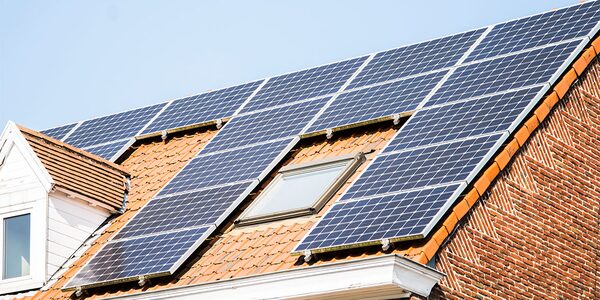
Across official, independent and maker guidance, 30 to 40 degrees recurs more consistently than any other figure. NICEIC describes a roof sloped at around 30 to 40 degrees as ideal for solar panels12. The Chartered Institute of Plumbing and Heating Engineering gives the same range alongside a south-facing, unshaded location13. Welsh national park guidance for energy efficiency measures cites a pitch of 30 to 40 degrees14. Consumer testing puts a 30 to 40 degree slope as ideal2. Makers and suppliers repeat it, one adding that 35 degrees is often considered optimal in the UK15, another that 30 to 40 degrees is the typical angle of most UK rooftops.
The wider ranges quoted elsewhere are not contradictions so much as a recognition that the curve is flat near its peak:
| Source type | Stated pitch | Notes |
|---|---|---|
| Independent guidance3 | 30 to 50 degrees | Paired with a south-facing roof |
| Independent guidance16 | 30 to 40 degrees | 35 degrees often described as optimal |
| Independent guidance1 | around 40 degrees | Optimum on a south-facing roof for year-round consistency |
| Independent guidance8 | 30 to 40 degrees | Given as ideal, with south-facing and unshaded roof |
| Supplier guidance11 | 30 to 45 degrees | Cited as the optimum range in the northern hemisphere |
The 40 degree figure is worth separating out because of the reasoning attached to it: on a south-facing roof, around 40 degrees is described as optimising energy generation and ensuring consistency throughout the year1. A steeper tilt favours the low winter sun at some cost to high summer, which matters to a household trying to flatten its seasonal dependence on the grid rather than simply maximise an annual total.
There is no pitch that is formally disqualified. Very shallow roofs approach the flat-roof case, where tilted frames restore angle at the cost of extra mounting and weight. Very steep roofs shade less of themselves but catch less midday sun. For solar thermal specifically, one consumer body states that up to 65 degrees will still work in the UK17.
Where north-facing roofs fall short
A north-facing roof is the one orientation UK guidance routinely advises against. Consumer testing quantifies it at around 30% less energy than the reference case2 and states plainly that panels on a north-facing roof are unlikely to receive enough sunlight to be worth it18. Energy Saving Trust advice is the same: east or west facing roofs still work, but installing on a north facing roof is not recommended19. Welsh guidance for solar water heating rules out north explicitly, describing collectors as working best on a south-facing roof or somewhere between east to west, but not north facing20.
One nuance is worth keeping. Shallow-pitched north-facing roofs can also be used, typically if the pitch is less than 10 degrees1: at a near-level pitch, the roof face barely tilts the modules away from the sun, so orientation loses most of its force. This is the same physics that makes flat roofs workable regardless of which way the building points.
For energy independence, the north-roof case is the clearest example of a constraint that equipment cannot solve. The remedy, where one exists, lies elsewhere: ground-mounted solar, a different roof plane, or accepting a smaller array on whatever south-ish surface exists.
East and west roofs: viable alternatives with a different daily shape
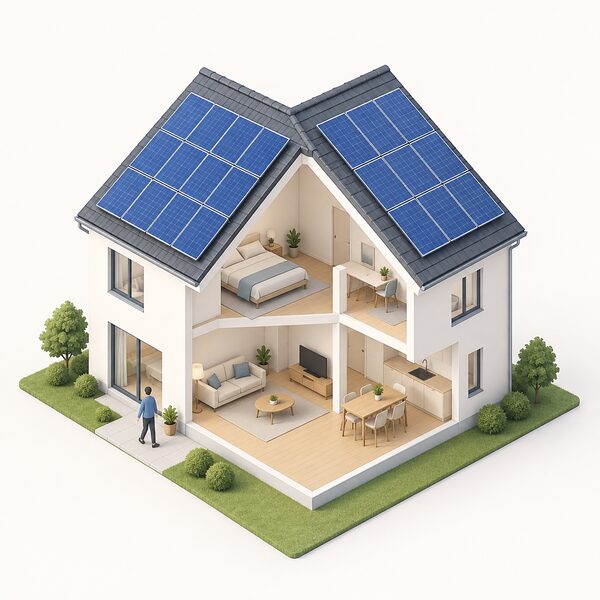
East and west roofs are described by an engineering consultancy as still presenting a good opportunity for solar installations, with good potential for energy generation1. Energy Saving Trust guidance published with MCS goes further on the screening question: an unshaded roof that faces east, south or west gives a good chance the home is suitable22. On raw annual yield the ordering is not in doubt. Panels generate the most electricity facing south because they capture as much sunlight as possible, and around 15% less on an east or west roof23.
What changes is the daily profile. West-facing panels do better in the afternoon and early evening23. A maker's guidance describes east-west facing roofs as offering more balanced energy production through the day24. A house with an east-west aspect can carry panels on both sides25, which raises total installed capacity even though each plane peaks at half a day.
That shape has real consequences for how much of the generation a household actually uses rather than exports. A broad, flatter curve overlaps better with morning and evening demand than a narrow midday peak does, and it reduces the amount of output arriving at the hours when the house is empty. One installer's guidance describes east and west-facing roofs as highly effective especially when paired with battery storage26: storage decouples the timing question, so the daily shape matters less once a battery is in the system. Where there is no battery, the shape is the whole argument. See adding battery storage to a solar system and are solar panels worth it on east or west roofs.
None of this makes east or west preferable to south. It makes them workable, and in a household whose consumption sits outside the middle of the day, it makes the lost 15% less costly than the headline figure suggests.
Shading: why an unshaded roof beats a perfectly angled one
Every source that describes an ideal roof attaches "unshaded" to it. Energy Saving Trust: an unshaded, south-facing roof is ideal for maximum performance19. The Renewable Energy Consumer Code describes a large, un-shaded, predominantly south-facing roof space as ideal9. OFTEC, for solar water heating, describes a south facing roof free of shading as ideal27. Welsh guidance requires collectors to be free of the shade of trees and buildings6.
The reason shade outranks angle is that its effect is not proportional. A panel a few degrees off optimum loses a slice of its output; a panel with a shadow across a row of cells can lose far more, and in a conventional string it drags the string with it. Official local authority guidance is blunt: if a roof is heavily shaded, solar panels may not be the most suitable option28.
On how much is too much, the clearest published benchmark comes from consumer testing: a roof with 20% shading or less is best2. That is a guide rather than a threshold in any standard. What matters as much as the percentage is when the shade falls. A shadow at 8am in June costs little; one crossing the array between 11am and 2pm in winter costs a great deal more. Shading sources fall into groups a surveyor will treat differently:
- Permanent building features: chimneys, dormers, aerials, adjacent buildings. Fixed, and usually addressed by layout or module-level electronics.
- Vegetation: trees and hedges, which grow. Trimming trees causing partial shade is a recognised mitigation23.
- Self-shading: rows of tilted panels on a flat roof shading one another, which is why they are spaced as well as tilted23.
Shading is also the point at which a household's independence claim needs honesty. A heavily overshaded array will still produce, but the annual figure and the self-consumption figure both fall, and the home stays more dependent on imported electricity than a headline system size implies. Further detail sits in how shade affects solar panel output.
When shading is unavoidable: module-level electronics
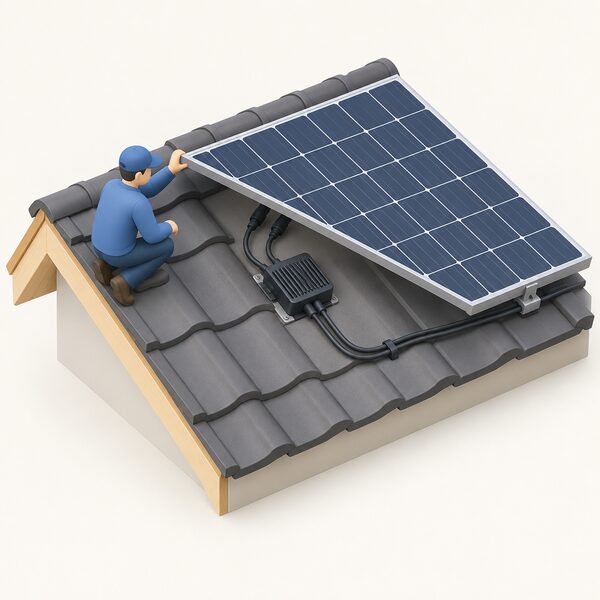
Where shade cannot be removed, the standard responses are microinverters or power optimisers, which let each panel work independently23. Instead of one string current set by its weakest module, each module is tracked on its own, so a shaded panel drags down only itself.
The limit should be stated as firmly as the benefit. Optimisers reduce the losses of the overall system, but individual panel losses will still affect performance1. They recover the string penalty, not the shaded panel's own lost generation. A household told that optimisers "solve" shading has been told something the evidence does not support.
Optimisers bring secondary functions beyond shade management. A distributor's technical guidance describes rapid shut down and arc fault circuit interruption on the DC side of a solar system, and notes that optimisers simplify the string array and enable oversizing at double the inverter power, with longer strings reducing cable and installation costs29. The same guidance sets a compatibility condition:
"It's also crucial to ensure that optimisers are compatible with both panels and inverters."
Mismatching manufacturers should be avoided29. That introduces a dependence worth naming: module-level electronics tie the array to a specific manufacturer's ecosystem, and in many cases to its monitoring platform, for the life of the system. A plain string array has fewer parts and fewer companies to outlive. The trade-offs are set out in power optimisers, microinverters and microinverters vs string inverters.
The third option is layout. Splitting a shaded roof into separate strings by plane and by shading pattern, so that affected modules sit together, is a design decision taken at survey rather than a product bought afterwards.
Flat roofs: tilt frames, spacing and the 0.6 metre rule
Panels can be installed on both pitched and flat roofs30. On a flat roof the panels need to be tilted to maximise generation, and spaced to avoid shading one another30. Energy Saving Trust advice confirms that panels on flat roofs are normally tilted up to help maximise energy production19 and notes the cost consequence: there is more flexibility over the angle, but the installation is more complex because panels may need additional mounting systems and the roof must support the extra weight, so it might cost more than a pitched roof installation23.
In England, permitted development places a dimensional limit on both cases. On a flat roof, panels should project no more than 0.6 metres from the plane of the roof5. On a pitched roof, panels should not be installed above the highest part of the roof excluding the chimney, and should not project more than 200mm from the roof slope31. Planning rules differ between the four nations; see flat roof solar permitted development rules and the planning pages for England, Scotland, Wales and Northern Ireland.
The freedom a flat roof gives is real: orientation is chosen rather than inherited, so a north-pointing building can still carry a south-facing array. The cost is ballast or fixings, spacing that reduces the panels per square metre, and a structural check.
Solar thermal and heat pumps: related but not identical roof requirements
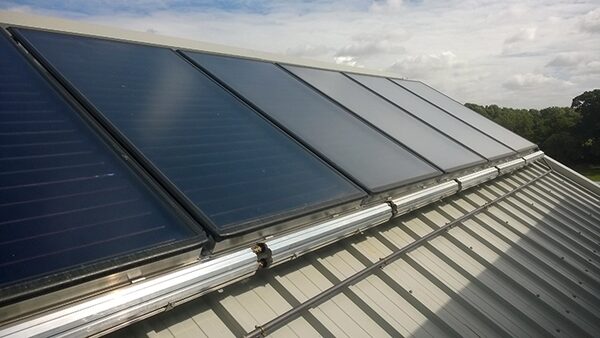
Solar water heating is judged on the same axes with slightly different numbers. Northern Ireland's official guidance specifies south facing roofs between south-east and south-west at an angle of about 30 to 50 degrees7. Consumer testing puts thermal collectors on a south-facing roof at 30 degrees to the horizontal, adding that up to 65 degrees will still work in the UK17. OFTEC describes panels as usually sited on a south-facing roof, using the sun's heat to warm water32, and a south facing roof free of shading as ideal27. Energy Saving Trust guidance widens the acceptable arc to anywhere between east and west, but not north facing20. A Scottish Government technical feasibility study assigned solar thermal suitability to homes with roofs facing South, South-West or South-East33.
The difference in tolerance follows from the duty. A thermal collector serves a cylinder with a fixed daily demand, so a broader orientation window is acceptable once the cylinder reaches temperature. More detail is in solar water heating and how much roof space solar water heating needs.
Heat pumps introduce an area constraint rather than a new angle. One maker states that a roof carrying PV to power a heat pump should ideally face south and have at least 20 square metres of available space34. That is the maker's own figure for its own product. Useful area, not orientation alone, is often what decides whether PV can meaningfully offset a heat pump's winter consumption, and winter is precisely when PV output is lowest, so the offset is annual rather than simultaneous.
| System | Orientation guidance | Pitch guidance |
|---|---|---|
| Solar PV | South ideal; south-east to south-west performs well1 | 30 to 40 degrees ideal; 20 to 50 workable12 |
| Solar thermal (NI official) | South facing, south-east to south-west7 | About 30 to 50 degrees7 |
| Solar thermal (consumer testing) | South-facing17 | 30 degrees, up to 65 degrees still works17 |
| PV for a heat pump (maker) | Ideally south, at least 20 m²34 | Not specified |
What an installer assesses before quoting
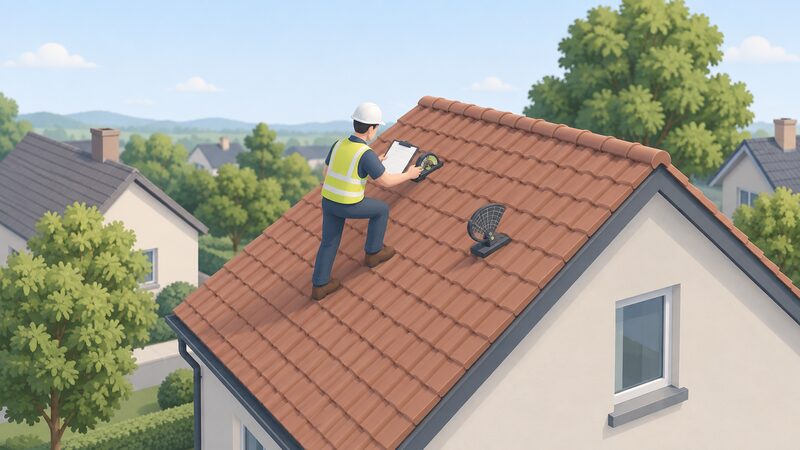
A quotation that arrives without a site visit has skipped the stage where roof suitability is actually established. Consumer testing sets out what a good technical site survey covers2:
- Roof orientation.
- Measured roof tilt.
- Roof quality, inside and out.
- Any risks of shade on the panels, recorded.
- The consumer unit and metering.
- The household's electricity use.
- Where cables and equipment will be located.
Installers describe starting with the roof pitch and orientation and any overshading from trees or other buildings35. Under a local authority group-buying scheme, a surveyor visits once an offer is accepted, to assess whether the roof is suitable and confirm the number of panels, their location, cabling locations and colour36.
Structure is assessed separately from yield, and it is a regulatory matter. English local authority guidance states that the roof must be checked to support the additional wind, snow and static load imposed by the solar panels, and to comply with Part A: Structure37. Welsh building regulations guidance puts it as a requirement of proof: the adequacy of the existing roof to carry the load from the panel will need to be checked and proven38. The MCS installation standard for solar PV systems also records the postcode region as an assessment field, because irradiance varies geographically39. A large, south-facing, 30 to 40 degree pitched roof in the south of England, free from shading, is described by consumer testing as the combination that generates maximum power output in the UK40.
Householders can estimate orientation and pitch themselves, but the survey is what turns an estimate into a design: it fixes string layout, decides whether module-level electronics are warranted, and confirms the roof can carry the array. See solar panel installation, building regulations and roof loading and MCS certification, or the full solar PV guide.
What roof suitability means for independence
Orientation, pitch and shading set the upper bound on how much of a home's electricity can come from its own roof. A south-facing, unshaded, 30 to 40 degree roof reaches that bound; an east-west split reaches roughly 15% less per plane but may match demand better across the day2; a shaded roof or a north-facing one falls short in ways no equipment recovers1.
What remains dependent is worth stating. Even a well-oriented array leaves the household importing at night and through winter, tied to a supplier and to a grid connection, unless storage is added, and even then not fully. Module-level electronics add a dependence on one manufacturer's hardware and platform. And the roof itself is a fixed asset: the single biggest determinant of a home's generation potential was decided when the house was built.
Sources40 cited
- What makes a good solar PV roof, Renewables First, 2026-04-08
- Buying advice for solar panels, Which?, 2026-08-12
- Solar photovoltaic information service, Centre for Alternative Technology, 2026-03-10
- Microgeneration planning advice, Scottish Government, 2013-03-04
- Solar panels and permitted development, Richmond Council, 2026-07-06
- Generating your own energy: solar electricity, Welsh Government
- Solar thermal panels, nidirect, 2024-10-22
- Solar panel myths debunked, Which?, 2026-06-09
- Consumer guidance on renewable energy, RECC, 2026-09-17
- Solartwin solar thermal brochure, Solartwin, 2012-01-10
- Renewable energy FAQs, Electricity North West, 2023-02-23
- Solar panel installation, maintenance and repair, NICEIC, 2026-09-17
- Plumbing with renewables, CIPHE, 2026-09-17
- Advice on improving energy efficiency, Eryri National Park Authority, 2022
- Is my roof suitable for solar panels, Fuse Energy, 2026-06-05
- Solar PV technologies, Flexi-Orb, 2025-04-22
- Solar water heating with solar thermal panels, Which?, 2026-05-15
- Solar panel installation, Which?, 2026-08-12
- Solar panels advice, Energy Saving Trust, 2026-08-27
- Could solar water heating work for you, Energy Saving Trust, 2026-05-20
- How do solar panels work, Smart Energy GB, 2026-03-16
- A guide to solar panels with Energy Saving Trust, MCS, 2023-08-18
- Solar panel installation guidance, Energy Saving Trust, 2026-09-07
- Is my roof suitable for solar panels, E.ON Next, 2024-12-02
- A complete guide to solar PV, Centre for Sustainable Energy, 2025-11
- Solar panel installation in Inverness, Fuse Energy, 2026-09-16
- Your home guide to solar water heating, OFTEC, 2026-09-20
- Solar photovoltaic (PV) panels, Bromley Council, 2026-09-17
- Solar panel optimisers: what are the benefits, Alternergy, 2024-10-21
- Solar panels: energy improvement options, Hammersmith and Fulham Council, 2026-09-17
- Planning permission for solar equipment mounted on a house, Planning Portal, 2026-09-17
- What heating options are available off the grid, OFTEC, 2026-09-20
- Technical feasibility of low carbon heating in domestic buildings, Scottish Government, 2020-12-22
- Do you need solar panels with a heat pump, Aira, 2025-02-06
- Solar PV panels, AgilityEco, 2026-09-20
- Installing solar panels on your home, Brighton and Hove City Council, 2026-09-17
- Solar panels: planning and sustainability, East Herts Council, 2026-09-17
- Building regulations: energy efficiency, Welsh Government, 2026-09-17
- MIS-3002 Solar PV Systems V4.0, MCS, 2025
- Could solar panels save you £500 a year, Which?, 2026-06-17
 Solar Mounting SystemsWill your roof take the extra weight of solar panels, and will it still keep the rain out afterwards?
 Panels by Home TypeCan your house have solar panels, and how many will fit?
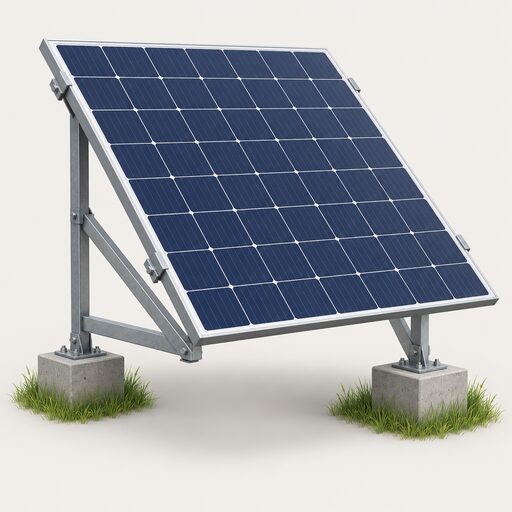 Ground-Mounted SolarGround-mounted solar panels sit on a frame in your garden instead of on your roof, which helps if your roof is shaded, small or facing the wrong way.
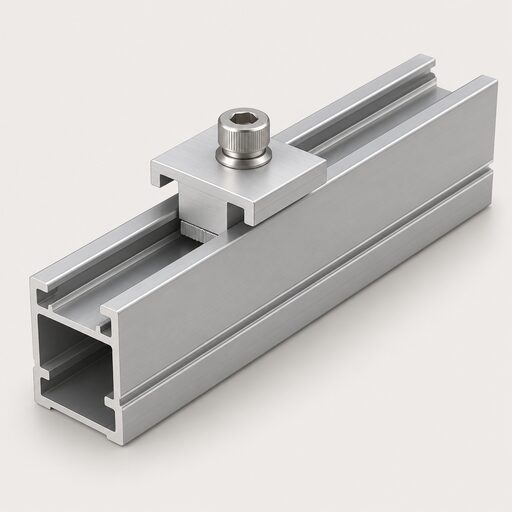 Solar Mounting System MakersWhich solar mounting brands might appear on your quote, and does the maker actually matter?
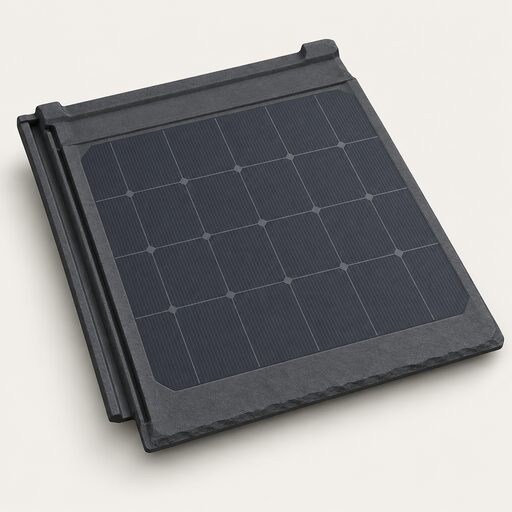 Roof-Integrated SolarSolar tiles replace your roof covering instead of sitting on top of it, so the finished roof looks like a roof.
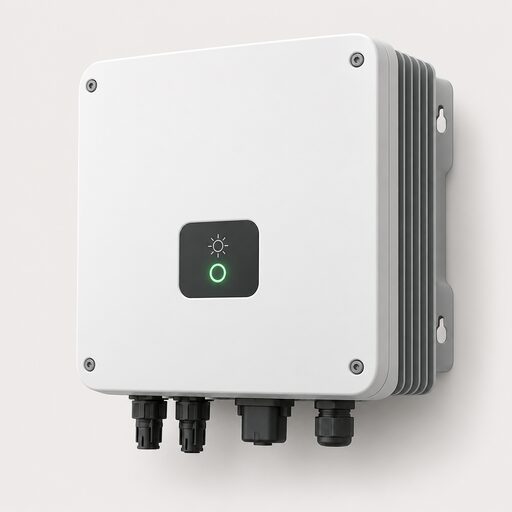 Cooling with Solar PanelsCan solar panels run an air conditioner, and will they cover the whole bill?