
In this answer
Short answer
East and west facing roofs work for solar panels. The penalty against a directly south-facing system is around 15 to 20% less energy, a figure given by both official and independent guidance1. A consumer body puts the reduction at 15% for an east or west-facing roof, against around 30% for a north-facing roof4. The array still generates, and it generates at different times: east-facing panels produce more in the morning, west-facing panels in the afternoon and early evening5.
That timing matters more than the annual total for many households. A south-facing array peaks at midday, when many homes are empty. An east or west array spreads output towards the hours when people are at home, and an east-west split array uses both slopes to stretch generation across the day6. The trade is a lower annual yield for a profile that may be used more directly, reducing what is exported at low value and imported at high value.
The suitability question is not orientation alone. Pitch, shading and the condition of the roof all bear on it, and the planning position is broadly permissive across the UK. What follows sets out the output penalty, the timing difference, the split-array option, the conditions that make an east or west roof unsuitable, and the cost and VAT timing that affect a decision in 2026.
How roof orientation affects solar output
South is optimal because a south-facing roof captures the most direct sunlight across the day, and guidance from the Energy Saving Trust describes an unshaded, south-facing roof as ideal for maximum performance2. A consumer body states that a south-facing roof will give the best power output, with south-west or south-east also good10. The Centre for Alternative Technology puts the workable band at south-east to south-west, at a pitch of 20 to 50 degrees3.
Optimal is not the same as required. Maker guidance notes that while a south-facing roof is considered optimal for maximising electricity generation, it is not strictly necessary11. The same source observes that east-west facing roofs may generate power which better meets a household's lifestyle, peaking in the morning on the east and the afternoon on the west11. That is the crux: orientation sets the shape of the generation curve, not just its height.
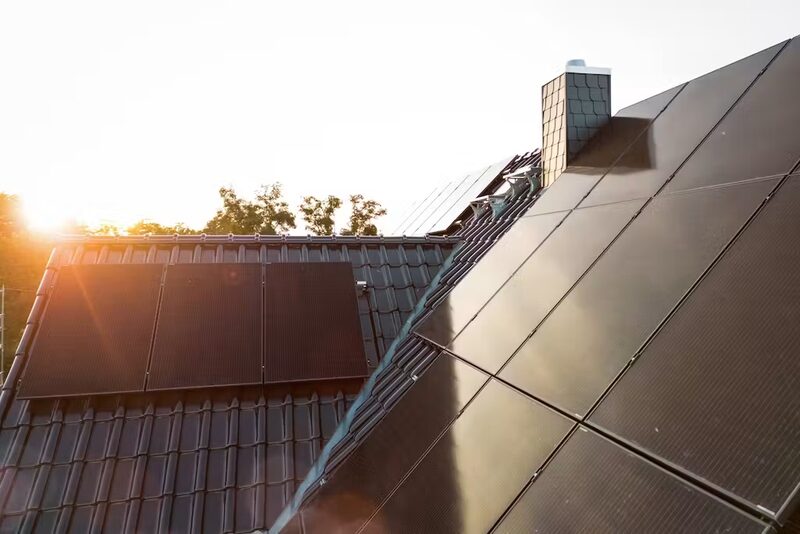
The height difference is well established. Official guidance states that a system facing east or west tends to get around 15 to 20% less energy than one facing directly south1. The Energy Saving Trust repeats the same 15 to 20% figure2, and the Centre for Alternative Technology gives about 20% less for an array facing due east or west3. A consumer body gives 15%4. The range across sources, 15 to 20%, reflects different modelling assumptions rather than a disagreement about the direction of the effect.
North-facing roofs sit outside the workable band. The Energy Saving Trust does not recommend installing panels on roofs that face north, on the basis that they will not get enough sunlight to make it worth the while2. A consumer body puts the north-facing penalty at around 30% less energy4. Solar thermal collectors follow a similar rule: they work best on a south-facing roof, or somewhere between east to west but not north facing12.
East or west facing: how much energy you lose and when it matters
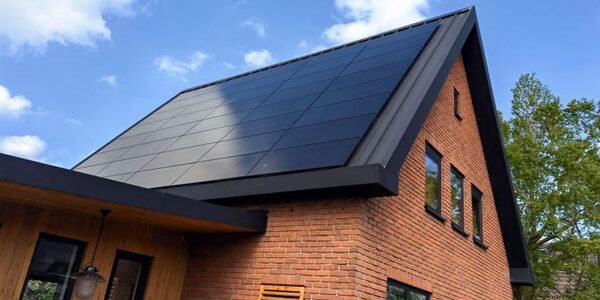
The annual loss is the headline, but the hourly profile is what a household experiences. East-facing panels generate more electricity in the morning, while west-facing panels do better in the afternoon and early evening5. For a household with daytime occupancy, or one that charges an electric vehicle in the evening, a west-facing array may deliver more usable energy than its annual total suggests. For a household with high morning demand, the east slope does the same.
Neither direction is better than the other in annual terms. Both carry roughly the same penalty against south, and the sources do not distinguish between them on yield. The distinction is entirely one of timing, and it is a distinction that a battery can flatten: stored morning or afternoon generation can be drawn on in the evening regardless of which slope produced it. Guidance on adding storage notes that a battery shifts generation to when it is needed, which reduces the practical significance of the orientation penalty for households that install one.
The penalty also interacts with pitch. Guidance from the Chartered Institute of Plumbing and Heating Engineering gives an ideal pitch of 30 to 40 degrees in an unshaded location7. A steeper or shallower roof shifts the effective angle to the sun, and the further a roof departs from south, the more a non-ideal pitch compounds the loss. In practice, most UK pitched roofs fall within a workable band, and the orientation penalty is the larger of the two effects.
For solar water heating, the same logic applies with a size adjustment. Guidance states that even an east or west facing panel can still be worthwhile, but it needs to be about 20% bigger13. That is a useful way to think about PV too: the penalty can be offset by adding capacity, roof space permitting.
East-west split arrays: using panels on both sides of the roof
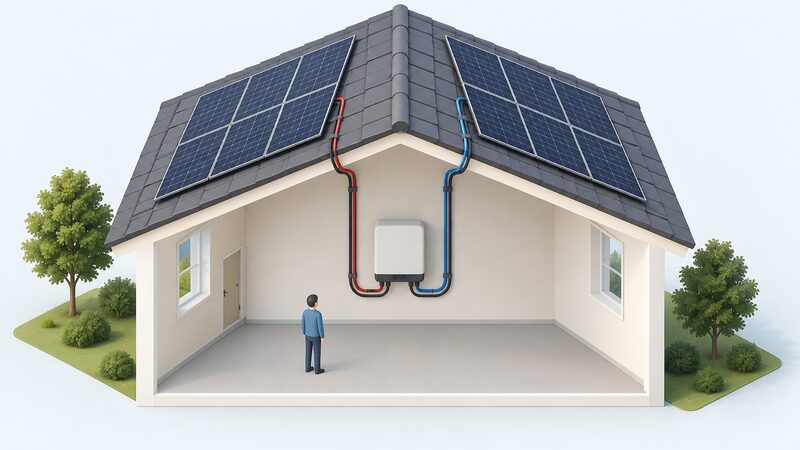
An east-west aspect can use panels on both sides of the roof3. This is the configuration that most directly addresses the timing problem: the east slope produces in the morning, the west slope in the afternoon, and the combined output curve is flatter and longer than a single south-facing string. For a household without a battery, that flatter curve can match self-consumption better than a midday peak that is largely exported.
A split array needs two roof areas of adequate size and orientation, and it usually needs either two string inputs on the inverter or module-level electronics to manage the two orientations independently. Guidance on optimisers and microinverters explains how per-module management handles mixed orientations, which is the standard approach where one string would otherwise be limited by the weaker slope.
Planning is not a barrier. Placing solar panels on the roof of a house or flat, or a building within the grounds, is in most cases permitted development, whether in a conservation area or otherwise14. A local authority confirms that placing solar panels on the roof of a house or flat, or on a building within the grounds, is considered in most cases permitted development under the Town and Country Planning (General Permitted Development) (England) Order 2015, Schedule 2, Part 14, Class J15. Planning permission is required for panels on flat roofs16.
Where a roof fronts the highway, some authorities expect panels to be positioned to retain even distances to roof margins, including ridge, eaves, party walls and wall margins17. Approved Document L gives a reference orientation of south-east to south-west for roof-mounted photovoltaic arrays on dwellinghouses18. Neither rule prevents an east-west split, but both shape how it should be laid out.
When an east or west roof is still a good fit
A consumer body states that solar PV panels are worth considering if there is a south, east or west-facing roof with little or no shade and no plan to move home in the near future10. The same source notes that an unshaded roof facing east, south or west gives a good chance the home is suitable19. Official guidance is firmer on the negative case: if a roof is heavily shaded, solar panels may not be the most suitable option20.
Shading is the condition most likely to rule out an otherwise good east or west roof. A roof that is shaded in the morning is a poor candidate for an east array, because the morning is precisely when that array generates. The same applies in reverse to a west roof shaded in the afternoon. Guidance on shading explains how shade affects output and how module-level electronics can mitigate it, though mitigation is not elimination.
Pitch is the second condition. The ideal is 30 to 40 degrees, unshaded7. A UK pitched roof within that band, facing east or west, is a workable candidate. A flat roof needs panels tilted and spaced to avoid shading, and planning permission is required for panels on flat roofs16.
The third condition is the roof itself. A large, un-shaded, predominantly south-facing roof space is described as ideal, but the same guidance treats south-west or west-facing as suitable, though a little less productive22. Official guidance from Wales states that east or west installations can also provide good performance and can be used for a building with a roof or wall that faces within 90 degrees of south23. That 90-degree tolerance is the widest official statement of what counts as workable.
Solar thermal sits alongside PV here. Official guidance states that suitability was assigned to homes with roofs facing south, south-west or south-east24, and Northern Ireland guidance states that all solar panels should be mounted on south facing roofs between south-east and south-west25. Solar thermal is therefore less tolerant of an east or west roof than PV, and the size adjustment of about 20% bigger applies13.
Cost and timing: VAT change and grant schemes to weigh
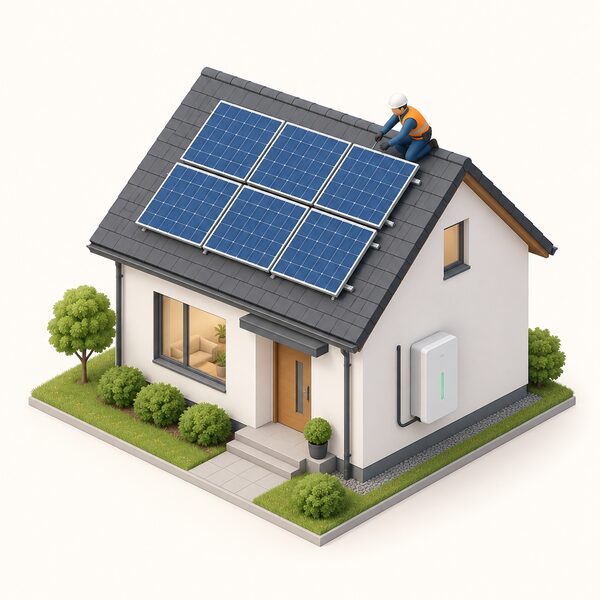
Solar panels qualify for a lower rate of VAT26. Independent guidance states there is currently 0% VAT paid on solar panels and batteries until March 20278. The 0% rate for qualifying energy-saving material installations in Great Britain, including solar panels, battery storage and heat pumps, is expected to return to the reduced VAT rate of 5% from 1 April 202727. The reduced rate legislation excludes the installation of solar panels, wind and water turbines from the reduced rate of VAT28, which is why the current 0% treatment is a temporary measure rather than the default.
Northern Ireland has a different position. Where the cost of the materials supplied as part of an installation, such as solar panels, is more than 60% of the total, the VAT treatment differs29. Official guidance gives a worked example: an installer charges £5,385 excluding VAT, comprising £3,500 for materials and £1,885 for labour; because materials are 65% of the total, standard 20% VAT applies to materials and 5% VAT to labour29. That is a Northern Ireland-specific rule and does not apply in Great Britain.
On grants, the Warm Homes scheme is the main landscape. The government plans to more than double combined funding of Warm Homes: Local Grant and Warm Homes: Social Housing Fund from £462 million per year in 2025/26 to £1 billion per year in 2027/28, when they are set to merge9. Warm Homes: Local Grant closed to new applications in September 2026 due to high demand, with applicants completing the expression of interest form added to a waiting list for when further funding becomes available30.
For cost figures, independent guidance gives a 4.6kWp ten-panel system on an east-facing 35-degree pitched roof with modest shading an installation cost of £7,400, with a total annual benefit of £460 in London and a payback of 16 years 1 month1. The same source gives a south-facing equivalent in Belfast a total annual benefit of £620 and in Edinburgh £6051. Those figures are as of 1 June 2025 and are modelled, not quoted. Prices for a specific installation are installer-quoted.
What an east or west roof means for energy independence
An east or west array reduces reliance on imported electricity in the same way a south-facing array does, just with a smaller annual total and a different daily shape. The household still draws from the grid at night and in winter, still depends on a supplier for import and export payments, and still depends on the inverter manufacturer for monitoring and, in some cases, app-based control. Orientation changes the size of the benefit, not the nature of the dependence.
The timing profile is the independence argument for east and west roofs. Generation that arrives in the morning and evening overlaps more with household demand than a midday peak, which means more of it is used on site and less is exported. That reduces both the volume imported and the exposure to export rates that are set by suppliers rather than by the household.
The limits are real. A north-facing roof is not recommended2, and a heavily shaded roof may not be suitable at all20. Solar thermal is less tolerant of east or west orientation than PV24. And the VAT deadline of 31 March 2027 is a timing factor that affects cost, not suitability27.
For the wider picture, see solar panels and household energy independence, roof orientation, pitch and shading, and solar panel savings and payback.
Sources30 cited
- Are solar panels worth it?, Which?, 2025
- Solar panels, Energy Saving Trust, 2026
- Solar photovoltaic, Centre for Alternative Technology, 2026
- Buying advice for solar panels, Which?, 2026
- Solar panel installation, Energy Saving Trust, 2026
- Solar panel myths, Which?, 2026
- Plumbing with renewables, Chartered Institute of Plumbing and Heating Engineering, 2026
- Are solar panels worth it?, Uswitch, 2026
- Warm Homes Plan, Sunsave, 2026
- Solar panel installation, Which?, 2026
- How do solar panels work, E.ON Next, 2026
- Could solar water heating work for you, Energy Saving Trust, 2026
- Solar water heating, Centre for Alternative Technology, 2025
- Solar photovoltaics and planning in conservation areas, West Suffolk Council, 2026
- Solar panels, Wirral Council, 2026
- Planning and solar, Frome Town Council, 2025
- Solar panels and permitted development, Richmond Council, 2026
- Approved Document L, Volume 1: Dwellings, HM Government, 2026
- A guide to solar panels with Energy Saving Trust, MCS Certified, 2023
- Solar photovoltaic panels, London Borough of Bromley, 2026
- Solar panels, London Borough of Hammersmith and Fulham, 2026
- Consumers, RECC, 2026
- Generating your own energy: solar electricity, Welsh Government, 2018
- Technical feasibility of low carbon heating in domestic buildings, Scottish Government, 2020
- Solar thermal panels, nidirect, 2024
- Energy saving products, HM Government, 2026
- VAT on solar and battery storage, Solar Energy UK, 2026
- Draft explanatory notes, clause 48, HM Government, 2026
- VAT on energy saving materials, HM Revenue and Customs, 2026
- Warm Homes: Local Grant, Act on Energy, 2026
 Roof Orientation and ShadingWhich way should your roof face for solar panels, and does it really matter if it is not south?
 Panels by Home TypeCan your house have solar panels, and how many will fit?
 Building-Mounted Wind TurbinesWill a wind turbine on your roof actually make enough electricity to be worth it?
 Cooling with Solar PanelsCan solar panels run an air conditioner, and will they cover the whole bill?
 Solar Panel CostsA typical UK home pays somewhere between four and eleven thousand pounds for solar panels fitted, with most landing in the middle.
 Solar Mounting SystemsWill your roof take the extra weight of solar panels, and will it still keep the rain out afterwards?