
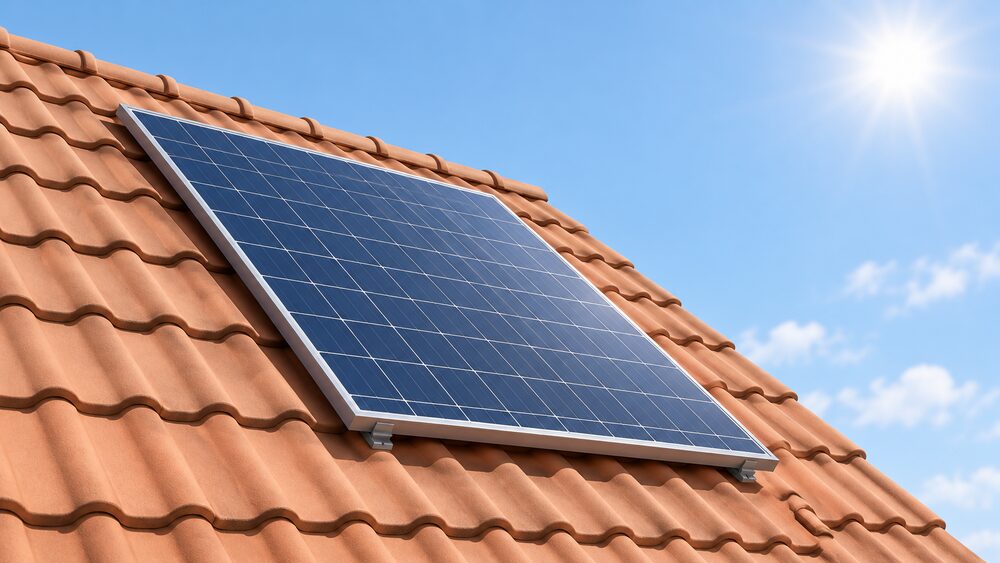
On this page
A typical domestic solar PV system in the UK generates between 3,400 and 4,200 kilowatt hours (kWh) of electricity a year1. A well-sited system of about 3.5kW peak output produces around 3,000 to 3,500kWh a year2, while a larger setup of 18 panels has been recorded generating about 4,500kWh a year3. How much of that lands in your home depends on the season: the same roof can produce around 20kWh a day in summer and under 1kWh a day in the depths of winter4.
The starting point for all these numbers is the panel itself. A typical residential solar panel produces around 250 to 400 watts of power under ideal conditions, with more efficient panels reaching up to 450 watts5. Panels convert sunlight into electricity6, and they only produce it during daylight hours7. Everything else, the annual totals, the seasonal swings, the differences between homes, follows from how much sunlight reaches those panels and how much of the resulting electricity the household actually uses.
What a solar panel actually produces: from a few hundred watts to around 400W
A solar panel's output is measured in watts, and a typical residential panel produces around 250 to 400 watts of power under ideal conditions, with the more efficient modules on the market reaching up to 450 watts5. That ideal is worth pinning down, because a panel rarely sustains its rated power for long. The rating is a peak figure, reached only in strong direct sunlight with the panel at a favourable angle and at a cool temperature.
In hourly terms, a 350W panel may generate 0.35kWh of electricity per hour under optimal conditions9. Over a full day, a 400W panel typically produces about 1.6kWh, based on an average of 4 peak sunlight hours in the UK12. A more conservative calculation that applies a performance ratio of 0.75, which allows for real-world system losses, puts the same 400W panel at approximately 1.2kWh a day12. The gap between those two figures is the gap between theory and a real British roof.
The electricity itself is ordinary household electricity. Solar electricity panels take the sun's energy and convert it into electricity that you can use in your home13. Nothing about the generation process is exotic; the variables are how much sun falls on the panels, how efficiently the modules convert it, and how much of the output is consumed in the house rather than exported.
Typical daily output: 100W, 350W and 400W panels compared

Panel size sets the ceiling on daily generation, and the differences between panel sizes are larger than their wattage ratings might suggest. The figures below assume UK conditions with roughly 4 hours of usable sunlight a day.
| Panel | Daily output | Annual output | Notes |
|---|---|---|---|
| 100W | 0.3 to 0.6kWh | not stated | Small panel, typical UK conditions9 |
| 350W (average) | 0.7kWh | about 265kWh | UK average9 |
| 400W | about 1.6kWh | about 584kWh | 4 hours of daily sunlight9 |
| 400W (with losses) | about 1.2kWh | about 438kWh | Performance ratio of 0.7512 |
A 100-watt panel usually generates 0.3 to 0.6kWh of daily electricity9; in an area with 4 to 5 peak sunlight hours, it can be expected to create about 0.4kWh9. An average 350W panel does better, at around 0.7kWh a day in the UK, though under optimal conditions the theoretical ceiling is 1.4 to 1.75kWh a day9. A 400W panel, assuming 4 hours of daily sunlight, generates about 1.6kWh a day and about 584kWh a year9.
The two 400W annual figures, 584kWh and 438kWh, differ because they are calculated on different assumptions9. The higher figure assumes the panel delivers its rated output for 4 hours a day; the lower applies a performance ratio of 0.75 to account for the losses every real system suffers, from cabling and inverter conversion to dirt and heat. Both are modelled figures from panel makers' guidance rather than measured results from a specific roof, and a household's own numbers will depend on where the figures' assumptions hold.
Annual generation: 3,000 to 4,500kWh depending on the system
The headline figure most households want is the annual total, and the independent guidance is reasonably consistent. An average domestic solar PV system generates between 3,400 and 4,200kWh of electricity a year1. A 4kWp system could generate around 3,500kWh a year depending on where you are in the country14, and an average 4kW solar panel system produces around 3,500kWh of renewable energy per year15. A well-sited domestic system of about 3.5kW peak output produces around 3,000 to 3,500kWh per year2. A typical 4kW home solar system, if well positioned, can be expected to produce between 3,500 and 4,000kWh per year16.
Rooftop systems sit at the upper end of the domestic range, with typical annual power generation of 3,800 to 4,350kWh17. Larger setups go further: one case study of a home with 18 panels records about 4,500kWh of electricity generated a year3. At the other end of the scale, plug-in solar panels, the small balcony or window-ledge kits, are estimated to generate up to 720kWh a year17, and a few owners with smaller systems between 2.1kWp and 2.5kWp reported their panels generated as much as 2,700kWh over a year18.
The most useful rule of thumb converts system size to expected generation. In the UK, one kilowatt of panels generates between 800 and 1,000kWh of electricity per year2. A well-designed system typically generates around 700 to 900kWh per kWp each year8. Multiply the system size in kWp by those figures and the annual totals above follow: a 3.5kWp system at 700 to 900kWh per kWp lands at roughly 2,450 to 3,150kWh, and a 4kWp system at the same yields lands at roughly 2,800 to 3,600kWh, before the better-sited roofs push toward the higher published figures.
Over its lifetime, the totals compound. A solar PV system should produce around 80,000 to 100,000kWh of electricity over a 25-year working life16. For guidance on matching system size to your home, see solar panel sizing.
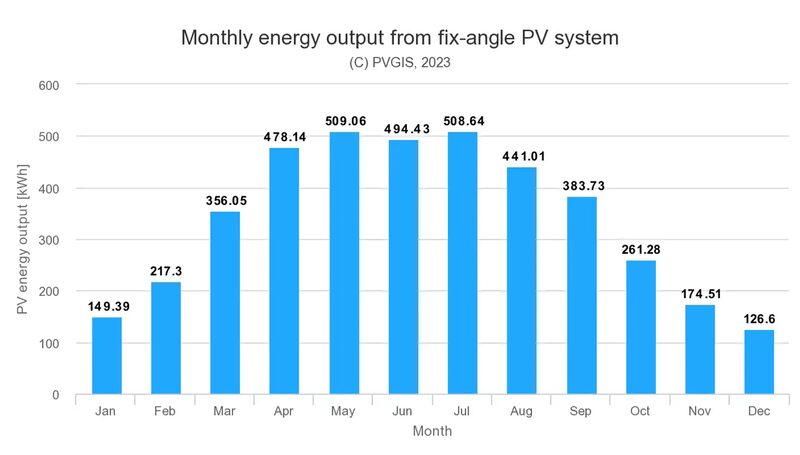
Seasonality: 20kWh a day in summer, under 1kWh in winter
Annual averages hide the single most important fact about solar generation in the UK: it is overwhelmingly a summer activity. Based on typical figures, a solar array yields around 20kWh per day on average in summer, and around just under 1kWh per day in winter4. Measured per square metre, the average is around 5,000W/m2 per day in summer, dropping to around 800W/m2 in winter4.
Solar panels do work in winter, but they generate less electricity than in summer19. They can be 25% to 50% less effective in winter than in summer due to winter's shorter days and increased cloud cover20. On a cloudy day at any time of year, output falls to maybe 10% to 25% of a sunny day20. Panels typically produce most electricity during the daytime in summer when it is sunny21.
The winter figure deserves emphasis because it collides with the season a household needs electricity most. As one analysis of solar with electric heating puts it, the roughly 1kWh achieved from solar panels in winter, the time when electric heating is needed most, is not enough to run the fridge and television for a day, let alone electric heating4. A household planning to rely on solar for heating, or for an electric vehicle through the winter months, should plan on the basis of the winter number, not the annual average.
Within each day, generation is concentrated in the middle hours. On a normal sunny day, solar panels produce the most electricity from around 11am to 3pm22. Panels are likely generating the most power during the middle of the day and do not generate electricity after dark23. Shifting daytime household jobs into that window is one of the simplest ways to use more of the output, a tactic covered in detail in solar diverters and solar PV monitoring.
How panel efficiency limits output: 14 to 22% for modern modules
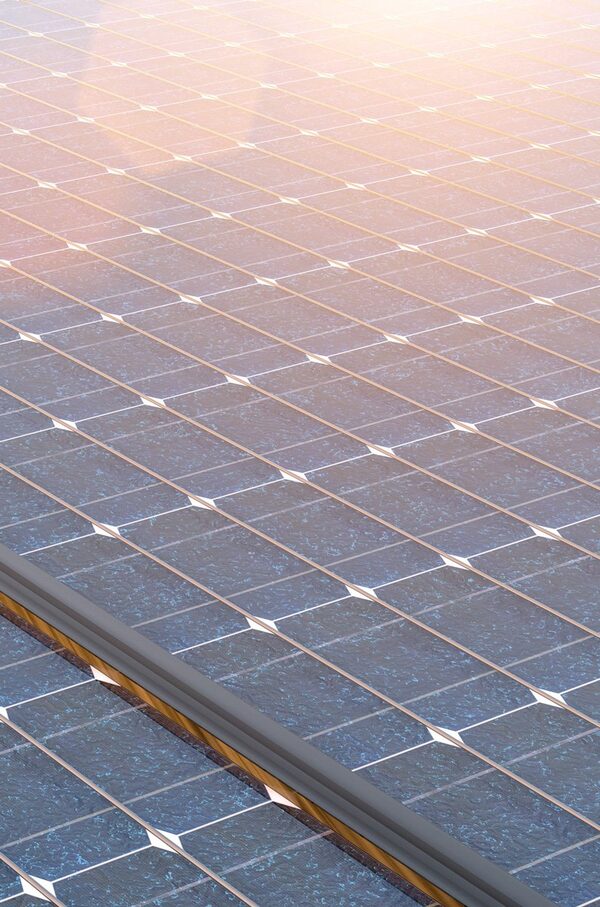
Not all the sunlight landing on a panel becomes electricity. The efficiencies of panels presently on the market tend to be in the range 14 to 22%11. That fraction, the proportion of sunlight converted to usable electricity, is the panel's module efficiency, and it directly caps what any given roof area can produce.
Efficiency matters most when roof space is tight. Two panels of the same physical size but different efficiencies will produce different amounts of electricity from the same sunlight, so a higher-efficiency module delivers more watts per square metre. This is why more efficient panels reach up to 450 watts while typical modules sit at 250 to 400 watts5. The average domestic system size is around 3.5kWp, taking up around 20 square metres of roof24, and a household with less usable roof may need the more efficient modules to reach a worthwhile capacity.
Efficiency should not be confused with output. A 20%-efficient 350W panel and a 15%-efficient 350W panel have the same rated output; the difference is that the first achieves it from a smaller area. What efficiency buys is watts per square metre, not watts per panel. The technical detail behind these figures, and how to read a panel datasheet, is covered in solar panel specifications and efficiency and solar cell technology.
Why output varies: location, roof, shading and system losses
The total amount a system generates depends on several factors: your geographical location; the season and therefore hours of daylight; your roof's compass direction and slope; any shading that might block the panels at certain times of day; and the efficiency of the system18. Each of these can move annual output by a meaningful margin, which is why the published figures for similar-sized systems span a range rather than a single number.
Location works through peak sunlight hours. The UK average of about 4 peak sun hours a day12 is an average across the country and the year; a roof in southern England sees more usable sun than one in northern Scotland, and the same 4kWp system generates different totals accordingly. This is why a 4kWp system's output is described as depending on where you are in the country14.
Roof direction and slope determine how much of the available sunlight the panels actually catch, and shading removes it at certain times of day18. These effects are covered in depth in roof orientation, pitch and shading and how shade affects solar panel output. System efficiency, the last factor, covers the losses between the panel and the socket, which is what the performance ratio of 0.75 in some modelled figures represents12.
The scale of the national picture gives context for the domestic one. The UK's solar panels generated an estimated 6,964 gigawatt hours (GWh) of electricity across the April-to-September period in 201625, a figure dominated by large solar farms but built on the same seasonal pattern a household roof sees. Community-scale examples show the same physics at work: one retrofit project recorded total electricity generation of 25,732kWh per year from its solar panel installations26, and a residential retrofit to Passivhaus standards recorded photovoltaic panels supplying 801kWh annually, based on a two-year average27.
What this means for household energy independence
Solar panels generate clean energy for your home, and as a bonus this can cut down on your energy bills28. Once you have paid for the installation, the electricity the panels generate is completely free for you to use6. That is the core of the independence case: generation that, after the upfront cost, needs no supplier, no fuel and no imports, only daylight.
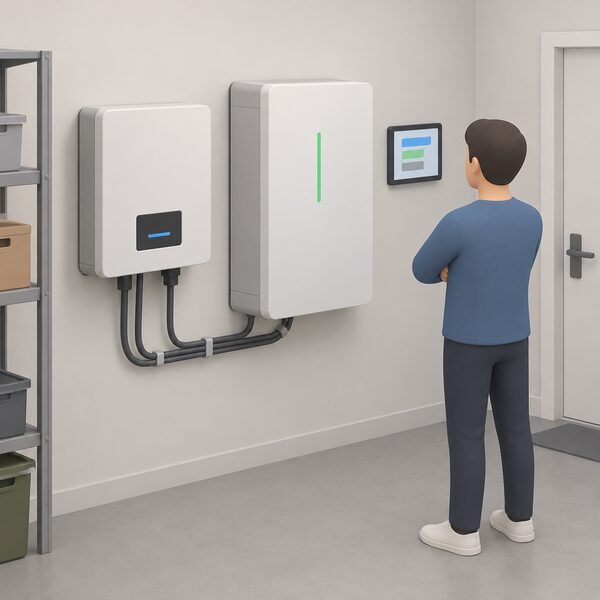
The realistic share is substantial but not total. As a general rule, 10 to 20 square metres of PV panels will generate between 20 and 40% of a typical household's electricity needs10. The Energy Saving Trust estimates that you can provide 40% of your home's energy with solar panels, especially when used alongside a solar battery29. A battery shifts daytime surplus into the evening, and a household's ability to use its own generation rather than export it is what turns kilowatt hours into bill savings; adding storage is covered in adding battery storage to solar.
Self-consumption matters even for the smallest systems. If a household is able to use 90% of the output of a plug-in installation, typical for such installations, then the panels would provide 400kWh of the home's electricity30. Plug-in solar kits are limited to 800W of capacity31, so their contribution is small, but the principle holds at every scale: electricity used in the home is worth more to the household than electricity exported.
What remains is the dependence a solar household does not escape. Panels generate nothing after dark7 and almost nothing in midwinter4, so the grid remains the backup for the hours and weeks when generation falls short. Surplus is typically exported rather than stored, which ties the household to an export arrangement, covered in solar export payments. And the equipment itself, panels, inverter and any battery, is manufactured hardware with a finite life, which is why the 25-year lifetime output of 80,000 to 100,000kWh16 is a better measure of value than any single year's figure. For the fuller picture of what solar does and does not free a household from, see solar panels and household energy independence.
Sources32 sources
- Solar Power, Electricity North West, 2026-09-19
- Solar Photovoltaics, Centre for Alternative Technology, 2026-03-10
- Russell and Kate's Story: Solar Panels and Heat Pump, Energy Saving Trust, 2026-08-13
- Using Solar Panels with Electric Heating and Electric Radiators, Electrorad, 2025-04-28
- Energy Glossary, Low Carbon Hub
- How Do Solar Panels Work?, Smart Energy GB, 2026-03-16
- Energy Saving Myths, Centre for Sustainable Energy, 2026-07
- Solar Photovoltaic Panels, Plymouth Energy Community, 2026-09-20
- How Many kWh Will a Solar Panel Generate, Jackery UK, 2026-04-29
- Plumbing with Renewables, CIPHE, 2026-09-17
- Existing and Future Technologies for Retrofitting the UK Housing Stock, CREDS, 2021-06-08
- Solar Panel Calculator, EcoFlow UK, 2025-04-07
- Renewable Energy, Consumer Council, 2026
- Electric Central Heating, Which?, 2025-09-22
- Are Solar Panels Worth It?, Uswitch, 2026-09-16
- Electric Vehicles Combined with Domestic Solar PV Can Help Cut the Cost of Charging, Zemo Partnership, 2022-04-28
- Plug-in Solar Panels vs Rooftop Systems, Which?, 2026-04-27
- Solar Panels: How Much of Your Electricity Can They Produce?, Which?, 2024-06-27
- Solar Power Facts, Energy Saving Trust, 2026-08-13
- Do Solar Panels Work in Winter?, Uswitch, 2026-09-15
- Make the Most of Your Solar Panels, Which?, 2026-08-12
- Making the Most of Your Solar PV Panels, Centre for Sustainable Energy, 2026-08
- Living with Solar Panels, Plymouth Energy Community, 2026-09-20
- Renewable Energy FAQs, Electricity North West, 2023-02-23
- UK Solar Beats Coal Over Half-Year, Carbon Brief, 2016-10-04
- Deep Retrofit Comes to Greater Manchester, Carbon Co-op, 2014-12-18
- CIBSE Case Study: Residential Retrofit to Passivhaus Standards, CIBSE, 2014-01
- What Is Global Warming and What Can I Do About It?, Smart Energy GB, 2026-03-16
- Make Your Home More Energy Efficient, Confused.com, 2026-07-06
- How Plug-in Solar Can Save UK Homes £1100 on Energy Bills, Carbon Brief, 2026-04-02
- MCS Responds as Plug-in Solar Panels Become Available in the UK, MCS, 2026-09-14
- A Homeowner's Experience of Solar Panels and Battery Storage, MCS, 2024-04-10