
In this answer
Short answer
A micro-hydro turbine's output is set by two things on the site, not by the machine alone: how far the water falls (head) and how much of it flows (flow). The greater the height and the more water there is flowing through the turbine, the more electricity is generated1. A worked example makes the arithmetic concrete: a 3kW turbine running for 4,400 hours, about half the year, produces 13,200 kilowatt-hours (kWh)2.
That figure is large by domestic standards. Independent guidance states that small hydroelectricity systems can produce enough electricity for all electrical appliances and lighting in your home3. Official guidance is more cautious about what the power is used for off the grid, noting that in off-grid applications the power is used for lighting and electrical appliances, with space and water heating supplied only when available power exceeds demand1.
The catch is siting. Micro hydropower is only practical in very specific locations, usually requiring reliable water flow all year round, the right permissions and enough height difference4. Where those conditions exist, hydro is the most continuous of the home renewables: a hydro system can operate 24 hours a day, often generating all the electricity you need3.
What a micro-hydro turbine can generate: the headline figures
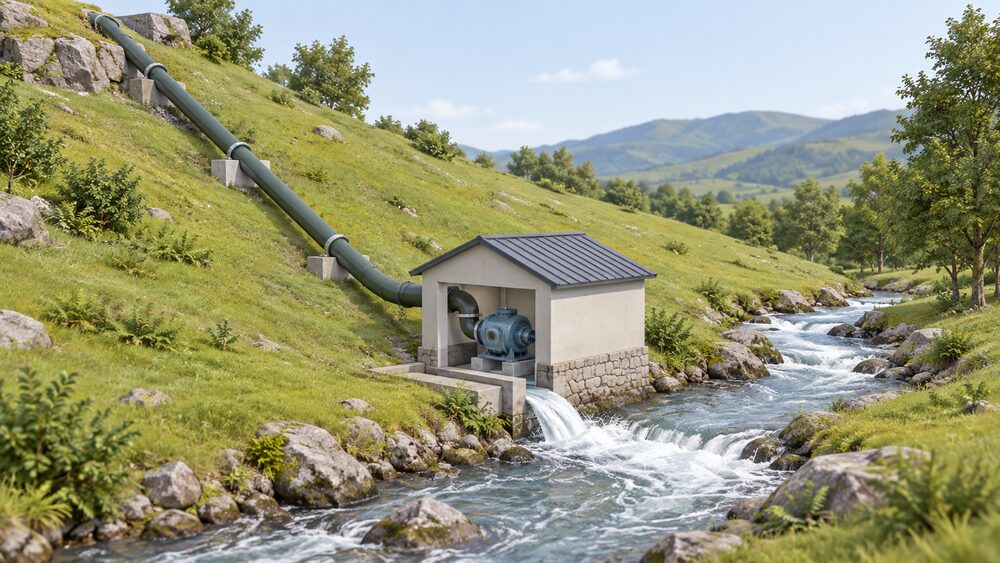
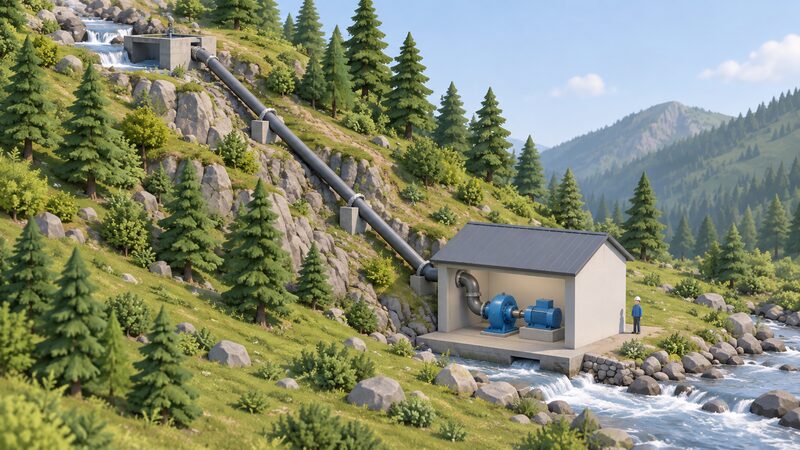
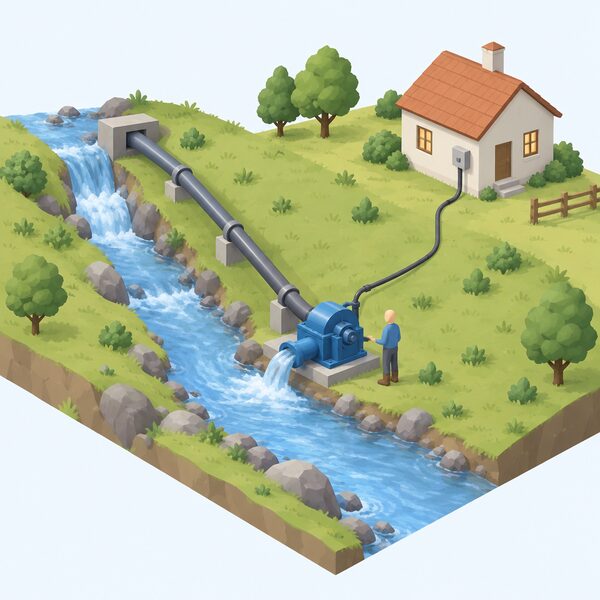
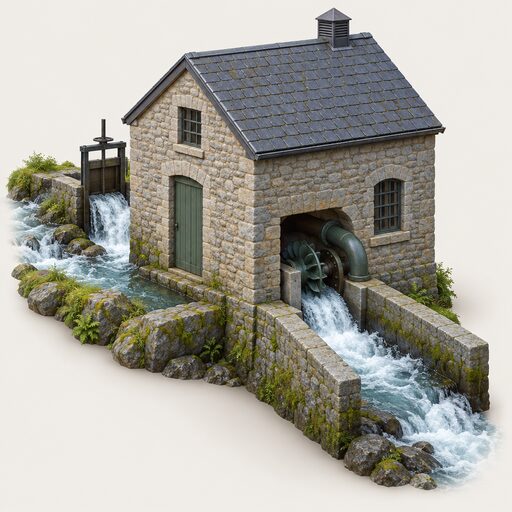
Hydroelectrical power systems use running water turning a turbine to produce electricity1. The conversion chain is straightforward: hydro converts the potential energy of water moving downhill into kinetic energy in a turbine, which drives a generator to produce electricity5. Useful power may be produced from even a small stream1, which is why the technology appears on sites that would never support a wind turbine of comparable rating.
The scale of the resource is defined by capacity. A micro hydro plant is one that generates less than 100 kilowatts1, and the same threshold appears in scheme rules, where systems with a capacity of less than 100 kilowatts, the size typically used for small-scale generation, are sometimes referred to as micro-hydro6. That is a wide band: at one end sits a machine serving a single off-grid cottage, at the other a scheme large enough to supply several properties, and both sit inside the same definition.
Output is not a fixed number attached to a model. It is the product of head, flow and running hours, and the running hours are governed by the watercourse rather than the equipment. The 13,200 kWh example assumes 4,400 hours, roughly half the year2, which is a realistic allowance once abstraction limits and low summer flows are taken into account. A site with a stronger, more dependable flow will beat it; a marginal one will not reach it.
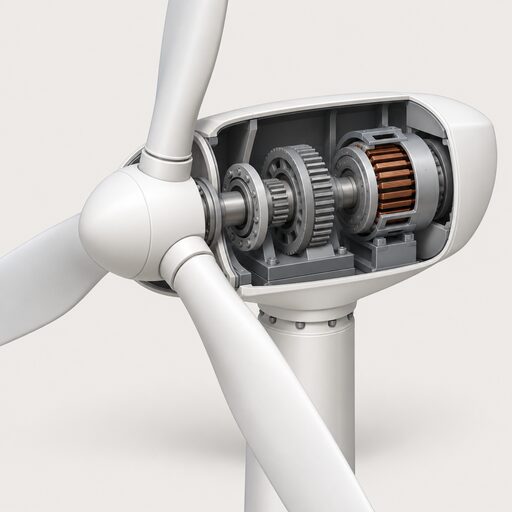
For a household, the significance is that hydro output is measured in thousands of kWh a year rather than hundreds. Guidance for small wind turbines describes a machine with a rotor diameter of about 1 metre on a good site giving a few hundred kilowatt-hours of electricity per year7, and building-mounted turbines generating around 1 to 2kWh8. Hydro's numbers sit in a different band entirely, which is what makes the siting requirements worth taking seriously.
Output vs solar PV: about seven times more per kilowatt at 70% capacity
The comparison that matters most to a rural householder is hydro against solar, because both are mature, both are sold through certified installers, and both can be connected to the grid or run off it. The headline is stark: if a water turbine can be run at about 70% capacity then the output per kilowatt will be about seven times that of a PV array2.
That ratio is not a claim about panel quality. It is a consequence of when each technology generates. Solar output is bounded by daylight, season and cloud, and the domestic market reflects that: solar PV accounts for 98.12% of capacity in the 0 to 50kW microgeneration band9, with the majority of applications up to 50kW10. Solar dominates by volume because it works almost anywhere. Hydro wins on intensity where it works at all.
The comparison also has a practical edge. Solar roof tiles are less efficient per area than solar panels, typically producing only 80% of the electricity for the same area11, so even within solar there are trade-offs between appearance and yield. Plug-in solar systems are capped at 800W through the micro-inverter12, and the EcoFlow STREAM Ultra's grid-tied terminal supports up to 800W export or feed-in13. These are small, incremental contributions. A hydro turbine of equivalent capital cost, on a good site, is not.
What hydro cannot do is scale down to a suburban semi. It needs a stream or river flowing through your land5, and the guidance is explicit that for homeowners micro hydropower is only practical in very specific locations4. The seven-times figure is therefore best read as a statement about sites that qualify, not as a general recommendation. For a property with a suitable watercourse, it explains why hydro is often the first technology considered; for one without, it is irrelevant.
| Technology | Output basis | Continuity |
|---|---|---|
| Micro hydro | About seven times a PV array per kW at 70% capacity2 | Can run 24 hours a day3 |
| Solar PV | 98.12% of 0 to 50kW microgeneration capacity9 | Daylight and weather dependent |
| Small wind | A few hundred kWh a year at 1 metre rotor7 | Wind speed dependent14 |
| Micro-CHP | About 1kW of electricity while running15 | Runs with heat demand |
Why capacity factor makes the difference
Capacity factor is the share of the year a generator actually runs at its rated output, and it is the single reason hydro's per-kilowatt figures look so different from solar's. A hydro system can operate 24 hours a day, often generating all the electricity you need3, and in theory a hydro system can generate 24 hours a day, which could provide all the electricity you need and more, without releasing any harmful CO2 or other pollutants into the atmosphere5.
The worked example assumes the turbine runs for 4,400 hours2, well short of a full year of continuous operation. That is a deliberately conservative assumption for a run-of-river scheme, where abstraction limits, fish passage requirements and seasonal low flows all reduce the hours available. Even on that basis, hydro outperforms the alternatives by a wide margin, because the flow is steady rather than intermittent.
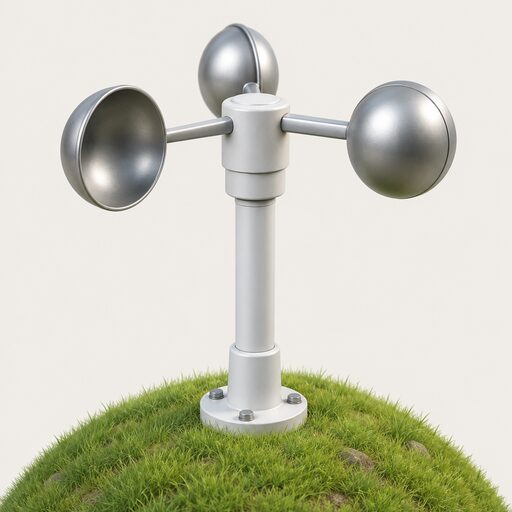
The contrast with wind is instructive. The stronger the wind, the more electricity produced14, which means wind output is variable and unpredictable in a way hydro output is not. A pole-mounted wind turbine typically produces 3 to 15kWh8, and a larger pole-mounted machine can generate around six kilowatts of electricity16, but those figures depend entirely on the site's wind resource. Hydro's variability is seasonal and broadly predictable, which matters for sizing a battery bank or an off-grid system.
Micro-CHP offers a different model again. It produces heat and hot water and also generates electricity17, with about 1kW of electricity while it's running15. Its electrical output is tied to heat demand, so it runs in winter and idles in summer, the opposite of hydro's profile in some respects. The Feed-in Tariff scheme, now closed to new applicants, set capacity limits of up to 5 megawatt, or 2 kilowatt for Micro CHP18, and the same limits appear in the scheme's own records19.
For a household, capacity factor is the number that determines whether a technology can carry a whole property or merely offset part of its consumption. Hydro's high capacity factor is what makes the 13,200 kWh example achievable; a solar array of the same rated capacity would need a far longer period to produce the same total.
What flow and head mean for your output
Flow is how much water is flowing through the system3, and head is the vertical fall the water drops through. Together they set the power available before any losses. The greater the height and the more water flowing through the turbine, the more electricity generated20, a statement repeated across independent guidance for both hydro and home energy upgrades21.
The estimation method is simple enough to apply on site. To estimate the energy that could be available, multiply the flow rate in litres per second by the head in metres, and multiply by 10, then halve the result for losses, to give watts2. Flow is how much water is passing through the system, and head is the height it falls; doubling either roughly doubles the figure, and doubling both quadruples it. The halving step is the allowance for losses in the turbine, generator and pipework.
Flow rates vary enormously between sites. The turbine at the Centre for Alternative Technology uses a flow of up to 20 litres per second2, which is a modest figure and reflects a small demonstration scheme rather than a commercial installation. Sites with low head need different machinery: for low head sites, options include Crossflow and Archimedes Screw turbines, which tend to be much bigger for the same power output2. That size penalty is a real constraint on installation in tight locations.
Head is the harder variable to change. A flow switch designed for hydro applications operates from a small head of water22, which shows that control equipment can work at low heads, but the turbine itself cannot manufacture fall that the land does not provide. Where head is limited, output is limited with it, and the only route to more power is more flow, which in turn runs into abstraction limits.

Is micro-hydro right for your site?
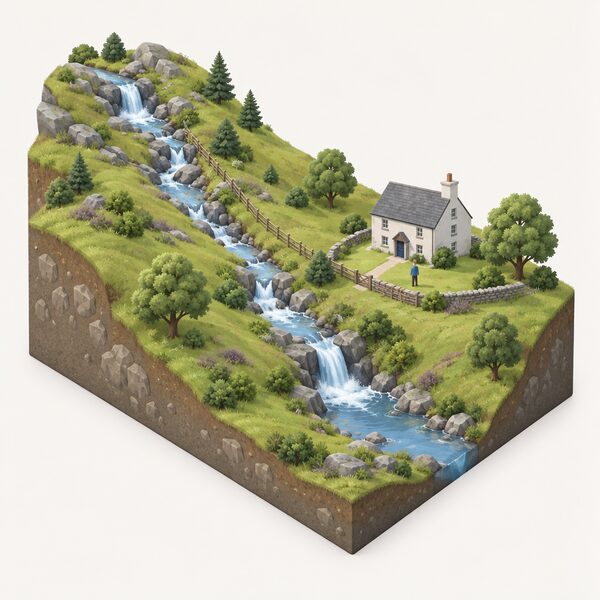
The case for hydro is strongest where there is no grid connection at all. For houses with no mains connection but with access to a micro hydro site, a good hydro system can generate a steady, more reliable electricity supply than other renewable technologies at a lower cost1. Micro-hydro systems generate power from running water and are ideal for off-grid homes, offering long-term savings despite high initial costs8. Micro hydropower for homes can be especially cost-effective for rural or off-the-grid homes, farms and businesses that are close to a suitable water source4.
The conditions are cumulative rather than alternative. A site needs a stream or river flowing through your land5, reliable flow all year round, the right permissions and enough height difference4. A site that meets three of those four does not have a hydro scheme.
Permissions are the part most often underestimated. Planning rules for microgeneration differ across England, Scotland, Wales and Northern Ireland, and hydro does not enjoy the same permitted development treatment as some other technologies. Permitted development rights for wind turbines and air source heat pumps will only be accorded for equipment installed by an installer who has been certificated through the Microgeneration Certification Scheme using a certificated product23, and the same condition is set out in Welsh guidance24. For renewables systems generally, an MCS installer and an MCS or Solar-Keymark certified product are required, except for micro-hydro systems, which will be assessed on a case-by-case basis25.
Separately, abstraction and environmental consents normally apply, and the Feed-in Tariff scheme, now closed, set out the technologies it supported: solar photovoltaics, wind, micro-combined heat and power, hydropower and anaerobic digestion, up to 5 megawatts in capacity, with installations located in Great Britain26. The Smart Export Guarantee remains available for hydropower, alongside solar, wind and micro-CHP, up to 5MW27, and MCS certification is a condition of accessing it28.
For a household, the honest summary is that hydro offers the highest output per kilowatt of any home renewable and the narrowest set of sites on which it can be installed. Where the water is there, it delivers; where it is not, no amount of equipment changes the answer.
Sources28 cited
- Hydro electricity, Planning Portal, 2026
- Micro-hydro, Centre for Alternative Technology, 2025-07-01
- Hydroelectricity, Energy Saving Trust, 2025-11-06
- What is hydropower and how does it work?, Smart Energy GB, 2026-08-19
- Hydro, Electricity North West, 2026-09-19
- Consumer Code, Renewable Energy Consumer Code, 2026-07-01
- Wind power, Centre for Alternative Technology, 2025-06-27
- Small wind turbines, MCS Certified, 2026-08-18
- FIT annual report SY14, Ofgem, 2026-09-17
- Generation FAQs, NIE Networks, 2026-09-19
- Solar roof tiles, Energy Saving Trust, 2026-08-13
- Plug-in solar consumer guide, Electrical Safety First, 2026-08
- EcoFlow STREAM Ultra, EcoFlow, 2025-09-01
- Renewable energy, Consumer Council, 2026
- Micro combined heat and power, nidirect, 2026-09-17
- Wind turbines, Energy Saving Trust, 2026-05-20
- VAT energy saving materials, HM Revenue & Customs, 2026-09-17
- Feed-in Tariffs (FIT), Ofgem, 2026-09-17
- Feed-in Tariffs (FIT) scheme, Ofgem, 2026
- Hydroelectricity, Home Energy Scotland, 2026-09-20
- Home energy upgrades, Home Energy Scotland, 2026-09-20
- FS05-C flow switch, Nu-Heat, 2026-06-08
- The Microgeneration Certification Scheme, Planning Portal, 2026-09-17
- Planning permission: wind turbines, Welsh Government, 2026-09-17
- Grants and loans, Home Energy Scotland, 2026-09-17
- Smart Export Guarantee, Energy Saving Trust, 2026-04-27
- Smart Export Guarantee, MCS Certified, 2026-05-13
- Sustainable home energy solutions, Planning Portal, 2024-09-02
 Micro Hydro Power for HomesA stream on your land that flows all year can make steady electricity, day and night, even when there is no sun or wind.
 Wind Turbine Output and SizingHow much electricity a home wind turbine makes depends far more on your wind than on its size.
 Domestic Wind TurbinesCan a wind turbine really power a home, and is your site windy enough?
 Building-Mounted Wind TurbinesWill a wind turbine on your roof actually make enough electricity to be worth it?
 Micro Hydro CostHow much does a micro hydro scheme cost to build and run, and what makes one worth it?
 Micro Hydro InstallationHow much water do you need, and how far does it have to fall, for a micro hydro system to be worth it?