
In this guide
The turbine is the part of a hydro scheme that turns falling water into rotation, and the type chosen is decided by the site, not by preference. Two measurements settle it: flow, the volume of water passing per second, and head, the height it falls through. Official guidance puts it plainly: the viability of an installation depends on whether there is enough water flowing per second and the height or "head" that it falls from1.
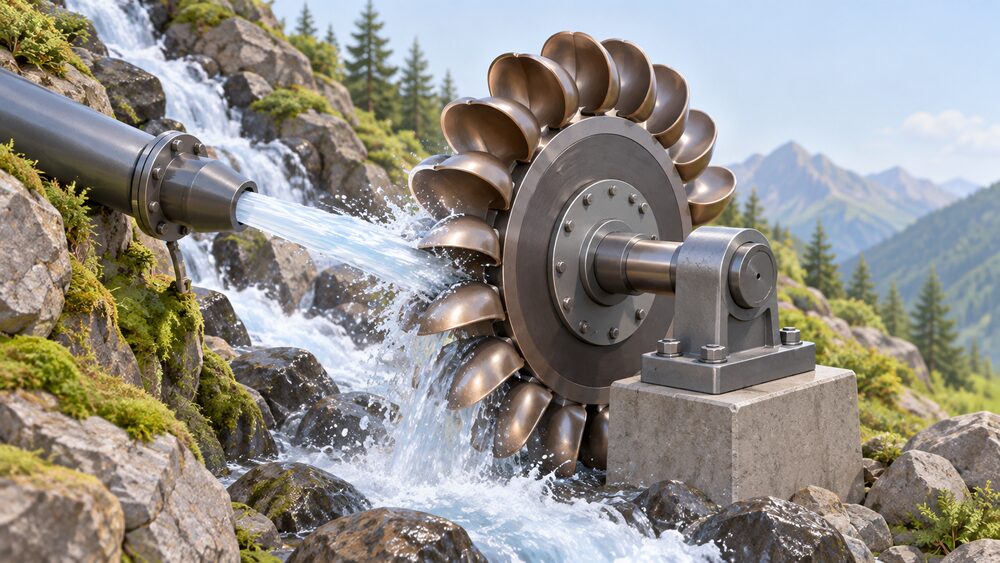
Five families cover almost every small scheme. Pelton and Turgo wheels are impulse turbines for high head. Crossflow turbines sit in the middle. Propellers and Kaplan machines are reaction turbines for low head on large flows. The Archimedean screw is a low-head machine that turns slowly and passes debris and fish. Each has a head and flow band where it works well and outside which it does not.
The prize is modest in national terms and real in household terms. Hydropower made up just 2% of electricity generation in Great Britain in 2024, though globally it generates over 50% of renewable energy1. For a property with a suitable water course, the appeal is different: a good hydro system can generate a steady, more reliable electricity supply than other renewable technologies at a lower cost2.
What hydropower is and why it counts as renewable
Hydropower is renewable because it uses the natural water cycle1. Water evaporated by the sun falls as rain, gathers in a catchment and runs downhill; a turbine takes some of the energy of that descent and the water continues on its way. Nothing is burned and the fuel is replenished by weather rather than by extraction.
The legal definition is broader than the popular one. Energy from renewable sources means energy from renewable non-fossil sources, namely wind, solar, aerothermal, geothermal, hydrothermal and ocean energy, hydropower, biomass, landfill gas, sewage treatment plant gas and biogases5. Hydrothermal and ocean energy sit in the same list as hydropower, which matters for anyone reading a planning or licensing document: the category is defined by the source, not by the size of the plant.
Because it does not burn fossil fuels during operation, hydroelectric power produces very low greenhouse gas emissions once the system is running1. The carbon cost sits in construction: concrete, steel, the turbine, the pipeline and the civil works. Those emissions are incurred once, while the running emissions are effectively nil. That is why hydro is often described as low-carbon rather than zero-carbon, and why the embodied figure matters more on a small scheme, where a relatively large amount of material serves a relatively small output.
The renewable status has a practical consequence beyond carbon accounting. Water turbines appear in the official list of energy-saving materials, at paragraph (g)6. That listing is what connects the technology to the reduced rate of VAT described below, and it is the reason a hydro installation is treated differently from a general building project.
From mill wheels to the grid: why local hydro declined
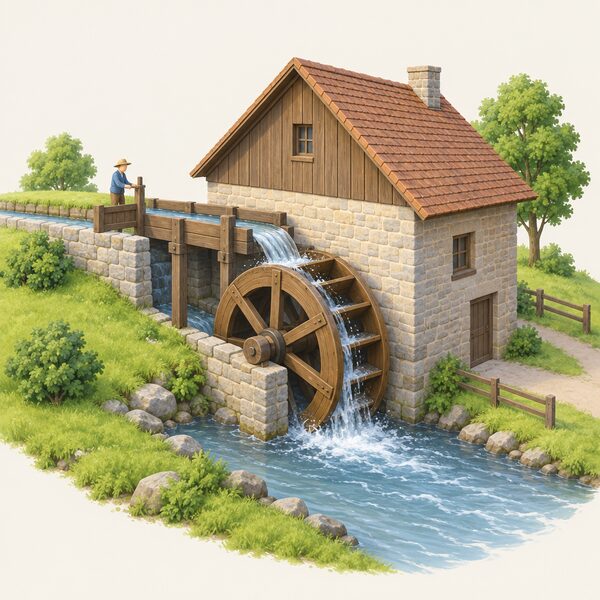
Britain once had water power everywhere. Hydropower or hydroelectricity, generated from dams, sluices and mill wheels, was used for many years to generate electricity in a local area7. Those schemes were not curiosities; they were the ordinary way a mill, a big house or a small works got its electricity before a national network existed.
The decline was not a failure of the technology. Official guidance records that this method of generation generally disappeared with the introduction of the electricity grid7. Once a central generator could deliver power down a wire at a fraction of the trouble of maintaining a wheel, a weir and a channel, the local scheme lost its reason to exist. The water kept flowing; the economic case went.
Policy then worked against a revival for a period. The UK was required to exclude wind and water turbines from the list of qualifying energy-saving materials in the 2019 changes8. During that period, wind turbines and water turbines did not qualify as energy-saving materials, and their installation did not qualify for the reduced rate9. The exclusion was later reversed: wind and water turbines will also be permanently added to the list of qualifying energy-saving materials8.
The practical effect today is that a household installing a water turbine in Great Britain can expect the reduced rate of VAT to apply, because water turbines qualify for a lower rate of VAT, Great Britain only4. The "Great Britain only" qualifier is not decorative. Northern Ireland sits outside that VAT treatment, so a scheme there faces a different tax position, and the same is true of the wind turbine listing4.
Hydropower's share of electricity: around 2% in Great Britain
The national picture is small and stable. In Great Britain, hydropower made up just 2% of electricity generation in 20241. That figure covers everything from the large pumped-storage and conventional stations in the Scottish Highlands down to the smallest run-of-river schemes, and it has moved little in decades because the good sites were developed long ago.
Set that against the wider grid. In 2024, 51% of UK electricity generation was from renewable sources such as solar power and wind power, and 14% was from nuclear energy10. Another estimate puts about 42% of the UK power grid from renewable sources, with wind being the biggest contributor11. The two renewable figures differ because they measure different things: one is generation, the other a grid-mix estimate. Either way, hydro's 2% is a rounding error beside wind and solar.
Globally the position is reversed. Hydropower generates over 50% of renewable energy worldwide1. The technology that is marginal in Britain is the backbone of renewable generation in countries with large rivers and steep terrain. That contrast explains why British policy treats hydro as a niche contributor while international bodies treat it as central.
For a household, the national share is context rather than a reason. A domestic scheme does not move the 2% and is not intended to. What it does is displace imported electricity at the point of use, and in an off-grid setting it can displace a generator entirely. The value is local and specific, and it should be judged that way.
What makes a site viable: flow and head
Two measurements decide whether a scheme is worth pursuing. The viability of the installation will depend on whether there is enough water flowing per second and the height or "head" that it falls from1. Flow is usually expressed in litres per second or cubic metres per second; head is a vertical distance in metres. Multiply the two, apply gravity and an efficiency factor, and you have the available power.
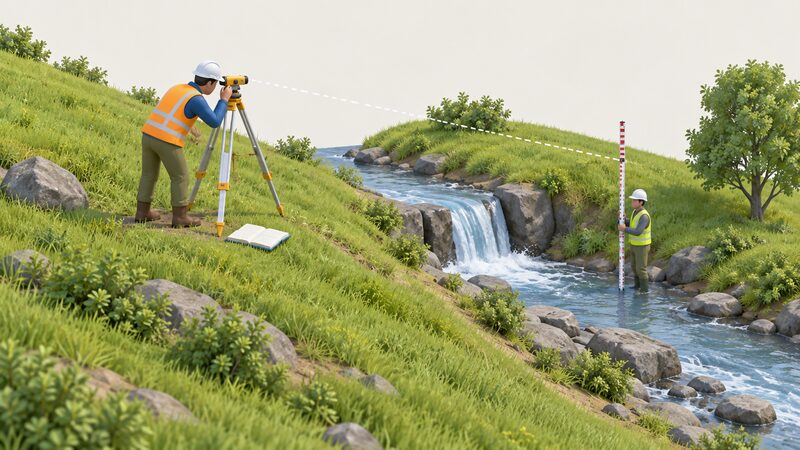
Head is the vertical fall between the point where water is taken and the point where it leaves the turbine. It is measured on site with a level or a pressure gauge, not read off a map, because a contour line can hide several metres of error over a long pipeline. A steep hillside stream may offer tens of metres of head over a short distance; a lowland river may offer one or two metres over hundreds of metres of channel.
Flow is the volume passing a point each second, and it varies through the year. A scheme is designed around a flow that is available for most of the year, not the winter peak, because a turbine sized for a flood spends most of its life throttled. The residual flow left in the channel reduces what is available for generation, and it is a legal requirement rather than a design choice.
There should also be enough residual flow to maintain the water course1. That single sentence carries a lot: the environmental regulator will set a minimum flow that must remain in the channel at all times, and the turbine can only take what is left. On a small stream the residual flow can be a large fraction of the total, which is why a scheme that looks generous on a wet day can be marginal on paper.
Useful power may be produced from even a small stream2. That is the encouraging half of the picture. The discouraging half is that small streams also tend to be the ones where the residual flow requirement bites hardest, and where a low head forces a physically large machine for a modest output.
Turbine types: matching the machine to the site
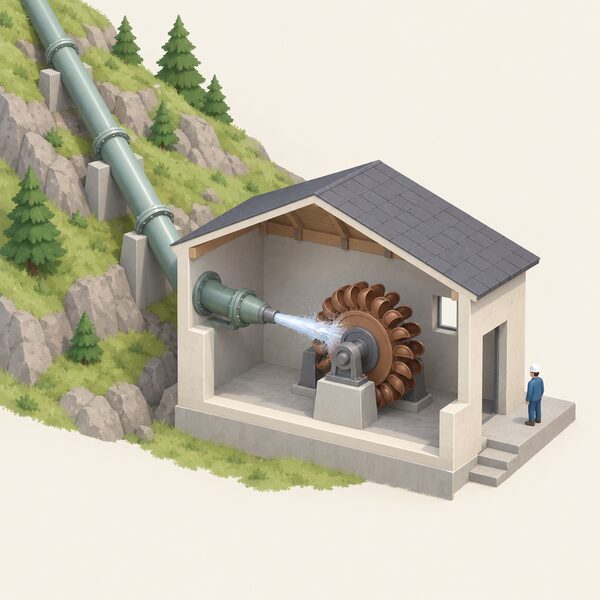
Turbine families divide by how they extract energy. Impulse turbines turn a jet of water against buckets or blades in air; reaction turbines run fully submerged and are pushed by pressure and momentum. The first group suits high head and modest flow, the second low head and large flow. The crossflow sits between them, and the screw is a low-head machine with its own logic.
| Turbine family | Type | Head band | Flow character | Typical setting |
|---|---|---|---|---|
| Pelton | Impulse | High | Low to moderate | Steep hillside streams, long pipelines |
| Turgo | Impulse | Medium to high | Moderate | Where a Pelton would be too fast or too wide |
| Crossflow | Impulse | Low to medium | Moderate to high | Low weirs, small rivers |
| Propeller / Kaplan | Reaction | Low | High | Large rivers, existing weirs |
| Archimedean screw | Reaction | Low | High | Low heads on rivers, fish-friendly sites |
The table is a guide to the shape of the decision, not a set of thresholds. The exact band for any machine comes from the maker's own performance data, and the same family can be built across a wide range. What does not change is the direction of the match: as head falls, the machine must pass more water and becomes physically larger for the same power.
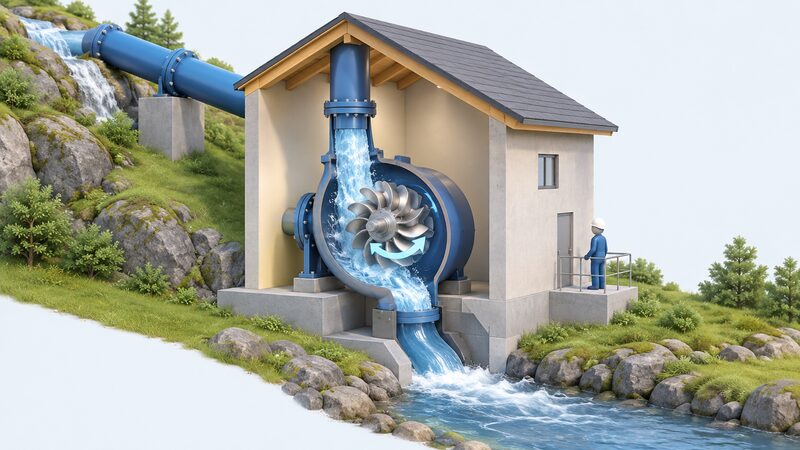
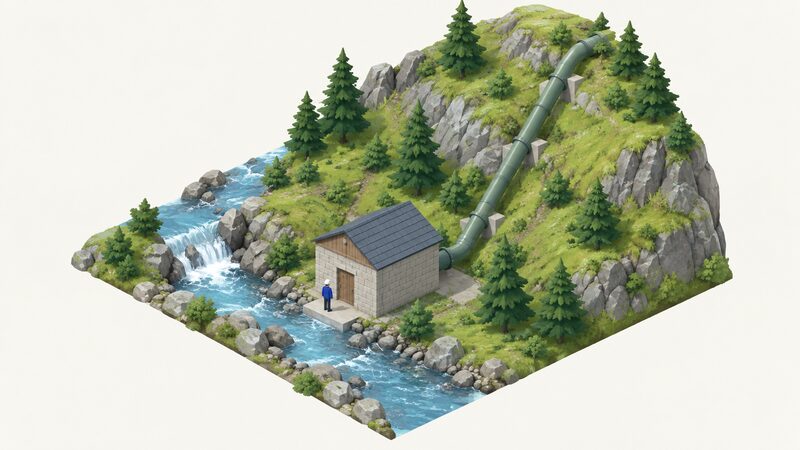
The choice also carries consequences beyond output. A high-head impulse machine sits at the bottom of a pipeline and can be housed in a small building. A low-head reaction machine sits in or beside the channel and needs civil works in the river itself, which brings the environmental regulator and the planning authority into the project early. The machine is the cheap part; the water control structure is not.
For a household, the practical sequence is to measure head and flow first, then approach a maker or installer with those numbers. A supplier asked "which turbine should I buy" without site figures cannot answer usefully. The site data is the specification.
Crossflow turbines: the low-head option, much bigger for the same power
The crossflow turbine, sometimes called a Banki or Michell turbine, is an impulse machine that passes water twice through a drum-shaped runner. Water enters at the top, crosses the runner, and leaves at the bottom, so the same water does work on the way in and again on the way out. That double pass is what gives it a workable efficiency at low and medium head without the fine tolerances of a Pelton.
Its reputation rests on robustness rather than peak efficiency. The runner is a simple fabrication of curved blades between two discs, with no precision nozzles and no need for a pressure casing. It tolerates silt, leaves and small debris far better than a Pelton, whose jets can be blocked by a single twig. For a run-of-river site with a modest head and a variable flow, that tolerance is worth more than a few points of efficiency.
The cost of that tolerance is size. Because a crossflow works at low head, it must pass a large volume of water to produce the same power as a high-head machine, and the runner and casing grow accordingly. A crossflow installation for a given output occupies considerably more space and uses more material than a Pelton doing the same job. The civil works, not the turbine, dominate the budget at low head.
Part-flow behaviour is the other consideration. A crossflow can be fitted with a guide vane that regulates the flow entering the runner, which lets it keep working as the river drops through the summer. That matters on a stream whose flow varies by a factor of ten between winter and summer, because a machine that only works at full flow produces very little over a year.
For a household, the crossflow is the realistic option where head is too low for an impulse wheel and the flow is too modest or too debris-laden for a propeller. It is a compromise machine, and on many small British sites the compromise is the right one. The alternative at the same head is often a screw, which is slower, larger again, and kinder to fish.
How much electricity a household scheme can produce
Output follows from head, flow and efficiency, and the honest answer for most sites is a few hundred watts to a few kilowatts. The comparison with wind is instructive: a typical domestic wind system for a home would be 2.5 to six kilowatts, depending on the location and size of the house, while individual wind turbines vary in size and power output from a few hundred watts to two or three megawatts12. Hydro spans a similar range, but with a crucial difference in character.
That difference is steadiness. For houses with no mains connection but with access to a micro hydro site, a good hydro system can generate a steady, more reliable electricity supply than other renewable technologies at a lower cost2. A wind turbine's output rises and falls with the weather and can be zero for days; a hydro scheme fed by a catchment produces a predictable baseline, varying with rainfall but rarely stopping.
The trade is that hydro is site-specific in a way wind is not. A wind turbine can be sited on most properties with enough exposure; a hydro scheme needs a water course with rights, a fall and a legal entitlement to take water. Where those exist, the output is more valuable per kilowatt because it is available when needed rather than when the wind blows.
Grid connection changes what the output is worth. Hydropower is one of the technologies supported by the Smart Export Guarantee, alongside solar photovoltaics, wind, micro-combined heat and power and anaerobic digestion, with installations up to 5 megawatts in capacity and a requirement that they be located in Great Britain3. A scheme that exports surplus electricity can be paid for it, which improves the economics of a site whose output exceeds the household's own demand.
Off grid, the calculation is different again. There is no export payment and no grid to fall back on, so the scheme must be sized to the load and backed by storage or a secondary source. The reward is independence from a connection that may never have existed: for a remote property, hydro can be the difference between a generator running daily and a generator running rarely.
Consents and licences: what a hydro project needs first
Consents come before equipment. Various consents and licences are required for a hydro project7. The list in practice runs from an abstraction licence to take water, through planning permission for the intake, pipeline and turbine house, to an environmental assessment where the water course is sensitive, and a grid connection agreement where the scheme exports.
The abstraction licence is the one that shapes the design. It fixes how much water may be taken and how much must be left, and it is granted by the environmental regulator for the nation concerned. England, Scotland, Wales and Northern Ireland each have their own regulator and their own process, so a scheme on a border stream can face two regimes. The residual flow condition in the licence feeds straight back into the power calculation.
Planning is the second gate. Guidance on the planning regime for England notes that the policy in Wales may differ, and the same caution applies across the devolved nations13. A turbine house, an intake weir and a pipeline are all development, and a scheme in a protected landscape or near a listed building faces additional consent: adding renewable energy solutions like solar panels or air and ground source heat pumps might be acceptable but will require listed and or planning consent15.
Certification matters where permitted development rights are claimed. Permitted development rights for wind turbines and air source heat pumps will only be accorded for equipment installed by an installer who has been certificated through the Microgeneration Certification Scheme using a certificated product16. The scheme includes clear standards to support the installation of wind turbines and air source heat pumps16. Hydro schemes follow the same certification route, and an uncertificated installation can lose rights that would otherwise apply.
Insulate before you install
The order of work matters more than the choice of machine. Guidance on renewable technologies states that a property should be properly insulated before renewable technologies are installed7. The same instruction appears in guidance on ventilation systems and on solar thermal panels: make sure that your property is properly insulated before installing renewable technologies18.
The reason is arithmetic. A hydro scheme's output is fixed by the site, and it is usually small. Every kilowatt-hour of that output spent heating a draughty house is a kilowatt-hour not available for lighting, appliances or export. Insulation reduces the demand the scheme has to meet, which raises the fraction of the property's consumption it can cover without any change to the turbine.
There is a second, harder reason. A scheme sized against an uninsulated house's demand will be oversized for the house once insulation is fitted, and hydro machines do not throttle gracefully across a wide range. Sizing after the fabric work is done gives a better match and a better return, and it avoids the cost of a larger machine than the load requires.
The funding rules reflect the same priority. The list of qualifying energy-saving materials covers central heating and hot water controls, draught stripping, insulation on walls, floors, ceilings and lofts, solar panels, ground-source heat pumps, air-source heat pumps, micro combined heat and power units, wood-fuelled boilers, and wind and water turbines in Great Britain only20. Insulation and controls sit at the head of that list for a reason.
For a household, the sequence is fabric first, then generation. A hydro scheme bolted onto a leaky house will work, but it will work harder for less benefit, and the site's limited output is the resource being wasted.
Hydropower's future role in the UK: smaller schemes and community projects
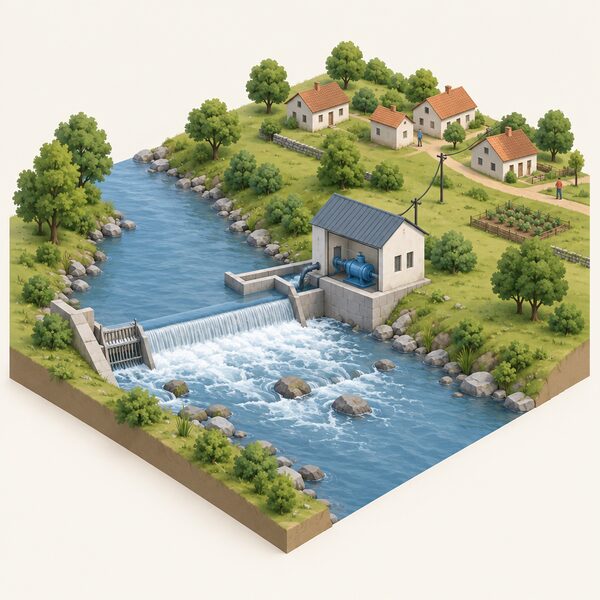
The direction of travel is small. There may be fewer opportunities for new large-scale hydropower projects, but smaller schemes and community projects could provide local renewable electricity, energy storage and grid flexibility1. The large sites are largely built, and the remaining potential lies in the many small falls and weirs that once powered mills.
Community ownership is the model that fits that potential. A scheme on a river that serves a village rather than a single house spreads the capital cost, the consenting work and the maintenance across more shoulders, and it can sell its output under the same export arrangements as a domestic installation. The grid flexibility point is the newer one: a scheme with storage can shift its output to when the network needs it, which is worth more than a flat export.
The policy context is a net zero target. Great Britain is working towards net zero by 20501. Hydro's contribution to that target is small in percentage terms, but it is firm and predictable in a way that wind and solar are not, and firm output has value on a grid with a high share of variable renewables.
For a household, the future role translates into a practical point about timing. Consenting a small scheme takes time, and the environmental requirements are not going to loosen. A site that is viable now is likely to remain viable, but the paperwork will not get shorter. The schemes that get built tend to be the ones where the site data, the land rights and the consents were assembled before any equipment was ordered.
The wider context for a household considering any form of local generation is set out in the material on microgeneration and on micro hydro power for homes, which cover the technologies and the site requirements in more detail.
Sources20 cited
- What is hydropower and how does it work, Smart Energy GB, 2026-08-19
- Hydro-electricity, Planning Portal, 2026
- The Smart Export Guarantee, House of Commons Library, 2026-05-13
- Energy-saving products, GOV.UK, 2026-09-17
- The Renewable Energy Sources Regulations 2012, regulation 2, legislation.gov.uk, 2026-09-17
- Water turbines as energy-saving materials, legislation.gov.uk, 2026-09-17
- Hydropower, nidirect, 2026-09-17
- VAT relief for energy-saving materials: explanatory memorandum, legislation.gov.uk, 2026-09-17
- VAT relief for energy-saving materials: explanatory memorandum 2024, legislation.gov.uk, 2026-09-17
- UK electricity generation in 2024, House of Commons Library, 2024
- Home energy efficiency key terms explained, Development Bank of Wales, 2024-10-17
- Small-scale wind turbines, nidirect, 2026-05-18
- Wind turbines: planning permission, Planning Portal, 2026-09-17
- Planning permission: wind turbines, Welsh Government, 2026-09-17
- Making alterations to a listed building, Bristol City Council, 2026-09-17
- The Microgeneration Certification Scheme, Planning Portal, 2026-09-17
- Class H: installation of a wind turbine on domestic premises, legislation.gov.uk, 2026-09-17
- Ventilation systems, nidirect, 2026-09-17
- Solar thermal panels, nidirect, 2024-10-22
- Energy-saving materials: qualifying products, HM Revenue and Customs, 2026-09-20
 Micro Hydro Head and FlowHead is the drop from the top of your water supply to the bottom, and flow is how much water comes down.
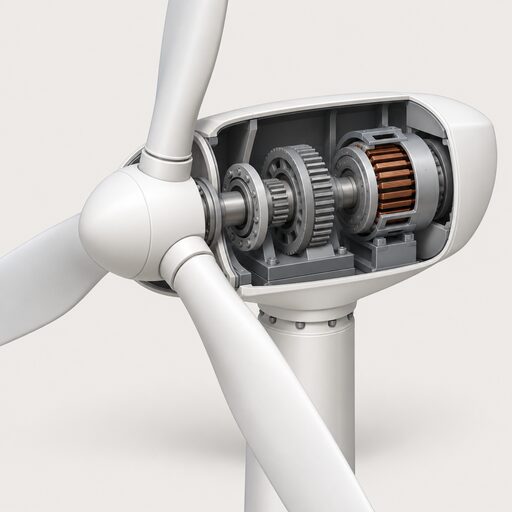 Domestic Wind TurbinesCan a wind turbine really power a home, and is your site windy enough?
 Abstraction Licences and PermitsTaking water from a stream to power a turbine needs permission, and where you live decides who grants it.
 Microgeneration by Home TypeA stream running through your land, a windy exposed spot, or a gas boiler that runs almost all day: each points to a different technology.
 Micro Hydro Power for HomesA stream on your land that flows all year can make steady electricity, day and night, even when there is no sun or wind.
 Air-to-Water Wet SystemsAir-to-water heat pumps feed radiators, underfloor heating and a hot water cylinder, and are the most common domestic heat pump in the UK.