
In this answer
Short answer
A Pelton turbine is a high head machine. Independent guidance states that a higher head turbine such as a Pelton usually needs a drop of over 10 metres to be viable1. That is the threshold that matters most when assessing a stream for a Pelton, and it is the figure to check first before any other consideration.
Head itself is defined as the difference in height between the water at the top of the system and the bottom2. A suitable hydro site needs a water source with a combination of flow, meaning how much water is flowing through the system, and head, meaning that vertical drop2. The viability of any installation depends on whether there is enough water flowing per second and the height or head that it falls from3. Neither figure alone tells you whether a Pelton will work: a steep drop with a trickle of water and a generous flow with almost no fall are both problematic for different reasons.
For a household, the head available on a stream is fixed by the landscape. It cannot be increased by equipment choice, only used well or lost to friction in the pipe that carries water down to the turbine. This page sets out what head means, the minimum threshold for a Pelton, how head and flow combine to determine power, how to measure head on site, and how net head differs from gross head.
What head of water means and why Pelton turbines need it
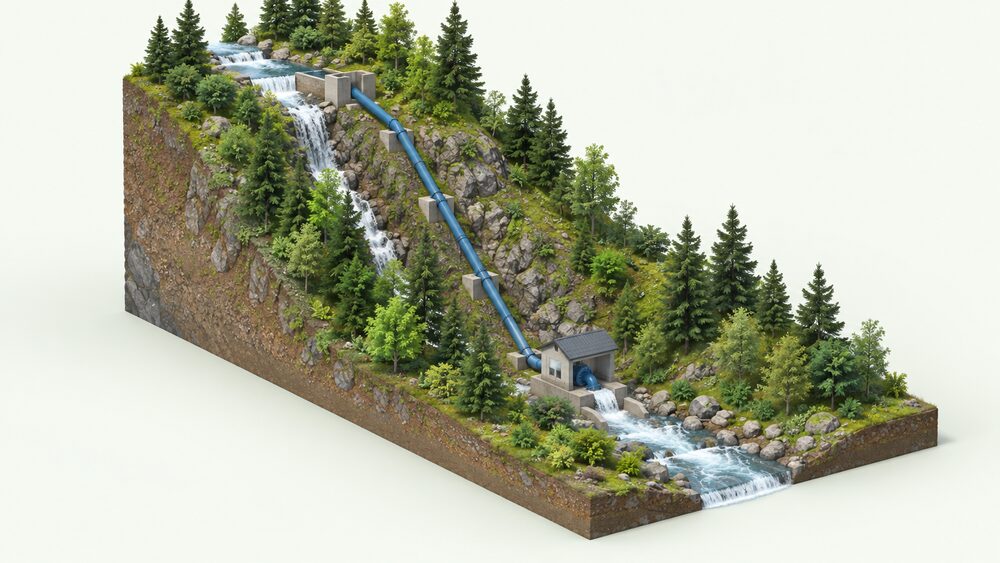
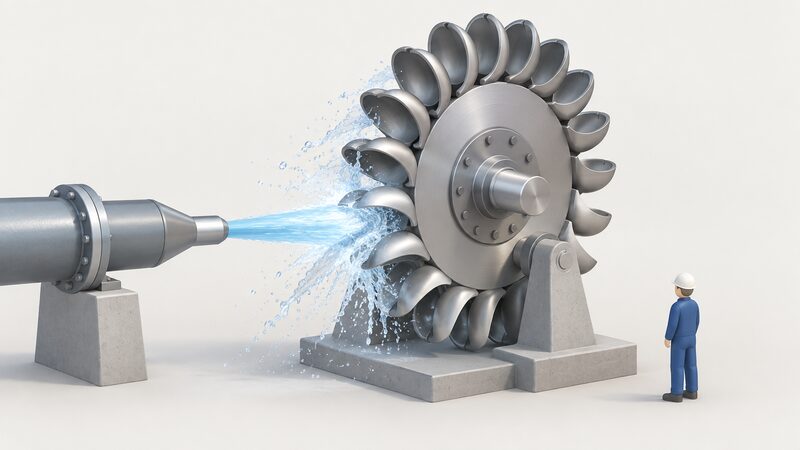
Head is the vertical distance water falls from the intake to the turbine. Independent guidance defines it plainly as the difference in height between the water at the top of the system and the bottom2. A Pelton turbine uses that fall to drive a jet of water against the buckets of a runner. The greater the fall, the more energy each litre of water carries as it arrives, which is why Pelton turbines are classed as high head machines.
The reason a Pelton needs height rather than volume is mechanical. A high head turbine such as a Pelton or Turgo is comparatively cheap, easy to install and works well in fluctuating flow1. That combination suits a stream with a steep drop, where the machine can be small for the power it produces. The same guidance notes that for low head sites, options include crossflow and Archimedes screw turbines, and these tend to be much bigger for the same power output1. A Pelton on a low head site would need to be disproportionately large, which is why it is not the usual choice there.
For a household's energy independence, head is the resource that cannot be bought. A stream with a genuine fall of over 10 metres offers a generating opportunity that runs on gravity and rainfall rather than on a supplier or the grid. What remains dependent is the grid connection for export and backup, the manufacturer of the turbine, and the abstraction licence regime that governs how much water can be taken. The head itself is free and fixed, but the right to use it is not.
Minimum head: the typical threshold for a Pelton to work

The working threshold for a Pelton is a drop of over 10 metres. Independent guidance states that you usually need a drop of over 10 metres for a higher head turbine to be viable1. This is the figure to apply when first assessing a stream: if the available fall is comfortably above 10 metres, a Pelton or Turgo is a candidate; if it is below, a low head machine is the more likely fit.
The 10 metre figure is a practical threshold rather than a hard engineering limit. It reflects the point at which a high head machine becomes worthwhile relative to its low head alternatives, which are much bigger for the same power output1. A site with a fall of 12 metres and a modest flow may suit a Pelton well, while a site with a fall of 4 metres and a large flow is better served by a crossflow or Archimedes screw.
It is worth being clear about what the threshold does not say. It does not mean a Pelton cannot physically turn below 10 metres, and it does not set a maximum. It is a viability guide, and the actual decision depends on the combination of head and flow at the site. For a fuller comparison of machine types, see hydro turbine types and Pelton vs crossflow turbine for home hydro.
Head and flow: the trade-off that determines power output
Head and flow together determine how much power a hydro scheme can produce. Independent guidance gives a straightforward estimation method: multiply the flow rate in litres per second by the head in metres, multiply by 10, then halve the result for losses, which gives an estimate in watts1. Both figures matter, and a shortfall in either reduces the output.
The trade-off is that a high head site can produce useful power from a modest flow, while a low head site needs a much larger flow to produce the same output. This is why a Pelton, which suits high head, can be a small machine on a steep stream, whereas a crossflow or Archimedes screw on a low head site tends to be much bigger for the same power output1. The physics rewards height.
Micro hydro also compares well with other microgeneration on output per unit of capacity. Independent guidance notes that if a water turbine can be run at about 70% capacity then the output per kilowatt will be about seven times that of a PV array1. That figure reflects the steadier, more predictable nature of a stream compared with solar, and it is one reason a good hydro site is prized.
For a household, this means the head and flow assessment is the single most important step. A site with a strong fall and a reliable flow can deliver meaningful generation for much of the year, reducing reliance on imported electricity. A site with a marginal fall will need a large flow to compensate, and the machine will be larger and the civil works more extensive. The head and flow sizing guide covers the calculation in more detail.
| Factor | What it is | Why it matters for a Pelton |
|---|---|---|
| Head | Vertical drop from intake to turbine2 | Pelton needs over 10 metres1 |
| Flow | Volume of water passing per second2 | Determines power alongside head1 |
| Power estimate | Flow x head x 10, halved for losses1 | Gives an estimate in watts1 |
Measuring head on your own site
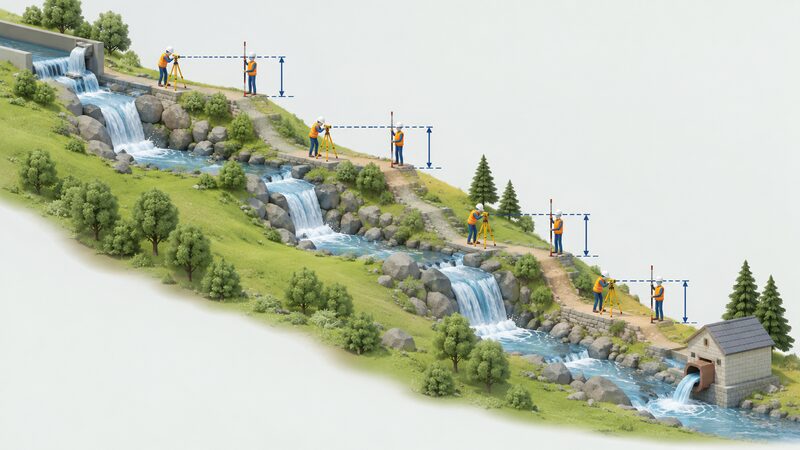
Measuring head means establishing the vertical difference in height between the water at the top of the system and the bottom2. On a real site this is the drop between the proposed intake point on the stream and the proposed turbine position. Because head is a vertical measurement, it is not the same as the length of the pipe run: a long pipe on a gentle gradient may have less head than a short pipe on a steep one.
The practical difficulty is that a stream bank is rarely a clean vertical face, so the measurement is usually taken in stages. A surveyor or installer will typically work along the route with a level, recording the fall over each section and adding the sections together. No specific field method or instrument for this is published, so the reliable route for a householder is a site survey by an installer who can measure the fall accurately and confirm the flow at the same time.
The definition to work to is straightforward. Head is the difference in height between the water at the top of the system and the bottom2, and a suitable site needs a water source with a combination of flow and head2. Any measurement method is only useful if it produces those two figures for the actual route the water will take.
It is also worth measuring flow at the same time, since the two figures are used together in the power estimate1. A head measurement on its own cannot tell you whether a Pelton is viable; it only tells you whether the site clears the 10 metre threshold. For the wider site assessment, see micro hydro power for homes.
Net head versus gross head: losses in the penstock
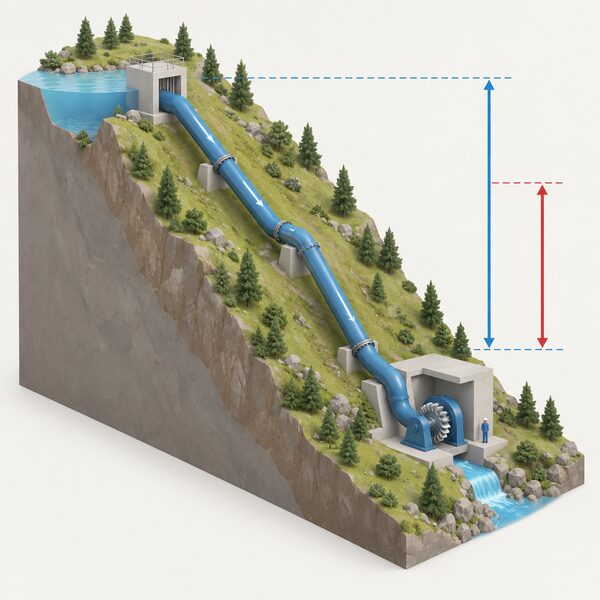
Gross head is the full vertical drop between the intake and the turbine. Net head is what remains after losses in the penstock, the pipe that carries water down to the machine. Friction against the pipe walls, turbulence at bends and fittings, and the energy needed to accelerate the water all reduce the head that actually reaches the turbine. Net head is therefore always lower than gross head, and it is the figure that should be used in any power calculation.
The estimation method given in independent guidance already accounts for this in a rough way: multiply the flow rate in litres per second by the head in metres, multiply by 10, then halve the result for losses, which gives watts1. That halving is a broad allowance rather than a precise figure, and the actual loss depends on the pipe diameter, its length, its material and the number of fittings. A longer or narrower penstock loses more head than a short, generously sized one.
The practical consequence for a household is that the pipe specification matters as much as the fall. A site with a gross head of 15 metres might deliver a noticeably lower net head if the penstock is long and undersized, and that reduces the power available. Sizing the penstock to keep losses low is part of the design work, and it is one reason a professional assessment is worthwhile before committing to a scheme.
For energy independence, net head is the honest figure. It is the head the turbine actually sees, and it determines the output the household can rely on. A scheme designed on gross head alone will underperform against expectation. The micro hydro installation and maintenance page covers the practical side of building the penstock and the rest of the system.
"Head, the difference in height between the water at the top of the system and the bottom."
Matching turbine type to your head and flow
The choice of turbine follows from the head and flow at the site. A Pelton or Turgo suits a high head, typically over 10 metres, and is comparatively cheap, easy to install and works well in fluctuating flow1. A crossflow or Archimedes screw suits a low head site, and these tend to be much bigger for the same power output1. The machine type is a consequence of the site, not a preference to be imposed on it.
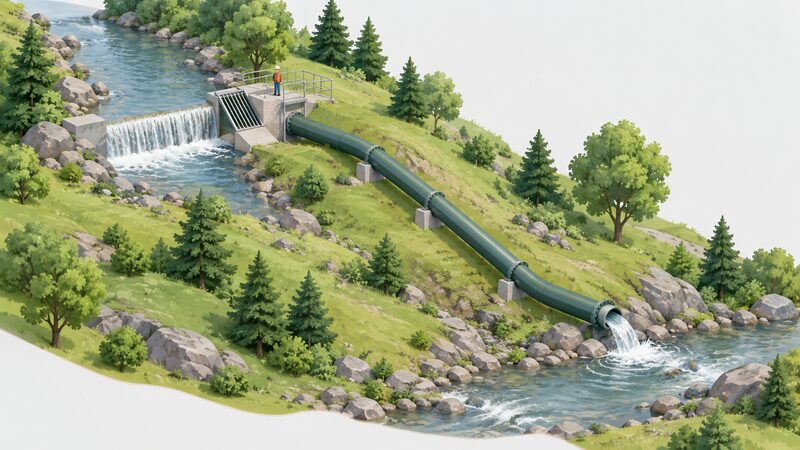
Most hydro schemes are run-of-river, which does not mean they sit in the river, but that water is diverted from a stream into a pipe or channel, called a penstock, and returned downstream1. That approach suits a Pelton well, because the penstock delivers water under pressure to the turbine and the fall provides the head. The diversion also means the scheme depends on the stream's flow, which varies with rainfall, so the machine's behaviour in fluctuating flow matters.
There is a regulatory dimension to matching turbine to site. Water turbines are included in the list of energy-saving materials for reduced VAT purposes4, and the qualifying energy products list includes water turbines for Great Britain only5. That means the VAT treatment differs between Great Britain and Northern Ireland, and a household should check the position that applies to its location. The abstraction licence regime also governs how much water can be taken, which affects the flow available to the turbine.
For a household's independence, the turbine choice determines how much of the year the scheme can run and how much maintenance it needs. A Pelton on a suitable high head site is a relatively simple machine with few moving parts compared with a low head alternative, but it still needs servicing and it still depends on the stream. The micro hydro cost and hydro abstraction licences and permits pages cover the financial and regulatory sides. For a wider view of how hydro sits alongside other microgeneration, see the microgeneration pillar.
Sources5 cited
- Hydropower, nidirect, 2026-09-17
- Hydroelectricity, Energy Saving Trust, 2025-11-06
- Micro-hydro, Centre for Alternative Technology, 2025-07-01
- Energy-saving materials, legislation.gov.uk, 2026-09-17
- Qualifying energy products, HMRC, 2026-09-20
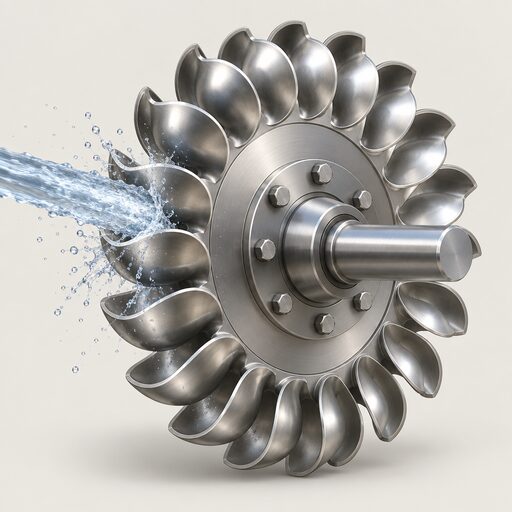 Hydro Turbine TypesWhich hydro turbine suits your site comes down to how far the water falls and how much flows past each second.
 Turbine Siting and Wind SpeedIs my garden windy enough for a home wind turbine?
 Abstraction Licences and PermitsTaking water from a stream to power a turbine needs permission, and where you live decides who grants it.
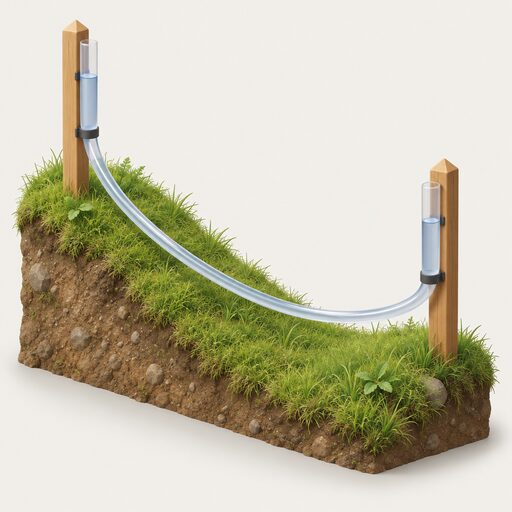 Micro Hydro Head and FlowHead is the drop from the top of your water supply to the bottom, and flow is how much water comes down.
 Micro Hydro InstallationHow much water do you need, and how far does it have to fall, for a micro hydro system to be worth it?
 Wind Turbine InstallationWill a wind turbine actually pay for itself in a normal British garden, and how much wind does your spot really need?